Gutter quotes name a material before they name a price, and the choice is wider than it looks. The five that matter on a house are uPVC, aluminium, galvanised steel, cast iron and copper. American guides call uPVC vinyl; in Britain it is unplasticised polyvinyl chloride, the white, black or brown plastic seen on most modern fascias.
Each material suits some houses better than others. A 1930s semi on the edge of Taunton, a Victorian terrace near the centre, a cottage in a conservation village on the Quantock edge and a newly built home on a large estate all call for different answers. A listed building, or a home inside a conservation area, can raise consent questions that a plain modern house does not raise.
This post goes through the materials one at a time, with what each is made of, how it is jointed, how it is repaired and what to put to the installer before you commit to it. It also covers the fall a run needs, the typical UK cost of replacing guttering, and why a published lifespan is a weak reason to choose any of them.
uPVC: the plastic gutter
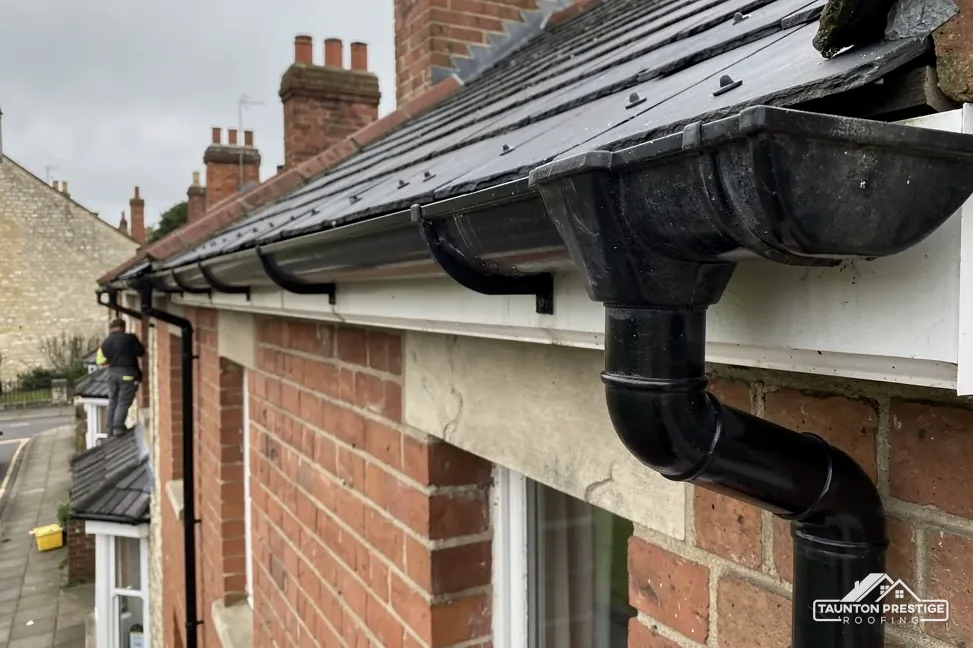
uPVC gutters are lengths of extruded plastic, joined by clip-in unions with rubber seals and held on brackets screwed to the fascia or the rafter ends. They are light, easy to cut on site, and come in half-round, square and ogee profiles, which is a moulded shape with a curve like a letter S. Colours are limited, but they are made to match the white, black and brown boards that sit above them.
What goes wrong with uPVC?
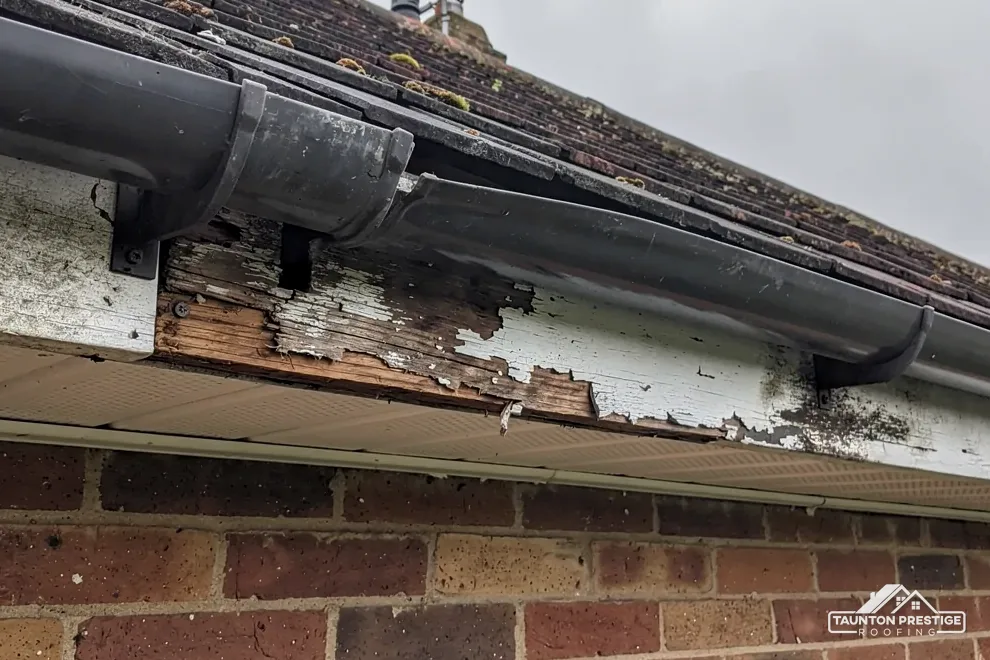
Joints are the weak spot. The rubber seal in a union dries out or slips, and a gutter that drips at a joint is the most common call about plastic runs. Brackets spaced too widely let the run sag, and sagging holds water where it should flow. Plastic can also turn brittle and fade after years of sun, and a cracked length is replaced rather than mended. Our answer on why a gutter leaks at the joints sets out the usual fixes.
How long does uPVC last?
Published lifespans for gutters are thin on the ground. A retailer.s 20 to 40 years for uPVC fascia boards is sometimes applied to gutters too, but it belongs to boards, and the seller has an interest in it. Ask the maker what its product is rated for and what that rating covers, and remember a stated life is not a guarantee. Fit matters as much as the plastic: a well-supported run lasts, and a sagging one does not.
Cost is the strength. The sections below return to prices, but uPVC is the usual starting point for a plain modern house because it is light, fast to install and simple to swap out in sections.
Downpipes in uPVC are clipped to the wall at intervals and join to the gutter through an outlet. Look at the clips as well as the gutter, because a downpipe that has pulled away from the wall tips water over the brickwork. When a run is renewed, the shoe at the foot of each pipe and the drain gully it feeds should be checked in the same visit, since a blocked gully puts water back up the pipe.
Aluminium and seamless gutters
Aluminium gutters are made from coated sheet. They are lighter than steel, do not rust, and take a powder coating in a wide colour range, which suits a house where the plastic look is wrong. They are joined with sealed or riveted unions, or they are made as seamless gutters.
What are seamless gutters?
Seamless gutters are formed on site from a coil of aluminium, run through a machine to the exact length of the run. With no joints along the length, the only joins are at corners and outlets. Fewer joints mean fewer places for a leak, and the run is made to fit rather than cut from stock lengths. Our answer on whether seamless aluminium gutters are worth it sets out where the extra cost pays back and where it does not.
What are the drawbacks?
Aluminium dents. A ladder leant against the run or a ball can leave a mark that stays. A long continuous length also moves as it heats and cools, so the fixings are set to allow it. Repair means a section cut out and sealed, which is possible with sectional gutters and harder with a single length. Colour-matched lengths made years apart may not match perfectly.
Where the house suits it, aluminium gives a crisp line, and the coated surface needs little more than an occasional wash and clearing of the run. It costs more than plastic to buy and fit, and the extra pays off most where the view of the roofline matters or the run is long.
Galvanised steel and copper
Galvanised steel is steel coated with zinc to resist rust. It is stiff, takes knocks better than aluminium, and is often painted or pre-coated. The weak point is the cut edge and any scratch that goes through to the steel beneath, where rust can start. A gutter that is painted and kept clear lasts longer than one left bare to the weather.
Where is steel used?
Steel is common on farm buildings, garages and industrial units, where strength matters more than finish, and it is used on houses in rolled or formed profiles. It is heavier than plastic or aluminium, so the brackets and the fascia behind must be sound.
Why choose copper?
Copper is chosen for looks and for long service. It starts bright, then dulls to brown and finally to the green patina that suits stone and slate. It is soldered or jointed with sealed fittings, it is costly, and it should be fixed by a roofer used to metalwork. Copper on a roof with aluminium or steel parts can cause trouble where different metals touch, and a roofer will usually keep them apart.
Where the two metals meet other materials, the joint needs thought. Steel against copper, or either against bare aluminium, can set up a reaction at the contact, so a roofer keeps different metals apart with a plastic washer or a coated bracket. Fixings should match the gutter, and a stainless or coated screw is a better pairing than a plain steel one. These details cost little at the time and save a rusted bracket later.
Both metals suit houses where the owner wants a metal finish and is willing to maintain it. Neither is a casual choice, and neither will be right for a terrace where the neighbours have plastic and the freeholder has a view.
Cast iron on Victorian and older houses
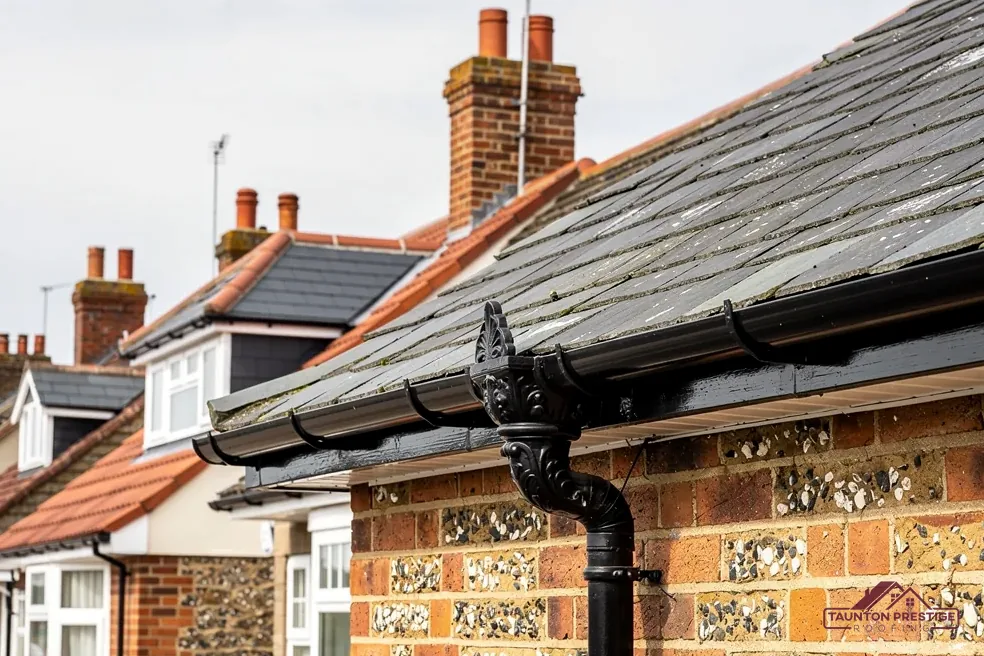
Cast iron was the standard gutter material on Victorian and Edwardian homes, and a great many in Taunton still wear it. The sections are heavy, joined with bolts and a sealant in the joint, and carried on brackets fixed to the wall or the rafter ends. The profile, often an ogee or a half-round with a decorative bead, is part of the look of the house.
Should cast iron be repaired or replaced?
Repaired where it can be. A leaking joint can be taken apart, cleaned and resealed; a cracked length can be replaced with a matching section; rust is cut back and the iron repainted. Our guide on cast iron gutters on Victorian homes: repair or replace sets out when each makes sense. Iron needs painting to stay sound, and neglect is what finishes it.
Do consent rules apply?
On a listed house, works that alter the character of the building will need listed building consent, and a change from cast iron to plastic would be a case in point. A straight swap that leaves the look of the building as it was is not treated as development under the planning Act. In a conservation area, ask Somerset Council's planning team before changing the material or the profile. Taunton has several conservation areas, and Somerset Council lists them with their designation dates.
Modern cast-aluminium and cast-iron-effect plastic lookalikes are sold for period homes. They suit a house that has lost its original runs, but a conservation officer may prefer the real thing on a listed frontage, so ask first rather than after the new run is up.
Cast iron brackets and the wall behind them also deserve a look. Rust swells the metal, and a swollen bracket can crack the brick or the render around its fixing. Where the old runs are sound but sagging, the cure is often new brackets and a reset fall, not a new gutter.
Fall, size and cost
A gutter must lean slightly towards the downpipe so water runs rather than sits. Brett Martin's manufacturer guidance is "1mm for every 600mm", so a six-metre run drops 10 mm from one end to the other. A run that is dead level or leans the wrong way holds water, rusts steel from inside, and overflows in heavy rain. Our answer on what fall guttering should have goes into the practicalities.
Does the size of the gutter matter?
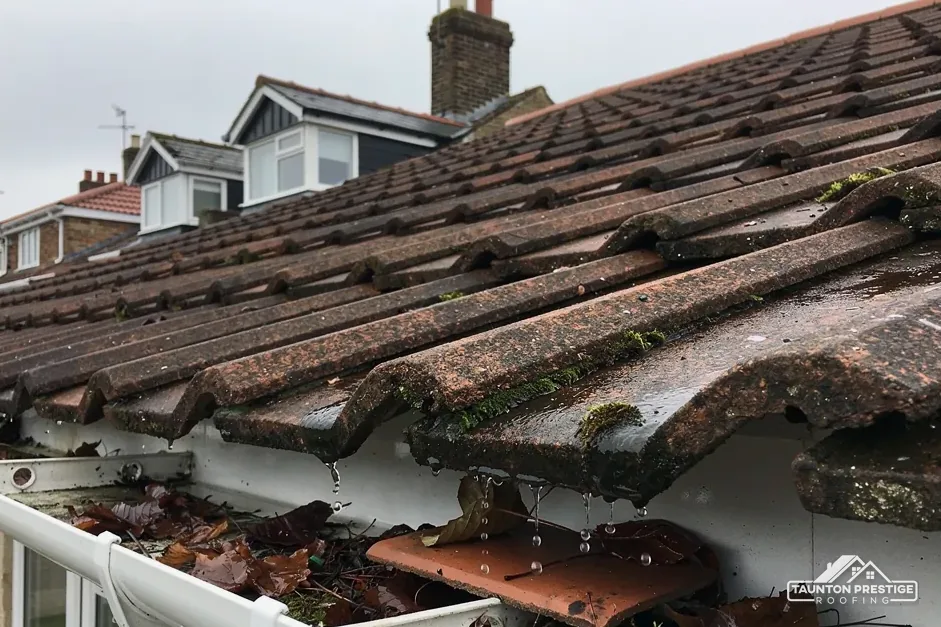
Yes. A gutter that is too small for the roof area overflows in a downpour however good the material. Size depends on the roof area draining into it and on the number and position of downpipes. Our post on gutter sizing and Somerset rain looks at that side of the choice.
What does replacing gutters cost?
MyJobQuote gives around £1,000 to £1,600 for replacing guttering on a typical house (MyJobQuote, Oct 2026). That is a national range. The material, the length of the run, the number of corners and outlets, the height and any scaffold or tower required to get at it all change the figure. Fascia and soffit work done at the same time shares the access. Check whether VAT is included in the total, and whether the old run is taken away.
| Material | Suits | Ask about |
|---|---|---|
| uPVC | Plain modern houses | Joint seals and bracket spacing |
| Aluminium | Houses where the line matters | Dents and colour matching |
| Galvanised steel | Garages, farm buildings, outbuildings | Cut edges and paint |
| Cast iron | Victorian and older houses | Repainting and joint sealant |
| Copper | Stone houses and long-term owners | Cost and contact with other metals |
Choosing the material comes down to the house, the finish you want and the upkeep you will accept. A plastic run suits a plain modern home. A coated aluminium run suits one where the line matters. Cast iron belongs on the house that was built for it. If you want a roofline looked at, our gutters, soffits and fascias page lists the work we take on.
Gutter material questions
Can I mix uPVC and cast iron on the same house?
You can, but the join needs the right adaptor and the colour and profile will rarely match. Mixed runs also age differently and can look patched. On a period house or a listed frontage it is better to keep one material along each elevation, and to ask the planning team where consent might apply.
Which gutter material is least likely to need repainting?
uPVC and factory-coated aluminium need no repainting during their working life, though both can fade. Galvanised steel is often painted to protect the zinc, and cast iron needs repainting to stay sound. Copper is left bare and weathers to a green patina. The choice depends on how much upkeep you are willing to do.
Do new gutters have to be the same colour as the old fascias?
No rule says so for a plain house, but a mismatch looks odd and is hard to undo. Where the fascias are being replaced at the same time, choose the two together. In a conservation area or on a listed frontage, ask the planning team about colour as well as material before anything is ordered.
More on this subject: Gutters, soffits and fascias in Taunton