A pitched roof is the default for much of rural Somerset, from the barns and cattle sheds of the Levels to workshops, village halls, farm shops and small business units. Gravity does the work: rain runs down the slope, off the eaves and into a gutter. That is why the shape has lasted, and why a pitched roof is more forgiving than a flat one of the same age.
It is not free of trouble. A pitched roof needs enough slope for its covering, a ridge that is fixed properly, drainage that copes with a large roof area and, on a commercial building, access arrangements that keep people safe when they have to go up. The covering matters too. A tiled or slated roof behaves very differently from profiled sheet, which is long, ribbed metal or fibre-cement sheeting fixed to purlins, the horizontal beams that carry the roof.
Below are the real pros and cons of pitched roofs on business and farm buildings around Taunton, drawn from published lifespans and minimum pitches rather than guesses. No per-square-metre prices appear, because the price depends on the building, and we explain what moves it instead. The survey is where those questions get answered for your commercial roofing job.
What a pitched roof does well
The advantages are practical, and they are the reason most agricultural and many commercial buildings keep this form.
Why does the slope help?
Water leaves the roof quickly, so it has less time to find a weakness. A tiled roof is a series of overlapping layers, and a slate or tile laid at the right pitch sheds nearly all the rain without relying on a single sealed layer. A profiled sheet roof sheds water along the ribs to the eaves. Either way, there is no ponding to plan for, and a small gap in the covering may let in nothing for years.
How many years does a pitched covering give?
Published figures vary by material. CORC puts well-maintained slate at 100 years or more. Marley's expected figure for concrete tiles is around 60 years, offered without a warranty. BRE's 60-year minimum belongs to clay tiles, and old peg tile is the exception, where that number cannot be relied on. None of these are promises, and a neglected roof will fall short of them.
Does a pitched roof leave useful space?
It does. The roof space under a pitch can be a store, a loft or a plant area, and in a farm building the volume under the ridge helps with air movement. Our page on the disadvantages of a pitched roof gives the other side of the argument.
Pitch, covering and the minimum slope
A pitched covering only works above a minimum angle, and below it, rain blows up under the laps. The minimum depends on the product, so the data sheet is the final authority.
What are the minimum pitches?
Marley lists minimums for its own ranges. Among clay tiles: Canterbury 40 degrees, Ashdowne 35, Hawkins 30, Acme Single Camber 30, and the Lincoln pantile 15. Among concrete tiles: Plain 35 degrees, Edgemere 17.5, Double Roman 22.5 (smooth), Mendip 15 (smooth), Ludlow Plus 22.5 and Wessex 15. For natural slate, Cupa reads BS 5534 as pointing to a 20 degree minimum, with no hook fixings below 25 degrees. Check the data sheet every time, because exposure and headlap change the answer.
Why does that matter on a business building?
Because a commercial roof is often shallower than a house roof, to keep the ridge down or save on materials. A low-pitch roof needs a covering made for it, such as a profiled sheet or a pantile. Putting a slate or plain tile on too shallow a slope is the classic cause of a roof that leaks in every storm. Our page on minimum pitch for roof tiles goes through it.
The Double Roman is worth a mention here. Bridgwater's yards produced a popular clay Double Roman tile, according to a local heritage leaflet, and modern concrete versions are laid on many Somerset roofs. Whether a given building carries it depends on when it was roofed and by whom, and the roof survey is what tells you for yours.
Profiled sheet on units and farm buildings
Profiled sheet is the working covering of many agricultural and light industrial buildings around Taunton. It is quick to fit and covers long spans, and it has its own set of strengths and weaknesses.
What are the advantages?
Long sheets mean fewer laps and fewer joints per square metre, and the sheet is light enough that the frame can be lean. A box-profile or corrugated sheet can be overclad, meaning a new sheet goes over the old one, which saves removing the existing roof and can keep a building in use while work goes on. Our page on roof overcladding covers when it suits.
What goes wrong?
Fixings loosen, laps open, sealants age and the sheet itself can corrode, especially at cut edges and where it sits in damp or in contact with animal waste. Condensation is common on uninsulated metal roofs, where warm moist air meets a cold surface and drips back inside. Our local piece on condensation on metal roofs goes through it.
What about older fibre-cement sheeting?
Treat it with caution. For a building built or refurbished before 2000, HSE advises assuming asbestos until a survey proves otherwise, and it calls asbestos cement roofs always fragile, so nobody walks on the sheets or the rooflights. Taking whole sheets off with care needs no licence, but smashing them into pieces turns the job into notifiable non-licensed work. Waste goes with a consignment note, never into a skip.
We survey first, record what we find, and tell you before any sheet is touched.
Binoculars from the ground show rust streaks below fixings, lifted laps and sagging sheets, and a look from the inside shows daylight and drips. Note where staining starts, because on a ribbed sheet water often runs sideways along a lap before it drops, so the stain sits away from the fault. Photograph it all, and keep the pictures with the date.
Gutters, drainage and rooflights
A big pitched roof collects a lot of water, and all of it ends up in the gutters. On a farm building or a unit with a long frontage, the gutter system is as important as the covering.
How should a commercial gutter run?
With a continuous fall to the outlets, of the order that the manufacturer specifies. Brett Martin gives 1mm of fall for every 600mm of run for its rainwater systems. Valleys, parapet gutters and box gutters in the middle of a roof need the most care, because they carry the water of two slopes and are out of sight. Our page on lining a box gutter shows how a failing one is relined.
What do rooflights add?
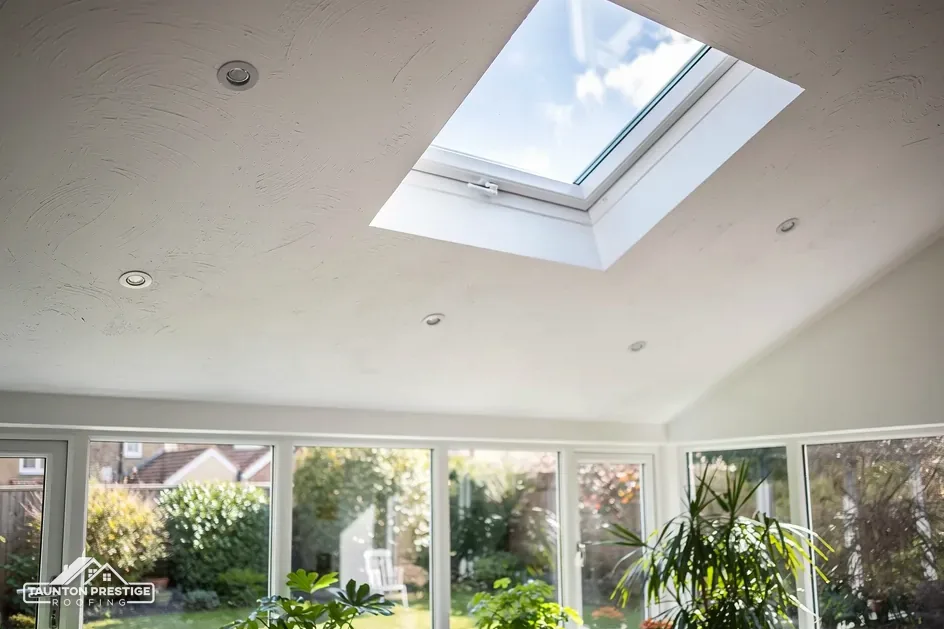
Daylight, and a place for leaks. A rooflight is a glazed or translucent panel set in the roof. In profiled sheet roofs they sit in the same ribs as the sheets and rely on sealed laps, while in tiled roofs they need flashings. They age faster than the surrounding sheet, they go brittle with sun and weather, and they can be the most fragile part of the roof. Anyone working on the roof should be told where they are and use proper access boards.
On a roof with rooflights, plan the repair of the whole roof, not just one side. A new sheet beside a tired rooflight leaves a weak point that still lets water in at the next gale.
Who looks after the roof?
The building's owner or manager. We recommend a simple inspection routine after storms and each spring and autumn, with notes and photos so changes stand out.
Ridge, verge and the exposed edges
On any pitched roof, the highest and most exposed parts get the hardest weather. In Somerset, that means the ridge, the hips and the verges on buildings that stand on the Levels or on the hill edge, where driving rain finds every weak joint.
Do ridge tiles still get bedded in mortar?
Yes. Mortar is allowed, and BS 5534 is guidance, not law. The change is that ridge and hip tiles are also clipped or screwed down, instead of resting on the mortar alone. Dry-fix systems, tested under BS 8612, use clips and caps. Typical UK figures for a house are £225 to £550 for ridge tile replacement and £500 to £2,000 for a dry verge system (MyJobQuote, Oct 2026), so a long commercial run costs more.
What goes wrong first?
The mortar cracks and washes out, the verge pulls away from the gable and the first few courses of tiles lift in wind. On profiled sheet roofs, the ridge flashing and the end laps fail first. Our page on dry ridge and verge compares the systems.
An inspection from the ground with binoculars catches a loose ridge or a gap along a verge before it becomes a leak. It also gives you something to show the roofer when you ask for a price.
Cost, access and getting it done
The drawbacks centre on getting at the roof. A pitched roof is more expensive to reach and to work on than a flat one, and that shows up in the price.
What drives the price of pitched roof work?
Area, height, the covering, the condition of the battens and rafters underneath, and above all access. A high eaves on a large building often means scaffold or a mobile platform, which can cost a large share of the job. On a commercial project, the cost guides we use give domestic figures, such as MyJobQuote's range of £3,000 to £8,000 for re-tiling the whole of an 80m² roof (Oct 2026). That is a guide to the order of magnitude for a house, not a price for a farm building. The written price follows the survey.
Does a commercial re-roof need approval?
It can. Our page on commercial re-roofing and building control covers the approval side. Class C permitted development covers a dwellinghouse, not a business building, so ask Somerset Council's planning team whether the change needs an application. Our page on farm building roof replacement sets out the usual route.
What about the work itself?
Where several firms share the job, the client must appoint, in writing, both a principal designer and a principal contractor under CDM 2015. Before we start, we agree access, edge protection and sequence with you, and you hear what happens each day.
Pitched roofs on business buildings
What pitch does a slate roof need on a commercial building?
Slate needs about 20 degrees at the least, and Cupa warns against using hook fixings on pitches under 25 degrees. The slate maker's data sheet and the exposure decide, and a shallow roof needs a covering made for it.
Can I walk on a fibre-cement or asbestos-cement roof sheet?
No. Asbestos cement roofs are always fragile, says HSE, and rooflights in any sheet roof can be too. Keep off the surface, use crawling boards or a platform for any work, and have the roof surveyed before anyone goes up, particularly on a building from before 2000.
Is dry ridge better than mortar on a business building?
Not always. Mortar is allowed, with mechanical fixings added to bedded tiles. Dry-fix uses clips and caps, tested to BS 8612. The survey tells us which suits the tile, the exposure and the length of ridge.
More on this subject: Commercial roofing in Taunton