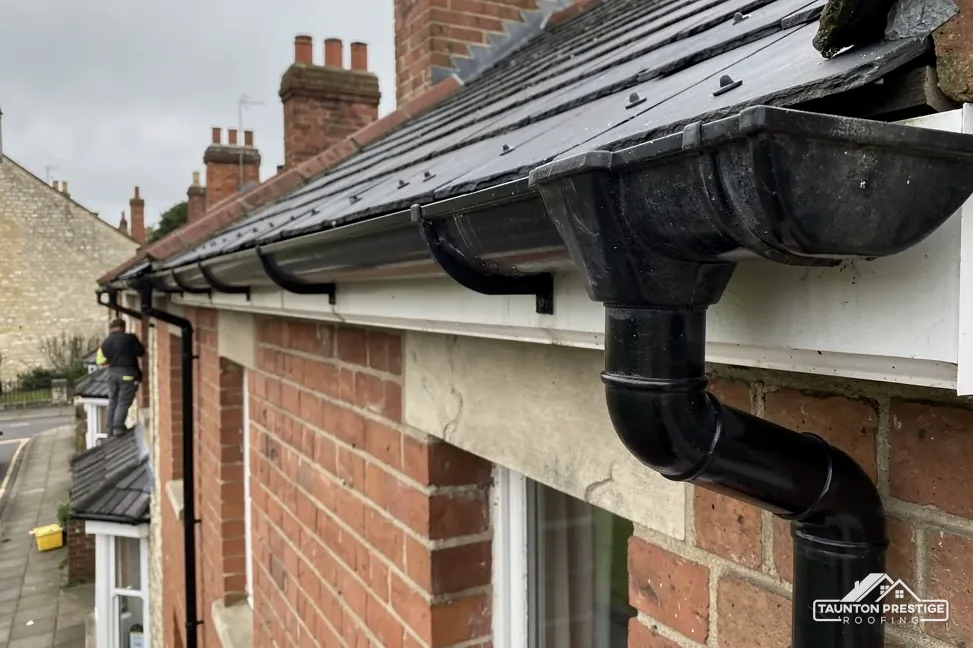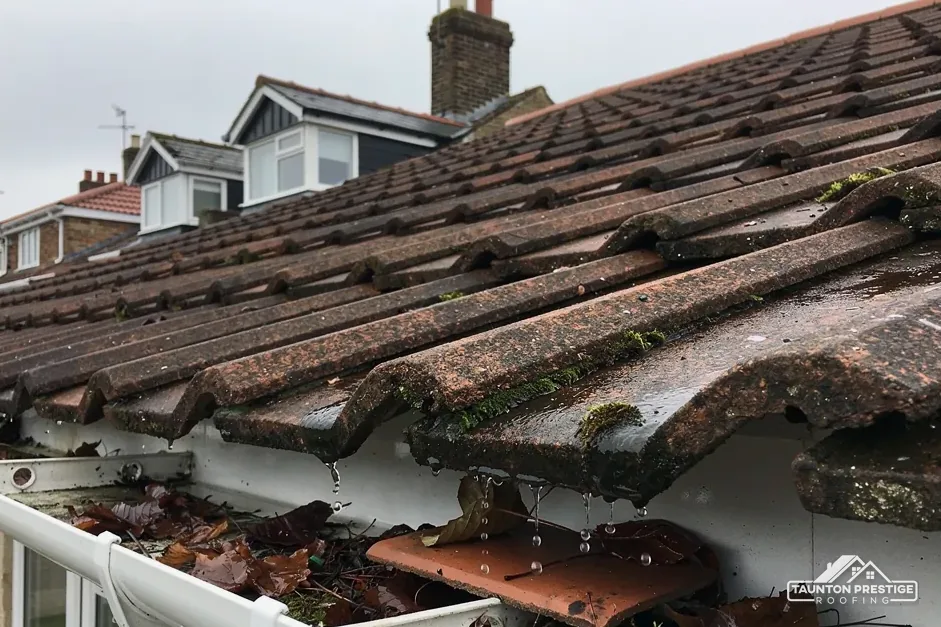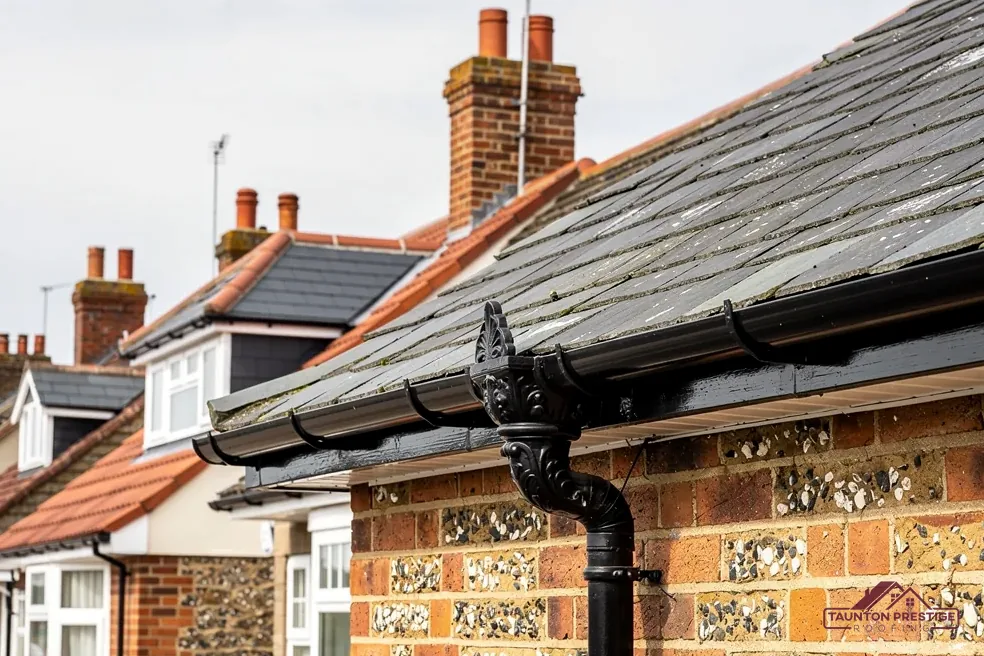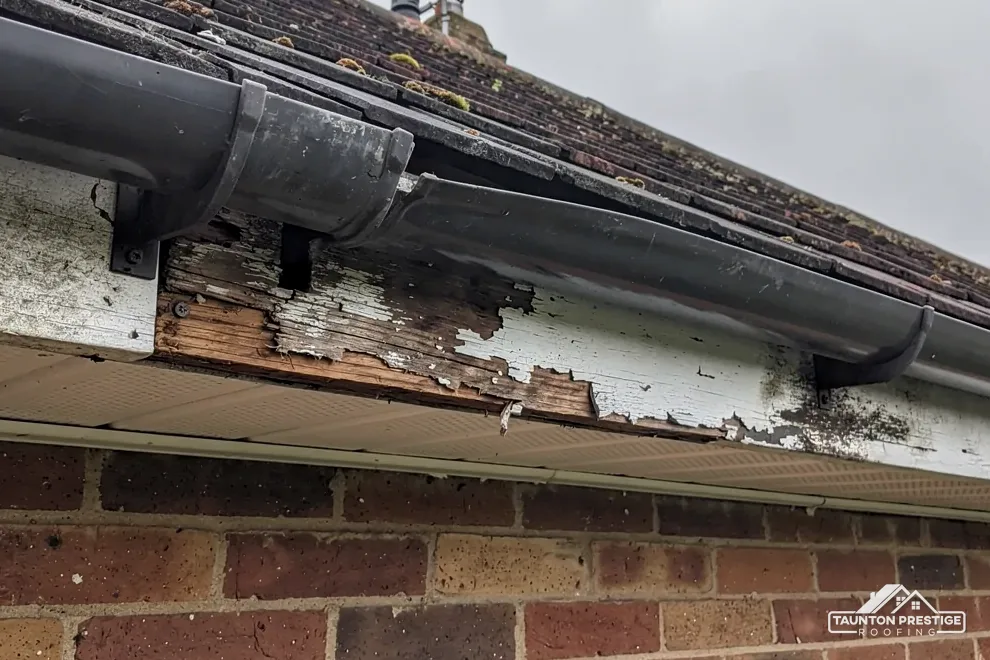
Damage to the boards at the bottom of a roof usually starts small and out of sight. A fascia is the board facing outwards along the roof edge, while the soffit is the flat underside panel visible when you look up at the eaves. Both sit above head height, so the first sign is often something you notice by accident: a stripe of peeling paint, a gutter that no longer sits level, or a bird slipping into a gap above the window.
This post is for owners of Taunton houses and of small business premises, such as shops, workshop units and farm buildings, where long eaves runs are common and often go unchecked. It covers what damage looks like from the ground, how rot behaves in timber boards, why gutters sag, and when a repair is a better buy than replacement. It also covers the point that comes before any repair: checking for nesting birds and bats, because the law protects both and that check can change the timing of the job.
What damage looks like from the ground
Binoculars and a slow walk round the garden or pavement tell you plenty. Walk the whole building, not only the side you see from the front door, and look along the roof edge at each elevation in turn. Damage tends to start where water sits: below a leaking joint in the gutter, at an internal corner, and on the side of the house that gets the weather first.
Which signs are worth acting on?
Paint that bubbles, flakes or shows dark stains on a timber board points to damp getting in. A gutter that dips between brackets, or one that stands away from the board at one end, suggests the board is no longer holding the fixings. Dark streaks down the wall below the eaves mean water is running over the wrong edge. Gaps along the top of a fascia, or open joints between soffit panels, let wind, rain and wildlife in. Pieces of board or paint chips on the ground, or in the gutter, also tell their own story.
What does the loft show?
If you can reach the eaves from inside, a torch shows more. Look for damp or darkened timber at the rafter ends, light coming through where it should not, and droppings or nesting material on the wall plate. Take pictures. They help a roofer give an accurate quote, and you can compare them over time to see whether a patch is spreading.
None of this needs a ladder. If something looks wrong, a survey can confirm it from the roof edge, with photographs of the actual board.
Rot: how it starts and how far it goes
Timber boards rot when they stay wet and cannot dry. Water gets behind a failed paint film or a leaking gutter, the wood takes it up, and fungus does the rest. The damage often hides at the bottom edge of the fascia and on the upper face of the soffit, where you cannot see it from below.
How do you tell soft wood from sound wood?
A roofer pushes the tip of a screwdriver or a bradawl into the board. Sound wood resists. Rotten wood gives way, comes up in crumbly chunks and may feel spongy or stringy. Do this from a safe position, not from the top of a wobbly ladder: the test belongs with a person who has proper access. Discoloured wood alone does not prove rot, and a board that looks fine on the outside can still be soft at the back.
Does rot spread beyond the board?
It can. Rafter ends, the angled timbers the roof frame is made of, sit directly behind the fascia and can take on the same damp. The wall plate, the timber that spreads the roof load onto the wall, sits behind that. If rot has reached either, repair means cutting out and replacing the damaged section with treated timber, and sometimes bringing in a joiner. Our short answer on eaves felt rot explains how the underlay at the roof edge fails too and why a new board cannot cure it.
Sagging gutters and loose boards
A sagging gutter is a symptom, and the cause may be the gutter, its brackets or the board. Brackets fixed into soft timber pull out as the wood crumbles. A gutter packed with silt and leaves, or filled with water because it has no fall, is heavy enough to bend its own brackets. In winter, ice can add more weight still.
Is the gutter or the fascia at fault?
Look at how the sag behaves. If the gutter dips evenly along a run, the brackets have probably spread or been spaced too far apart. If one section drops sharply near a joint, the board there may have rotted or split, or an old fixing may have failed. A gutter that is full of standing water on a dry day has lost its fall and needs resetting, which is a gutter job. A gutter that holds its line but leaves marks on the wall behind it may be leaking at a joint.
Fixing a gutter back onto a rotten board is a short-lived repair. Fixing a new board and then re-hanging the old gutter works if the gutter is sound, and a new set of brackets is cheap compared with doing the job twice. Our answer on bats behind fascia boards explains what to do if the gap behind a board is already occupied.
What about the soffit above?
Soffit panels sag when the fixings loosen or the board behind has gone. A bulge or a gap at the edge means water or pests have reached the space above, and a damp patch on a ceiling beneath the eaves can mean the same.
Gaps, birds, wasps and bats
An open gap between roof and wall is an invitation. House sparrows, starlings and jackdaws will use a hole behind a fascia, wasps will build in a soffit void, and bats may roost in the narrow space between board and wall. Spotting this before work begins matters, because the law treats nests and roosts differently from builders' rubbish.
Which rules cover nesting birds?
Section 1(1) of the Wildlife and Countryside Act 1981 is breached when someone, acting intentionally, harms a nest that birds are building or using. GOV.UK adds that no licence can be granted where the aim is development or construction. In plain terms, if birds are nesting in a gap, the repair waits.
And bats?
Bats come under separate protection. The Habitats Regulations 2017, regulation 43, make it an offence to deliberately disturb them, and to destroy or damage a site where they breed or rest. Section 9(4) of the same 1981 Act covers a person who, acting intentionally or recklessly, upsets a bat inside a place it shelters in, or blocks its way in. GOV.UK states that all bat species have full protection, and its guidance counts roof repair among the jobs that may disturb them.
That is why we look first. If we see droppings, staining at a crevice, or birds going in and out, work stops at that spot and you hear what the options are before anything else is done. Our answer on bats behind fascia boards sets out the steps, and a reputable roofer will explain the options before any board comes off.
Repair or replace the boards?
The right answer depends on how much of the board is sound, how old it is, and what is behind it. A few small repairs can extend the life of a board that is otherwise in good order. Where rot has spread through a long run, a patchwork of repairs costs more in the end than renewing the lot.
When is a repair enough?
A local patch of rot in an otherwise firm board, a loose section that needs refixing, or a split joint that needs closing are all repair jobs. So is a hole that needs stopping up with a proper mesh strip or board, to keep birds out of the void. The test is whether the timber behind is firm and dry once the fault is dealt with. If it is, a repair will hold. Repainting without dealing with the cause, such as a leaking gutter above, simply traps damp again.
When does replacement make more sense?
If the rot runs along most of a side, if the board has warped or split in several places, or if the rafter ends have gone soft, replacement is the better buy. For houses where the boards are sound but tired, capping is a middle route: new cover boards over the old ones. Capping fascias and soffits has a typical UK average of around £800 (MyJobQuote, Sep 2026).
New uPVC or aluminium boards rot far less than timber, but cover only helps if the structure underneath is dry. Our guide to asbestos soffits matters here too, since older boards may need testing before anyone cuts or drills them.
Shops, units and farm buildings
Business premises raise the same issues on a larger scale. A row of shops in a Taunton street, a trading estate unit, or a farm shed outside Wellington may have eaves runs of many metres, taller roof edges and a mix of old and new boards. Long runs mean small faults repeat many times, and one leaking joint can stain a whole elevation.
What changes with commercial buildings?
Access is the first difference. A tall frontage may need a scaffold or a mobile tower, and where it narrows a footpath, the highway authority's scaffold licence comes into it. Safe access for the roofer, and for the public on the pavement below, is part of the survey. The second difference is age: industrial and farm buildings put up before 2000 may contain asbestos in soffits or sheeting, so the material is checked before it is touched.
Does a building owner have extra duties?
The CDM Regulations 2015 give clients duties, and for a domestic client these usually pass to the contractor. A business owner is not a domestic client, so ask your roofer how the construction phase plan and site safety will be handled. A good roofer can explain this in a few sentences.
Our gutters, soffits and fascias page covers the full range of work for houses and business premises alike. Whatever the building, the steps are the same: check the ground, look for wildlife, find out how far the damage goes, then decide between repair and renewal.
Damaged boards and what to do
Can I paint over a flaking fascia to stop it rotting?
Paint only helps if the board is still sound and the cause of the damp is dealt with first. Over soft wood it just hides decay. Strip loose paint, probe the timber, repair or replace any soft parts and fix leaks above, then prime and paint including the cut ends, which soak water up fastest.
A bird is using the gap behind my fascia. What now?
Hold off until the birds have finished. The 1981 Act makes intentionally damaging an active wild bird nest an offence, so the repair waits for that nest to be empty. After that, close the gap with a proper board or mesh so it cannot be reused.
Is damaged soffit board always asbestos?
No, but you cannot tell by looking, so older boards are treated with caution. The Health and Safety Executive says anything built or refurbished before 2000 should be assumed to contain asbestos until tested. Do not drill, break or sand a suspect board; have it checked first.
More on this subject: Gutters, soffits and fascias in Taunton