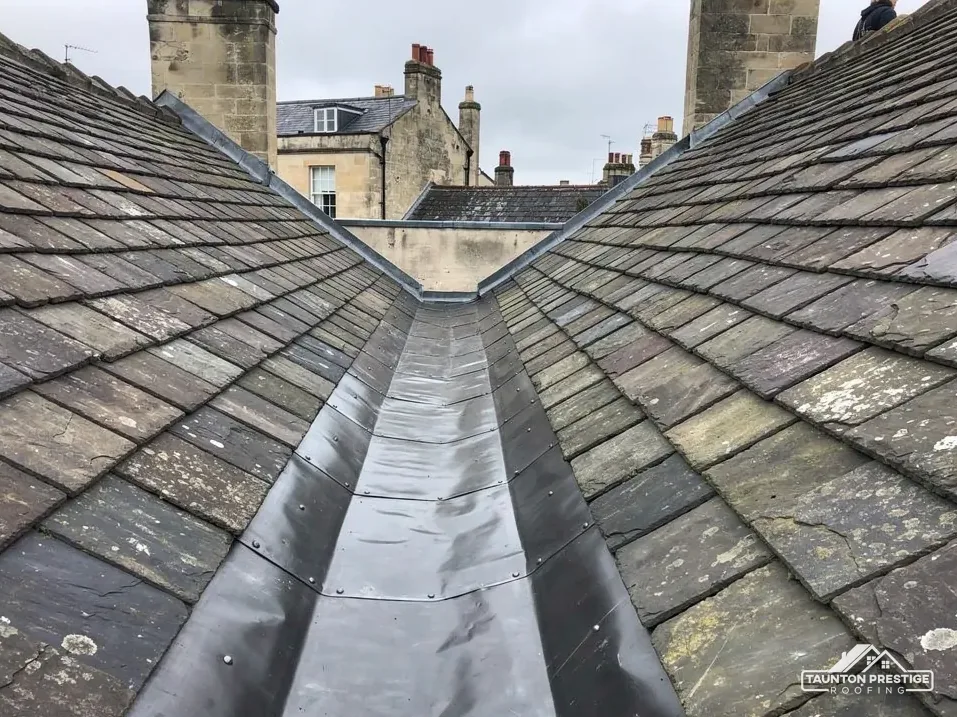
Picture the V-shaped fold where two slopes of a roof come together: that is a valley. Rain from each side runs into the fold and out to the gutter, so the fold copes with a heavier load of water than any open stretch of roof. Leaves, moss and small pieces of tile gather there too. If any single thing on a pitched roof is going to leak, a valley is high on the list.
The usual question is how to seal one. The better question is what has failed, because water is almost never entering through a hole that a tube of sealant can plug. It is entering because the lining has split, the tiles have lost their bedding, or debris has dammed the channel and forced water sideways under the covering. This post explains the main kinds of valley, how each one fails, what lead codes mean for valley work, and where a repair is enough and a replacement is the better buy. It uses typical UK costs from published guides and explains what sets the price of a job on your own roof.
Open valleys and closed valleys
Roofers describe valleys by how much of the lining you can see from the ground. The two kinds look different and fail in different ways.
What is an open valley?
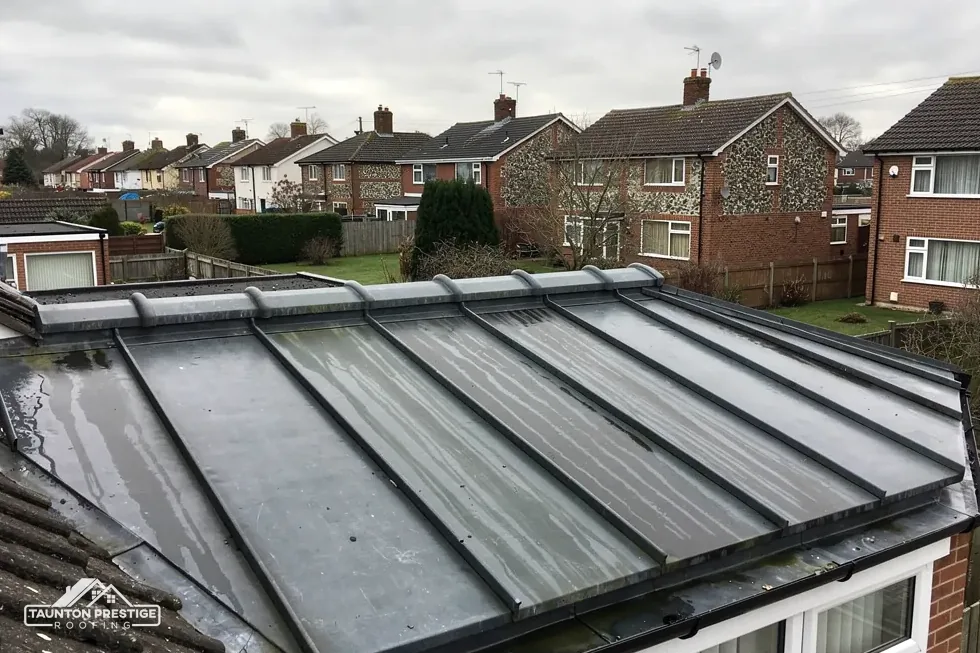
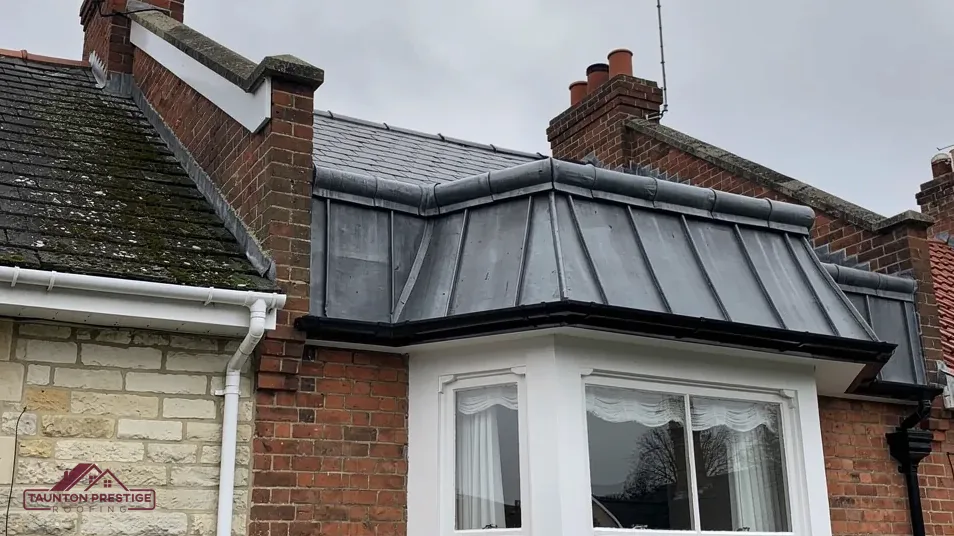
An open valley leaves a strip of the lining exposed between the edges of the tiles or slates on either side. The lining is usually lead, though it can also be a glass-reinforced plastic (GRP) channel, formed from resin and fibreglass, or a metal such as zinc. The visible channel does the carrying. Open valleys are easy to inspect, because you can see leaves, cracks and staining with binoculars. They also show up as a tidy, dark line down the roof, especially on older slate.
What is a closed valley?
A closed valley hides the lining. The tiles or slates from the two slopes meet, or are cut and woven together, over a lead sheet or a similar underlay that sits out of sight. It gives a neat, uninterrupted look and works well when it is detailed properly. When it goes wrong, though, the fault is hidden under the covering, so a leak may show inside the house before anything looks amiss outside.
The old advice that one is always better is too simple. A closed valley sheds water well when the lead beneath is sound. An open valley tolerates leaves badly, but is easy to clear and easy to repair. Tile profile counts as well. Somerset roofs include pantiles and Double Roman tiles, both with deep rounded profiles that are harder to cut neatly into a closed valley than a flat plain tile. That is why the valley itself gets surveyed before anything is recommended, with photographs taken of the lining.
Why sealing a valley does not work
Sealant and roof cement are the first fixes many people reach for, and the last thing a roofer wants to find. A leaking valley is not a crack in a flat surface. It is a hard-working drainage channel, and a patch on top of it fails for the same reasons the channel did.
Why do sealant and bitumen patches fail?
Because they stiffen, shrink and tear away. Sealant run across a split in a lead valley has to stretch whenever the metal moves, and it cannot. Bitumen paint on a lead lining hides cracks and traps moisture underneath. Roof cement smeared along the tile edge stops water draining out of the gap between tile and lining, so it pushes sideways under the covering instead. Meanwhile the real fault, a split, a gap or a dammed channel, carries on getting worse. Our guide on why sealant will not fix failed lead flashing sets out the same reasoning in more detail.
What does the valley need instead?
A repair that deals with the cause. That may mean clearing debris and moss and checking the fall, re-bedding or replacing broken tiles along the valley edge, welding or patching a short split in sound lead, or stripping the covering back and laying a new lining. The decision depends on how much of the valley has failed and how old the rest is.
Some DIY advice online suggests covering a valley with membrane, roof cement and tar paper. Layers of that kind trap water and make inspection impossible, and a roof built that way is harder to repair later than it was to start with.
Lead valleys and what the codes mean
Lead is the traditional valley lining on slate and clay roofs across Somerset, and with good reason: it is durable, it can be dressed to the shape, and it does not rot. Lead "can last for over 80 years", a lower bound for a well-fitted sheet, so a lead valley is seldom what fails first through age alone.
Which lead code is used for a valley?
Lead arrives in numbered codes, each one a different thickness. In Royston Lead's cast-lead brochure, a pitched valley gutter takes code 4, with codes 5 to 8 as heavier choices for the same job, and code 3 is kept for soakers only. Thicker sheet comes at a higher price and is harder to dress, but it stands up better in a hard-working channel. The right code follows from the roof area and the water the valley carries, which is why a roofer should choose it after looking, not before. Our guide to lead codes explained shows where each one goes.
How does a lead valley fail?
Usually in one of four ways: a split at a join or a fold, where the metal has been bent too often; a sheet that has crept downhill and left a gap at the head; a crushed channel where someone has stood in it; or corrosion on the underside where the timber below is wet. Stains on the ceiling directly below the valley, or a dark line on the rafters, point toward the last of these.
When a lead valley is sound but the tiles on either side have worn, the edges can be stripped back and re-bedded while the lead stays. A sound lead lining can outlast the covering around it.
GRP and tile valleys
Not every valley is lead. Some are a glass-reinforced plastic channel, others use a purpose-made tile or a mortar-bedded finish. Each has its own habits.
How long does a GRP valley last?
Less gives 25 to 40 years for GRP roofing in general (Oct 2026), and a valley is only one use of the material. GRP is moulded in one piece, which means it has no seams to open, and it is light and quick to fit. Its weak points are cracking where it flexes, loss of surface colour in strong sun, and lifted edges where the tiles have been cut against it. A hairline crack in GRP can be mended, but a panel that has crazed or lifted along its length is usually better replaced.
What goes wrong with tile and mortar valleys?
A valley finished in tiles with a mortar bed relies on the mortar to hold the cut tiles in place and seal the join. Mortar shrinks, cracks and washes out. Once it has, wind-driven rain pushes through the open joint and lands on the lining below. Mortar is not banned; BS 5534 simply stopped treating a bed of it as the only hold. Where the bedding has failed, we re-bed and fix the tiles mechanically, then check the lining beneath.
Valley tiles, shaped to turn the corner, suit some profiles but need to match the roof. On a clay or concrete roof, finding the right one is half the job.
Whatever the material, ask what is under the covering. A roofer who lifts a few tiles and photographs the lining can tell you more in ten minutes than a guess from the ground.
Spotting a valley leak early
Valley leaks can be found before they show up on a ceiling. A few minutes after rain, or with a pair of binoculars on a dry day, gives a good picture.
What can I see from the garden?
From the lawn or the pavement, find a spot that shows the whole valley line. Look for moss or leaves lying in the channel, a slipped or cracked tile along the edge, a bright line where lead has split, and a sagging section. Rust-coloured streaks beneath a zinc or steel valley point to the lining wearing through. On a closed valley, look for gaps or broken tiles where the two slopes meet. Take photographs from the same spot each year so you can compare them. Wet weather shows the water path best, because a dark streak or a spill of water over the channel edge marks exactly where the flow goes wrong. Make a note of which bedroom or landing ceiling sits below, so a roofer can match inside and outside.
What does the loft tell me?
If you can reach the roof void safely, shine a torch at the rafters below the valley. Dark tide lines, damp boards and stained insulation show where water has been getting through. Step on joists or boarding only. A stain that follows the pattern of the valley, running diagonally down the roof, is a strong clue.
Take care with wet leaves. They cover the channel and can hide a crack or a gap. Keep off the roof itself, because valleys are often steep and slippery. A telescopic pole and a camera on a phone are safer than a ladder, and they let you photograph the valley for a roofer to study before they visit.
Repair or replace: what a valley costs
Replacing a valley means lifting the covering on both sides, laying a new lining, and refixing the tiles or slates along the edges. It is skilled work, and it is often cheaper to do once than to keep repairing.
What are typical costs for a roof valley?
For a full valley replacement MyJobQuote shows around £540 (Sep 2026). That is a typical UK figure, not a Taunton Prestige price. The cost on your roof changes with the length of the valley, the roof pitch, the lining material and the lead code, how many tiles or slates need relaying, and whether scaffold is needed to work safely. Scaffold on the public road needs a highway licence, which we arrange with the scaffolder. A short, easy valley on a low roof may cost less than a long one running to a high ridge.
Is a repair or a replacement the right call?
Where the lining is sound and the fault stays local: a blocked channel, a few broken tiles, a short split in good lead. Clearing, re-bedding and patching cost far less than a new valley and do the job. Replacement wins when the lining is cracked across several places, has been patched with sealant more than once, or has rotten boards below it.
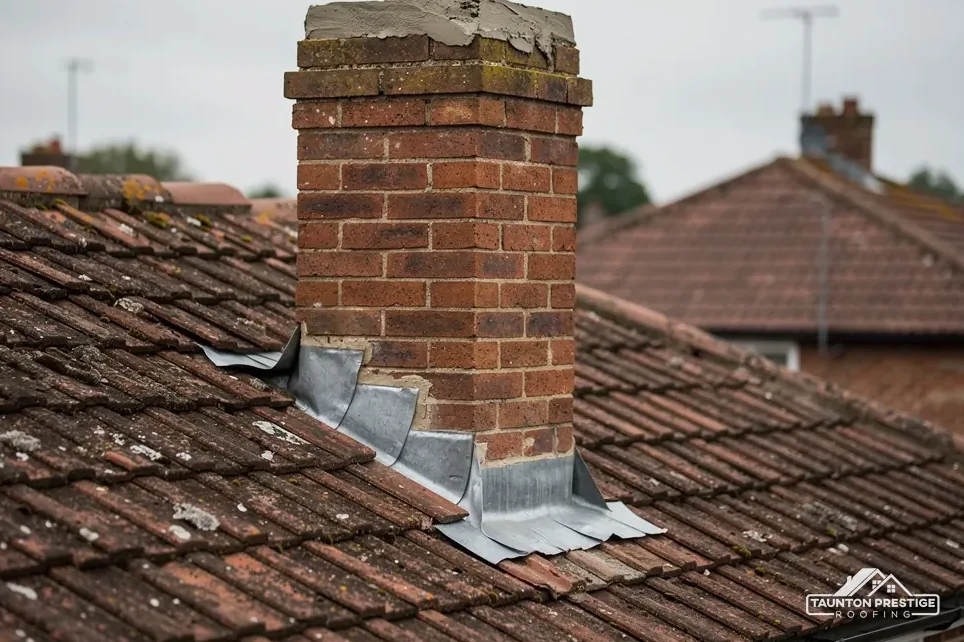
If the valley sits next to other weak points, such as a chimney or a wall junction, we check those on the same visit. Our lead work page covers the flashing and valley jobs we take on, and how much leadwork costs explains what moves the figure. After the survey and photographs, you get one written price for the work.
When a valley leaks
Is a valley leak an emergency?
A slow drip is not an emergency, but a valley runs water from two slopes, so a small fault can turn into a large one in heavy rain. Set a bucket beneath the drip, move belongings out of the way, and ask for a visit soon. If water is near a light, or the ceiling is bulging, stay out of the room.
Can moss in a valley be left alone?
Moss holds water and dams the channel, so rain backs up under the tiles at the sides. Clearing it by hand, with soft tools, is reasonable on a low roof reached safely from a platform. Marley does not recommend jet washing tiles, so do not blast the valley with a pressure washer.
Do I need planning permission to replace a valley?
Class C permitted development usually covers a like-for-like repair to a house roof. Listed houses keep that right but also need consent where character is affected, and a conservation area adds its own checks. Somerset Council's planning team can confirm for your address.
More on this subject: Lead work in Taunton