A leak over stock, a ceiling tile on the floor of a workshop, a tenant on the phone about a wet corner: commercial roofs tend to announce themselves at the worst moment. Many of those moments start months earlier as something small. A flat-roof outlet choked with silt, a cracked sheet on a profiled roof, a flashing lifting at a parapet, a gutter that has been overflowing quietly down the wall.
Owners of premises around Taunton carry the cost and the responsibility when that happens. The point of regular inspection is to find the small thing while it is still cheap, to give you pictures you can hand to a landlord, tenant or insurer, and to plan repairs so that they do not land in the middle of trading. This post covers how often a look is sensible, what we check on different kinds of commercial roof, how a photo-reported visit works, why some roofs need more care than others, and how planned maintenance sits alongside the odd emergency.
How often should a business roof be checked?
There is no single rule that fits a steel-framed unit on an estate edge, a Victorian shop with a lead-lined valley and a timber farm barn. What suits each depends on the covering, its age, the trees nearby and how much a leak would cost you. Our guide on how often to have a roof inspection covers the household version of this question.
Is once a year enough for a shop or unit?
For many premises a regular visit through the year, with a second one after severe weather, is a sensible rhythm to start with. A roof with a known fault, an old membrane or a history of blocked drainage may deserve a closer interval. A new roof with a clean record can go longer between visits. The first inspection sets the pattern: once we have seen the roof up close, we can say how soon it needs looking at again, and which areas deserve a quicker return than the rest.
What should trigger an extra visit?
A gale, a heavy rain event, work by another trade on the roof, a new rooftop unit or aerial, or a leak that appears and then dries. After any of those, a quick look beats waiting for the next scheduled date. Roof access by an electrician, an aerial fitter or a heating engineer is a common cause of damage that nobody reports. A footprint through a membrane or a dislodged sheet can sit unseen for months, then show up as a stain.
For tenanted buildings, check the lease. Repair duties for the roof often sit with the landlord, while keeping gutters clear and reporting damage may fall to the tenant. A dated inspection report gives both sides the same facts.
What gets checked on the different roof types
A commercial inspection starts by identifying the covering, since each type tends to fail in its own way.
What shows up on a flat or shallow roof?
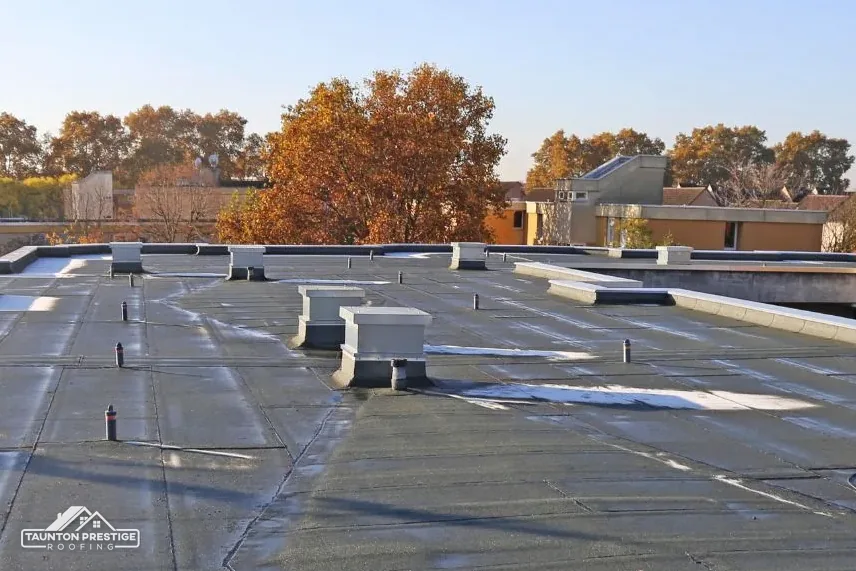
Water that stands after rain is the first sign. We note ponding, blistering or splits in felt, creases and lifted seams in single-ply membranes, failed sealant around penetrations, and drainage that is partly or fully blocked. A flat roof drains because it is laid to a fall. BS 6229:2025 sets a finished minimum of 1:80 across general areas and internal gutters, with the design aiming for 1:40 to achieve it, so a roof that holds a pond has often lost its fall or its outlet. Our guide to flat roof inspection goes through the checks in order.
What about profiled sheets, slate and tile?
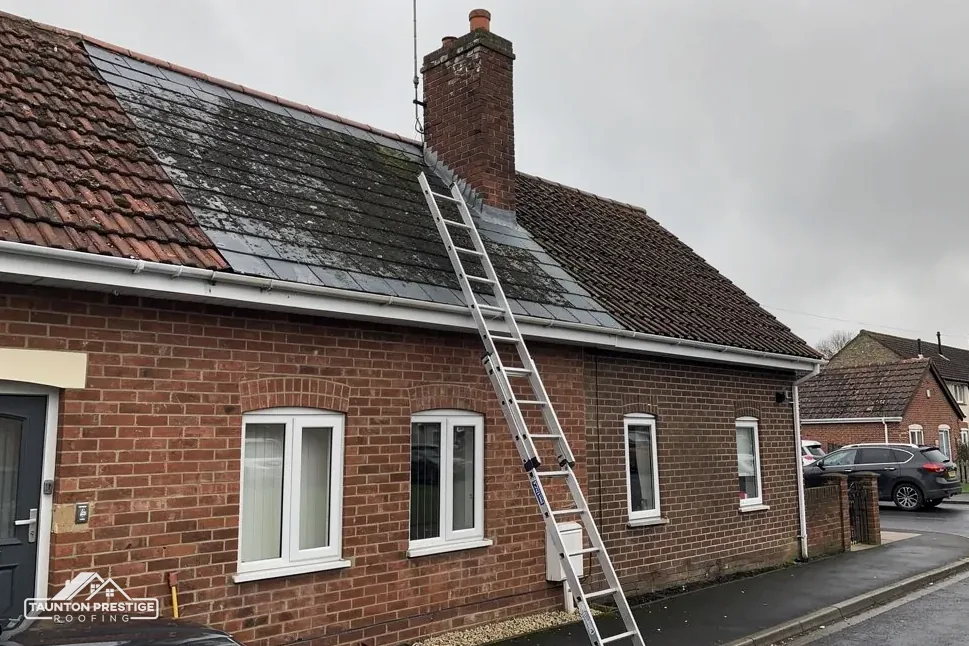
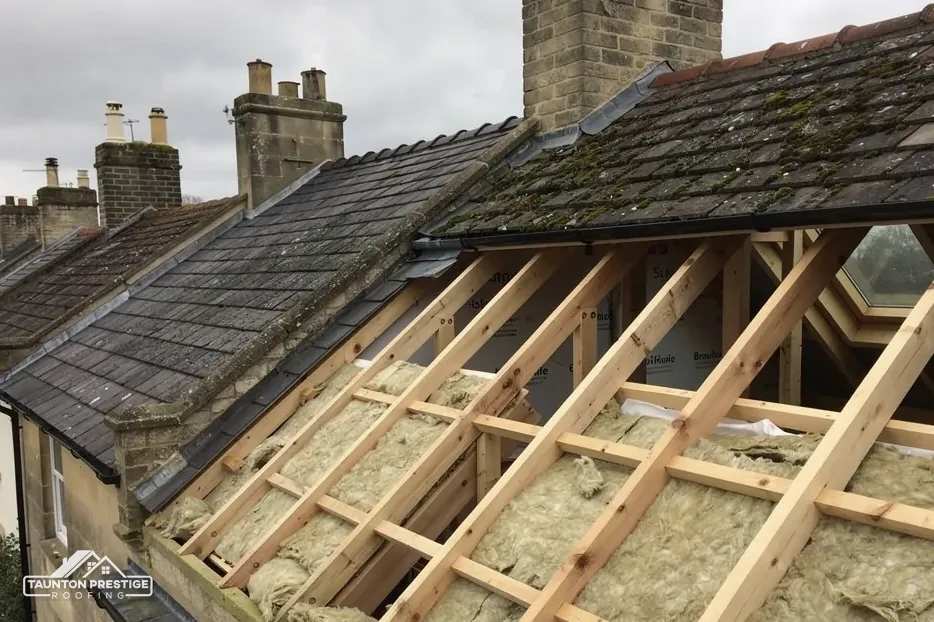
On sheeted roofs we look at fixings, laps, rooflights and the sealing at ridge and eaves. On pitched slate or tile, as on older shops in the centre of Taunton, we check slipped slates, ridges, chimney flashings and valleys, the gutter-like folds between slopes. Gutters, downpipes, fascias and any parapet walls are included for every type.
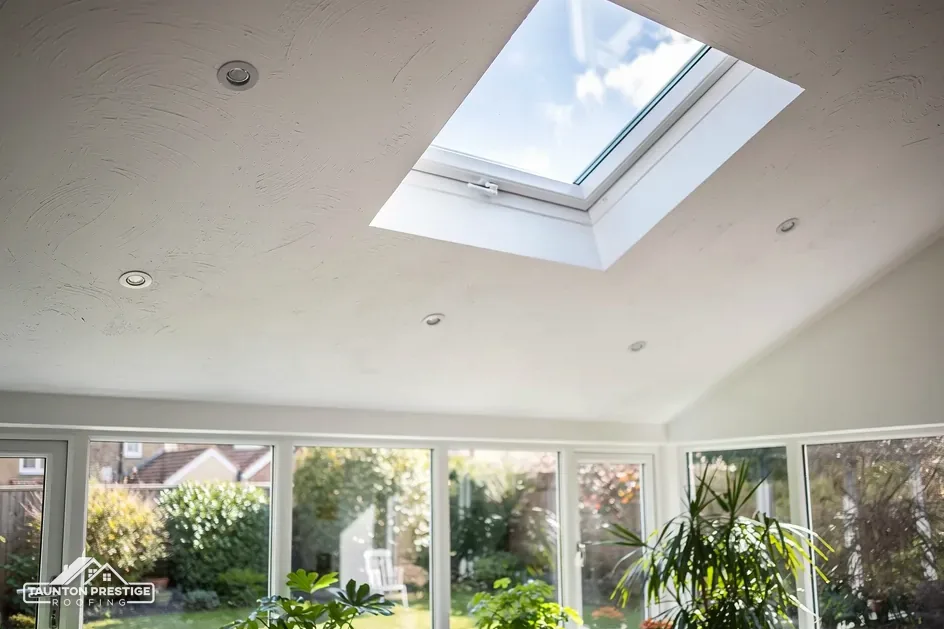
Less gets noticed at the junctions: the line where the roof meets a taller wall, the base of a skylight, the edge trim. Those details take the most water and are the places we photograph closely.
Published lifespans give a rough scale for what you are looking at: Less gives torch-on felt at 10 to 20 years, GRP at 25 to 40 and EPDM at 30 to 50, while GreenSpec puts EPDM at 20 to 30 (Oct 2026). The figures are typical ranges and not promises.
How a photo-reported inspection works
The report is the useful product, so we build the visit around it. We go onto the roof when the structure will carry us, or use a drone when the surface is fragile, high or awkward, and photograph each area we find a problem in, plus the general condition of each slope or bay.
What lands on your desk afterwards?
You receive a set of photographs of your own roof, each tied to a note in plain English: what we found, how urgent it looks, and what a repair would involve. Findings are sorted into those needing attention now, those to plan for and those just to watch. The same photographs are what you pass to a landlord, a managing agent or an insurer.
That evidence matters if a claim ever arises. If damage occurs, the order is the insurer first, then a temporary repair to stop the spread, with photographs and receipts kept throughout. A dated record of the roof's state before the event is something many owners wish they had. Whether a policy responds depends on its wording, so read your own cover.
Does a drone replace a roof visit?
Sometimes, not always. A drone is ideal for large or high roofs and for surfaces nobody should walk across. It shows overall condition quickly, but a hands-on check is needed for fixings, sealant and the feel of a membrane. MyJobQuote puts a typical roof survey at around £300 and drone surveys at £200 to £350 (Oct 2026), both typical UK ranges. Our guide to drone roof surveys explains where each approach fits.
Fragile roofs, asbestos and safe access
Some commercial roofs are dangerous to walk on, and the inspection method has to allow for that before anyone steps off a ladder.
Which roofs are fragile?
Old sheeted roofs, rooflights set into profiled sheets and weathered cement sheets can all give way under a person's weight, sometimes without warning. HSE's A14 guidance counts every asbestos cement roof as fragile. That applies to farm buildings, workshops and garage ranges across Somerset, many of which date from before 2000. HSE's starting point for any building from that period is to assume asbestos may be present.
In practice that means we plan the access before the visit: crawl boards, edge protection or a platform, or a drone where a person should not go. If the roof is cement sheet of uncertain type, we treat it as asbestos until tested and photograph it from a safe position.
What happens if asbestos cement is found?
It depends on its condition and what is planned. On HSE's rules, intact sheets lifted off with care count as non-licensed; once they are substantially broken up, the job is notifiable. Either way the waste goes on a consignment note. We tell you what we can see and what the next steps are, and an identification needs a sample, not a view from the ground.
CDM 2015 also matters for business owners. In the HSE's definition a domestic client means a private individual having their own home worked on, with no business involved. Premises used for a business sit outside that definition, so the client duties rest on the owner or occupier commissioning the work. Our team sets out the access and site arrangements with you before work begins.
Planned maintenance rather than emergency repairs
A maintenance plan is a list of small, dated jobs that keep a roof sound, drawn from the inspection. It is cheaper in disruption than emergency work, since you choose when the roofers arrive.
What goes into a maintenance visit?
The routine jobs are similar across many roofs: clearing outlets, gutters and valleys of leaves, silt and moss; resealing around penetrations; refixing loose flashings and ridge pieces; replacing slipped or cracked tiles, slates or sheets; and noting anything that has changed since the last report. A flat roof outlet cleared in ten minutes can prevent a ceiling being replaced.
Moss and debris are worth watching on shaded, damp roofs, and Marley does not recommend jet washing tiles or slate, so clearing is done by hand or with a treatment used to its label.
What if something fails between visits?
A leak is dealt with by making the roof safe first, usually with a temporary repair, and a return visit follows when the weather allows. Somerset Building Control names loose or falling tiles among its dangerous-structure cases, and leaves the cost of making a building safe with its owner. For the shop, unit or barn that has lost a sheet in a gale, tell us what happened and where.
How is the work priced?
Price follows access, roof area, covering type and the survey. Scaffold is a frequent addition: MyJobQuote lists scaffold hire for one week on a front elevation at £550 to £750 (Oct 2026). We give one written total after the survey, and you decide whether to book the maintenance visits yearly, after weather or one at a time.
Starting with a baseline inspection
All of this rests on a first visit that records the roof as it is now. That baseline report is the document you compare every later inspection against, and it is where trends become visible: a patch that was dry last year and is stained now, a seam that has opened by a few more centimetres, a gutter run that sags further each winter.
What should I have ready?
Gather what you know: the roof's age if recorded, any previous repair invoices, any known leaks and where they showed, a plan of the building and the access arrangements, including keys to hatches and any ladder or gantry. If you rent, tell your landlord that an inspection is planned. Tell us about any asbestos register or survey the building has, because it changes how we plan access. Mention too any rooflights, solar panels or plant on the roof, and which areas staff use for deliveries, so we can keep the work clear of them.
What does the written price include?
For an inspection, it is a single total after we have seen the premises. For repair work arising from it, the quote arrives once the survey is complete, again as a single figure. If a roof is better replaced than patched, you see the proof on your own roof, and our roof inspections service page explains how the visits and reports fit together.
If you would like a first look at your premises, tell us the type of building, the covering you think it has and any area that has leaked, and we will arrange the survey with the access that roof needs.
Questions from business owners about roof checks
Who is responsible for the roof if I rent my unit?
It depends on the lease. Some tenants repair everything, others only keep gutters clear, and the landlord holds the structure. Read the repairing clause, and ask your landlord or managing agent before arranging work. A dated report from an inspection gives all parties the same facts to work from.
Can an inspection be done without disturbing trading?
Usually. Most of the work happens outside, on the roof or from a drone, so staff and customers carry on. If we need to view the underside from inside, we agree a time with you, and we tell you where access and any temporary barriers will be.
What if the report finds a problem I cannot fund straight away?
Ask for the findings to be ranked: what needs doing now, what can be planned and what to watch. A temporary repair can hold a fault while you plan a proper one, and you decide the order. Nothing in the report commits you to booking the work.
More on this subject: Roof inspections in Taunton