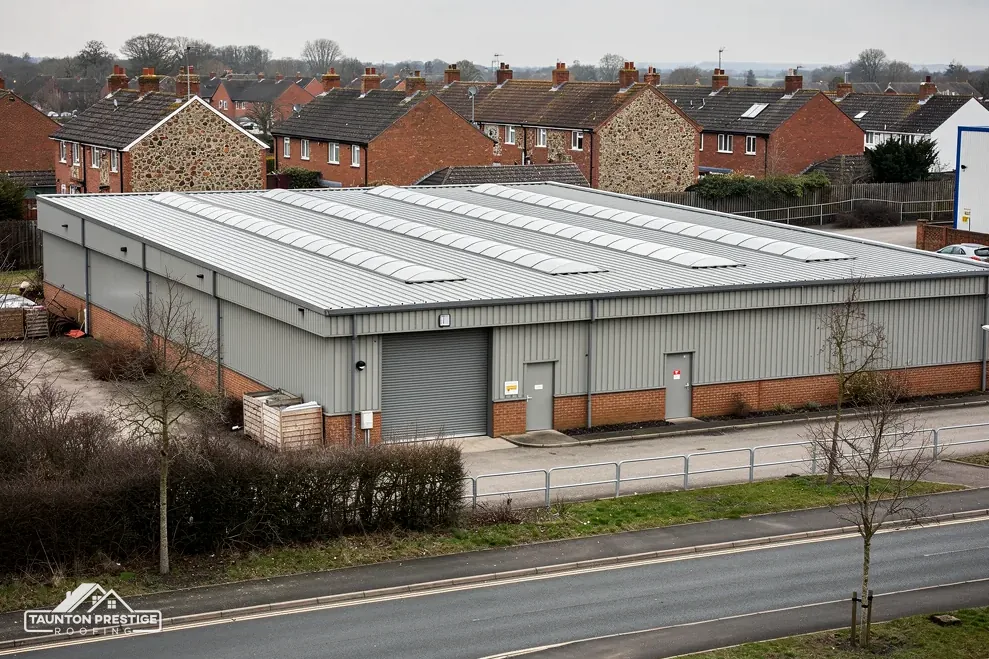
Profiled metal sheeting is a common roof on Somerset farm buildings, industrial units, workshops and warehouses. The sheets are steel with a factory coating on both faces, and that coating is what keeps the weather off the metal. It works well until a sheet is cut. The cut leaves a bare edge of steel, and rust can creep inward from it, lifting the coating as it goes.
That is cut-edge corrosion. It shows as orange or brown staining and bubbling paint along the ends and sides of sheets, often long before the middle of a sheet looks tired. Caught early, the edge can be cleaned, treated and sealed at a small part of what new sheeting would cost. Left alone, the corrosion eats along the laps and fixings until the sheet is thin enough to perforate, and then the leaks begin.
This guide explains where rust starts, how to read a sheet roof safely, what treatment involves, and how to judge when sheets need replacing. It forms part of our commercial roofing work for owners of shops, units and farm buildings around Taunton.
Why a cut sheet edge starts to rust
A coated steel sheet is made as a sandwich. The steel core carries a metallic layer on each face, then a primer and a paint finish on top. Together they keep moisture away from the steel. The system is applied to a wide coil in the factory, and the sheets are then cut or profiled to length.
The cut is the weak point. Wherever a guillotine, a saw or a grinder has passed, the steel core is exposed at the edge, with only a thin line of coating either side. Water sits on that line, especially at the bottom edge of a sheet where it meets the gutter or the next sheet. Over time the exposed steel rusts, and the rust spreads sideways under the paint, which then blisters and peels.
Why do the edges go before the middle of the sheet?
Because that is where the protection stops. Edges also stay damp longer. Water is held between overlapping sheets by capillary action, the same pull that draws liquid into a narrow gap, so the laps stay wet after the rest of the roof dries. Any cutting done on site, for rooflights, flashings, ridge pieces or around penetrations, adds more raw edges.
The result is a pattern roofers recognise: rust staining at the eaves, along the laps, around cut-outs and at the ridge, with the open face of each sheet still in fair condition. The pattern tells you the roof's coating is not necessarily worn out. Often only the edges need attention, which is good news when you are weighing up repair against replacement.
Where to look on a sheet roof
Start from the ground. Walk round the building on a dry day and look at the eaves first, because the bottom edge of each sheet takes the most water. Check the roof from inside as well, since daylight, drips and rust dust on the floor tell you what the top face hides.
- Orange or brown staining along the lower edge of the sheets above the gutter.
- Bubbling, flaking or peeling coating along the laps and ends.
- Rust streaks running down from fixings.
- Edges around rooflights, flues and extractor cut-outs.
- Gutters and valley gutters with rust flakes or sludge in the bottom.
- Drips, damp patches or condensation marks inside the building.
Is the roof safe to walk on?
Treat any sheet roof as fragile until a roofer has proved otherwise. Corroded sheets can fail under a person's weight. For asbestos cement sheets, HSE guidance A14 states plainly that "AC roofs are always fragile". Metal sheets that have corroded can be just as unforgiving. Never step on a sheet that is rusty, and do not rely on rooflights to take weight.
HSE's advice for premises dating from before 2000, whether built or refurbished then, is that asbestos should be presumed present, so the sheets, linings and any rooflights should be checked before any work starts. Our answer on an asbestos survey before roof work explains what that involves.
Photographs from the ground, a ladder at the eaves where it is safe to use one, and a look inside are enough to start the conversation.
Rust staining or real damage: how to tell
Staining on its own is not the same as structural loss. A roofer judges how far the corrosion has gone by looking at the metal, not just the colour.
Surface rust is a thin, orange film on the edge or lap. It brushes off with a wire brush and leaves sound steel beneath. Treatment can hold it.
Scale rust is thicker and layered. It flakes off in chunks and leaves pitting, small pits in the steel. The sheet may still be usable if the pitting is shallow and confined to the edge.
Perforation is when the rust has eaten right through. Light shows through the sheet, or water drips in. A perforated edge cannot be coated over. The sheet or the end of it has to be cut back or replaced.
Does corrosion at the fixings matter?
Yes. Sheets are held down by screws or bolts with sealing washers, and a fixing hole is another cut edge. If the washers have perished or the head is rusting, water gets in beside the fixing and the hole widens. A sheet that is loose at its fixings can lift in wind and flap, which breaks the seal along the lap.
Look for three things: heads with rust bleeding around them, washers that have split or gone hard, and screws that stand proud or turn freely. Replacement fixings are cheap compared with replacing the sheet. They are the first thing we look at on a tired sheet roof, because a fix that ignores them will fail again at the same spot.
Any sheet that feels spongy or flexes underfoot has lost strength, and nobody should be walking on that roof until it has been properly assessed.
Treatment systems for corroded sheets
When the corrosion is on the edges and laps and the sheet is otherwise sound, treatment can add years to the roof. The principle is always the same: remove what is loose, stop the rust at its source and seal the surface so water cannot get back in.
- The roof is washed down to remove dirt, moss and loose coating, using a method suited to the sheet.
- Rust is cleaned back by wire brush or mechanical tool to sound metal.
- A rust-inhibiting primer goes on the bare steel.
- Seams, laps and cut edges are sealed with a flexible compatible sealant or tape.
- A protective top coating is applied to the whole sheet or to the treated areas.
What is a liquid roof coating?
A liquid coating is a waterproof paint-like layer that is rolled or sprayed on and cures into a membrane. On a sound but ageing metal roof it can seal the laps and edges in one go. Our answer on a commercial liquid roof coating covers how it works, and the page on coating a rusty metal roof goes through what the preparation involves.
The coating is only as good as the clean-back beneath it. A coat over loose rust traps moisture and peels within a season or two, so we photograph the prepared surface before the coat goes on, and you see what was done to your own roof.
Some coating makers publish their own warranty or expected life. Treat those as the maker's terms for a specific system applied to their specification, and ask to see them in writing. A warranty is not the same as a lifespan, and no coating stops a failing sheet from failing.
When sheets need replacing instead
Treatment cannot rebuild lost metal. When the corrosion has gone past surface rust, replacement becomes the sensible option, either for a few sheets or the whole roof.
How many bad sheets make a repair pointless?
There is no fixed number. The decision turns on how widespread the damage is and how the survivors look. A handful of perforated sheets at one end, with the rest in fair condition, is a sound candidate for swapping a few. Corrosion across most of the eaves, laps and fixings suggests the whole roof has nearly used up its coating, and patching one area just moves the leak somewhere else.
These signs point towards replacement:
- Perforations or pitting through the sheet in several places.
- Sheets that flex, dip or feel weak when a roofer checks them from a safe board.
- Corrosion running along many laps instead of one area.
- Rusted or enlarged fixing holes that will not hold a new screw.
- Gutters and flashings corroded along with the sheets.
Where the structure beneath is sound, overcladding is another route: new sheeting is fixed over the old, avoiding disturbance to the existing roof. Our answer on roof overcladding explains the idea. It is not right where the old sheets are failing badly or where the extra load matters, and a survey settles that.
Replacing sheets with a lighter or heavier product, or changing the roof's fire performance, can bring Building Regulations into play. If a new covering makes the roof 15 per cent or more heavier, Building Regulations approval has to be obtained, so ask your building control body before ordering sheets.
Planning the work and what sets the price
Commercial roof work is as much about access and safe working as it is about the sheets. The access method, such as edge protection, a mobile tower or a platform, is chosen before anyone steps near the roof, and it often takes up a good share of the budget.
Who carries the safety duties when a commercial roof is being refurbished?
Under the CDM Regulations 2015, if there is only one contractor, a construction phase plan has to be drawn up by that contractor (reg 15(5)). Where several contractors share the project, the client puts both a principal designer and a principal contractor in place by written appointment (reg 5(1)). Our answer on the principal contractor on a roofing job explains the roles.
Price depends on a short list of things, and the survey finds out each one:
- The area of roof and how much of it is affected.
- Whether the job is treatment, partial replacement or full replacement.
- The access and edge protection needed, and the height of the eaves.
- The state of the fixings, gutters and flashings.
- Whether asbestos is present and needs specialist handling.
- Whether the building has to stay in use while we work.
For the last point, our guide to replacing a commercial roof while trading covers how the work can be sequenced.
The first step is a survey. We look at the edges, laps, fixings and gutters, show you photographs, and give one written price covering the option that suits the roof. If a coating will hold the roof, that is what we recommend. If sheets have to go, the photographs show why.
Rust on metal roof sheets
Can cut-edge corrosion be stopped once it has started?
Often, if it is caught at the surface stage. The edge is cleaned back to sound metal, primed and sealed, and the laps are checked at the same visit. Once rust has eaten through the sheet, treatment cannot rebuild the lost steel, and the affected sheet or section needs cutting out and replacing.
Why do new sheets rust at the edges too?
Every cut exposes bare steel, including cuts made on site for rooflights and flashings. Edges that are left untreated stay damp at laps and eaves, so the rust can start within a few seasons. Sealing cut edges when new sheets go on slows the process.
Does a rusty metal roof always need replacing?
No. Rust confined to edges, laps and fixings on sheets that are otherwise firm is often a treatment job, worth doing before the damage spreads. The roof needs replacing when corrosion has perforated several sheets, the fixing holes no longer hold, or the sheets flex underfoot.
More on this subject: Commercial roofing in Taunton