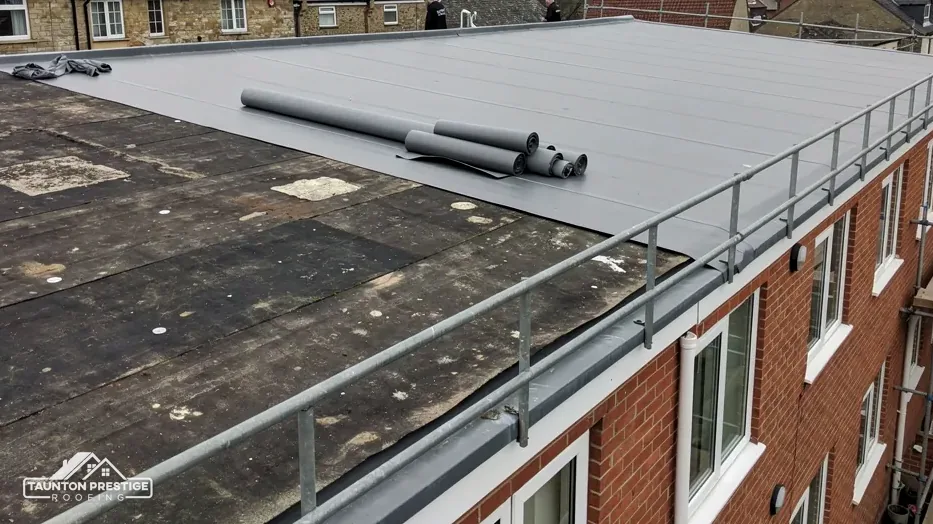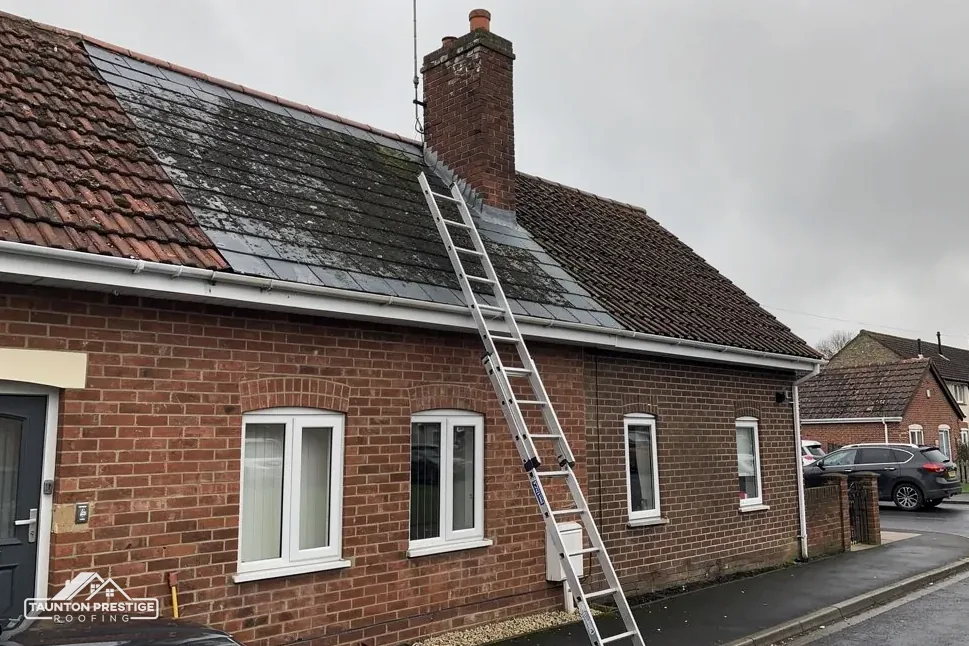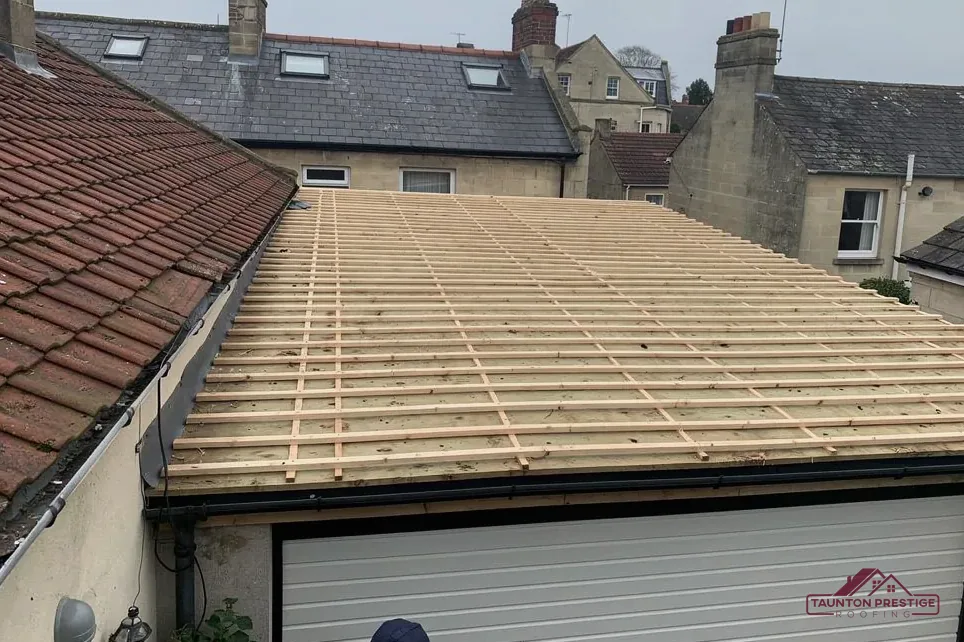
Drive out of Taunton in almost any direction and you pass farm buildings under grey corrugated roofs that have been there for generations. Some of those sheets are asbestos cement, a material made from cement reinforced with asbestos fibre and sold for sheds, barns and workshops for much of the last century. HSE's advice is plain: treat anything from before 2000 as suspect and assume asbestos is in it. When a roof like that starts to leak or sag, the owner faces two routes. You can overclad it, which means fixing new sheets over the top of the old ones. Or you can strip the old sheets and fit a new roof.
Neither route is a simple swap of one sheet for another. Each one changes who handles the material, what paperwork follows it and how the work is planned around stock, machinery and people. This post sets out how HSE sorts the work, what makes these roofs dangerous to stand on, how the waste has to travel, and the questions that decide which route suits a farm shed, a yard building or an estate outbuilding. It sits under our commercial roofing work for farms and business units.
Is the old roof sheeting asbestos at all?
You cannot tell by looking. Asbestos cement and the fibre cement that replaced it look alike from the ground: pale grey, corrugated, often with lichen across the high spots. HSE's rule of thumb is to treat anything from before 2000 as holding asbestos until a survey proves otherwise. MyJobQuote puts an asbestos survey at around £325, a typical UK price (Sep 2026), which is small beside the cost of a roof job that has to stop halfway while a sample result comes back.
What does a survey tell you?
A surveyor takes small samples from the sheets, and from anything else suspect such as flue pipes, rainwater goods and soffits, and sends them to a laboratory. The report names the material, says where it sits and describes its condition. That report then shapes everything else: the method, the waste route and the order of work.
Can you rely on the paint or the age?
No. Sheets get repainted, patched and extended. A barn may carry original sheets on one slope and newer fibre cement on the other, and rooflights, ridge pieces and gutter brackets may be a third material again. Treat every unmarked piece as unknown until the report says otherwise.
Modern fibre cement sheets contain no asbestos, but only the laboratory can say which one you have. If the farm has a mix of buildings put up in different eras, ask for one survey that covers every roof, so the work is not stopping and restarting each time another shed turns up. It also gives you a single report to keep with the deeds and hand to any contractor who comes onto the holding afterwards.
Why asbestos cement roofs are always fragile
HSE's guidance A14 says it flatly: "AC roofs are always fragile". Age and weathering make it worse, not better. Moss and lichen hide cracks, and the sheets sit on purlins, the horizontal timber or steel rails that carry them, which can be a long way apart. A person stepping between purlins can go straight through.
Rooflights in the same roof are often more fragile still, and a rooflight painted over by weathering looks like sheet. Nobody should walk on a roof of this kind to look at it, take a photograph or clear a gutter. The work is done from crawl boards that spread the load, from a mobile platform at the eaves, or from below, with edge protection and a plan agreed before anyone goes up.
Does an owner need to stay off the roof too?
Yes. Farmers and estate managers are used to climbing on buildings to fix a loose sheet, and it is the habit that causes the falls. If a sheet has lifted in a gale, tie off the area from the ground, keep animals and vehicles away from the drop zone underneath, and call for a proper assessment.
The same fragility affects the repairs people try first. A patch screwed down from above, or a sheet of ply laid across a gap, still needs someone to stand on the roof. That is why our page on the fragile asbestos cement roof treats access as the first question and the repair as the second.
Licensed, non-licensed or notifiable: how HSE sorts the work
HSE sorts asbestos work into three bands, and the band depends on the material and on what happens to it. Careful removal of asbestos cement, such as roof sheeting and rainwater goods, is non-licensed work. HSE says this includes asbestos cement which is weathered but not otherwise substantially damaged. The condition is that the material is carefully handled and removed without breaking up.
What turns it into notifiable work?
If the plan involves breaking the sheets up or leaving them badly damaged, HSE treats it as notifiable non-licensed work. The example it gives is dropping an asbestos cement roof, which creates significant quantities of dust and debris. The contractor notifies the enforcing authority before the job starts, and registers of the work, which act as health records, must be kept for 40 years.
Where do licences come in?
Licensable work covers asbestos insulating board where the risk assessment says the job will not be of short duration. On a farm that matters because AIB, a board made from asbestos fibre, turns up in external soffits and linings of older buildings, and by eye it can be difficult to tell from non-asbestos board. So we do not assume soffits are in the easy group. If a roof job reaches AIB, it is checked against HSE's rules first, and any licensable part goes to a contractor who holds that licence.
In practice the sorting happens before pricing. The survey says what is there, the method says whether sheets come off whole, and the group follows from that. Any gutters, flue pipes or lean-to roofs on the same building get the same treatment, because they often prove to be something other than the main sheets.
Overcladding: what it solves and what it leaves behind
Overcladding means fixing a new roof covering, usually profiled metal or fibre-free sheeting, over the existing sheets. Its appeal is real. The old sheets are not broken up or lifted, so dust and waste are far less of an issue, the building keeps its weather protection throughout, and stock or machinery below can often stay where it is.
What are the catches?
The asbestos is still there. It is now hidden under a new skin, so whoever owns the building next, or whoever demolishes it, has to be told. Keep the survey report, a record of what was fixed where, and photographs, and hand them over with the deeds.
The new fixings also have to go somewhere, and each one is a hole or a bearing point on a brittle old sheet. Depending on the system, they may pass through or alongside the old sheets, and that is a question for the survey and the risk assessment before anyone orders material, not for the day on site. The structure carries extra weight too: purlins that were sized for one layer may need checking. For houses, the Planning Portal suggests having the weight of a new covering looked at by someone qualified, and a farm building deserves the same care.
When does overcladding stop making sense?
When the old sheets are cracked through, when the purlins are corroded or rotten, or when the owner plans to demolish or extend within a few years. In those cases the extra layer postpones the problem and makes removal harder later. Our answer on roof overcladding covers the principles in a shorter form.
Replacing the sheets and getting the waste away
Full replacement is the cleaner answer for the long term, because the asbestos leaves the site. It asks more of the plan. The sheets come off whole where the method allows, they are handled without breaking, and they are double-wrapped and labelled, as HSE's EM9 guidance puts it for asbestos waste. Nothing goes in an ordinary skip.
How does asbestos waste travel?
It travels with a hazardous waste consignment note. The household exemption for hazardous waste explicitly excludes asbestos, so a farm cannot simply load sheets onto a trailer and take them to a tip. The carrier must hold an upper-tier waste carrier registration, and the receiving site must be permitted for the material. You keep the paperwork as proof of where the roof ended up.
MyJobQuote's average cost of taking off an asbestos roof comes to around £2,750 (Sep 2026). That is a typical UK price for a modest roof, so a long cattle shed or a large grain store will sit well above it. What moves the price is area, height, the number of sheets that come off whole, the distance to the disposal site and whether the building is in use.
What goes on in its place?
A new profiled metal roof on new or checked purlins is the usual choice, often with an insulated lining where the building holds animals or crops. Our answer on asbestos roof sheet disposal covers the waste route in more detail. Before any new sheet is ordered, the purlins are checked for rot or rust and replaced where they have gone, since a new roof is only as sound as the frame it sits on.
Planning the job around a working farm
A farm roof is rarely an empty building, and the people who use it every day know its quirks better than anyone. There may be cattle, feed stores, machinery, hay or grain below, and the yard may be the only route through the holding. The plan has to say which areas are cleared and when, where the exclusion zone sits and how the laid-out sheets are stored before collection.
Who needs to know before work starts?
The owner and any tenant, the farm manager, anyone who works under the roof and the neighbours if the lane is shared. Notifiable work needs notice to the enforcing authority first, which the contractor arranges. Where the building is a listed barn, in a conservation area or within Exmoor National Park, ask the planning team before any change to the roof's appearance. Somerset Council covers most of the district, and Exmoor National Park Authority acts as the planning authority within the Park boundary.
What about the new roof's own rules?
Building Regulations may apply to a replacement roof, and Somerset Building Control is the place to ask: 0300 303 7790. A new metal roof also affects condensation, rooflights and rainwater, so decide those with the sheets, not afterwards.
Before you ask for prices, gather the survey report, the dimensions of each roof slope, a note of what stands beneath, and where lorries and a cherry picker or platform can reach. The more the survey shows, the less a quote has to guess.
The same planning questions come up on any commercial roofing project, whether the building is a shed or a shop.
Questions from farm owners
Can a leaking asbestos cement sheet be patched?
A patch means someone working on or near a fragile surface, and any drilling or cutting can release fibre. Cover the area below, keep people and stock away, and have the roof assessed first. Often the cleaner choice is to replace the failed sheet whole, or to plan the overcladding or strip-out for the whole slope.
Do I need to tell anyone before removing the roof?
Lifting whole sheets off with care is non-licensed work. Where sheets are to be substantially broken up, the work becomes notifiable and the contractor tells the enforcing authority beforehand. Soffits and linings in AIB are checked against HSE's rules first, because some of that work is licensable. Your contractor should explain which group applies.
Does sound asbestos cement have to come off?
Sound sheets that nobody disturbs are a common situation, and the danger comes from damage, drilling and falls. HSE's advice is to assume asbestos in older buildings, record where it is and stop anyone drilling, cutting or walking on it. When the roof fails or the building changes use, the decision comes back.
More on this subject: Commercial roofing in Taunton