A little water on a flat roof for an hour after a shower is normal. Standing water that is still there the next morning, or that leaves a tide-mark ring on the surface, is something else. It means the roof is not shedding water the way it was designed to, and the cause is usually in the shape of the roof or in the outlets, not in the waterproof layer itself.
Ponding matters because a flat roof covering is under water for longer than it was designed to be. Dirt collects, algae grows, seams soften and ice forms in winter. It is rarely the first cause of a leak, but it speeds up other failures. This post explains why ponds form, what the current British Standard says about falls, how outlets and gutters affect the result, and where Somerset's weather fits in, using only Environment Agency and GOV.UK facts. We finish with the fixes, from clearing a gully to re-laying a roof with tapered insulation, with typical UK costs from two named cost guides.
What ponding is and when it matters
Ponding means pooled water that the surface has failed to send to an outlet or gutter. It is common on roofs that are almost level, where a slight dip is enough to hold a pool. It happens on every type of covering, from felt to EPDM to GRP.
Is a puddle always a problem?
Not always. A shallow film that evaporates within a short spell of dry weather is a nuisance, and many roofs show it. A deep pool that stays for days, comes back in the same place every time it rains, or has left a ring of dirt and algae behind needs attention. The pool is telling you where the surface is lowest, and that place deserves a closer look.
What harm can it do?
The waterproof layer sits in water for far longer than the designer allowed for, so seams, laps and trims are tested constantly. In winter the water freezes and expands in any small gap. Weight matters as well, since a big pond loads a deck that could already be sagging. A deck that dips under the pool will dip further the next time.
Can you see it from the ground?
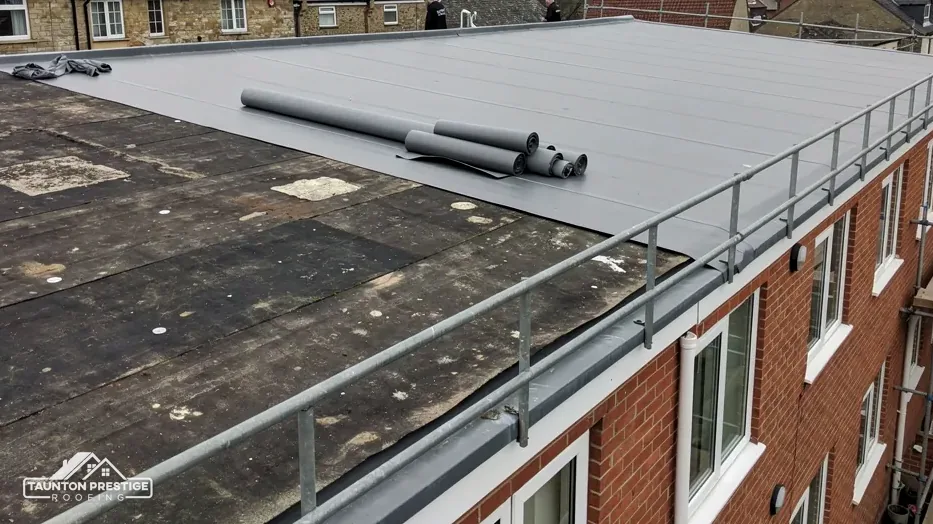
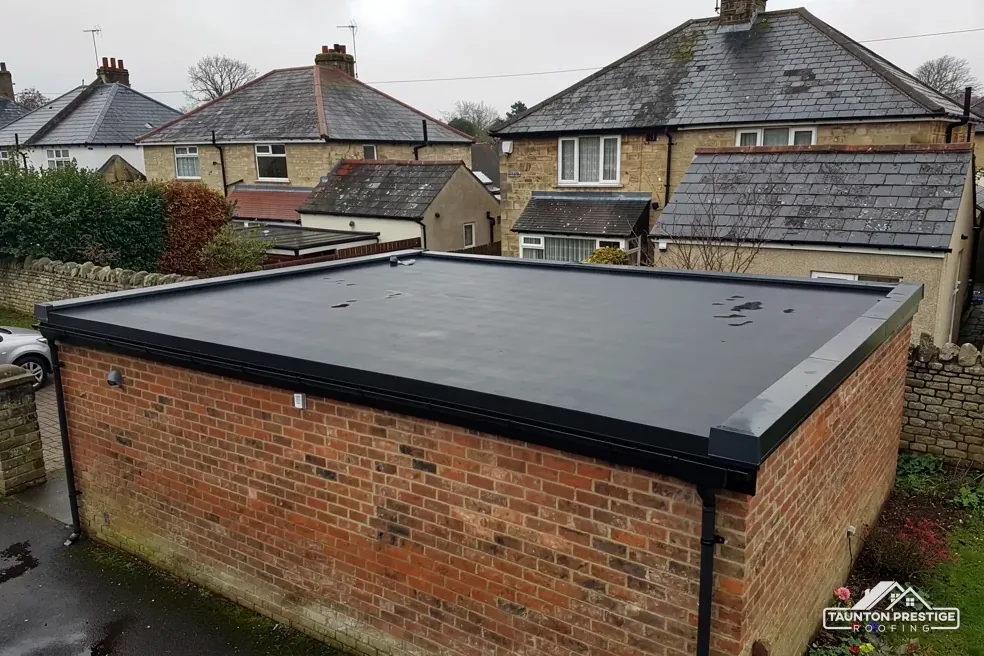
Often you cannot, which is why ponds go unnoticed. From an upstairs window, or a neighbour's, you may see a shine where the roof reflects the sky. Take a photo after rain and compare it a day later. A level and a straight edge let a roofer measure the fall, and the survey photos show the result. Our flat roofing page explains how we survey one.
Why water ponds in the first place
Water stays where there is nowhere lower to go. That sounds simple, but the reasons the lowest point is in the wrong place are several, and each needs a different fix.
Is the roof simply too flat?
The commonest cause is a fall that was never enough. A roof built almost level has no margin. A small sag in a joist or a thick patch of adhesive is enough to hold water. This is where the standard's design figure matters, and the next section covers it.
Has the deck moved?
Timber decks flex over time. Boards bow, joists deflect under load, or the structure beneath settles. A roof that drained when it was new can slowly develop a dip in the middle of a span. Rot below a pond is another cause.
Are the outlets in the wrong place?
An outlet set above the lowest point of the roof will never drain it. This can result from a roof relaid over old boards without adjusting the outlet, or from an outlet that was fixed to the deck and then covered by an extra layer of insulation. The outlet needs to be at the low point, not near it.
Has the build-up changed?
Extra layers of felt, an overlay or thicker insulation can reduce the fall at the edge of the roof or bury the outlet. Tapered insulation, which is cut in slopes so that its thickness changes across the roof, is the usual way to create a fall where the deck is level. This is the usual way to build in a fall over a level deck.
Falls: 1:80 finished, 1:40 to design
A fall is the slope of a flat roof expressed as a ratio. A fall of 1:80 means the roof drops one unit for every 80 units of run. It is gentle enough to look flat, and steep enough to move water.
What does BS 6229:2025 say?
BS 6229:2025 is the current British Standard for flat roofs whose waterproof layer is flexible and supported along its whole area, which means membranes laid over a full deck. It applies to roofs with a pitch of up to 10 degrees. It replaced BS 6229:2018, which BSI shows as withdrawn on 16 December 2025. It keeps 1:80 as the minimum finished fall, both for the main roof areas and for internal gutters. Lead is outside its scope.
Why design to 1:40 if 1:80 is the minimum?
Because building work is never exact. Single-ply maker IKO, writing about the 2018 edition, advises designing a roof for a fall of 1:40. The reason is simple: if the roof is designed to 1:40 and then loses some of that to deflection and tolerances, the finished fall still reaches 1:80. A roof designed to exactly 1:80 can fall short in places.
How do you tell what yours has?
You cannot judge a fall by eye. A roofer measures it with a spirit level and a long straight edge, or a laser level, and records the result. If the roof is below the minimum, the options are to add a fall with tapered insulation or firrings, which are timber strips laid to create a slope, or to relay the deck. Our answer on the flat roof minimum fall explains the options in more detail.
The standard sets the target for new work. An older roof that falls short may still perform if it is otherwise sound.
Outlets, gutters and blockages
Even a roof with a good fall will pond if the outlet is blocked or too small. The outlet is the weak link between the roof and the drainage system, and it is the part owners can check without climbing anywhere.
What blocks an outlet?
Leaves, moss, grit that washes off the surface, and bird debris. Trees overhanging the roof make it a regular job. A blocked outlet can turn a roof into a shallow tray, and the water rises until it reaches an edge or finds a seam. Our answer on a blocked flat roof outlet shows the signs.
What about the gutter?
Many flat roofs drain into a gutter along one edge, and the gutter has its own fall. Brett Martin, a gutter manufacturer, advises 1 mm of fall for every 600 mm of run. If the gutter sags or the brackets have slipped, water collects in the low section and backs up onto the roof. Internal gutters, which are set into the roof itself, fall under the same 1:80 minimum in BS 6229:2025.
Is it a job for a roofer or the owner?
Clearing leaves from an outlet within reach, in dry weather, from a safe position, is a fair thing for an owner to do. Anything that involves going onto the roof, resetting an outlet or re-fixing a gutter is for a roofer. A flat roof can be slippery with algae and has no edge protection of its own, so do not step onto one to clear it.
After a clear-out, watch the roof through the next heavy shower. If the pool forms in the same place, the outlet was not the main cause.
Somerset's wet weather, in official terms
Somerset has a reputation for water, and some of it is earned. The point of this section is to say what official sources state and to be clear about what they do not tell us about a roof.
What do the Environment Agency and GOV.UK say?
The Environment Agency's Levels and Moors publication on GOV.UK calls them one of the UK's lowest areas, with 18% of Somerset under average tide level, and says flooding records there reach back to the 1600s. It also says that major incidents were declared in Somerset because of flooding in 2023 and 2026, and that the Agency runs 21 permanent pumping stations serving the Levels and Moors.
Does that mean Taunton roofs pond more?
No. Those facts describe rivers, tides and land levels. They say nothing about how water behaves on a particular roof, and how a roof drains is set by its fall and its outlets, wherever it stands. What the facts do suggest is that a county with this history will give a poorly drained roof plenty of wet weather to expose its faults.
How do you check your own flood risk?
GOV.UK offers long-term flood risk checks by postcode, and a separate page for warnings that are live now. Use those for ground-level questions, and keep this post for the roof. If rainwater is also overflowing at ground level, tell your roofer, because blocked rainwater pipes that discharge to a drain can back up in a downpour.
Ice is the other Somerset factor. A winter pond that freezes and thaws repeatedly will open weak seams faster than a summer pool.
Fixes, costs and when to replace
The right fix depends on the cause, and the survey is what identifies it. Fixes run from simple to substantial.
What are the options?
The simplest is to clear and test the outlet. If the pool persists, an extra outlet or one moved to the low point may be the answer. Where the deck is sound but the fall is poor, a new covering over tapered insulation adds the fall. Where the deck has failed, it must be replaced before anything is laid on it. A small localised dip can sometimes be built up, though that is a short-term measure.
What does it cost?
Costs vary widely with the cause. MyJobQuote's flat roof guide (October 2026) gave a typical UK range of £1,500 to £6,000 for replacing a flat roof, averaging £2,400. Less, in a guide updated on 26 October 2026, gave £1,200 to £2,500 for a 15 square metre garage roof. A clogged outlet clearance is a fraction of that. Ask whether any quote includes VAT, deck repairs and new trims.
When is repair the wrong answer?
If the deck is soft, the covering has failed at many seams, or the fall is far below the standard, patching treats the symptoms. A good survey tells you which side of that boundary your roof sits, and shows you the photos. Our post on flat roof materials compared helps with the choice of covering once a replacement is decided.
If you think your roof is ponding, send photos taken a day after rain through the enquiry form, and tell us roughly how big the roof is.
Ponding questions
How long can water sit on a flat roof before it is a problem?
No fixed time applies. What matters is whether the pool recurs in the same spot, stays long after other parts have dried, or leaves a ring of dirt and algae. Those signs mean the fall or an outlet needs checking, even if the roof is not yet leaking.
Does BS 6229:2025 mean my old flat roof is wrong?
Not necessarily. That standard works as a code of practice for new and renewed work, with a minimum finished fall of 1:80. An older roof may still shed water well. A survey measures the fall and the outlets, and tells you whether a repair or a re-lay makes sense.
Can I clear the outlet myself?
If you can reach it from a window or a safe, fixed position in dry weather, removing leaves is reasonable. Stay off the flat roof while you do it, because algae and wet surfaces are slippery and there is rarely an edge guard. If water still pools after clearing, call a roofer.
More on this subject: Flat roofing in Taunton