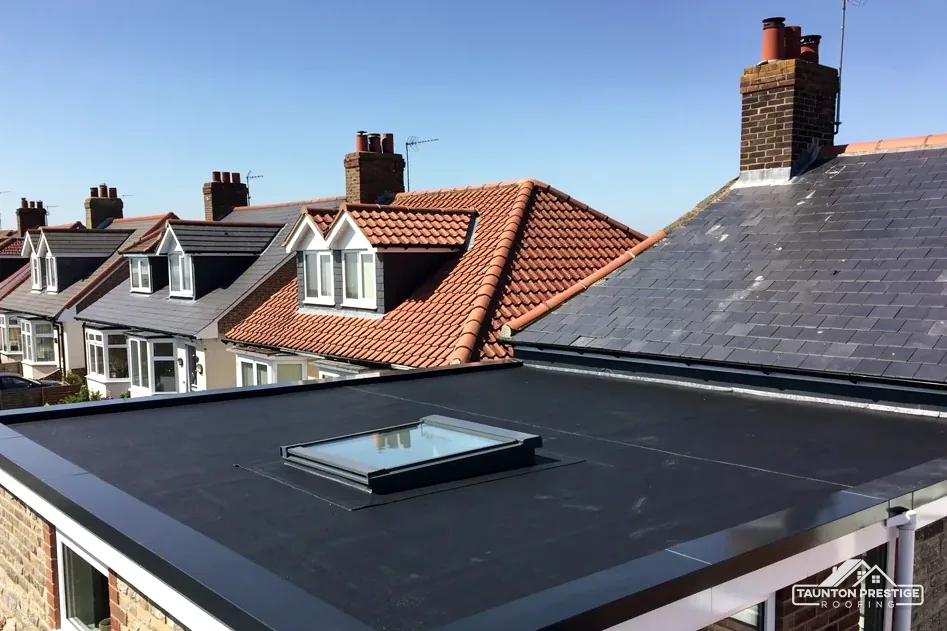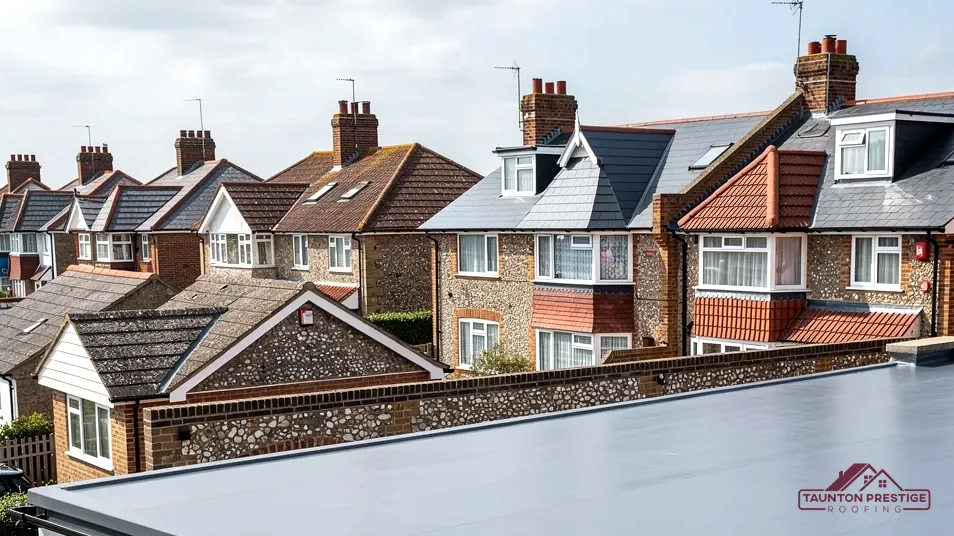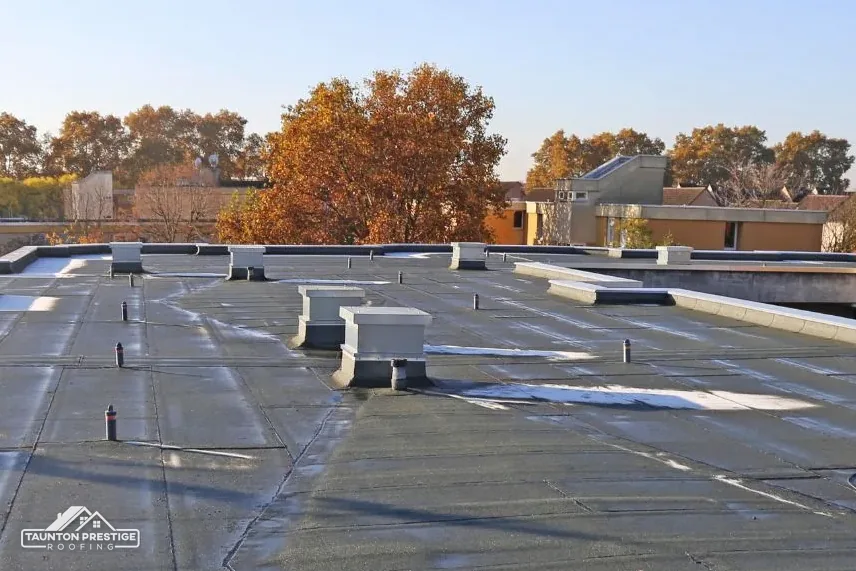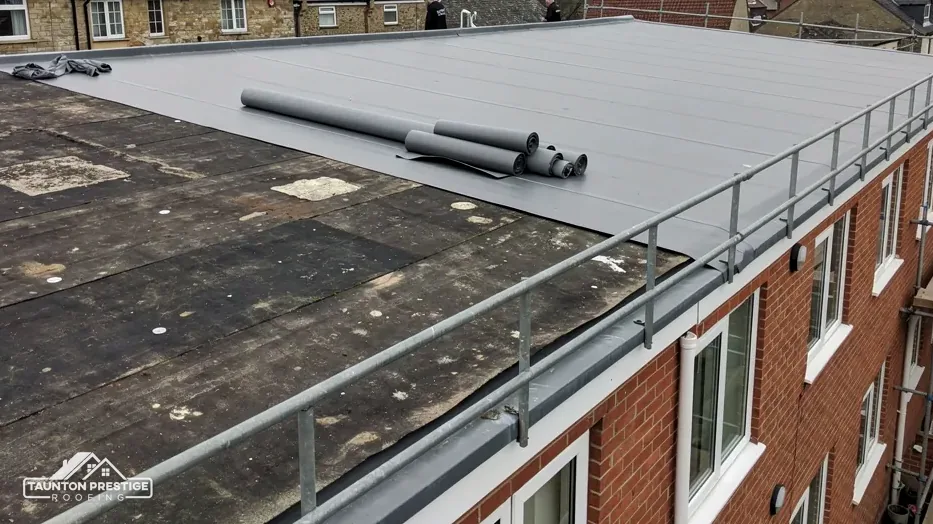
Ask three people what a new flat roof costs and you will get three answers, and all of them can be honest. A flat garage roof and a flat extension roof are different jobs, and a rubber membrane is priced differently from torch-on felt. The size matters, but so do the deck beneath, the edges around it and how easily materials can get onto the roof. Anyone who names a price without seeing the roof is guessing.
Instead of a single headline number, this guide gives the published UK ranges from named cost guides, with their dates, and then explains what moves a roof within them. They are national figures, not Taunton Prestige prices, and a quote for your own roof only exists once the roof has been surveyed. We cover the EPDM and felt figures, the garage example, scaffold, insulation, and what a fair written quote should state. It sits within our wider flat roofing work across Taunton and its villages, where a survey comes before any price.
What the published UK guides say
MyJobQuote, in a guide updated in October 2026, puts a flat roof replacement at between £1,500 and £6,000, with an average of £2,400. That is a wide spread, and it is wide for good reason: it mixes small porch roofs with large extension roofs, and basic coverings with insulated ones.
A second source gives a narrower picture for one common job. Less, in a guide updated on 26 October 2026, quotes £1,200 to £2,500 for a 15 m² garage roof. Elsewhere that guide gives published lifespans for the main coverings: EPDM 30 to 50 years, GRP 25 to 40 years, and torch-on felt 10 to 20 years, and adds that felt laid carefully can reach 20 years, whereas a poor installation may fail in under 10.
Why is the range so wide?
A figure per roof hides everything that matters: how big it is, what it is made of and how much has to be done to the structure under it. A small, sound deck with a single run of edge trim sits at the low end. A roof with a rotten deck, a long wall abutment, a rooflight and an outlet moved to the other side sits near the top. Treat the published range as a guide to scale and not a prediction for your house. Compare like with like when you read any figure: the same covering, the same insulation build-up and the same area, or the numbers tell you very little.
It also helps to remember that cost guides are compiled from many jobs across the country. Labour rates, access and the age of the housing stock differ from one county to the next, so a Somerset roof can land above or below the national average without anything being wrong with the quote.
None of these numbers is a Taunton Prestige price. They are there so you can sense-check any quote you receive, ours included.
What EPDM and felt cost
The two coverings homeowners ask about most are rubber and felt, and the published guides treat them differently.
For EPDM, MyJobQuote (Oct 2026) prices rubber roofing at about £60 per square metre, with £1,050 as the average for a finished job. The sheet is laid as one piece on small roofs, so there are fewer seams and less labour on the main area. The edges, the corners and the trims are still where the time goes. Our guide to EPDM rubber roof installation follows the work step by step.
For felt, the same guide (updated 14 October 2026) gives an average of around £1,500, and £1,200 to £1,800 for a 15 m² garage in SBS felt, a bitumen felt modified with a rubber-like polymer to stay flexible. Torch-on felt is laid in layers and sealed by heating the underside with a flame, which is why the roofer's skill, and a careful approach to fire risk near timber, matter. Our page on torch-on felt roofs explains the layers.
Is the cheaper covering the better buy?
Not automatically. A lower first cost with a shorter published lifespan can work out dearer over the years than a higher first cost that lasts longer. Those lifespans are published ranges, and a given roof can fall short of them or beat them. Edge details, drainage and the deck decide the outcome as much as the sheet does. GRP, a glass-reinforced plastic laid in liquid form, varies with the roof and the system, so ask for it to be priced on yours.
Garage roofs, porches and small flat roofs
Small roofs are where per-square-metre rates mislead. A garage, porch or bay roof has the same trims, upstands and outlets as a large one, packed into a fraction of the area, so the fixed parts of the job take a larger share.
MyJobQuote (26 October 2026) gives a garage roof replacement at between £750 and £3,500, with an average of £1,500. The upper end reflects a larger garage, an insulated build-up or deck repairs. A basic covering on a sound deck sits at the lower end.
Does an old asbestos or concrete garage roof change the picture?
It can. Many older garages have asbestos-cement sheet roofs, and that is a different job from a flat roof with a membrane. Asbestos cement can be removed as non-licensed work if it is handled carefully without breaking it up, but breaking it up substantially makes the work notifiable. Waste travels on a consignment note and cannot go in a skip. If your garage was built or refurbished before 2000, assume it could contain asbestos until it has been checked. The garage and asbestos roofs part of our site explains the options, and the price of that work is set after the roof is inspected.
For a porch or small extension with a flat roof over a sound timber deck, replacement is a more straightforward job and the cost sits at the lower end of the published range.
What moves the price of your flat roof?
Once you have the published ranges as a backdrop, the factors that pull a specific roof up or down are fairly consistent.
- The area, and the number of edges, corners, upstands and outlets within it.
- The covering chosen, and the quality of the system within that covering.
- The condition of the deck: sound boards stay, rotten ones and damaged joists are replaced.
- Insulation. A new membrane is treated as renovation under Part L, which brings an insulation upgrade into the job. A warm roof puts the insulation on top of the deck and a cold roof leaves a ventilated gap beneath it, so the choice changes both the materials and the build height.
- Falls. If the deck does not drain properly, tapered insulation or timber firrings are added to correct it.
- Access: a ground-floor extension is simpler than a dormer or a roof over a first-floor room.
What does scaffold do to the total?
The height and the number of sides that need it decide that. HomeBuilding (Sep 2025) gives approximately £1,000 for scaffolding a three-bed semi once the permits are counted, and MyJobQuote (Oct 2026) gives £550 to £750 for a week of scaffold on a front elevation. A low single-storey flat roof may need little or none, while a roof over a first-floor room usually does. Scaffolding that blocks the pavement or road has to be licensed. Somerset Council sets its rules so that licences go only to accredited firms, with the appointed contractor filing the application.
Our guides on warm roof versus cold roof and flat roof building regulations cover the insulation and approval points that can change the scope.
What a fair written quote looks like
Cost guides are useful for scale. They cannot tell you what to expect for your house, because the answer depends on what is under the old covering. The quote is where that becomes concrete.
A quote worth accepting is on paper and gives a single sum for everything. It says which covering is being laid and over what: the deck, the insulation and the fall. It says what happens to the old roof and the waste. It says whether VAT is included, which matters because VAT at the standard rate of 20 per cent applies to roofing work on an existing house, and whether scaffold is included. It names the edges and trims, and it says what the roofer will do if the deck turns out worse than it looked.
How do you compare two flat roof quotes?
Put the covering side by side first, then the insulation, then the deck work, and then check what each total includes. A lower total that leaves out VAT, scaffold or deck repairs is not a lower price at all. Citizens Advice suggests getting several written quotes for building work where you can, so you have something to compare.
Be wary of a price given over the phone for a roof nobody has seen, and of a quote that cannot say what happens if rot is found. Ask how payment is arranged too: a deposit for materials can be reasonable, but a request for most of the money before any work starts is a reason to pause. Photos of the existing roof and deck, taken on site, are a fair thing to ask for from any roofer.
Repair, overlay or replace?
Replacement is not always the right answer, and a good roofer will say so. A flat roof with one failed seam or a split in a trim may be a repair job, as our page on flat roof patch repairs explains. A repair is cheaper than a new roof for as long as the rest of the covering and the deck are sound.
When does replacement become the better buy?
When the covering is blistering or cracking across much of the surface, when water is getting into the deck and insulation, when previous repairs have started to outnumber the original surface, or when the covering has used up most of the life the guides give it. At that point each repair buys less time, and you pay for scaffold and a roofer's visit again each time. The decision rests on the condition of the deck, which only a survey shows. On a flat roof that has been patched more than once, the deck underneath is usually the part worth looking at, because repeated leaks can soften boards and rot the joists without showing at the surface.
Age is a guide, not a verdict. A roof near the published end of its life can still serve for a while if the deck is dry and the seams are sound, and a young roof with a poor fall can fail early. The survey weighs those against each other.
Overlaying a new covering on an old one is possible in some cases, but it hides the deck and adds weight, and it can trap moisture. Our answer on overlaying a flat roof covers when it makes sense.
A survey comes first here: you see photos of your roof and deck, hear whether repair or replacement is the better value, and receive one written total with VAT and scaffold stated.
Flat roof price questions
What is the typical UK range for a new flat roof?
MyJobQuote (Oct 2026) lists £1,500 to £6,000 for a replacement flat roof, £2,400 on average. Less (26 Oct 2026) gives £1,200 to £2,500 for a 15 m² garage. These are national guides rather than local prices, and what your own roof costs is settled by the survey and whatever it finds.
Is EPDM dearer than felt?
On the published figures they sit close. MyJobQuote (Oct 2026) gives around £60 per square metre for EPDM and an average of around £1,500 for a felt roof. Which one costs more on your roof depends on the area, the edges and the deck, so compare totals with the same insulation and VAT basis.
Does a flat roof quote include scaffold and VAT?
Only if it says so. Ask each firm to state both in the written total. VAT at the standard 20 per cent applies to roofing on an existing house, and scaffold depends on the height and the access. A total that leaves them out is not comparable with one that includes them.
More on this subject: Flat roofing in Taunton