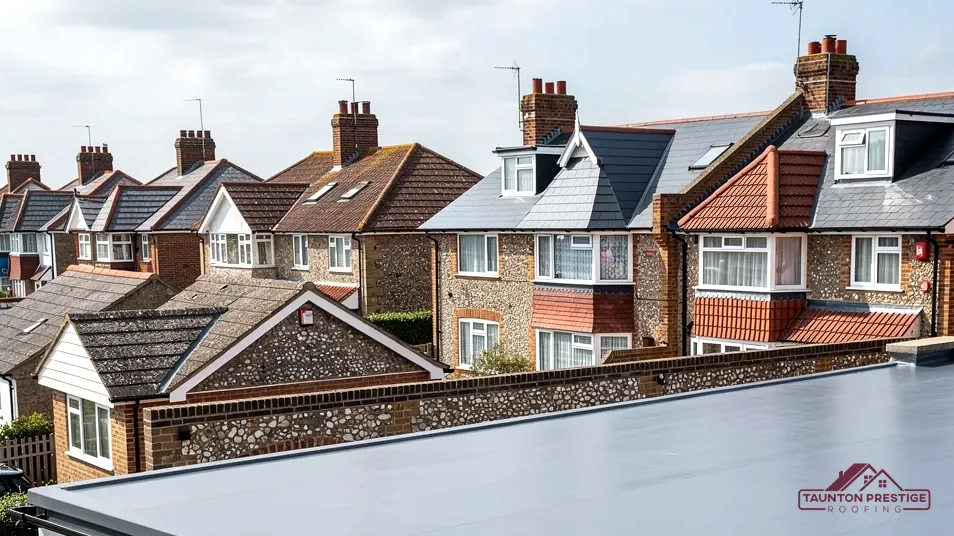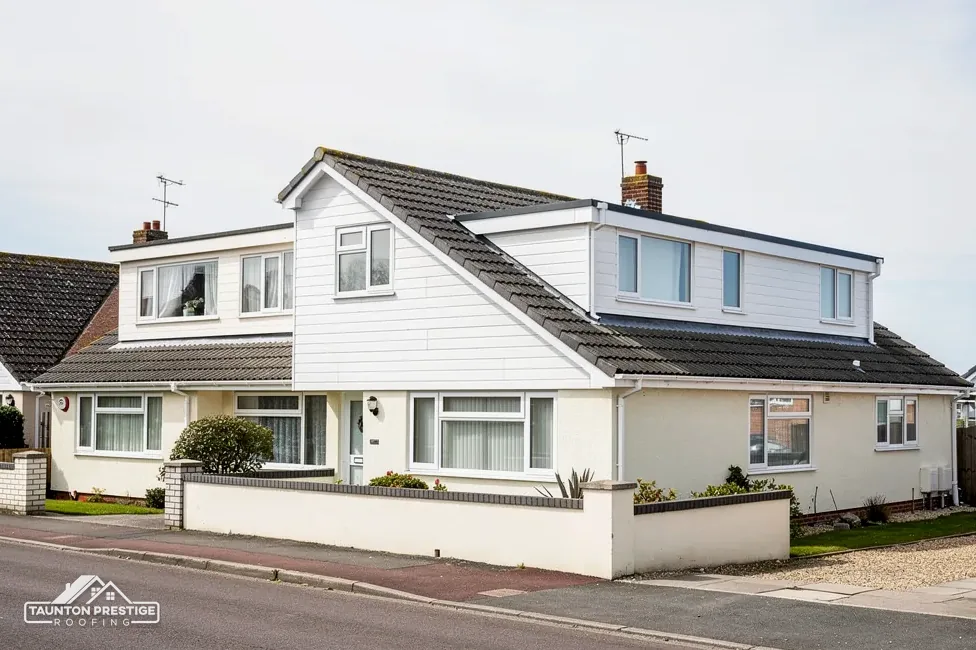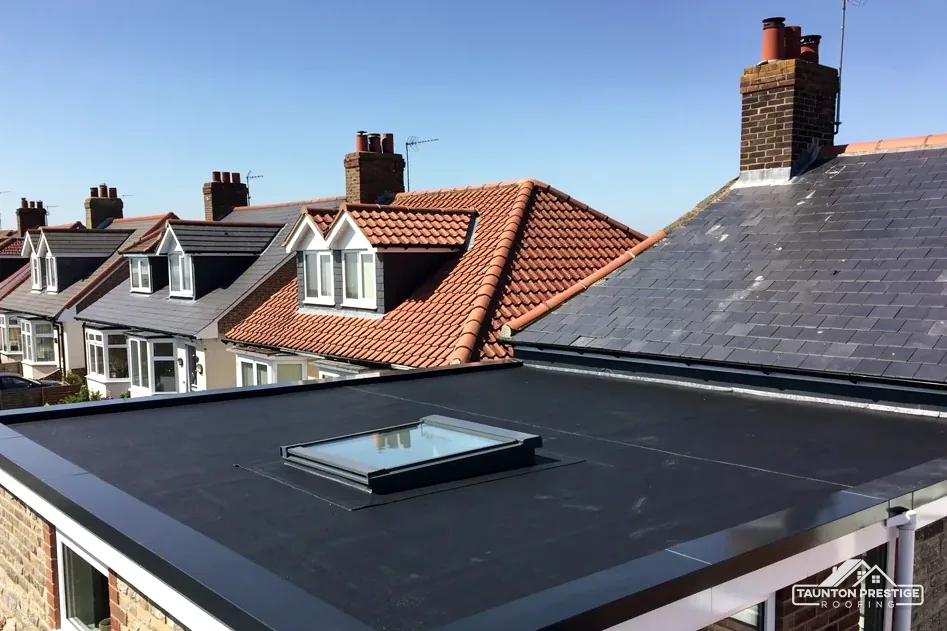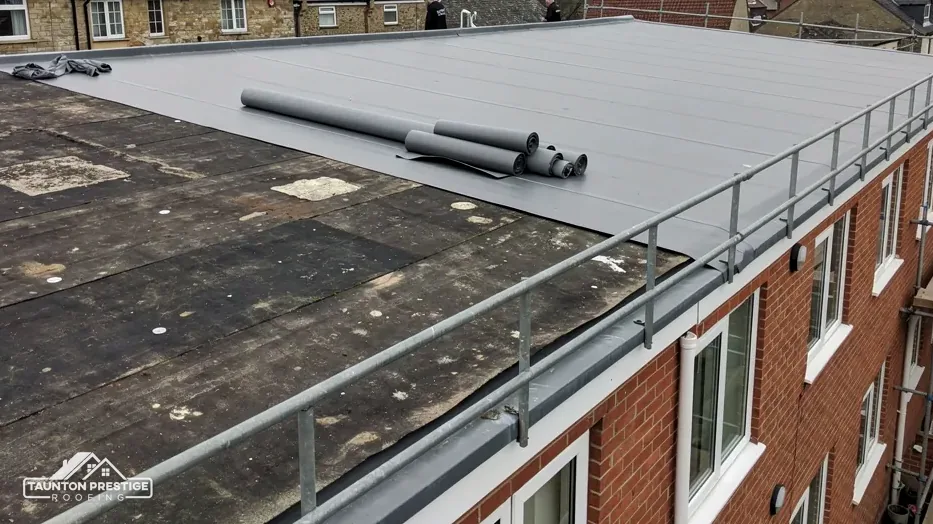
EPDM is a synthetic rubber, and a flat roof covered in it is often called a rubber roof. The name stands for ethylene propylene diene monomer, which tells you very little. What matters on a garage, a porch or a rear extension is that the covering arrives on a roll, is cut to the size of the roof and laid as a single sheet, so there are no seams across the middle of the main area where water usually finds its way in.
That simplicity makes a rubber roof look like an easy job. In practice, the quality of the finished roof depends on the deck underneath, the adhesive, the detail at every edge and the way the water leaves. This guide follows an installation in the order the work happens: preparing the deck, laying and bonding the sheet, forming the upstands and corners, fitting the trims and outlets, and checking the finish. It also covers lifespan figures and typical UK pricing. It sits alongside the rest of our flat roofing advice for Taunton and Somerset.
Preparing the deck before any rubber goes down
A rubber membrane takes the shape of whatever lies beneath it, so the deck decides how the roof looks and drains for the next few decades. A deck is the structural surface of the flat roof, normally plywood or OSB board on timber joists. Before laying starts it is checked for rot, soft patches, loose boards and protruding nails.
On a replacement, the old covering comes off first where it can. Felt, in particular, is stripped back to the deck so any damp timber is seen and put right. Leaving a failed layer underneath traps moisture, which spoils the bond of the adhesive and can rot the boards from the inside.
Does the fall get checked at this stage?
It should. A flat roof needs a slope so water runs off, and EPDM is no exception. The current code of practice is BS 6229:2025, which keeps a minimum 1:80 finished fall for general areas, and manufacturers such as IKO advise designing the deck for a fall of 1:40 so the finished roof still clears that mark. If the deck is flat or dips, tapered insulation or firring strips (tapered timbers fixed on top of the joists) are added to create the slope before the membrane is fitted.
Insulation is the other question at this stage. Replacing a flat-roof membrane is counted as renovation under Part L, so a roofer should talk through the build-up, either insulation above the deck under the rubber, or a ventilated cold roof. Our guide on warm roof versus cold roof compares the two.
Laying the sheet and bonding it down
EPDM is supplied in large rolls, and the sheet for a small roof is often cut to cover the whole surface in one piece. That is the main selling point: with no joins across the main area, the common weakness of felt and some other systems is simply not present. The sheet is rolled out loosely over the deck and left to relax in the open air, which lets creases and curls settle before it is stuck down.
Bonding comes next. The sheet is folded back in halves and a contact adhesive is applied to both the underside of the rubber and the deck, then left to go tacky before the two are pressed together. The adhesive is worked with a roller or brush, and the sheet is smoothed from the middle outwards with a soft broom to push out air.
Can the weather stop the work?
Yes. Contact adhesive needs a dry surface, and rain, damp boards or a heavy dew stop the bond forming. That is why a roofer watches the forecast, covers any open areas before they leave, and does not start more than can be finished and sealed in a working day. Cold air also slows the adhesive, so a bright, still day makes for the best result.
Where a roof is too large for one sheet, two sheets are joined with a purpose-made seam tape or strip. That seam is a part to ask about, since it is the one place on a big EPDM roof where the system relies on a joint made on site. Our answer page on EPDM roof lifespan looks at what affects the life of the sheet and its joints.
Upstands, corners and the edge trims
The field of the roof is the easy part. The edges are where the skill shows. An upstand is a section of the sheet that turns upward against a wall, a dormer cheek or a parapet so water cannot get behind it. At the base of the upstand, the rubber is bonded to the wall as well as the deck and is finished at the top with a flashing or a termination bar, a metal strip that holds the edge.
Corners are shaped from the sheet itself or from pre-formed corner pieces. Folding the rubber to form a corner without cutting or stretching it takes care, since a stressed fold is the likeliest place for a pinhole to appear years later. Pre-formed corners take away some of that guesswork on small roofs.
What do the trims do at the front edge?
At the eaves, a drip edge or fascia trim carries the water from the roof surface into the gutter and stops it creeping back under the sheet. The trim is fixed to the edge of the deck, the rubber is bonded over it and its top edge sealed. Where the roof meets a wall above, the flashing is lead or a prefabricated metal trim let into the wall and folded over the upstand.
Where the wall above is brick, the lead flashing laps over the top of the upstand, so it sheds water onto the membrane and not behind it. Our page on flat roof trims and upstands covers the faults to look for, and the linked page on lead work explains the metal itself.
Outlets, gutters and getting the water off
A rubber roof sheds water well, but only if the water has somewhere to go. On many garages and extensions that means a gutter along the lower edge with the roof draining into it. Others have an outlet, a hole through the roof with a drainage pipe, set into a sump (a shallow dip) in the deck and fitted with a sealed collar that is bonded to the membrane.
Fitting an outlet in a membrane roof is a precise job. The rubber is cut to the outlet flange, bonded to it and sealed around the edge with the product recommended by the sheet manufacturer. Done properly, the joint is watertight and flush, with the surface falling toward the outlet from every side.
Why do some EPDM roofs hold water in puddles?
Puddles are caused by the deck, not the rubber. Boards that sag between joists, a deck laid without a fall, or an outlet fixed above the level of the roof leave water sitting after the rain has stopped. A permanent pond is a sign that the structure needs attention, and the weight of the water adds load to the joists. See our page on blocked flat roof outlets for the clearing job.
Leaves, moss and silt collect at outlets and in gutters, and rubber roofs need an occasional clear-out. Keeping the outlet clear is the most useful thing an owner can do from the ground or an upstairs window, and it costs nothing. If water is still standing at the outlet a day after rain, photograph it and mention it to the roofer, because the cause is usually the level of the outlet or the fall of the deck around it.
How long an EPDM roof is said to last
Published lifespans for EPDM differ, and it helps to see the range rather than a single number. GreenSpec gives an expected service life of 20 to 30 years. The cost guide Less (updated 26 October 2026) says 30 to 50 years. The two sources disagree, so treat either as a typical range and not a promise.
The gap reflects how many things affect a roof in real use. The quality of the deck, the care taken at the joints and corners, how much foot traffic the surface takes, shade from overhanging trees and how clear the outlets are kept all matter. The length of any warranty tells you what a manufacturer or installer will stand behind, which is a different thing from how long the sheet lasts.
What makes a rubber roof fail early?
- A failed seam or a pinhole where the sheet has been stretched at a corner.
- Adhesive that did not bond because the deck was damp or dusty.
- A poorly sealed outlet or upstand that lets water in at the edge.
- Sharp objects, ladders and heavy foot traffic on the surface.
- Standing water over years, which stresses seams and trims.
Our short answer page on how long an EPDM roof lasts gives the sources in a few lines. For this guide the point is simple: the sheet is rarely the part that wears out first. The edges, the outlet and the deck beneath are. When you are shown photos of an installation, ask to see the corners and the outlet close up, since those two details say more about the quality of the work than a wide shot of a smooth black sheet.
What EPDM costs, and what decides the price
MyJobQuote (Oct 2026) gives EPDM at around £60 per square metre, and an average installed rubber roof at £1,050. Both are published UK figures for a typical job, quoted here for scale. On a small roof the per-square-metre rate is only a guide, because the fixed parts of the job, such as the trims, the outlet, the upstands and getting materials onto the roof, take up a larger share of the total.
What moves the figure for your roof?
- The area, and whether one sheet covers it or a seam is needed.
- The state of the deck: sound boards can stay, rotten ones are replaced.
- How many edges, upstands, corners and outlets the roof has.
- The insulation build-up and whether the fall has to be corrected with tapered insulation.
- Access, including scaffold if the roof is high or hard to reach.
Check whether any quote you receive includes VAT, which is charged at the standard 20 per cent on work to an existing home; a total without it reads lower than the bill will be.
A fixed price is only possible once the deck has been seen. We survey first, photograph the existing roof so you can see what is under the old covering, and then send one written price. Any cost per square metre you are quoted over the phone is a starting point only, because corners, trims and access change the total once the roof has been seen. If you are comparing EPDM with felt or GRP, our flat roof replacement cost guide sets the figures side by side, with the published source for each.
Rubber roof questions
How many years can a rubber roof be expected to give?
Published figures differ. GreenSpec gives an expected service life of 20 to 30 years, while Less says 30 to 50 years. Treat both as typical ranges. The deck, the corner details, the outlet and the care taken on site shape how long a given roof lasts, and a guarantee is not a lifespan.
Does old felt have to come off before the rubber goes on?
Usually the old covering is removed so the deck can be checked and the adhesive bonds to clean boards. Laying rubber over failed felt can trap moisture and hide rot. A roofer should look at the deck first and tell you plainly whether stripping is needed on your roof.
Is a rubber roof a job for one day?
A small garage or porch can be bonded in a day when the weather stays dry, but preparation, trims and the finish decide the real time. Adhesive needs dry boards, so a roofer waits for settled weather and covers any open area. The survey sets out the likely programme.
More on this subject: Flat roofing in Taunton