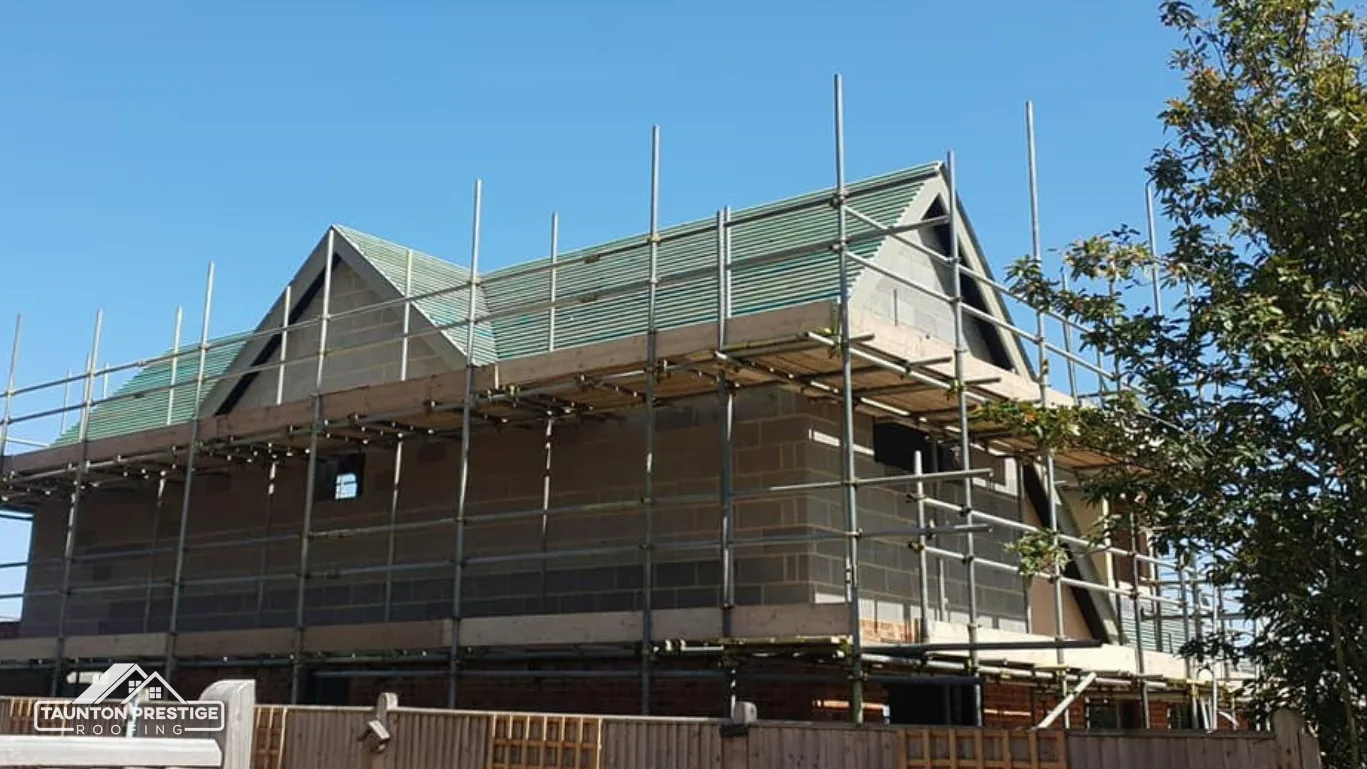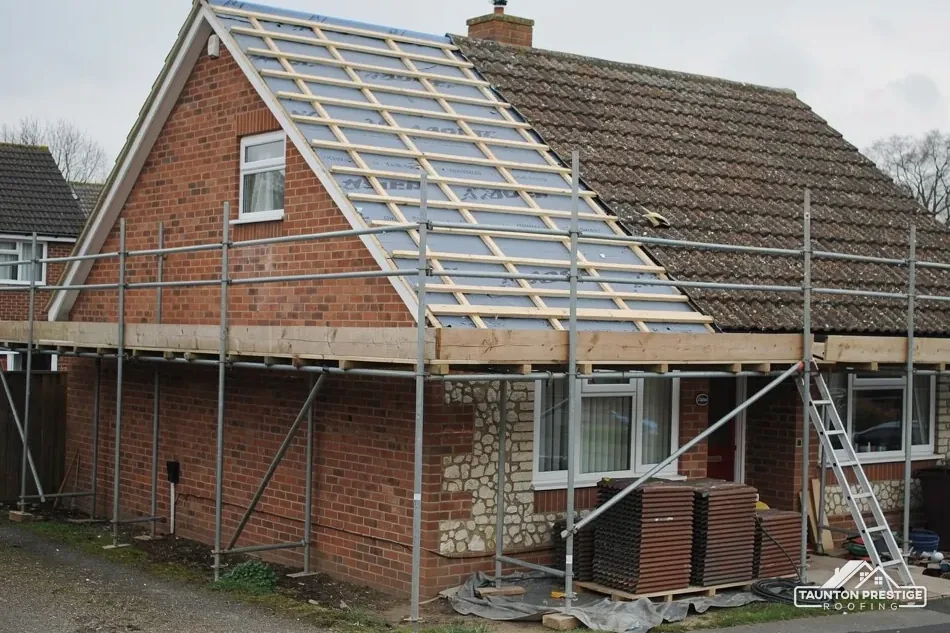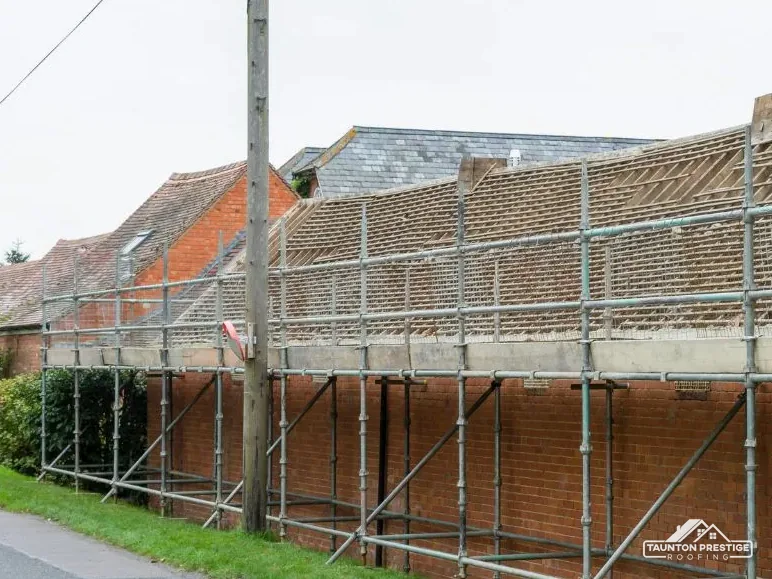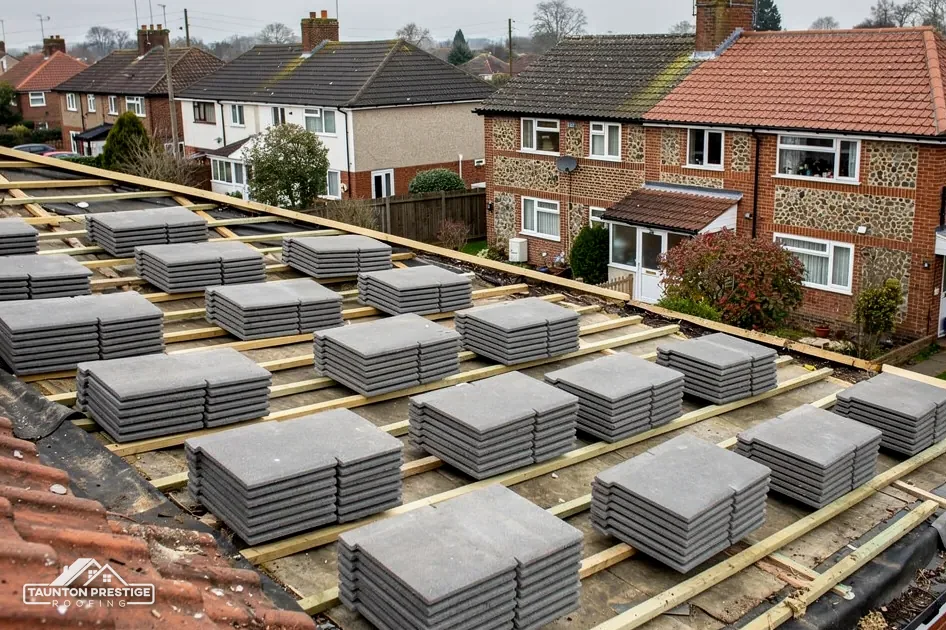
A re-roof starts and ends with the scaffold. Before a single slate is lifted, the roofers need a safe platform at eaves height, edge protection along the gutter line and a way to carry materials up and waste down. For most houses that means a frame of steel tubes standing alongside the walls, and for many Taunton homes part of that frame stands on the public footway or the road edge.
That is where the paperwork and the neighbours come in. A frame over the footway needs a licence, the licence has a fee and a notice period, and the people next door will want to know why it has appeared and how long it is staying. This guide sets out when a re-roof needs scaffolding, what Somerset Council asks for, how party wall rules touch some jobs, and how to talk to your neighbours before the first tube goes up. It sits within our roof replacement work around Taunton.
Do I need scaffolding for a re-roof?
In practice, yes. Stripping and recovering a roof means people working at the edge of a sloping surface with heavy slates or tiles in their hands, and a fall from the eaves of even a modest house can change a life. Scaffolding gives the roofers a level, guarded platform along the whole eaves line and a place to stack material close to where it is needed. A ladder alone does neither.
What does a re-roof scaffold actually include?
The frame runs along each elevation that has a roof edge above it. It carries guard rails and toe boards so nothing rolls off, and it is tied back to the walls so the wind cannot shift it. Where a house has a rear extension, a lower roof or a chimney standing proud, extra lifts are added so the work is reached from a platform rather than from the slope itself.
The scaffold also protects your home. Tiles and slates come off in quantity, and a boarded platform with a catch fence keeps debris off the paths, the conservatory and the car. Gutters and fascia boards, the timber boards behind the gutter, are reached from the same platform, so roofline work can be done in the same visit.
Small jobs differ. A handful of slipped tiles can sometimes be dealt with from a roof ladder and a small access tower, because the crew is at one spot for a short while. When a whole slope comes off, the answer is a full scaffold. We tell you at the survey which kind your roof needs and why, and we show you the access plan before any tubes are ordered.
The frame helps with weather too, because a platform lets the crew cover a stripped area quickly if rain is coming.
The highway licence and who applies for it
Section 169 of the Highways Act 1980 says scaffolding that obstructs a highway may be erected or kept there only with the highway authority's licence. The highway is not only the carriageway. It includes the footway, so a frame that narrows a pavement needs permission before it goes up.
Who applies for the licence in Taunton?
Under Somerset Council's rules, only accredited contractors can obtain a scaffold permit, and the firm appointed for the job completes the application. The homeowner does not fill in the form. On a Taunton job the licence is dealt with between your roofer and the scaffolder, and you are told when it has gone in and when the frame is due.
The council asks for at least 10 working days before the frame goes up and handles shorter notice only in an emergency (Somerset Council, April 2026). It also sends an inspector to check the frame once it is standing. That wait is one reason a re-roof cannot start the morning after you accept a price. Our page on booking a re-roof in advance covers the wider lead time.
What does the licence cost?
The fee is £124.60 for each 28-day period, covering administration and site inspection, and it is not refunded (Somerset Council, April 2026). If the frame stays longer, the scaffolding firm has to ask for and pay for an extension, and a frame that breaks the licence conditions can bring a further site visit at £40. Whether the licence fee sits inside a quote is a fair thing to ask any roofer, because on a long job with bad weather it can be paid more than once.
Devon, North Somerset and when no licence applies
Our patch runs out towards Tiverton and Cullompton, and the highway authority changes at the county boundary. The road outside the house is under that authority, so it is the one that grants the licence.
How does Devon differ from Somerset?
In Devon County Council's area the scaffolding company puts in the application for its customer, and the council wants at least 10 working days to process it. A licence is £158.00 and covers the dates of the works for up to 12 weeks; changing or extending one is £100.00 (Devon County Council). A homeowner in Cullompton therefore pays a different fee from one in Taunton for the same frame.
North Somerset Council, which covers Weston-super-Mare and the area around it, is a separate authority. North Somerset Council wants the company doing the work to make the application at least five working days ahead, for a permit that lasts anything from one day up to a maximum of 28 days. For a job there, ask the roofer who deals with the council and what the fee is, and get the answer in writing.
Does a back garden or private drive need a licence?
Section 169 is about the highway, so it does not say scaffolding always needs a council licence. A frame in a rear garden, or on a private drive that is not a public highway, raises no highway licence. Many farmhouses and detached homes set back from the lane in the Quantock and Blackdown Hills villages fall into that group.
Safety and courtesy still apply. If any part of the frame oversails or stands on land that is not yours, ask the owner first and mention it at the survey. A friendly word beforehand is quicker than a dispute halfway through the job.
Party wall points that can touch a re-roof
A plain re-covering of a roof does not usually bring the Party Wall etc. Act 1996 into play. Some work that travels with a re-roof does, and a chimney on a shared wall is the commonest case.
When does a chimney trigger party wall notice?
Section 2(2)(g) of the Act gives an owner the right to remove a chimney breast or flue that juts out of the shared wall, and GOV.UK counts taking chimneys off a party wall as notifiable work. The notice to the neighbour goes out two months before the work starts (s3), and a neighbour saying nothing does not count as consent. So if the plan is to take down a stack on the wall you share, that notice period belongs at the start of the programme, not the end. A re-roof that has to wait two months for paperwork is better planned that way than discovered halfway.
Our guide to re-roofing a terraced house covers how shared roofs change the planning.
Who do I ask about party walls?
Party wall questions go to a party wall surveyor, not to building control. When the two households disagree about the work, a surveyor is brought in to settle it. We can describe what the roof work involves, and the surveyor deals with the legal side. Nothing here is legal advice.
Where a chimney is only being repointed, flaunched or re-leaded, the work is repair rather than cutting away. Talk through which category your stack falls into at the survey, before anyone orders a scaffold, because the answer changes the order of the whole job.
Talking to your neighbours before the frame goes up
Neighbours rarely mind a re-roof. What they mind is finding out about it when a lorry blocks the road. A short, early conversation prevents most of the friction, and it costs nothing.
What should I tell them?
Tell them when the scaffold is due, roughly how long the roof will be open and where materials will be delivered. Mention noise: stripping old slates and pulling off battens is loud for a few days. If the frame sits against their wall, or the roofers need to step onto their side to reach a gable end, ask for permission at the door and leave a phone number in case something worries them.
What should I ask the roofer to do?
Ask who will tell the neighbours about deliveries and what happens to parked cars. Ask where the waste will be stacked, because a tidy site starts with a loading plan. On a terrace, ask how the frame will cope with shared eaves, since a neighbour's gutter or fascia can be disturbed by tubes fixed too close.
We tell you what is happening each day, so you can pass on a simple timetable. Where the road is narrow, we agree delivery slots with you first and the lorry waits for a safe place to unload rather than stopping across the footway.
One more courtesy is worth the trouble. Once the frame is down, look over the neighbour's side with them. Cracked paving, a bent downpipe or marks on a wall are far easier to settle that week than a month later.
If a neighbour is elderly, works nights or has a baby, a quiet word about the noisiest days helps. People will put up with a loud week when they know it has an end date and a person to ring.
Waste, access and what scaffold adds to the cost
Waste comes off a roof in volume: old slates, broken tiles, rotten battens, torn underlay. A tidy site clears it as the job goes, using a chute from the scaffold or a barrow run, so debris never piles up in the garden or on the footway. Taking it away is the contractor's job, and you should hear who carries it and where it goes. Heavy loads of slate and tile are best moved by chute or hoist rather than thrown, which protects the paving and the scaffold boards alike.
What does scaffolding cost?
Scaffold is one of the bigger parts of a re-roof bill. HomeBuilding (Sep 2025) puts it at approximately £1,000, including permits, for a three-bedroom semi, and MyJobQuote (Oct 2026) gives £550 to £750 for a week-long hire of a front-elevation scaffold. Treat both as typical UK ranges, not as a quote.
Your own scaffold cost depends on the number of elevations, the height of the eaves, any lower roofs or extensions, whether the frame stands on the highway and how many weeks it stays. Weather can stretch that last one. Whatever quote you hold, check that it covers scaffold, licence and VAT.
Our written price arrives as a single total once the survey is done. Our new roof cost guide sets out what moves it. To start, arrange a survey, and we will walk the street with you and mark exactly where the tubes can stand. We also note any gutter, drainpipe or satellite dish that must come off for the frame, so nothing surprises you on the first morning.
Scaffold and neighbour questions
Can I put up my own scaffold for a re-roof?
A homeowner can build a frame on their own land, but a re-roof is work at height with heavy materials, and a frame needs competent design, ties and edge protection. Over the highway, Somerset Council issues licences only to accredited contractors, so a private frame there could not be licensed.
What if the scaffold stays up longer than the licence allows?
The licence runs for set periods, and Somerset Council says an overrun needs a permit extension that the contractor applies for and pays. Bad weather is the usual cause, so ask the roofer up front who deals with an extension and whether its fee sits inside the price.
Do I have to tell my neighbours about a re-roof?
There is no general duty to notify them of a plain re-covering, though party wall notice can apply if a chimney on a shared wall is coming down. Telling them anyway, with dates and a phone number, avoids most complaints about noise, deliveries and the frame itself.
More on this subject: Roof replacement and new roofs in Taunton