Nobody wants a new roof they do not need, and nobody wants to keep paying for patches on a roof that is finished. The trouble is that the two look alike from the pavement. A few slipped tiles can mean a quick job or the first sign of a covering coming apart across a whole slope. A damp patch on a bedroom ceiling can come from one split flashing or from underlay that has perished everywhere.
This post sets out how we think about the choice. It starts with the signs of an ageing roof for each common covering, moves to the pattern of repairs that tells you the end is near, and gives typical UK figures for repairs and for re-roofing from national cost guides. It also explains why the decision should come from a close survey rather than a guess, and why a repair is sometimes the right answer even on an old roof. Taunton has a mix of Victorian slate, older clay, interwar concrete and flat felt extensions, and each of them ages in its own way.
The test: does each repair buy less time?
A sound roof with a single fault is a repair job. A tired roof with the same fault is the first of many. The difference lies in what the repair is fixing.
Is it one fault or a pattern?
A single slipped tile, a split in one valley or a cracked ridge piece points to a local defect, the sort of fault one visit can put right. Several faults at once, on different slopes, suggest the whole covering is losing its grip. If you have had two or three call-outs in a couple of years for different problems, the pattern matters more than any single visit.
Ask what a repair would be fixing, and what it would leave behind. Patching a leak at a flashing on a roof whose underlay has failed everywhere only moves the leak. A repair works best when the materials around it will outlast the repair.
Why does a repair sometimes win even on an old roof?
Because a roof's age on its own does not justify replacing it. A roof of sound slate with a few slipped slates and a perished valley can run for decades after the right repairs. Replacing it would cost more and give you the same material. When that is the case we tell you, and the pictures show it. Our guide to how long a roof should last goes through the typical ranges by covering.
The covering sits on battens, nails and rafters, and all of those age, and repairing the surface while the structure fails underneath is money spent in the wrong place.
Signs a slate or clay roof is tired
Slate and clay can outlive several generations of owners, so age is not the signal. Condition is.
What does an ageing slate roof show?
Look for slates that slip, sit crooked or lie in a pile in the gutter. Slates that flake or split along their layers, and ones that sound dull rather than ringing when tapped, are failing. The Confederation of Roofing Contractors says well-kept slate can pass 100 years, so a failing roof of Victorian slate often has fixing problems rather than worn-out slate. Nails that have rusted through let sound slates drop. Re-fixing or re-laying with the original slate can be the better answer.
And clay tiles?
Clay tiles show age as crumbling surfaces, flaking faces and cracked edges, especially on exposed slopes. The BRE figure of a minimum 60 year life applies to clay only, and for old peg tiles one building conservation source says it cannot be relied upon. Bridgwater's yards turned out hand-made plain tiles, pantiles and later the Double Roman, and clay of that sort still covers some older Somerset buildings. Matching an old profile is the hard part of a repair, so a partial re-lay with salvaged tiles can be worth pursuing.
Watch for sagging between rafters, which suggests the timbers or battens are letting go. A roof that dips or bellies is a sign to book a survey, not just a repair. If rot is found, our guide to rotten roof timbers explains what happens to the structure before the covering goes back.
On a clay or slate roof that is still sound, we would normally recommend repair and keeping the material. That also suits listed and conservation homes, where the material is part of the building's character.
Signs a concrete or felt roof is finished
Concrete tiles age on the surface first, and flat felt ages from the seams.
How does a concrete tile roof show age?
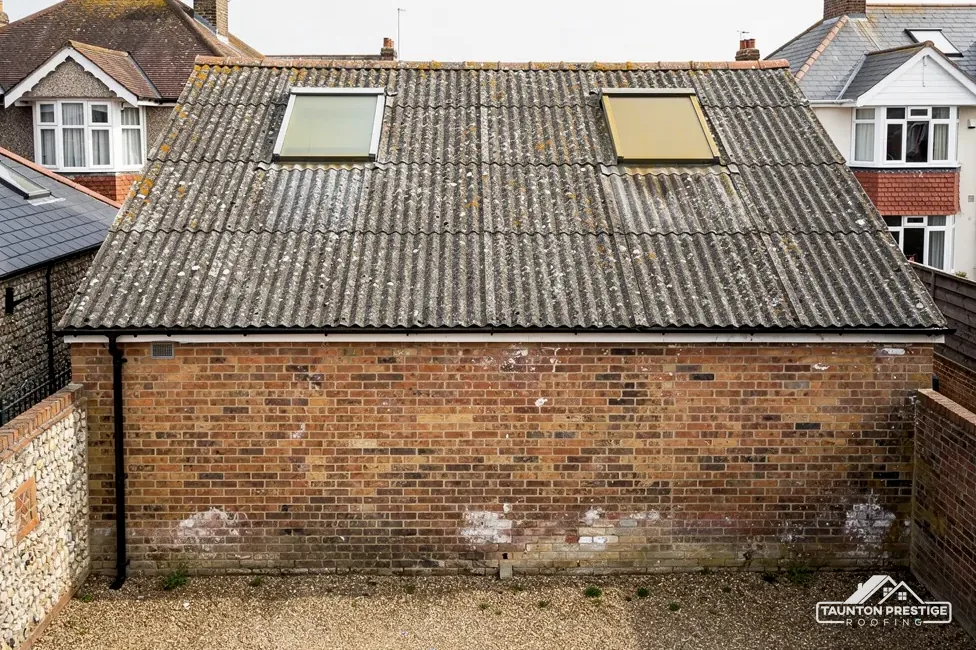
Marley's expectation for concrete roof tiles is around 60 years, with the caveat that the figure is not a guarantee or warranty. As they age, the surface layer wears and the tiles grow porous, so they hold water, gather moss and grow heavier. Look for crumbling edges, cracks that run through a tile and a rough, sandy face. Fixings and the mortar at the ridge and verge usually go sooner than the tiles do, and that is a repair. When a large share of the tiles are cracking and porous, a re-cover is the better value.
What about felt on a flat roof or extension?
Less gives torch-on felt as 10 to 20 years, saying a good job can last 20 years while a poor one can fail inside 10. Signs include blisters, splits along laps, cracking at the upstands and water standing in pools that never drains. A single split can be patched. Widespread cracking across the whole surface means the felt has reached the end.
Other flat coverings last differently: Less gives GRP at 25 to 40 years and EPDM at 30 to 50, while GreenSpec gives EPDM at 20 to 30 (Oct 2026). Those are typical ranges, and the condition of the decking beneath decides what you can do. Wet or rotten boards have to come out whatever goes on top.
Underlay is the hidden layer. On a tiled roof, torn or perished underlay seen from the loft may call for stripping and re-tiling that slope, even if the tiles themselves are good. We show you the loft photographs so the evidence is on the table.
What repairs and a re-roof typically cost
Published cost guides show the gap between a repair and a new roof. These are typical UK ranges, not Taunton Prestige prices.
What do common repairs cost?
MyJobQuote's average general roof repair is around £650 (Oct 2026). Replacing five tiles is £150 to £200, with an average around £215, and ten to twenty tiles £200 to £275. Ridge tile replacement runs between £225 and £550, and a full roof valley replacement is around £540 (Sep 2026). Chimney leadwork is £150 to £250 for a patch, or £350 to £920 for a full set.
Typical UK range to re-tile a whole 80m² roof (MyJobQuote, Oct 2026): £3,000 to £8,000, with access, scaffold and the covering moving the figure.
And what does a new roof cost?
MyJobQuote puts the average for a new roof at around £5,250 (Oct 2026), while HomeBuilding (Sep 2025) gives £10,000 to £15,000 for a three-bedroom semi of 65m² in plain concrete tiles, a total that covers labour, scaffold and insulation. Those two sources are far apart, so take both as markers. Slate is dearer, with MyJobQuote's average new slate roof around £7,800 (Oct 2026). Our guide to new roof cost in the UK goes into what drives the range.
Compare a repair figure with a share of the re-roof figure, not with the whole of it. If a roof needs three call-outs in the next five years, those add up to a notable part of a re-cover that would end the call-outs. If one repair buys another ten years, it is the better buy by a distance.
Why the survey decides, not a guess
A decision this size should rest on evidence from the roof itself, which means going up there and into the loft, not looking from the road. Quotes given over the phone or from a car window are guesses, and a guess can push you either way.
What does a survey look at?
We check the covering slope by slope, the ridge, hips, valleys and verges, the flashings, the chimney, the gutters and fascias, and from the loft the underlay, the battens and the rafters. We photograph what we find, including the good areas, so that the picture shows how much of the roof is sound.
The result is a clear list. Some roofs need a repair now and again, some need repair plus a plan, and some need replacing. For the last group we explain why: the percentage of failed tiles, the state of the underlay, or the condition of the timbers. A survey costs little against the sums above: MyJobQuote gives an average roof survey of around £300 (Oct 2026), and drone surveys at £200 to £350. Those are typical UK figures, not our prices.
Who should I be wary of?
Be careful with anyone who knocks to announce that your roof needs replacing, and with anyone who will not show you the evidence. Ask to see photographs of the faults on your roof, and ask what each repair will and will not fix.
You also get time. Unless there is an active leak, you can survey, compare and decide at your pace. A leak gets a safe temporary fix first, and the bigger decision waits for the weather and your budget.
Deciding, and what happens next
With the photographs and the list in hand, the choice usually settles into one of three paths. You repair now and review in a year or two, you repair and plan a re-roof for a set date, or you replace.
When is replacement the better buy?
Replacement tends to win when faults are spread across several slopes, when the underlay and battens are failing, when the timbers need work anyway, or when the cost of repeated repairs is heading towards the cost of the job. It also wins when you are about to spend on something that depends on the roof, such as loft conversion, solar panels or an extension. Our guide to roof replacement explains the route from survey to finish.
What should I do while I decide?
Deal with any active leak first. Put a bucket under it, tell your insurer if there is damage, and arrange a temporary repair. Keep photographs and receipts. Then use the survey to plan the bigger step.
A re-roof changes the weight and the fire rating only if the covering changes, and a like-for-like job on a house is normally permitted development under Class C. If a different material is on the table, the planning and Building Regulations checks come into it, and the survey covers them.
To book a survey for your own roof, tell us the covering, the age if you know it and what has gone wrong so far. We will arrange the visit, show you the photographs and give one written total for whichever route you choose.
Weighing a repair against a new roof
How many repairs make a new roof the better choice?
There is no magic number. Look at the pattern: repairs on different slopes, a repeat of the same fault, or problems with underlay and battens suggest the covering is failing as a whole. Add up what you have spent over the last few years and set it beside a share of the re-roof price.
Can I replace just one slope of my roof?
Often, yes. A single worn slope, usually the south or west face that takes the weather, can be re-covered while the rest stays. The new slope should match the old for pitch and look, and the junctions need careful detailing. We can price this as one total alongside the full option.
Does an older roof always cost more to repair?
Not always, but matching old materials can add time. A clay or slate roof may need salvaged pieces, and a rotten batten behind a good tile adds work. Concrete tiles and felt flat roofs are simpler. We say what a repair involves before you decide.
More on this subject: Roof replacement and new roofs in Taunton