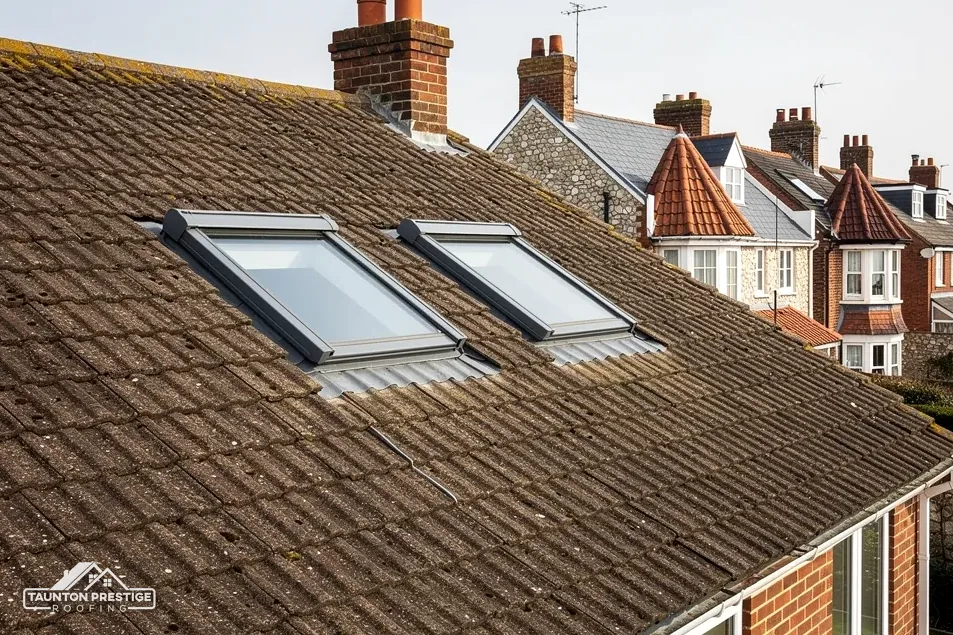
Search for a roof window and the same name comes up first. Velux is the name many people use, so it stands in for the whole product in the way Hoover once did for vacuum cleaners. It is not the only name on the shelf. Other manufacturers, such as Fakro, Keylite and Roto, sell roof windows built to the same idea: a sash and frame set into the slope, sealed to the covering with a flashing kit.
If cheaper is the goal, the sticker price is only part of the answer. A roof window leaves the factory as a unit, but it arrives on your roof as a job: a hole in the covering, a frame fixed to the rafters, flashing worked into slates or tiles, and a lining inside. This guide is about what to weigh across makers: the heat-loss figure the law asks for, whether the flashing kit suits your covering, and whether you can still get parts in years to come. It forms part of our wider roof windows and skylights work, and it takes no side against any brand.
What a cheaper window really saves
Start with the arithmetic of a fitted window. The glass and frame are one cost. The flashing kit, the labour, any scaffold or access, the lining and the making good inside are the rest. A lower price on the unit can shrink the total, but only if everything else stays the same, and it often does not.
In MyJobQuote's national guide, a standard mid-range Velux comes out at £1,100 fitted and a straightforward swap at around £100 less (MyJobQuote, Sep 2026). Those are typical UK figures from a national guide, not our prices, and they cover one maker's range. A unit from another maker may cost less to buy, but that saving can be eaten by a kit that needs extra work to suit your tiles, or a size that does not match the opening and calls for new timber.
Is a cheaper roof window always the better buy?
Not automatically, and not automatically worse either: the answer sits in the roof, not the brochure. What matters is whether the cheaper unit does the same job in your roof for the same length of time. A window that saves a modest amount on day one and leaks at the flashing in the second winter costs more than the dearer one. That is why we treat the choice as a roof question and not a shelf question.
Some savings are real. A smaller window, a simple fixed rooflight where you do not need to open the glass, or a standard size rather than a made-to-order one all lower the price without touching quality. Those are choices about what you buy, not who made it. A fixed unit has no hinge, no handle and no seal that moves, so there is less to wear. It cannot ventilate, though, and in a bathroom or kitchen loft room that matters.
The Part L figure comes first
Whichever maker you pick, a roof window fitted as new or as a replacement in an existing home has to meet the energy rule in Part L of the Building Regulations. Table 4.2 of AD L Volume 1 (2021 edition, 2023 amendments) gives a window figure of 1.4, or a Window Energy Rating at Band B or better, and note 8 to that row takes in roof windows. A rooflight counts as a separate product, with its own figure of 2.2.
How do you check a window meets that figure?
Ask for the data sheet and read the U-value, the measure of how fast heat passes through the unit, or the Window Energy Rating band. Both should be printed there. A lower U-value means less heat escapes. Band B is the minimum the table allows, so do not treat it as a mark of quality.
This matters when you compare makers because not every range reaches the figure with every glazing option. A basic double-glazed pane from one maker can pass where a similar pane from another does not, and the extra layer of glass that gets a unit over the line is what adds to the price. A unit that cannot show the figure is the wrong choice at any price. Ask for the sheet for the exact glazing option in the order, because a range often lists several panes and only some reach the number.
A 2026 edition of AD L is due to replace this one from 24 March 2027, with the tables renumbered 3.2 and 3.3. Until that date the 2021 tables apply, so quote them to any supplier. What the number means in a cold bedroom is a separate question: warm glass feels different on a winter night, and a better figure also cuts condensation on the pane.
Will the flashing kit fit your covering?
A flashing kit is the set of metal parts that joins the frame to the roof covering around it. It is made for a particular depth of covering, so a kit meant for flat concrete tiles is the wrong answer on a deep clay pantile, and neither suits slate. Each maker publishes which kit goes with which covering.
When you compare makers, look at the kit as closely as the window. Ask which kits exist for your covering, and whether a kit for it is on the shelf or must be ordered. A maker with a wider choice of kits can cost less in labour because the roofer is not forced to bodge a near fit with lead.
What if the makers do not list your roof tile?
Then the roofer works from the profile. Somerset has clay Double Roman tiles and pantiles on older roofs, and a kit designed for a low, flat tile does not sit tight on those curved shapes. The data sheets give the covering types each kit suits, and a roofer who reads them against the real roof avoids the gaps that let rain in. Our guide to flashing kits by roof covering covers it in depth.
This is where a survey earns its keep. We look at the roof from the ladder, show you photos of the covering, and name the kit that suits before the window is ordered. A cheaper unit with an awkward kit is not cheaper at all. Where old and new work meet near the opening, with a lead gutter or a chimney close by, the room around the window decides which kit goes in, and the survey is when that is checked.
Parts and repairs in ten years' time
A roof window works hard. The seals around the sash flex with every shower and every frost, the hinge takes the weight of the glass, and the glazing can eventually mist if its seal fails. Buying a window is partly buying the chance to repair it later.
Can you still get parts for the window you choose?
Ask the supplier three things before you order. Is there a spare-parts line, with seals, hinges, handles and replacement glass sold separately? Are those parts held in the UK or shipped on request? Does the maker keep older model sizes in production, or only the current range? A window from a maker whose parts are hard to find becomes a whole-unit replacement the first time something wears.
The same goes for blinds and motors. Accessories are usually made for the maker's own frames, so a blind that fits one range will not fit another. If you want a blackout blind or a motor now or later, check the accessory exists for the window you are buying. Our page on replacing roof window glass shows how often a pane swap solves a problem that a whole new window would also solve.
None of this says one maker is better than another. It says a cheaper window is only cheaper if you can keep it going. Ask what the maker offers, get any warranty terms from them in writing, and keep the paperwork with your house records. A window that comes with a clear parts list and a supplier who answers the telephone is worth a little more.
Matching the size already in your roof
If you are replacing a window that is already there, the new one has to fit the hole. Roof windows come in sets of standard sizes, and each maker has its own range, so a unit of the same nominal width from a different maker may not drop into the old opening. A gap round the frame means new timber, new flashing and a longer job.
Can a different maker's window go in the same opening?
Sometimes, if a size in that range lands within a tolerance the flashing can absorb. Often it does not, and the opening has to be trimmed to suit. Measure the frame in the roof and the inside lining, not the glass, and ask the supplier for the nearest listed size. Our guide to replacing a window in the same opening goes through what a straight swap needs.
Where the opening has to be altered, the job turns from a swap into building work on the roof structure, and the plaster lining inside has to be redone to suit. Cutting a rafter, the sloping timber the covering rests on, needs a trimmer put in on either side, and that is a different level of work from changing a sash. It can bring Building Regulations into play, and your building control body will say how.
For a house in a conservation area or a listed building, the choice of frame also matters to the planning team. Talk to Somerset Council's planning team first if the new window will look different from the one you have now, and do it before ordering.
How to weigh one against another
A fair comparison needs the same facts for every window on the table. Write them down and ask each supplier the same questions.
- Size, and whether it matches the opening.
- Opening type: centre-pivot, top-hung or fixed.
- The heat-loss figure or Window Energy Rating band on the data sheet.
- The flashing kit for your covering, and its availability.
- Parts, blinds and motor options.
- Delivery time.
The Citizens Advice advice on home improvements is to try for written quotes from 3 traders or more before you decide. Make sure each one names the same window specification, so you are comparing like with like, and ask whether VAT and any scaffold are included.
Which window would we choose for you?
It depends on the roof. On a slate roof with a straight swap, we would lean towards whichever maker lists a kit for your slate and an exact size match, because that keeps the job short and tidy. On a clay roof with a deep profile, the kit decides. We can work with several makers and have no reason to push one over another, except that the unit must fit and reach the Part L figure.
Send us the size and the covering, or the code on the label of the window you have, and we will tell you which alternatives suit. We survey the roof first, then send photos of it along with a single written price.
Choosing a roof window maker
Are other roof window makers cheaper than Velux?
Fakro, Keylite and Roto are among the makers selling roof windows, and some ranges cost less to buy. Whether the fitted job costs less depends on the size, the glazing, the flashing kit for your covering and the work in the roof. Check the U-value on the data sheet and the availability of parts.
Can I put a different brand into a Velux opening?
Sometimes. The new unit must be a standard size close enough to the old frame for the flashing to cover the gap, otherwise the opening is trimmed to suit. Measure the frame and the lining, not the glass, and ask the supplier for the nearest listed size before ordering anything.
Does a cheaper window meet the same energy rule?
It must. Part L sets the same window figure for every maker, a U-value of 1.4, or a Window Energy Rating at Band B, and roof windows are covered. If a data sheet cannot show that figure for the glazing you are offered, ask for a different option before you pay a deposit.
More on this subject: Velux roof window and skylight installation in Taunton