When a roof window leaks, the glass is rarely to blame. The water gets in where the frame meets the roof covering, and that joint is sealed by the flashing kit: a set of shaped metal pieces sold with, or alongside, the window. Pick the wrong kit and the window can look perfect from the loft and still let a damp stain spread across the lining after the first wet week.
Kits are not universal. They are made for a particular covering and a particular depth of profile, which is the height of the humps and hollows of a tile. A thin slate sits almost flat. A clay pantile or a Double Roman has a deep curve. This guide explains the families of kit, how to match one to a slate, plain tile, interlocking tile or clay roof, and what goes wrong when it is guessed. It forms part of our roof windows and skylights service for Taunton homes.
What a flashing kit is made of
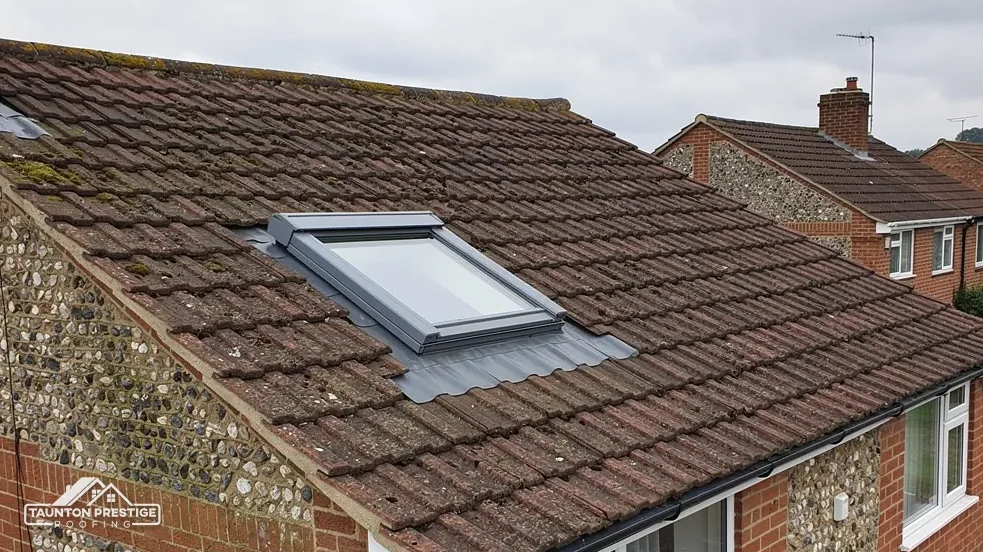
A flashing is a strip of metal that bridges the joint between two parts of a roof. Round a roof window it is done in four runs: a piece along the bottom edge, often called the apron, one up each side, and one across the top. Each is shaped so that water running down the slope is carried over the frame and back onto the covering.
Where the side pieces meet the tiles or slates they work with soakers. A soaker is a small, flat sheet of metal bent to an L, tucked beneath every course of slates or tiles, so the water that creeps up the edge is turned back onto the roof. Without soakers the side of the window is only as watertight as the gap between a tile and a frame.
What are the pieces of the kit actually made from?
Manufacturers supply kits in aluminium or other formed metal with a coloured finish, and a roofer can also form the same pieces in lead on site. Lead is a soft sheet that bends to the shape of the covering. Royston Lead's brochure lists code 3 for soakers only and codes 4, 5 and 6 among those used for flashings, and lead flashing is long-lived: MyJobQuote says it can outlast 80 years.
Both routes work when the kit matches the roof. A factory kit is faster to fit and arrives in the right shape for its covering. A site-made lead flashing is more forgiving on an old roof where the tiles are uneven. The kit comes first, though: choose it before the window is ordered, because the window and the kit are sold in pairs.
Slate and flat tile kits
Natural slate lies thin and close to the roof, so the kit for it is a flat one. The metal skirt tucks under the slates above the window and over the slates below it, and the soakers run under the courses at each side. The slates are cut to suit, nailed with the right fixings and trimmed neatly at the frame.
Pitch matters here as much as profile. BS 5534 gives 20 degrees as the minimum pitch for natural slate, and Cupa sets 25 degrees as the lowest pitch for hook fixings. A kit does not change that rule, but if the pitch is low the slates around the window need extra care, and the roofer should know before ordering.
Does a plain tile roof take the same kit as slate?
Often the kit for slate and for small flat tiles is the same family, because both lie close to the roof with little relief. Plain clay or concrete tiles are laid in overlapping courses, so soakers are used just as with slate. The pitch for Marley plain concrete tiles is 35 degrees, so the slope is steeper than for many other tiles. Look at the data sheet for the exact covering you have and do not assume the match.
The slate maker or tile maker publishes pitch limits, and the window maker publishes which kit suits which covering and its allowed thickness. Our slate roofing pages explain slate itself, and the roofer reads both sets of data before the roof is opened.
Take photos of the existing covering from the ground and, if it is safe, from a window, a tile or slate close up, and the roof from across the road. Those three pictures let a supplier narrow the choice before anyone visits.
Interlocking concrete tiles
Interlocking tiles have side grooves that lock one tile to the next and a ridged surface that sheds water. Marley lists minimum pitches that run from 12.5 degrees for its Mendip 12.5 up to 35 degrees for its plain tile. The Double Roman in concrete needs 22.5 degrees smooth, and the Ludlow Plus 22.5 degrees. A kit for this family is designed to sit over the humps and hollows with a sealing strip that squeezes to the shape.
What depth of tile does a kit allow?
Each window maker states the maximum depth of profile that a kit will cover, and the figure differs between kits. A flat concrete tile is within the limit of the common kits, but a deep-roll profile may need a kit sold for deep profiles or a site-made flashing. If the tile on your roof is not in the maker's list, the roofer must check its measurements against the kit rather than guess.
Interlocking tiles pose another problem: the cut. The flashing sits where the tile courses have to be trimmed around the frame, and a cut concrete tile loses its interlock on the cut side. A good fitter fixes the cut tiles mechanically and keeps them tight to the apron, so wind cannot lift them.
If your roof was re-roofed with a new covering some years ago, ask what was fitted. The tiles may be a profile that was changed or discontinued by the maker, and a kit for the old range may no longer be sold. Our guide to fitting a new roof window goes through the order of work.
Clay Double Roman and pantiles
Clay tiles with a deep curve, such as the pantile and the Double Roman, are where kit choice needs the most care. A pantile is an S-shaped clay tile; a Double Roman is a two-roll profile with a hollow between the rolls. These profiles belong to Somerset's older roofs. A Bridgwater heritage leaflet says the town's brick and tile makers added the popular Double Roman to a growing list of products, and pan tiles were made there too, so these shapes belong to the local roofscape.
Why are clay roofs harder to flash?
The wave in a pantile or a Double Roman is large. A standard flat-skirt kit lies on the high points and leaves a channel beneath it at every hollow, and water finds that channel in a storm. The answer is a kit made for deep profiles, with a flexible sealing strip, or a lead flashing dressed by hand into every roll.
Minimum pitches are different too. Marley lists 15 degrees for its clay Lincoln pantile, 40 degrees for the Canterbury and 35 for the Ashdowne, with the Double Roman in concrete at 22.5 degrees. Those are Marley's products, and an old Somerset clay tile follows no such sheet, so the roofer reads the real tiles, measures the rise of the wave and checks the kit against it. Check the product data sheet for any new tile.
Reclaimed clay adds a wrinkle: an old tile can differ from the maker's current one in curve and thickness, so the best check is a tile in the hand. If your roof is clay, tell us before you buy a window. We would rather change the order than fit a kit that does not sit down on your tiles. Matching the original material is part of doing the roof properly, and the flashing is part of that.
Why the wrong kit leaks
A roof window is simple in principle: water runs down, the flashing sends it round. Leaks come from a short list of failures, and each one traces back to a kit that was never meant for the roof.
- Gaps under the apron, where a flat skirt sits over a curved tile.
- Side channels that fill because the soakers were skipped or cut short.
- A top flashing that is too shallow, so water ponds against the frame.
- Sealant doing the job metal should do, which fails when the roof moves with the weather.
- Tile cuts left rough, so wind drives rain under them.
Can sealant fix a kit that does not fit?
It can hide it for a season. Sealant ages in sun and frost and can crack along the edge of a kit. A repair that relies on it will need doing again. The fix is to match the kit to the covering, and sealant stays as a trim, never the seal.
A leak around a window is easy to misread from inside, and it helps to know where water travels before anyone climbs up. Water that enters at the head can travel along the lining and show up lower down, away from the leak. Condensation on the glass is a different fault with a different cure, as our page on condensation on a roof window explains. A damp patch does not tell you which, so look at the flashing before assuming the glass has failed.
Getting the right kit before you order
The best moment to get the kit right is before anyone buys the window. Work through this in order.
- Identify the covering: slate, plain tile, interlocking concrete or clay, and the name of the profile if you know it.
- Note the pitch of the slope, which a roofer can measure with a level and a rule.
- Measure the existing opening if you are replacing a window, since the kit sizes go with the window sizes.
- Ask the supplier which kit suits that covering, and ask for its depth limit in writing.
- Check the kit is in stock, not on a long order.
What if the tiles are old or unusual?
Then the survey decides. We look at the tiles from a ladder, lift one to read the back, and photograph the profile. If no ready-made kit suits, the answer is a hand-formed lead flashing, and the job and price reflect that.
A listed or conservation-area house adds a point: the kit also affects how the window looks, because a low-profile flashing hides better than a raised one. Class C of the permitted development rules covers roof alterations on a house, and a listed house needs listed building consent as well, whatever the permitted development position. Ask Somerset Council's planning team before ordering.
Tell us what covering your roof has and which window you want, and we will name the kit that suits before you pay for anything. We survey, show you photos of your roof and send one written price.
Flashing kit questions
Can I reuse the old flashing kit on a new window?
Seldom. The kit is shaped for one window size and a particular covering, and an old one has usually been bent, cut or sealed with mastic. A new window is normally fitted with its own matching kit, and the covering is made good against the new metal.
Which kit does a clay pantile roof need?
One designed for deep profiles, or a lead flashing formed by hand into the waves of the pantile. A flat-skirt kit lies on the high points and leaves a gap at every hollow. Tell the supplier the tile name, or send a photograph of a tile and the pitch.
Does the flashing kit affect the Part L figure?
No. The Part L figure for a roof window, a U-value of 1.4 or Band B on the energy-rating scale, belongs to the glazed unit. The kit is about keeping water out. You need both right: a window that reaches the figure and a kit that matches the covering.
More on this subject: Velux roof window and skylight installation in Taunton