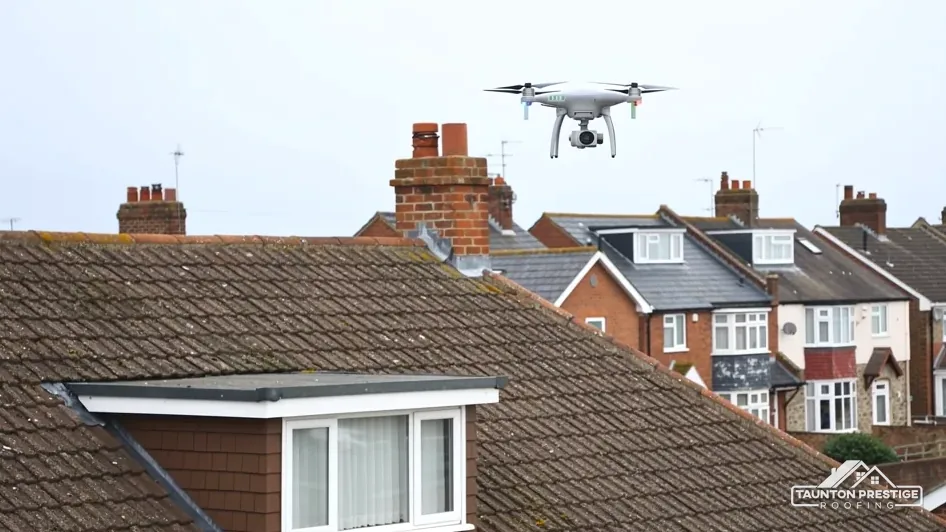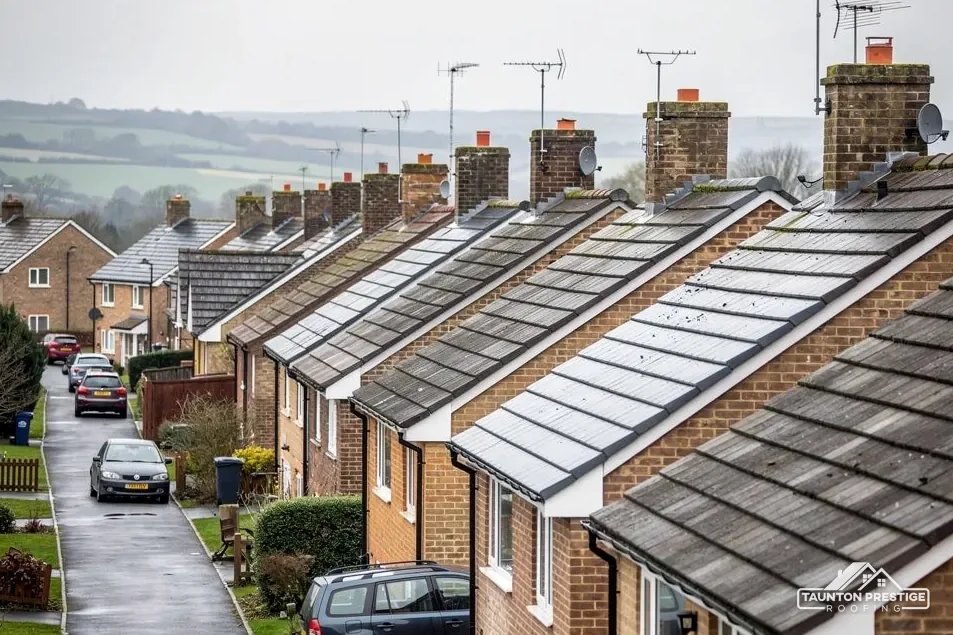
222 Staplegrove Road
Grade II from July 1975, so changes to its roof's character need consent.
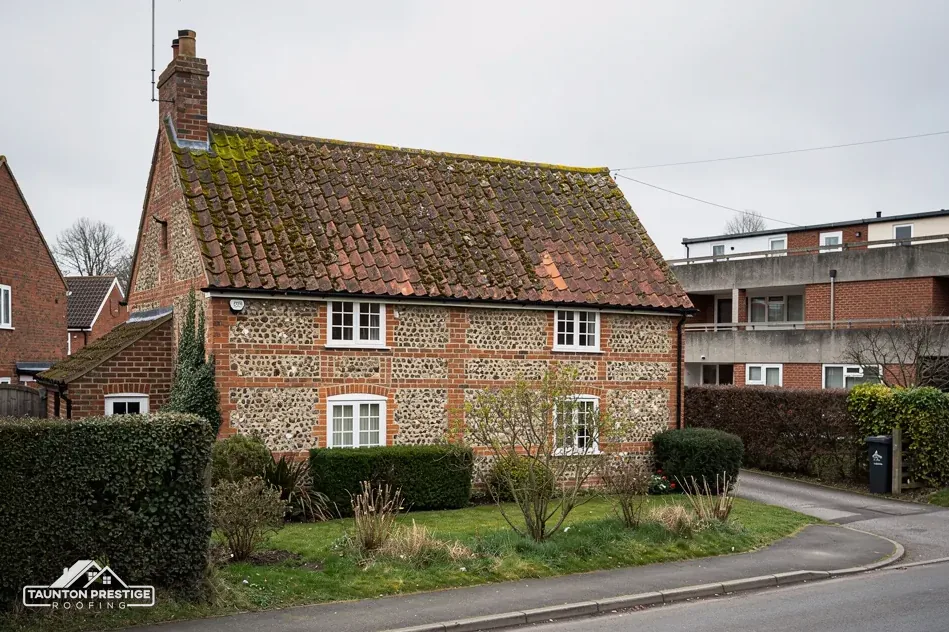
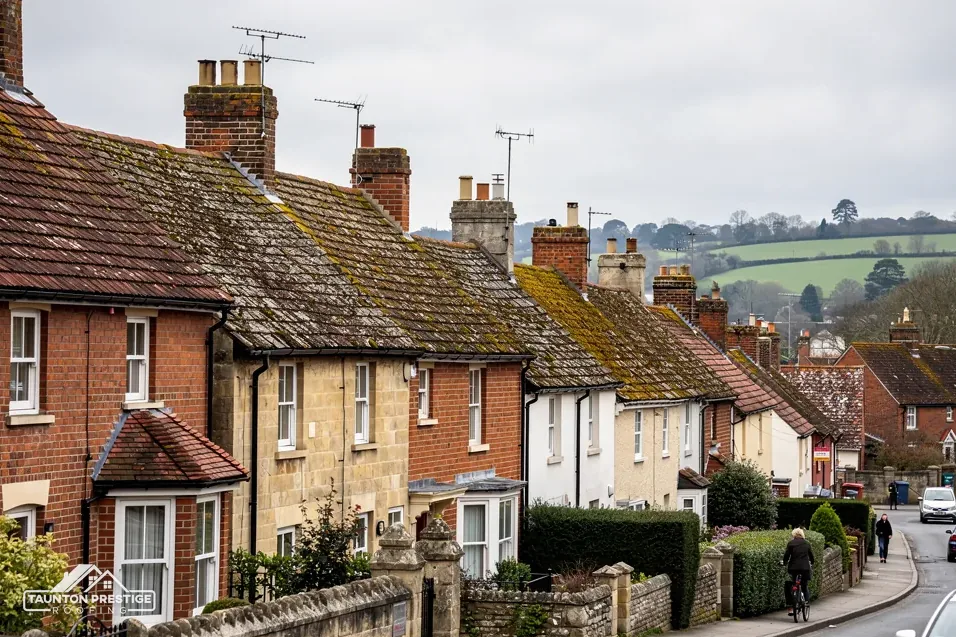
Staplegrove Road, a listed church and walls of Morte Slate
Staplegrove has a conservation area within about 0.75 km of its centre and a Grade II church. Every roof gets a survey, with photos, before a price is written.
Grade II from July 1975, so changes to its roof's character need consent.
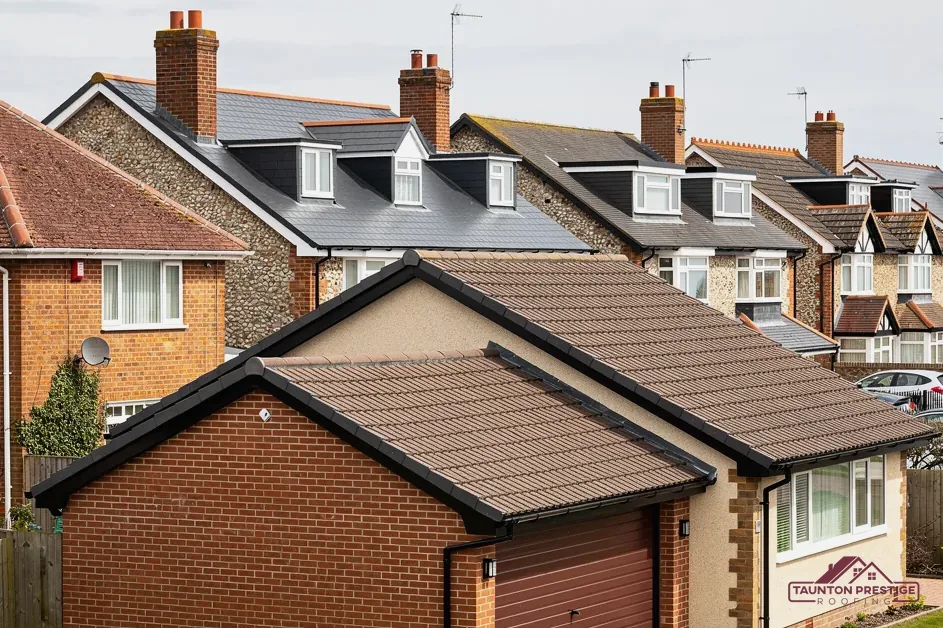
A Grade II church, first listed in February 1955, whose consent route depends on its denomination and use.
Pomeroy's Farmhouse has a Grade II barn beside it, and Kibbys nearby carries the same grade.
Street map of Staplegrove with Rowbarton, Lyngford, Norton Fitzwarren, Bishops Hull marked around it, and Taunton.
Rowbarton lies to the south-east of Staplegrove and Lyngford to the east, with Norton Fitzwarren to the west, Bishops Hull to the south and Priorswood further east.
About 2 miles north-west of Taunton, Somerset Council (unitary).
Four checks along Staplegrove Road
Four checks for a house on or near Staplegrove Road, covering consent, slate, old buildings and the limits that bring in building control.
Staplegrove is a more closely managed patch of Taunton than many owners realise. A conservation area called Staplegrove lies within about 0.75 km of the centre, and Somerset Council's table gives its designation date as 12 November 1998. A second one, the Staplegrove Road conservation area in Taunton, was designated on 15 January 1975 and revised on 12 November 1998. Separately, Somerset Council's Article 4 page includes Staplegrove Road in Taunton, dated 1977.
In Somerset Council's own description, a direction withdraws permitted development rights in a defined place, which can mean an application for work that normally needs none. What the Staplegrove Road direction covers needs an answer from the planning team, and we would rather you heard it from them than from a guess of ours. If your house is on or near that road, ask before the covering, the chimneys or the roof windows change. Our guide to planning permission for roof work explains how the pieces fit together.
The National Heritage List includes 222 Staplegrove Road (Grade II, July 1975) and Kibbys, also Grade II, along with the barn by Pomeroy's Farmhouse. A listed house still has the normal re-roofing rights, but work that changes its special character requires listed building consent, and chimney changes can fall into that.
We check all of this at the survey stage, so a roof inspection arrives with the consent question already answered. Finding out that a direction applies before slates are ordered costs nothing. Finding out afterwards can mean taking the new work off again. The survey photos help here too, because they show the planning team exactly how the roof looks today.
Look for
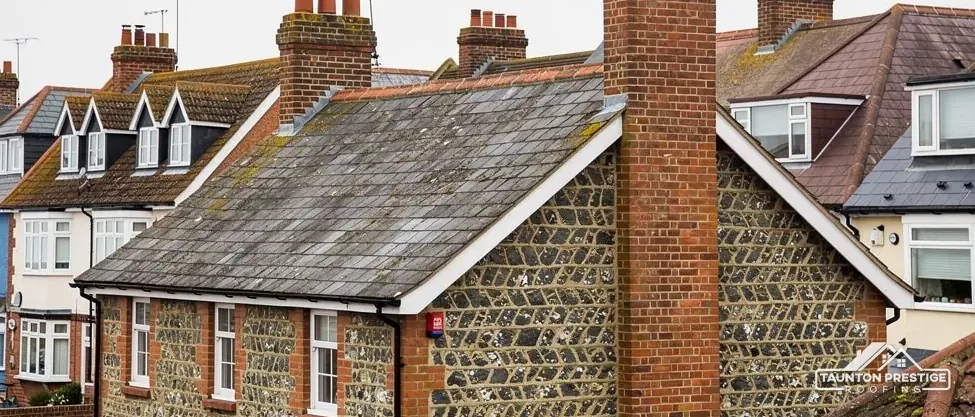
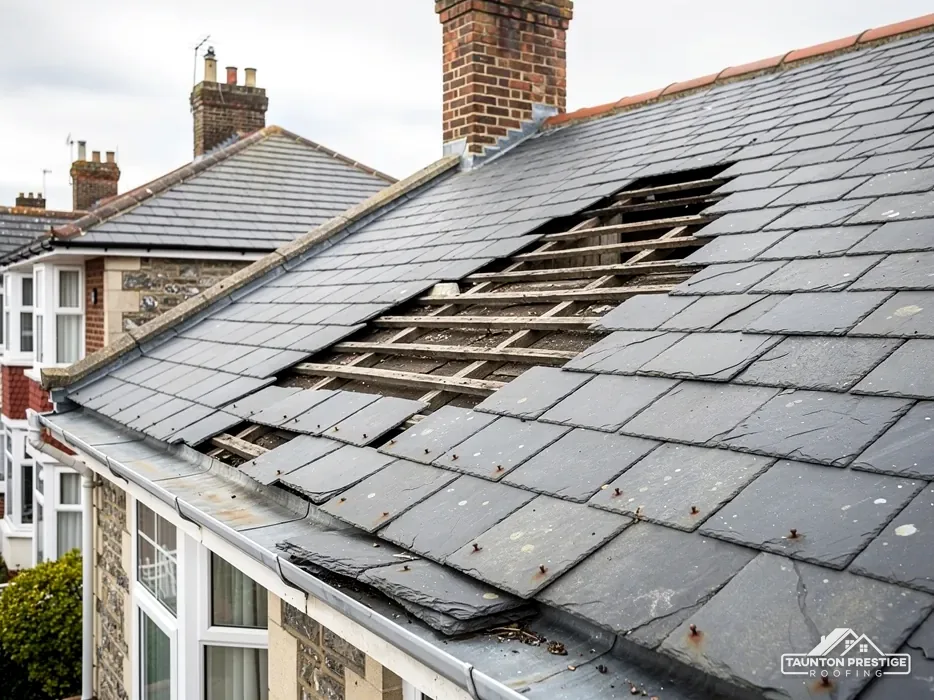
A South West Heritage Trust survey of pre-First World War buildings visible from public roads and paths recorded Morte Slate as 97 per cent of the building stone in Staplegrove. That is a count of walling stone. It says nothing about the roof above any wall, and we never assume. We read the covering at the survey, slope by slope, and show you the photos.
Slate given proper upkeep can go past a hundred years, says CORC (the Confederation of Roofing Contractors). That is a typical figure for a cared-for roof, not a guarantee, and it covers the stone rather than its fixings. Every slate is fixed to a batten, a thin timber strip run across the rafters, with a nail or a hook. Beneath the battens sits the underlay, a membrane that catches any rain the wind drives past the slates. When nails rust or battens soften, slates slide, whatever the age of the stone. Fixings usually give up before the slate itself, which is how a slope that seems tidy from the pavement can shed slates in a gale.
What decides the price
Frequently. A single slate can usually go back up on a clip, or be replaced with one that matches closely, and the rest of the slope stays as it is. We run an eye over the whole roof before saying so, because a loose slate in the middle of a tired run is a symptom, not an accident. Pitch counts as well. BS 5534 indicates a minimum pitch of 20 degrees for natural slate, and Cupa adds that hooks are unsuited to any roof pitched below 25 degrees.
It needs a like-for-like replacement, matched in size, colour and thickness, so the roof keeps its character. Our slate roofing page explains how we match and what the work involves.
St John the Evangelist gained its Grade II listing in February 1955. Its consent route follows its denomination and how the building is used today, so that is the first thing to establish. For a Church of England church in regular use, approval comes through the faculty system. The Methodist, Roman Catholic and United Reformed churches each approve work through their own schemes. A Unitarian or Quaker building, or a closed church, needs listed building consent from the council. The parish or trustees can tell you which applies, and the roofer follows whatever has been approved. If the answer is a faculty, the parish office starts the process, and our part is to supply the survey and a clear description of the work.
On an old building the roof is rarely the first question, because who must agree usually is.
The barn adjoining Pomeroy's Farmhouse is listed Grade II, so listed building consent is the route for any work that changes its character, from the covering to the ridge. Putting back matching material is the simplest case. Old barns bring wildlife into the picture as well, and that can change the timing of a job.
They can. GOV.UK's bat page puts a new or mended roof on its list of risky work, and bats have full legal protection wherever they roost or breed. Under the Wildlife and Countryside Act 1981, a person is guilty of an offence if they intentionally or recklessly disturb a bat sheltering in a structure, or block its way in. Birds' nests in use are protected where someone acts intentionally. We look for droppings, staining and nesting at the survey, before a start date is fixed, and we stop and take advice if we find signs.
None of this changes the way we work: look first, then price. For a barn or a church roof, looking first includes finding out who has to agree.
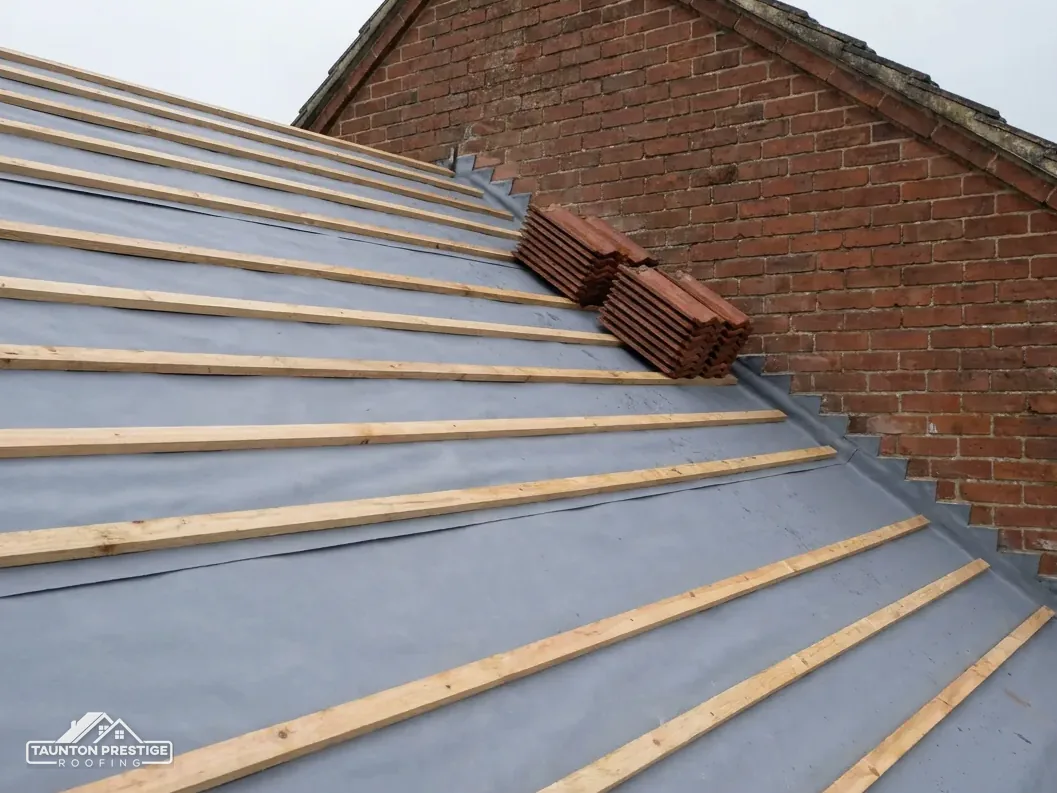
Replacing a roof is not always a building control matter, but it can be. The Planning Portal sets a two-part test: with under 25 per cent of the building envelope and under 50 per cent of the roof involved, no application is normally needed. The envelope here covers every wall, floor, window, door and rooflight as well as the roof. A job inside both limits is the simple case, and at the survey we say which side of the line your roof falls on. If the work also changes the insulation, or opens up a loft room, further rules come into play, and the survey is the moment to raise that so the price allows for it.
What decides the price
If the new covering outweighs the old by 15 per cent or more, Building Regulations approval is required, and the Planning Portal suggests a structural check by an engineer or surveyor before any work starts on the roof. That matters when natural slate replaces lighter tiles, or the reverse. Somerset Building Control states no re-roofing percentage in its published guidance, so we apply the Planning Portal test. Its fee calculator files a re-roof under renovation of a thermal element in a single dwelling.
For Staplegrove addresses, Somerset Building Control answers on 0300 303 7790. It covers the former Taunton and West district along with the rest of Somerset. A private registered building control approver is the other route, and either can issue the completion certificate a buyer's conveyancer will ask for when the house is sold.
Our roof replacement page lays out the sequence of a full re-roof, from strip to completion. Once the survey is done, the photographs and a written total come to you together. Send us your Staplegrove address and we will fix the visit.
Walked the roof?
When you have read the checks, we walk the roof and show you the photos.
An Article 4 direction is listed for Staplegrove Road (Somerset Council, confirmed 1977), and the planning team can confirm exactly what it covers. Where one applies, work that is normally free of an application can need one. Ask Somerset Council which rights it removes for your address before any materials are ordered.
No. The heritage survey that found Morte Slate in the walls counted building stone, not roof coverings. A house with slate walls can have slate, clay or concrete tiles overhead. We read the covering at the survey, slope by slope, and the photographs show you what is there before repair or replacement is discussed.
The Citizens Advice guidance on building work is to obtain three or more written quotes before choosing a trader. Ours is one written figure, given once the survey is done. When you compare, see that every quote states its position on VAT and scaffold, since those two decide whether the figures are really alike or only look it.
VAT at 20 per cent, the GOV.UK standard rate, applies to roof repairs and re-roofing for a house already built. Only CIS-registered businesses deal with the domestic reverse charge between themselves, so a homeowner never sees it on a bill. Make sure each quote you are given says plainly whether VAT is in the figure or added on top.
Send your Staplegrove address and what is worrying you, and we will book the visit.