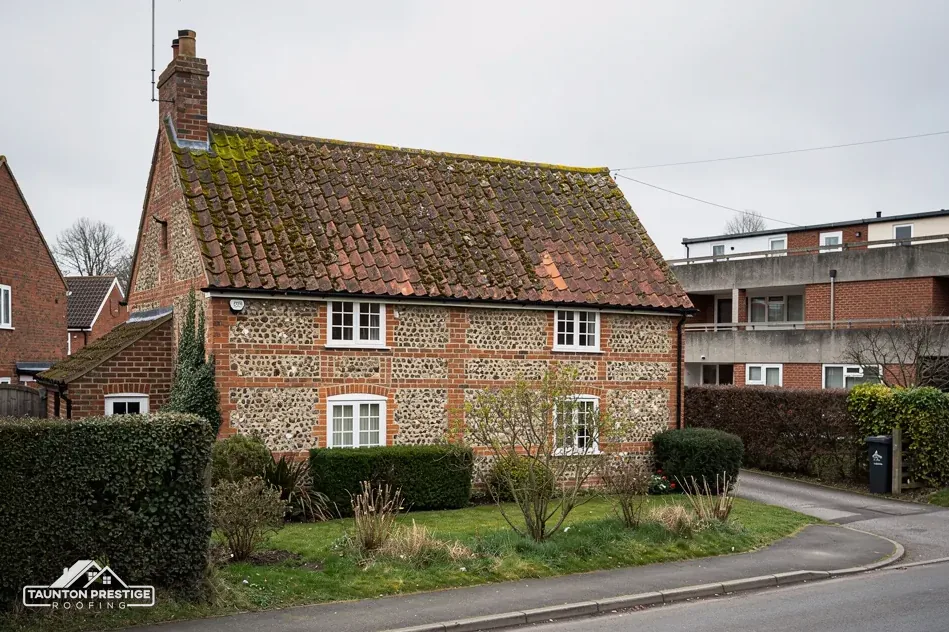
Tudor and Manor Farm Cottages
The cottages and a detached outbuilding with them are all listed Grade II, the outbuilding on 4 July 1975.
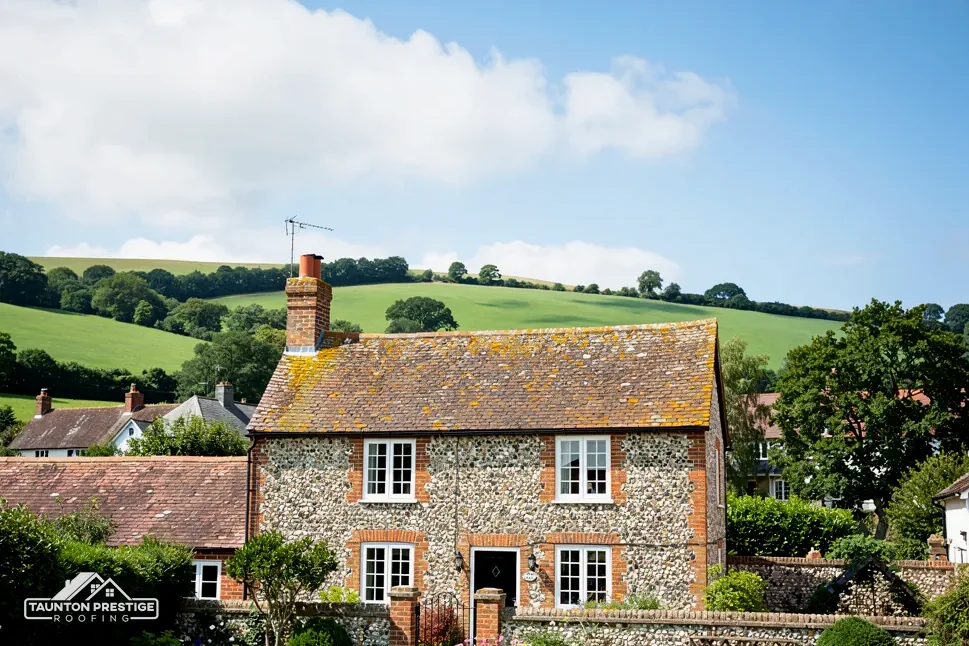
Listed farm cottages, a Kingston Road house and a conservation area nearby
Lyngford sits north of Taunton by Lyngford Park, and 3 list entries fall within 500 metres of its centre. We look over each roof in person before pricing it.
The cottages and a detached outbuilding with them are all listed Grade II, the outbuilding on 4 July 1975.
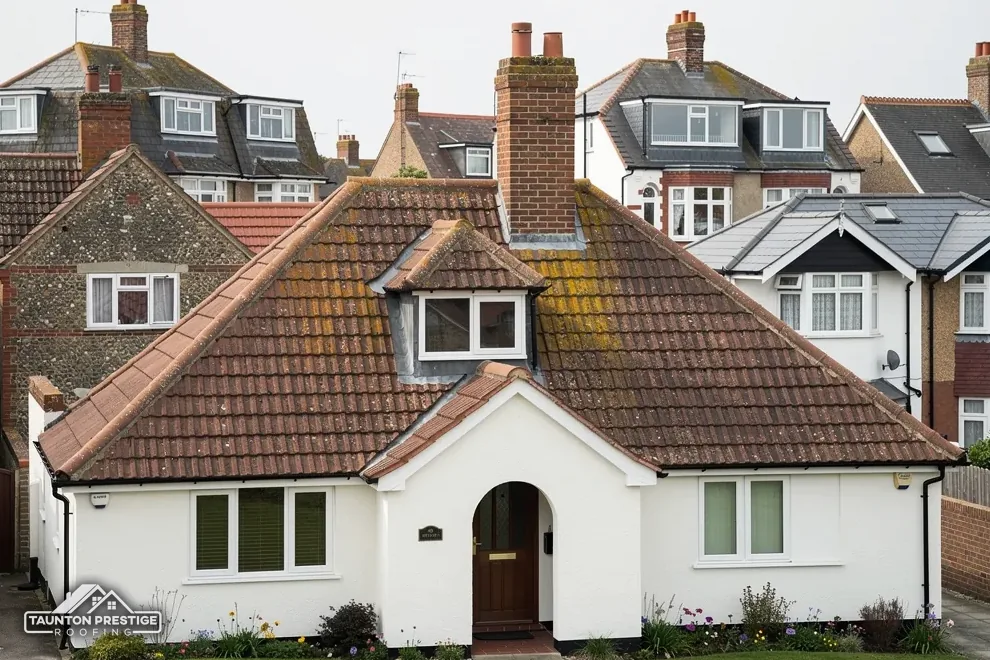
Listed on 4 July 1975; any change to its roof is judged against its special interest, not just its leak.
Within about 0.75 km of the centre; check the boundary with the planning team before changing a covering.
Street map of Lyngford with Priorswood, Rowbarton, Staplegrove, Halcon marked around it, and Taunton.
Rowbarton lies to the west of Lyngford, Priorswood to the north-east, Halcon to the south-east and Staplegrove further west.
About 1 miles north of Taunton, Somerset Council (unitary).
A north Taunton roof check
Four checks for a Lyngford house: listed outbuildings, moss, the weight of a new covering and roof windows.
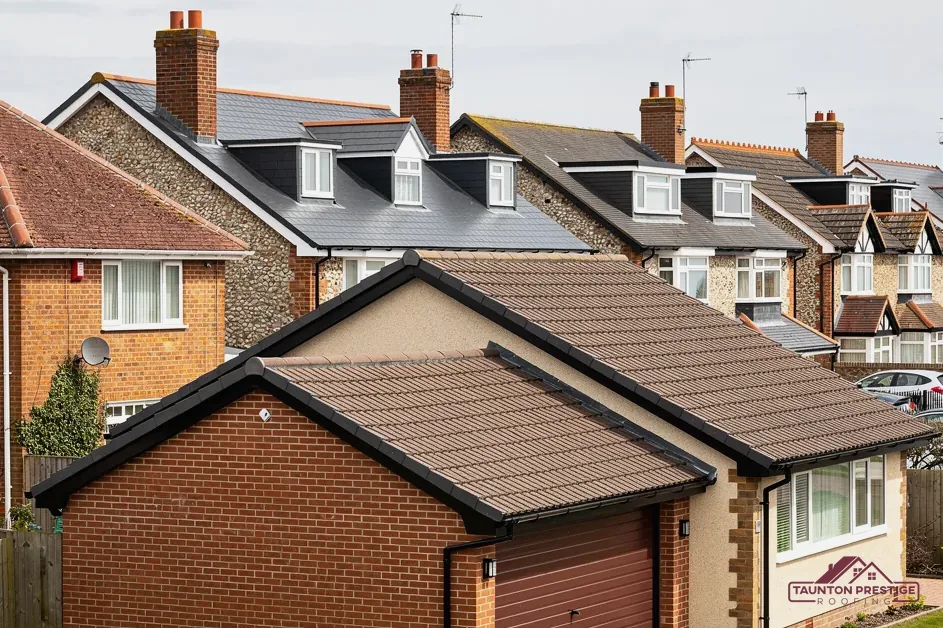
Lyngford has three list entries within 500 metres of its centre, and they are not all houses. Tudor and Manor Farm Cottages and the cottages to their right hold Grade II listings, as does a detached outbuilding that belongs with them, listed on 4 July 1975. That outbuilding is a useful reminder. A listing can reach garages, stores and barns as well as the main house, so a small roof can carry the same consent rules as a large one. 55 Kingston Road is also Grade II, with the same first-listed date.
If the outbuilding is listed, or counts as part of a listed house's grounds, any change to its character calls for listed building consent, exactly as for the house. Whether a particular shed, store or garage is covered depends on the list entry and its history, and the planning team decides. Repair in a matching material is the safer route, and at the survey we tell you which category the job falls into. Our guide to slate roofs in a conservation area shows how those questions are approached.
Search Historic England's National Heritage List by address. Each entry gives a grade, a reference number and the first-listed date, and the text can name outbuildings and boundary walls. The Staplegrove Road conservation area, designated on 15 January 1975 and revised on 12 November 1998, also lies within about 0.75 km of the centre, and Somerset Council lists an Article 4 direction for Taunton, Staplegrove Road (1977), so check the council's map and ask the planning team what applies.
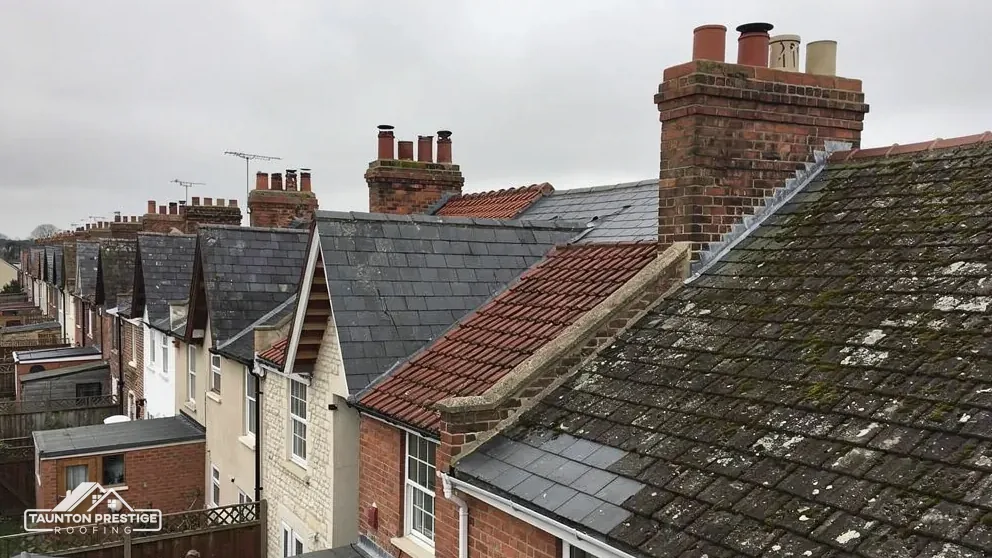
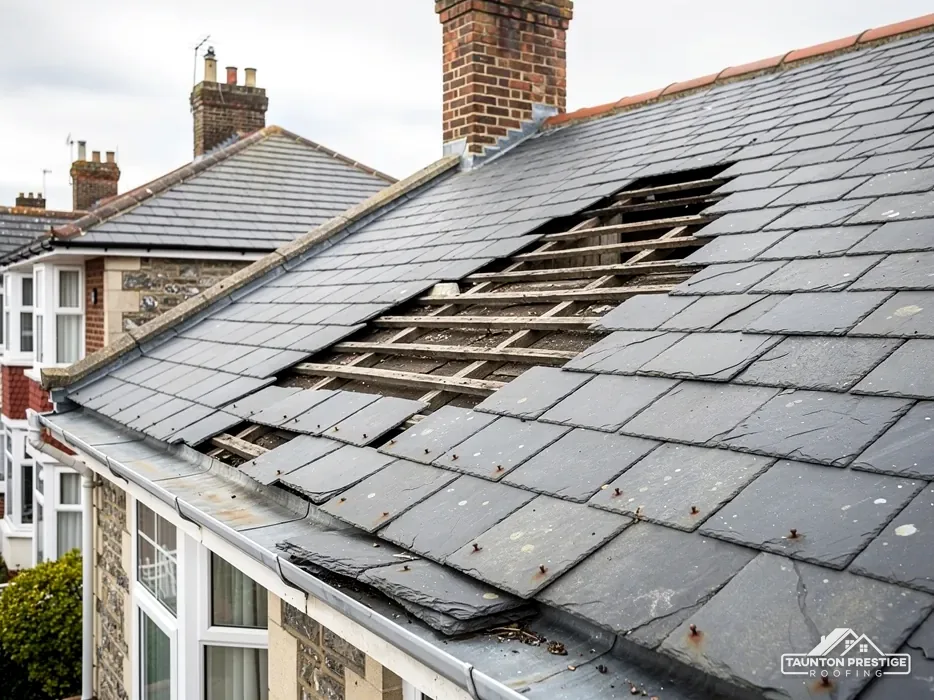
A roof that has been patched over many years can carry several slates, tiles and repairs side by side. We photograph each slope, mark where the patches are and show you which parts are sound. That way the choice between a careful repair and a full re-cover rests on what the photos show.
Look for
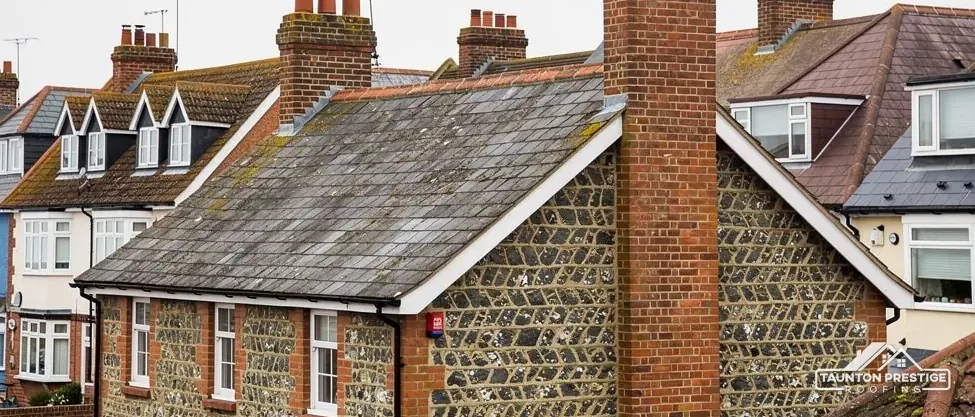
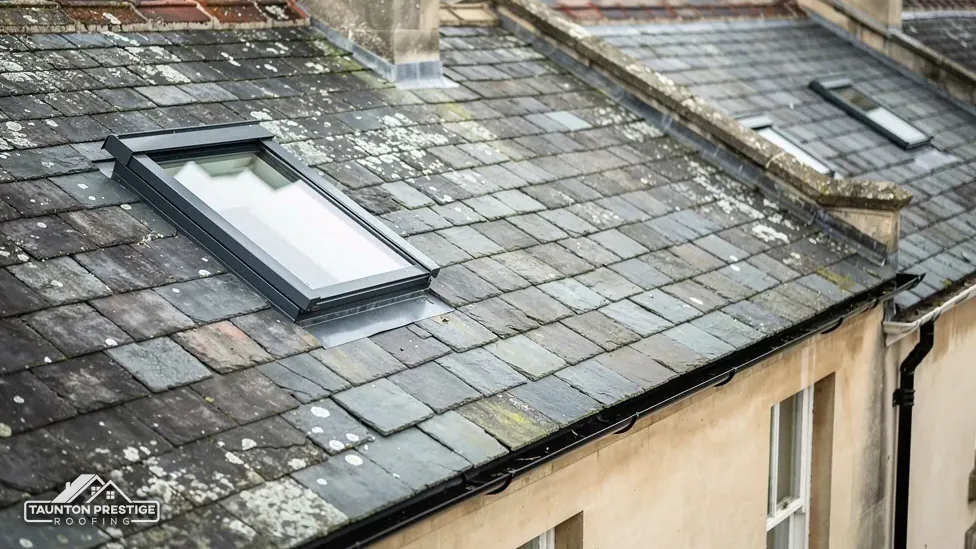
Moss and lichen grow on a roof that stays damp, and on a shaded Lyngford slope they can build up over a few wet winters. Moss is not always a fault by itself, but it holds moisture against the covering, it can lift the edge of a tile, and when it falls it blocks gutters and valleys. The first question is whether the roof is simply dirty or whether the covering underneath is failing.
What decides the price
Gently. Marley advises against powerful jet washes, warning that they damage slate and tile faces and cut their life short. Forcing water at a roof also drives it under the laps. A gentler approach works better: brushing off loose growth by hand, then a treatment applied exactly as its label directs.
Some products are sold to the public and some are not. HSE says householders should never use biocides meant only for professionals, and it treats using a non-approved product as an offence. Follow the label to the letter. On a pitched roof the bigger risk is the fall, so work from the ground and leave ladder work on the slope to a roofer.
Cleaning also shows what the moss was hiding, such as hairline cracks in slates, pointing that has crumbled and ridge tiles that have worked loose. Once the roof is clean we check the pointing, the ridge, the slipped pieces and the gutter lines, and you get the photos either way. Our roof cleaning and moss removal page explains what we do and what we leave alone.
Shade and overhanging branches keep a slope damp, so growth is usually heaviest there. Moss that has been scraped off needs clearing from the gutters straight away, because it packs the outlets and sends the next downpour over the edge.
Swapping one covering for another changes more than the look of the roof. Slate, clay tile and concrete tile weigh different amounts per square metre, and the rafters were sized for what was there before. The Planning Portal says Building Regulations approval is needed when the new covering weighs 15 per cent or more above the old, and it suggests getting a structural engineer or surveyor to look first. Approved Document A words it a little differently, as a loading increase of more than 15%, so it matters which source is being quoted.
What decides the price
Look for
Somerset Building Control sets no re-roofing percentage, so the Planning Portal's test is the working rule: a re-roof normally stays outside building control while it touches less than 25 per cent of the building envelope and less than 50 per cent of the roof. The envelope is every outer element at once (walls, floor, roof, windows, doors, roof windows and rooflights), which is why a small roof job rarely approaches the first limit.
We measure the slopes at the survey and tell you how much of the roof and the envelope the job touches. If approval is needed, you hear before the price is fixed, not after, and the application is made through the right route for your address. A heavy tile laid on a frame built for slate is the kind of change that starts the structural question, so we ask what the old roof was made of before anyone picks the new one.
Lifespans are ranges, not promises, and an older covering can be sound while a young one fails early. Marley puts concrete roof tiles at around 60 years and says that is not a warranty, so an older roof does not have to be replaced by default.
Our roof replacement page covers the full process from survey to clear-up.
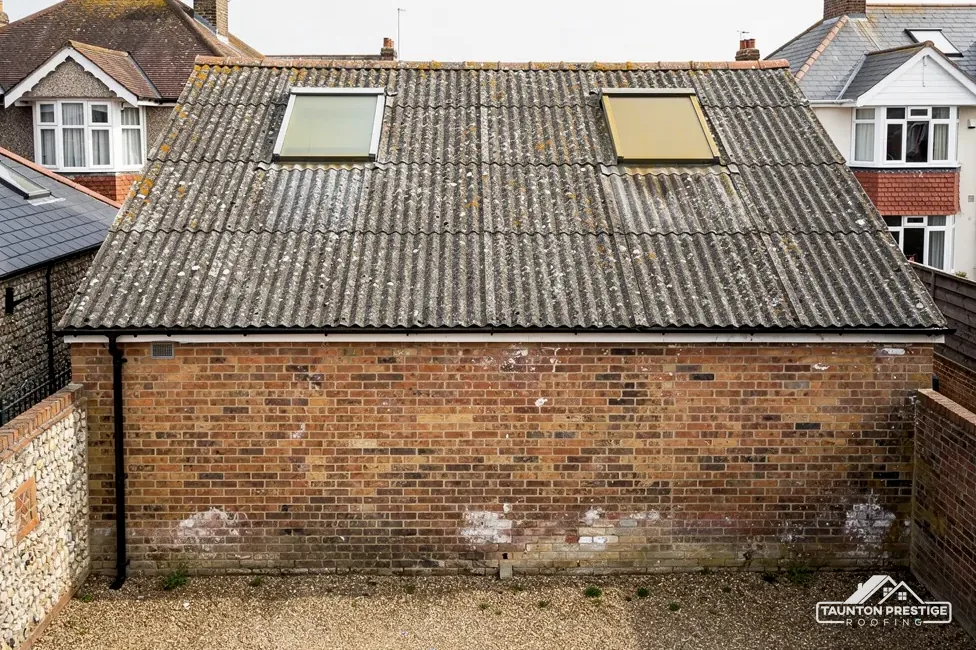
A roof window sits in the slope, and a loft room is the usual reason for fitting one. The rules for it sit in three places. Planning comes first: dormers face extra limits in a conservation area, and the Staplegrove Road area lies within about 0.75 km of Lyngford's centre. Building Regulations come second. Part L, on energy, is third.
What decides the price
Approved Document L (2021 edition) asks a new window, roof windows included, to reach WER Band B or 1.4 W/(m²·K). Rooflights have their own figure of 2.2. When an existing roof is renovated, the threshold is 0.35, and the element should be upgraded to 0.16 though paragraph 4.13 allows a lesser upgrade where 0.16 is not feasible or the payback would run beyond 15 years. A new edition, AD L 2026, takes effect on 24 March 2027, so the 2021 figures apply until then.
Usually, where the house has two storeys, though Approved Document B lets a designer use other solutions, for example sprinklers covering open-plan rooms. A window can serve for escape only where the storey is within 4.5 metres of the ground, and its opening must be 0.33 square metres or larger, with both height and width at least 450 mm. Building control checks these points, and a loft that cannot meet them is better known about before a window is bought.
Our roof windows and skylight page covers the fitting. The survey shows whether a window can go where you want it and what your own roof structure will allow. Photos from inside the loft, showing the rafters and any insulation, help us judge the job before the visit. Send your Lyngford address and a rough sketch of the planned room, and we will set up a visit.
Walked the roof?
When you have read the checks, we walk the roof and show you the photos.
Not without checking. If the building is listed, a change from the existing covering is likely to affect its character and need listed building consent, and matching reclaimed or new slate is the gentler route. Read the list entry, then ask the planning team which case applies. We record the old slate before anything is lifted, so the choice rests on facts.
Moss returns wherever the surface stays damp and shaded, so cleaning treats the symptom. Trimming back overhanging growth, keeping gutters clear and letting the slope dry out all help. A treatment should be used as its label permits, and Marley does not recommend jet washing, which can damage slate and tile surfaces and shorten their life.
It can be. Concrete tile weighs more per square metre than slate, and a covering that adds 15 per cent or more to the roof covering needs Building Regulations approval. The Planning Portal advises a structural engineer or surveyor check first. We tell you the position after the survey, before any price is agreed.
The answer depends on the house. A conservation area tightens the rules for dormers, and a roof window still has to meet Building Regulations. A flat or a listed house follows different rules again. Check the address with Somerset Council's planning team before you buy the window, and bring the survey photos with you.
Send your Lyngford address and a line about the work, and a survey date follows.