Ask three roofers which tile is best and you may get three answers, each sound for a different roof. The honest version is a set of trade-offs. Clay holds its colour and ages well. Concrete is made in many profiles and suits a wide range of pitches. Slate is the long-lived classic, split into thin sheets, and is what many older terraces were built for. Each one has a minimum pitch below which it should not be used, a weight your roof timbers have to carry, and a look that either suits the house or does not.
Guides written for other countries list materials that have no place on a British house roof, so we leave those out. What follows compares the three coverings that matter here, using published pitches and lifespans with the source named. We cover weight and the 15 per cent rule that brings in Building Regulations approval, the gap between a minimum life and a promise, and what the planning route looks like in Taunton's older streets.
Weight and the 15 per cent rule
The rafters and battens under a roof are sized around the weight of the covering they were built to hold. Fit something heavier and you may be asking the rafters and walls for more than they can give. The Planning Portal draws the line at 15 per cent: a replacement that adds that much weight or more needs Building Regulations approval. Approved Document A frames it as a significant change in loading when it rises by more than 15 per cent. The two wordings differ slightly, so we quote one and name it.
Can I swap my old tiles for something heavier?
Only after a check. The Portal wants an engineer or a surveyor to assess the structure before a heavier tile is ordered. A thick natural stone or a large concrete tile can weigh more than a thin slate, and an old roof built for light plain tiles may not tolerate the change. The reverse swap, to a lighter covering, is less of a structural worry but still deserves a conversation with your building control body, since a covering that behaves differently in a fire is also on the Portal's list of triggers.
Planning permission is a separate matter. Weight is a Building Regulations question. Whether a change of tile needs planning consent depends on the house: Class C normally covers a like-for-like change on a dwellinghouse, and a listed house needs listed building consent as well.
We check the roof structure at the survey, looking at rafters and purlins where the loft allows, and the photographs show you what we saw before you settle on a covering.
If the roof is old, we also ask whether the existing battens and rafters can take fresh nails and the new load. Tired timber is the usual reason a change of covering turns into a larger job, and it is far better found at the survey than halfway through the strip.
Clay tiles: colour and a long record
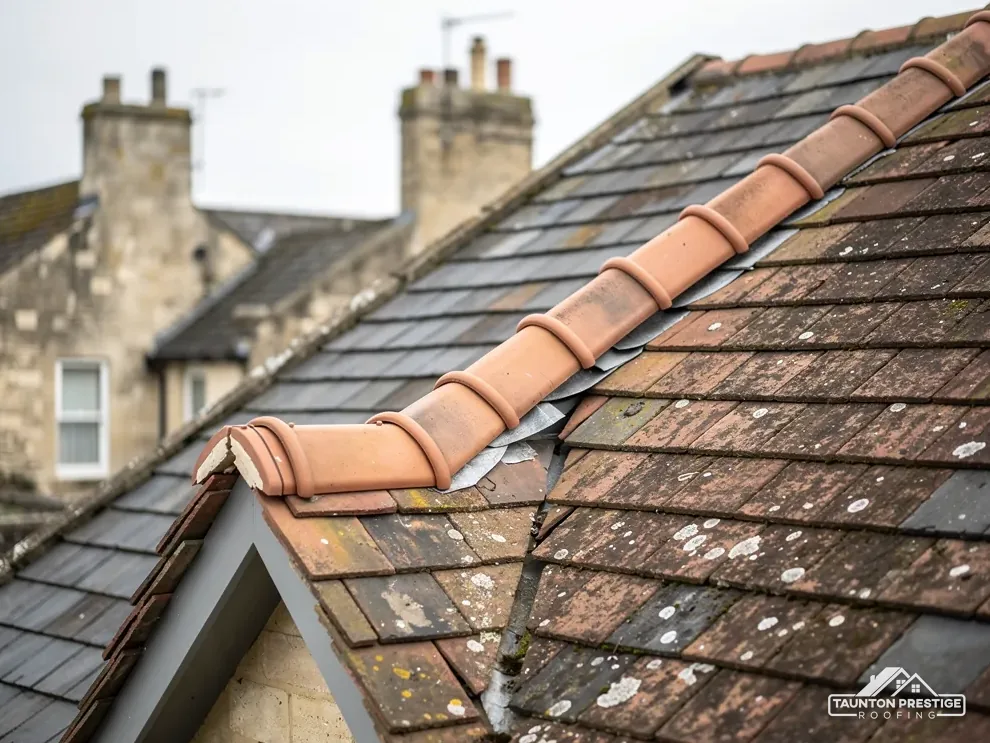
Clay is baked earth, and its colour runs right through the tile, so scratches and chips do not show as pale patches. The Building Research Establishment gives 60 years as the minimum life to expect from clay tiles, and Marley, which reports it, points out that the figure applies to clay only.
Is clay the longest-lasting tile?
Not necessarily. A minimum is a floor, not a forecast. Building conservation writing treats that minimum as a poor guide for old hand-made peg tile, which varies from batch to batch. On a modern roof, a clay tile that is well fixed, with sound battens and undamaged underlay, may last for many decades, though we would not put a number on any one roof.
Pitch is the limit with clay. Marley's published minimums for its clay tiles run from 40 degrees for Canterbury down through 35 for Ashdowne and 30 for Hawkins and Acme Single Camber, to 15 for the Lincoln pantile. A shallow roof can take a pantile but not a plain tile.
Clay is also the tile that fits Somerset's older buildings, since Bridgwater made plain tiles, pan tiles and the Double Roman, according to a local heritage leaflet. Our post on Somerset clay roof tiles tells that story and explains matching.
What clay costs depends on the profile, the quantity and whether reclaimed tiles can be used, so we leave figures to the survey.
Concrete tiles: range and value
Concrete tiles are cast from cement and sand and finished in many profiles. They cover a large area per tile and go on quickly. For a roof that has to match an existing concrete covering, they are the natural choice, and they come in colours and shapes that clay cannot always match at the same cost.
How long do concrete tiles last?
Marley expects its roof tiles to give around 60 years and states that this figure is neither a warranty nor a promise of longevity. Keep that separate from the BRE minimum, which belongs to clay alone. A concrete tile can lose surface colour and gather moss earlier than a clay one, and that stays cosmetic until the surface starts to break down.
Minimum pitches vary widely by profile. Marley lists Plain at 35 degrees, Edgemere and Modern-Duo at 17.5 smooth, Double Roman at 22.5 smooth, Mendip at 15 smooth and its Mendip 12.5 at 12.5, Ludlow Major at 22.5 smooth, Wessex at 15 and Anglia at 25 smooth. That spread lets concrete cover roofs that clay cannot. Ask for the exact profile by name on any quote: concrete interlocking tile is a family of products with different pitches, laps and weights, and a quote that names the tile lets you check the data sheet yourself.
Value sits in the price per square metre and in how well the tile is fixed. For a complete new roof, MyJobQuote (Oct 2026) averages around £5,250, while HomeBuilding (Sep 2025) quotes £10,000 to £15,000 for re-roofing a three-bed semi in plain concrete, with scaffold, labour and insulation among the costs. The guides differ because they count different things, which is why we price after the survey.
Slate: the long game
Natural slate is cleaved from rock into thin sheets. CORC, the roofing contractors' confederation, reckons slate kept in good order can pass a century, the longest figure in this comparison. Slate does not rot, fade or lose its surface, so a roof can outlive several sets of fixings.
Why do slate roofs still need repairs?
Because the stone outlasts what holds it. Nails corrode and slates slip, and an old slate roof that sheds a few slates after a gale often wants refixing rather than replacing. This is why a good slater looks at fixings, not just the slate in front of them. If slates are slipping on a sound roof, a repair is usually the better buy, and our post on slate against tile cost goes through that decision.
For natural slate, BS 5534 gives 20 degrees as the lowest pitch, and Cupa rules out hooks under 25. That makes slate fussier than some tiles on shallow roofs.
New slate costs more. MyJobQuote (Oct 2026) averages a slate roof at around £7,800, against £5,250 for a new roof of any kind. Over a long life that may be the better buy, but it is a bigger sum up front. Slate also suits Taunton's older streets, where the council may look for natural slate on listed houses and in conservation areas, so ask before a swap. See our slate roofing page for the repair work we do.
Side by side: pitch, life and look
Reading across what we have, the three families come out like this. Clay runs from 15 to 40 degrees minimum on Marley's published clays, with a BRE floor of 60 years for clay only. Concrete runs from 12.5 to 35 degrees on the Marley list, with around 60 years expected and no promise attached. Slate starts at 20 degrees, or 25 for hooks, and is quoted at 100 years and more when well kept.
Which tile suits my pitch?
Measure the pitch before you choose. Under 20 degrees, slate is out. Under 30, most clay plain tiles are out. Concrete interlocking tiles give the widest choice at shallow pitches. On a steep roof all three are possible and the choice turns on look and cost.
Look is a personal call, with local guidance behind it. A clay or slate roof that matches its neighbours keeps the character of the street. A concrete roof copying the profile of the original clay is a sensible compromise when the budget is tight, though the colour will not match at first.
Do not forget the rest of the roof. Underlay, battens, ridge fixing and the dry verge systems that replace mortar matter as much as the tile. BS 5534 is guidance, not statute, and ridge and hip tiles take mechanical fixings rather than mortar alone.
Getting a straight answer for your roof
A guide can narrow the field, but it cannot see your roof. The deciding facts are the pitch, the state of the rafters, the covering already up there, and any listing or conservation designation on the house. We look at all of these before we price.
What happens at the survey?
We measure the pitch, check battens and underlay where they show, lift a tile or two at a safe point, and photograph the roof from the garden and from the ridge. You see pictures of your own slopes, and we say which coverings the pitch and structure allow. If you are weighing two, we price both so the totals sit side by side.
If the property is in a conservation area, tell us. Somerset Council's table names areas such as Castle Green and Bath Place, St Mary and St James, and Haines Hill and Trull Road, and what the planning team requires for a change of covering is theirs to say. Where the house is listed, listed building consent covers works that change its character.
Our pitched roofing page sets out the work, and the guide to pitched roof coverings compared adds metal, fibre-cement slate and felt shingles. When you are ready, send the address and the pitch if you know it, and we arrange the survey and write the total.
Tile choice questions
Do all roof tiles last 60 years?
No. The BRE figure of 60 years is a minimum for clay tiles only. Marley expects its concrete tiles to give around 60 years but does not promise it. Slate is quoted at 100 years and more. All three depend on fixings, battens and upkeep.
Is a lighter tile always better for my roof?
Not always. A lighter covering is easier on the timbers, but weight also holds tiles down in wind. The rule that matters is the Planning Portal's: a new covering 15 per cent or more heavier needs Building Regulations approval. Ask a structural engineer or surveyor if you are unsure.
Can I use concrete tiles on a conservation-area house?
The answer comes from Somerset Council's planning team and turns on the house and the street. Class C normally covers a like-for-like change on a house, but a different material can alter the look of the street. A listed house needs listed building consent as well when the work alters its character.
More on this subject: Pitched roofing in Taunton