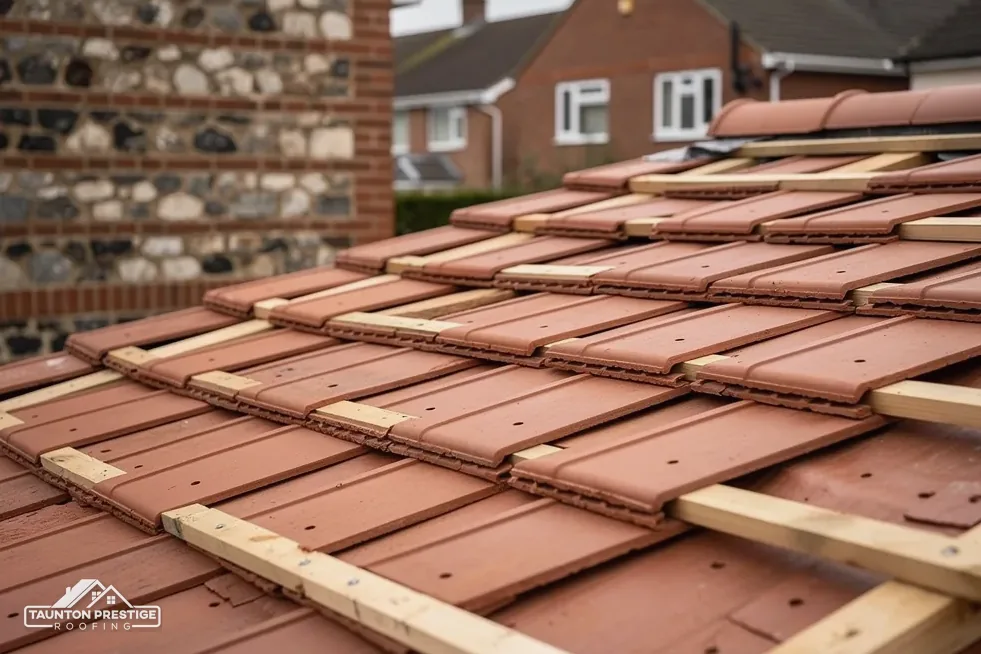
Walk the older streets and farmsteads around Taunton and a few tile shapes keep turning up: the flat plain tile, the curved pantile, and a broad interlocking tile called the Double Roman. A plain tile is a small, slightly cambered tile hung in overlapping courses. A pantile is an S-curved tile that locks into the next tile along. A Double Roman is a wide interlocking tile with two rounded rolls, which gives a roof its deep, ribbed look. The South West Heritage Trust describes Bridgwater's yards turning out many kinds of brick, tile and terracotta, and says they gave many Somerset towns their familiar appearance.
That history matters when a tile slips. Matching a repair on an old clay roof is not the same as buying a bag of anything similar from a merchant. This post tells the Bridgwater story as the heritage sources tell it, describes the profiles, covers reclaimed tiles and matching, sets clay against concrete, and looks at the extra consent steps for conservation areas and listed homes.
The Bridgwater brick and tile story
The Somerset Brick and Tile Museum in Bridgwater looks after a kiln that stood as one of six at what was Barham Brothers' Yard, East Quay. It was last fired in 1965, and the Trust records that it is a Scheduled Ancient Monument which escaped demolition in the 1990s. It is a reminder that tile making here was an industrial trade, not a cottage craft.
What did Bridgwater actually make?
A Bridgwater heritage leaflet from a local group traces the trade in steps. Hand-made plain tiles came first, alongside ridge tiles (called crease tiles in their day) and pan tiles, all added to the brick making. The Double Roman, it says, joined that list of products much later and became popular. It also records that around 1850 there were 16 brick and tile works within two miles of Bridgwater Bridge.
Clay tiles of several kinds were made in and around Bridgwater, and the town is about eleven road miles from Taunton, to the north-east.
If your roof carries old clay, it is worth looking at before anyone replaces it. Some tiles carry a maker's mark on the back or edge, though many do not. A good survey photographs the underside of a lifted tile as well as the face, so you can see what you have and show it to a conservation officer if needed.
Double Roman and pantile profiles
The two profiles that matter most in Somerset are the Double Roman and the pantile, and they behave differently on a roof, so it pays to know which you have.
Is mine a Double Roman or a pantile?
A pantile is a curved tile with a single sweeping S, so the roof reads as a run of waves. A Double Roman is wider and flatter in section, with two raised rolls separated by a flat, and it laps with the tile beside it. From the garden a pantile roof looks lightly ribbed, with a gentle rhythm, while a Double Roman looks bolder, with deeper shadow lines running down the slope.
The roof pitch they need differs too. Marley's table lists its concrete Double Roman at 22.5 degrees minimum on a smooth finish, and its clay Lincoln pantile at 15. Its concrete Plain tile needs 35. Your tile's own data sheet has the last word on pitch, because lap and exposure change the answer.
Profile matters most when only part of a roof is being repaired. A pantile does not sit properly beside a Double Roman, because the curves and ribs do not line up, and the gaps are where wind-driven rain gets in. We check the profile at the first visit, and photograph a spare tile from the ridge or eaves if we can reach one safely.
We also check the tile size. Two tiles of the same profile can differ enough in length to throw the gauge out, and a batten spacing that suits one will leave the other sitting proud.
Matching and reclaimed tiles
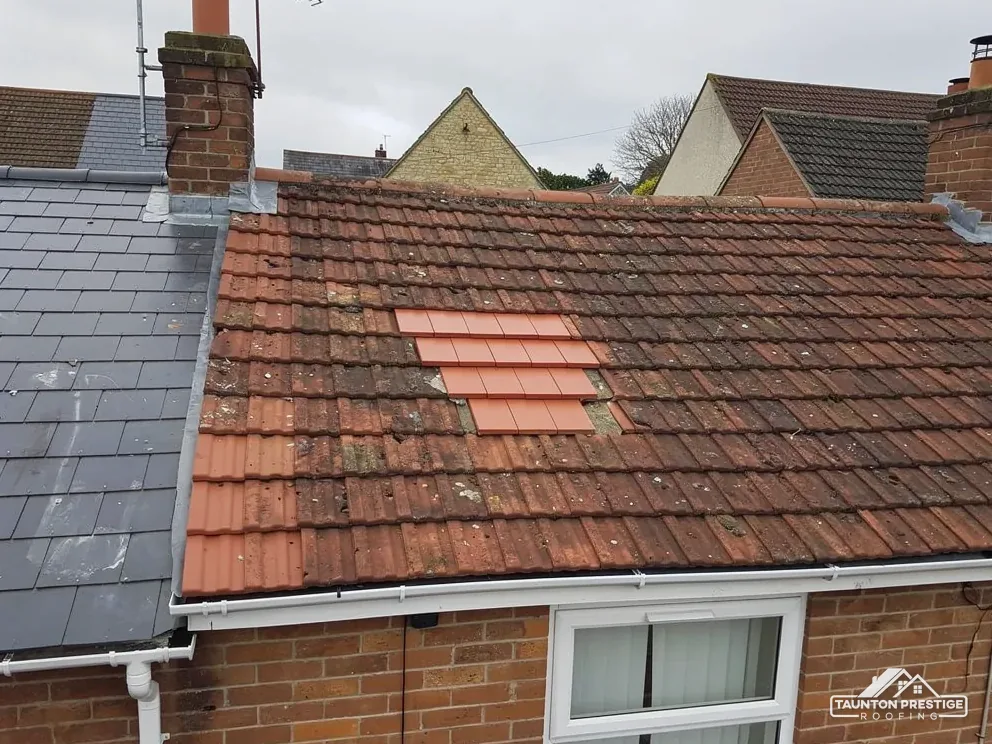
When a clay tile cracks, the sensible repair is a tile of the same profile, size and colour. A new tile in the right shape but a brighter colour will stand out until it weathers; a reclaimed tile has already weathered, and often matches better.
Where do reclaimed tiles come from?
From roofs that have been stripped or buildings that have come down, sorted and sold by reclamation yards and some builders' merchants. Quality varies, so we check each batch ourselves for frost damage, chips and delamination before they go on. A reclaimed tile that looks sound but has sat waterlogged for years may crack in the first hard frost.
Matching works best when the quantity is small. For a few slipped tiles, it is worth salvaging good ones from a hidden slope or the back of the roof and using them on the road side, then replacing the hidden slope's tiles with new ones. For a large area, the better route may be to strip and relay the whole slope, using every sound original tile and topping up with new or reclaimed to match.
Old peg tiles are a special case. Building conservation writing calls the 60-year life figure for clay a poor guide to them. They were hand-made, they vary, and the pegs or nails that hold them can fail well before the clay does. We may recommend refixing a slope before any tile is replaced, because there is little point setting new tile on tired fixings.
Ridge and hip tiles need the same care. On an old roof they are often bedded in mortar and have been for generations, but Marley and BS 5534 now point the other way: mortar on its own no longer carries them, and bedded tiles want a mechanical fixing too. BS 5534 guides practice but is not itself the law, so what counts is whether the fixings suit the roof in front of us. The alternative is a dry system tested to BS 8612, which uses clips and straps instead of a mortar bed. Crease tiles, the old name for ridge tiles, should be matched with the same attention as the field tiles.
See pitched roofing for how we survey and repair these roofs.
Clay or concrete: what changes
A like-for-like clay repair is not always practical, and concrete tiles are a familiar alternative. The two materials have much in common and some real differences.
Is clay better than concrete?
Neither wins in every case. BRE sets a floor of 60 years for the life of clay tile, and Marley, who relay it, say it belongs to clay alone. For its own concrete range Marley talks of around 60 years as well, and stops short of calling that a promise. On paper the two sit close together, so the choice turns on look, weight, profile and cost.
Look is the first. Clay holds its colour through the body of the tile and weathers softly, while concrete tiles are coloured on the surface or in the mix and show their age differently. A concrete Double Roman reads like the clay original from the ground but has its own character up close.
Weight is the second. Under the Planning Portal's rule, new tiles weighing 15 per cent or more than the old need Building Regulations approval, and an engineer or surveyor should be consulted beforehand. Replacing clay with something heavier can cross that line, so we raise it before ordering.
Cost is the third. MyJobQuote (Oct 2026) puts replacing five tiles at around £215, and a full re-tile of 80 square metres at £3,000 to £8,000. Treat those as national ranges only; neither is a price for a Taunton roof. A like-for-like clay repair on a small area can cost less than a concrete re-roof, while a full relay in matching clay may cost more, and the survey is where that is settled.
Pitch is the fourth. Marley's clay range starts at 15 degrees for the Lincoln pantile and runs to 40 for Canterbury, while a concrete Double Roman needs 22.5, so a shallow roof may force the choice before taste comes into it.
Conservation areas and listed roofs
Taunton has several conservation areas, and clay tiles often form part of what they protect. Among the areas in Somerset Council's table are Castle Green and Bath Place and St Mary and St James, both designated 15 January 1975 and revised 26 April 2007; Park Street and Wellington Road and Staplegrove Road, both designated 15 January 1975 and revised 12 November 1998; and, most recent, Haines Hill and Trull Road, designated 14 March 2023. The table also carries entries for Mount Street with Vivary Park, and for Wellington.
Wellington lies about six and a half road miles south-west of Taunton and Bridgwater about eleven to the north-east, both in Somerset Council's area, so one planning team and one Somerset Building Control service cover both, which keeps the consent route simple. Whichever town your roof is in, the first call is to the same council.
Do I need consent to replace clay tiles?
Class C of the permitted development order takes in other alterations to a dwellinghouse's roof, and re-covering a house with a different material is normally permitted development, conservation area or not. Repairing like with like may need no consent at all. Listed houses keep Class B and Class C rights but need listed building consent for works that change their character, and a different tile on a listed roof can do that. Article 4 directions are listed for several places across the Taunton area, so ask Somerset Council's planning team what each one actually covers.
Churches in use have their own route. A Church of England church goes through the faculty system, whereas a Quaker meeting house, a Unitarian chapel or any closed church falls under listed building consent instead.
If your house is on a street with a conservation designation, tell us at the survey. We photograph the roof from the road as well as the ridge, explain which route applies to a repair or a re-roof, and put one total in writing once the visit is done. For weight and pitch on a replacement, which roof tiles are best and our guide to pitched roof coverings compared are the next reads.
Clay tile questions
Can several cracked clay tiles be replaced without stripping the roof?
Usually yes. A roofer lifts the tiles above, slides out the broken one and fits a matching one, taking care with the nibs and the battens. If many tiles have cracked, or the nails have failed across a slope, relaying the slope is a better buy than replacing tile after tile.
Is there a clay tile museum I can visit in Bridgwater?
East Quay's Somerset Brick and Tile Museum is run by the South West Heritage Trust and looks after the Scheduled Ancient Monument kiln. Check the Trust's own site for visiting details before you go, as we leave times and prices to them.
Will new tiles ever match old clay?
Not at first. New clay tiles are brighter and more even than a weathered roof, and they soften over several seasons. Reclaimed tiles of the right profile match sooner. We may suggest reclaimed tiles on the visible slope and new ones on a hidden one.
More on this subject: Pitched roofing in Taunton