A flat roof is built to shed water slowly, not to hold it. In summer a shallow puddle on the membrane (the waterproof skin) dries out in a day or two and nobody notices. In winter the same puddle sits for longer, freezes overnight, thaws by lunchtime and freezes again the next night. That cycle is where many cold-season faults begin, and the leak often shows on a ceiling a week or two after the real damage was done.
This guide walks through the winter problems we are asked about on flat roofs around Taunton and across Somerset: ponded water and freeze-thaw, ice blocking outlets and gutters, condensation that looks like a leak, and the question of whether anyone can lay a new roof in the cold. It also explains why some coverings, and the adhesives and primers that go with them, need dry, mild conditions to bond properly. The wider picture sits on our flat roofing page, and the advice here applies whether the roof is felt, EPDM, GRP or a single-ply sheet.
Why ponded water does the damage
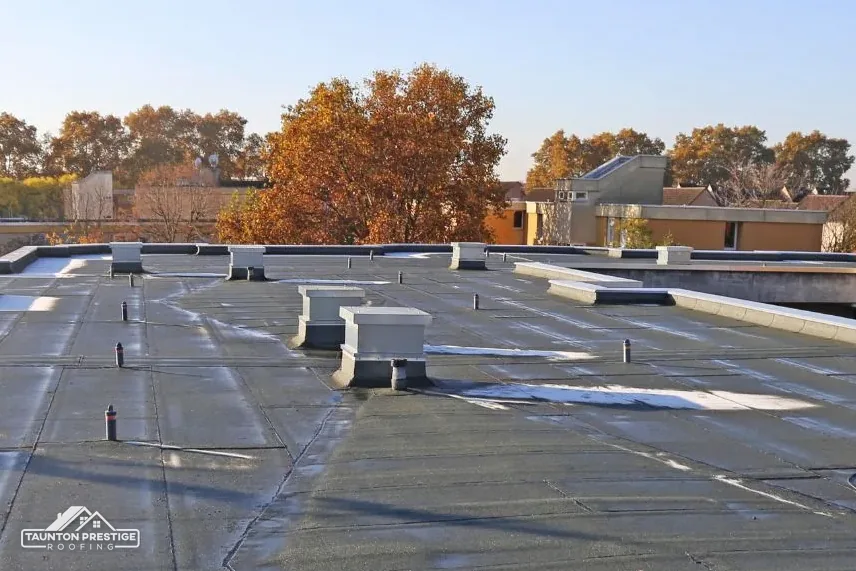
Ponding means water that stays on the roof after rain has stopped, usually in a shallow dip or against a blocked outlet. Despite the name, no flat roof is dead level. Each one is built with a gentle slope, called the fall, that sends rain towards a gutter or an outlet. The current British Standard for flexible-membrane flat roofs, BS 6229:2025, keeps a minimum finished fall of 1:80. To end up with that, the roof is designed for a steeper 1:40, because boards settle, joists deflect and the membrane never sits quite as drawn.
When a roof has lost some of that fall, water collects. Dirt and algae gather in the puddle, the surface weathers faster there, and in cold weather the pool becomes a slab of ice sitting on the weakest part of the covering.
What does freeze-thaw actually do to a membrane?
Water expands as it turns to ice. Any water that has found its way into a lap, a hairline split or a pinhole in the surface is forced open a little further each time it freezes. Thaw, and the gap stays slightly wider than before. A few dozen cycles over a winter can turn a hair-thin defect into a path for rain. Felt that has blistered or lost its surface granules suffers most, because the bitumen underneath is already exposed.
Standing ice also pulls at seams and edge trims as it moves. If you have a puddle that never clears, our answer on what fall a flat roof needs explains how the slope is meant to work.
Ice in outlets, gutters and at the upstands
The next winter weak point is the drainage. A flat roof sheds rain through a gutter along one edge or through an outlet, a round or square opening that leads into a downpipe. Both are small compared with the area they serve. A handful of wet leaves, a crust of moss or a build-up of grit is enough to slow the flow, and a freezing night finishes the job.
Once an outlet is plugged with ice, rain has nowhere to go. The level climbs, and it climbs towards the edges of the roof, where the membrane turns up the wall. That upturn is called an upstand, and the line where it meets the brickwork is sealed with a flashing or a trim. Those details were detailed to shed running water, not to sit under it for days.
Can a frozen gutter cause a leak indoors?
It can. Water backs up under the drip edge or behind a fascia board, finds a nail hole or a gap in the lap and appears inside as a brown stain on a ceiling near the outer wall. If you see that after a cold spell, look at the gutter and outlet from a safe spot on the ground first. If the water is slow to leave, ice is the likely cause, and the fix is clearing the outlet once it thaws, not a patch on the stain.
- Never chip ice off a roof with a spade or hammer, because the membrane cuts easily.
- Never pour boiling water onto a frozen outlet from a ladder.
- Do not walk on a frosted flat roof. The surface is slippery, and it hides splits.
For a roof that overflows rather than freezes, read our answer on why a flat roof outlet overflows.
Condensation: the winter leak that is not a leak
Some winter call-outs turn out to be moisture from inside the house, not rain from outside. Warm air carries water vapour from cooking, washing and breathing. When that air reaches a cold surface it turns back into droplets, which is condensation. On a flat roof the cold surface is the underside of the deck, or the cold side of the insulation, and the droplets can run, drip and soak the timber and plasterboard.
How do you tell condensation from a real leak?
Rain leaks follow the weather. They appear during or just after a downpour and tend to line up under a lap, an outlet or an upstand. Condensation follows the temperature. It builds on cold mornings, clears a little in the afternoon, and shows up as dark spotting, mould or damp patches spread widely across a ceiling, not one neat circle. Cold, still, damp days make it worse.
The root cause is usually how the roof was built. Within a cold roof, the insulation lies between the joists and air is meant to pass through the void above it, so blocked or missing ventilation lets moisture collect. In a warm roof the insulation sits above the deck, which keeps the timber warm, but a gap in the vapour control layer (the sheet that stops damp air rising into the build-up) can let moisture in. BS 5250:2021 is the British Standard that deals with moisture in buildings, and a designer works from it.
Our answer on condensation under a flat roof goes through the signs in more detail.
Can roofers work on flat roofs in winter?
Yes, flat roofing does go on between November and March. The real answer turns on the day and the system, and not on the calendar. A roofer needs three things before a waterproof layer goes down: a dry deck, a surface that is not frosted, and conditions that suit the product's instructions.
What stops a roofer working on a given day?
- Frost or dew on the deck. A film of moisture under a membrane can blister it later or stop adhesive from taking.
- Rain or rain forecast. A roof that is stripped and not yet waterproofed is at risk, so stripping is planned around the forecast.
- Wind. Sheets of membrane and boards of insulation catch the wind like sails.
- Ice underfoot. Safe access matters more than speed.
Good planning removes some of that risk. We strip and recover in sections, so no part of the roof stays open overnight, and we watch the forecast for the days either side of the job. If a fresh frost is due, the work moves. That is a delay that costs a few days. Laying a membrane on a damp deck costs a roof.
Repairs follow the same logic. A make-safe on a leaking roof can go ahead in poor weather, because getting water out of the house matters first. A permanent fix waits for a dry window. Class C of the permitted development rules normally covers re-roofing a house like for like, and building control may still apply to a larger job.
Why some systems wait for dry, mild days
Not every covering reacts to cold in the same way, and the reasons are practical rather than mysterious.
What is cold laying, and what does it need?
Cold laying means installing a roof without a naked flame. It covers single-ply sheets bonded with adhesive, self-adhesive felt layers, and liquid-applied coatings. These products depend on the adhesive or the liquid curing, which is a chemical change that is slowed by cold and stopped by moisture. Each manufacturer publishes the conditions its product needs, in the data sheet that comes with it, and a careful roofer follows that sheet rather than guessing.
Is a rubber roof harder to fit in winter than felt?
EPDM, a synthetic rubber sheet, can often be laid as one large piece, which means fewer seams for the weather to interfere with. The adhesive around the edges and upstands is the part that needs dry, mild conditions. GRP, glass-reinforced plastic, is a liquid resin that cures chemically, so it is the most sensitive to damp and cold. Torch-on felt uses heat from a gas torch to melt the underside of the sheet onto the layer below, so the felt must sit on a dry surface.
When someone offers to lay a roof in any weather, ask which product is going on and what its maker says about conditions.
Getting a flat roof ready for the cold
Most winter flat roof trouble starts with something small that was left alone in autumn. A short check before the cold arrives can save a ceiling.
What can you check from the ground?
- Look for water standing on the roof a day after rain. A pool that never clears means the fall has been lost.
- Check that gutters and downpipes run freely when it rains, and look for overflow marks on the wall.
- Look at the roof edge for lifted trims or a curled edge of membrane.
- Check inside for fresh stains and for mould in the corners of the ceiling.
Anything beyond that, such as clearing the outlet, lifting a lap or looking at the flashings, belongs to a roofer on a ladder with proper access.
What decides the price of winter work?
The cost of a flat roof job depends on the area, the covering you choose, how much old material has to come off, access and scaffold, and whatever the survey turns up when the covering comes off. A typical UK range for a complete flat roof replacement is £1,500 to £6,000, with an average around £2,400 (MyJobQuote, Oct 2026). Waiting for good weather does not by itself add to that, but it may change the start date. The written price follows the survey, where you see photos taken on your own roof.
If your flat roof is showing water on the surface or stains below it, send us the details and we will look at the build-up before the next cold spell arrives.
Winter flat roof queries
Will frost split a flat roof membrane?
Frost alone does not usually split a sound membrane. The danger is water already trapped in a small split, lap or blister, because it expands as it freezes and widens the gap. Roofs with ponding or old, cracked felt are the ones that open up over a winter.
Is it safe to clear snow from a flat roof?
Leave it to a roofer unless you can reach it from a stable position on the ground. Frost hides splits and the surface is slippery. Never use a metal shovel, because it cuts the membrane. Snow that melts normally drains through the outlets, which is why clear outlets matter.
Does an old flat roof need replacing before winter?
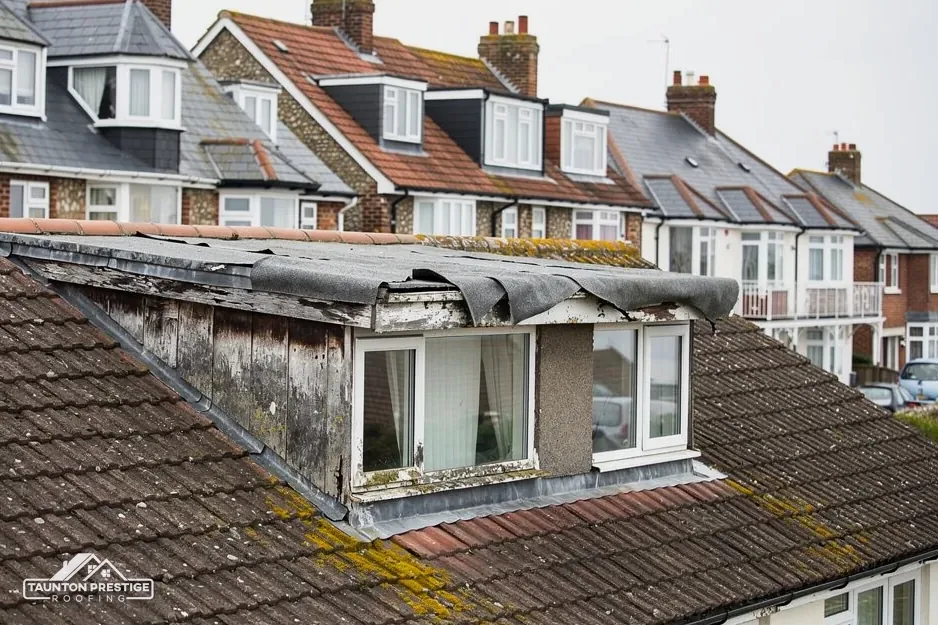
Not necessarily. A roof with a few lifted laps or a worn edge can be repaired and left for a drier month. Replacement makes more sense when ponding is widespread, the surface has blistered, or the same ceiling stains after every cold spell.
More on this subject: Flat roofing in Taunton