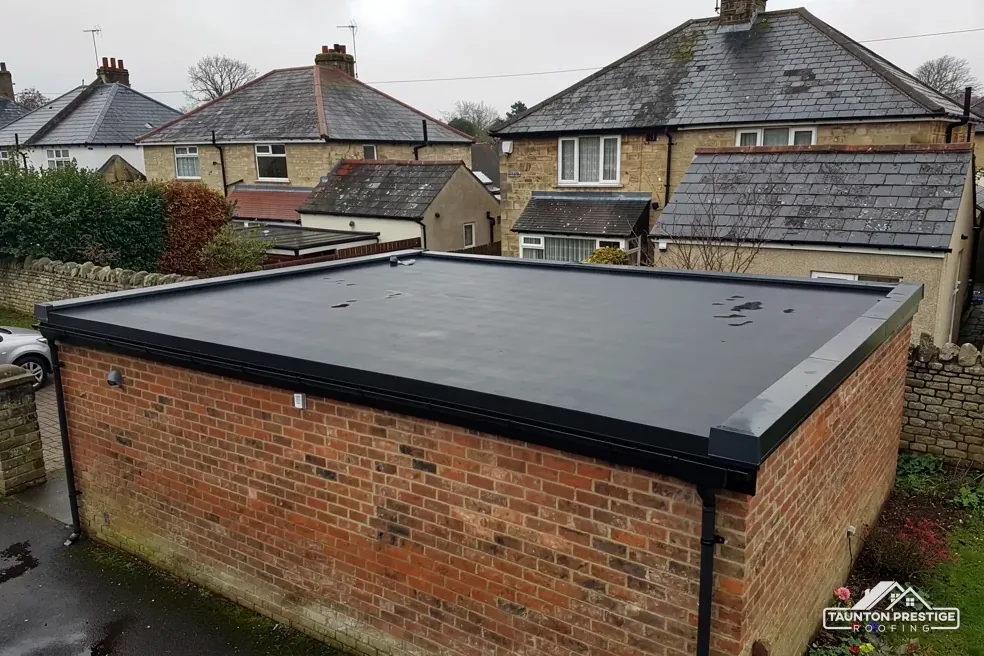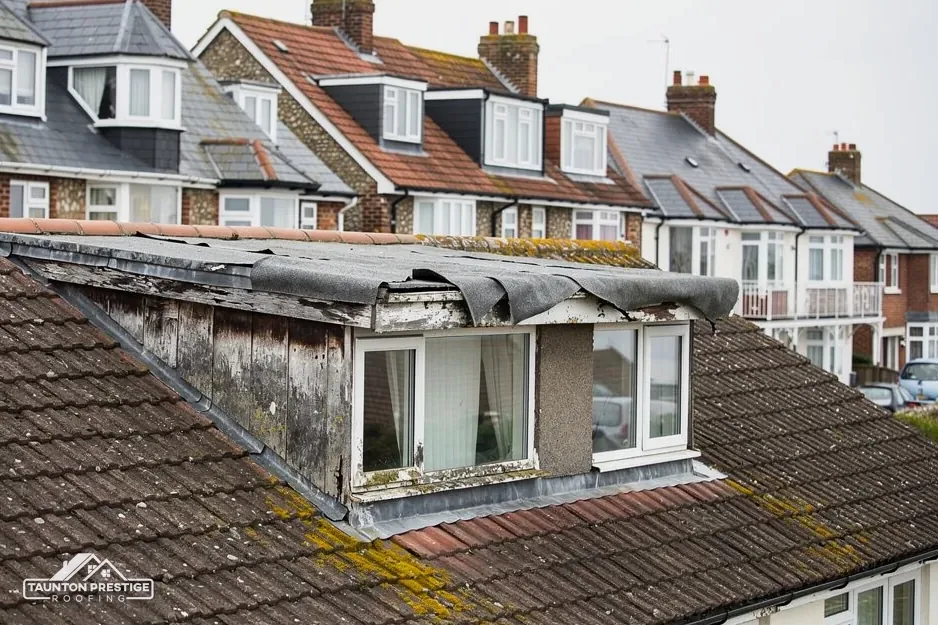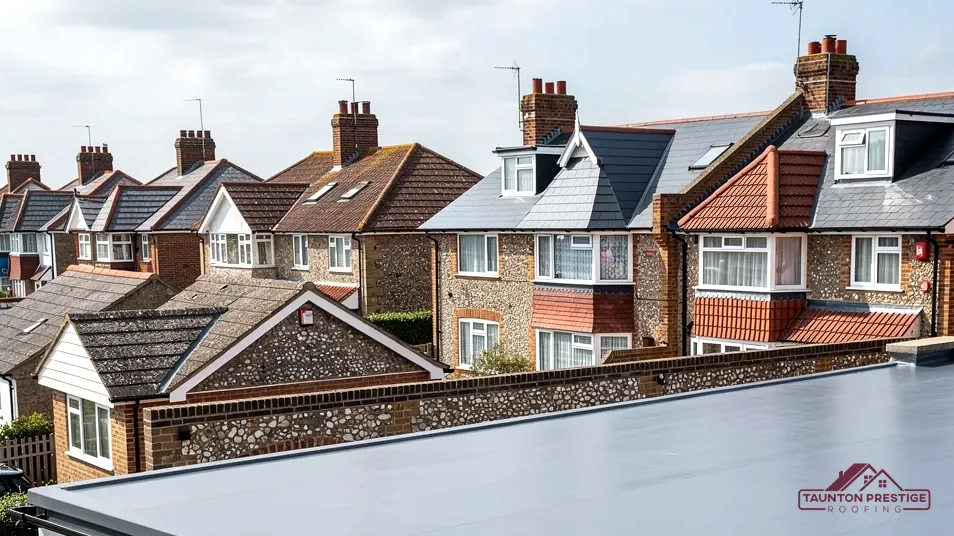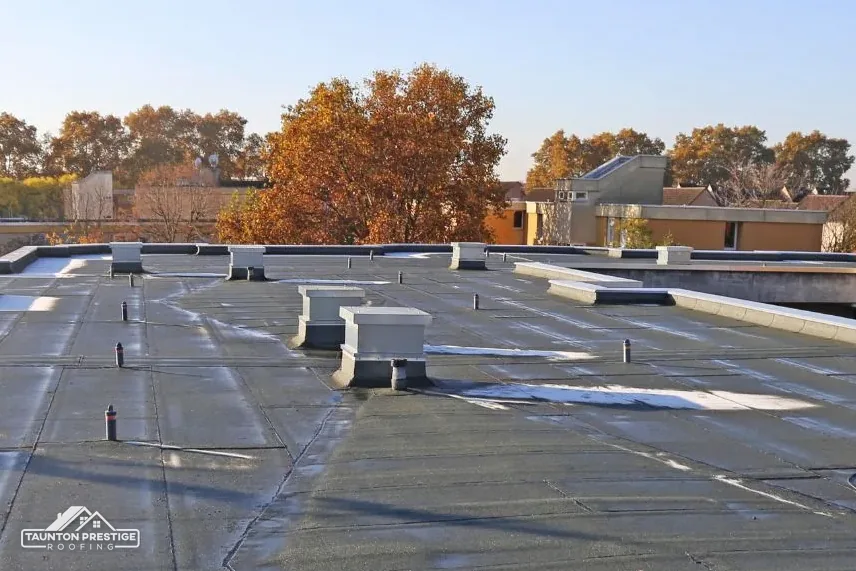
Ask a few people about felt roofs and you will hear about bubbling, splitting and leaks after five years. Some of that is deserved. Plenty of old flat roofs were covered in thin bitumen felt, laid quickly, and left to weather. But the roofing industry has moved on, and the modern product is a different material laid in a different way.
Torch-on felt is a flat roof covering made from sheets of bitumen, the black waterproof residue from oil refining, reinforced with a fabric core. Sheets are heated on their underside with a gas torch so that they melt onto the layer beneath, and the joins are fused together. This guide sets out what separates a modern felt system from the old kind, what the published life spans and costs are for a good job and a poor one, how felt compares with rubber and fibreglass, and which jobs still suit it. It belongs to our wider flat roofing work in Taunton and across Somerset.
How torch-on felt goes onto a roof
A felt roof is built up in layers on a deck, which is the flat boarded surface of the roof, usually plywood or timber boards laid across joists. Before any felt arrives, the deck is checked for soft or damaged boards, and anything that has been wet is cut out and replaced. Then the layers go on.
- A base layer, often a vapour control layer or a first sheet of felt, goes down over the deck.
- Insulation boards follow if the roof is being brought up to a better thermal standard, which Building Regulations can require when a covering is renewed.
- A second layer, the underlayer, is bonded over the top.
- A final cap sheet, which has a mineral surface to protect the bitumen from sunlight, is torched on last.
Throughout, the roofer unrolls the sheet, heats the underside with a gas flame until the bitumen turns glossy, and presses it into place. The joins overlap and are rolled firm so that a ridge of softened bitumen squeezes out along the edge, which is the sign of a properly fused join. The sheet is also taken up the walls and over the edges, with trims fixed at the perimeter. Rainwater needs a clear exit, so outlets and the gutter line are set before the final sheet goes on, and the fall is checked again at the end.
Why does the heat matter so much?
Too little heat and the sheet never fuses, leaving a lap that peels in the first winter. Too much and the bitumen thins and the reinforcement is damaged. This is skilled work, done close to timber and walls, which is why a roofer keeps an extinguisher on the roof and checks the edges before leaving.
Modern reinforced felt against old felt
The felt many people remember was a single thin sheet, or two, of a bitumen-soaked fibre mat, nailed or hot-mopped down. It softened in sun, went brittle in frost and cracked along the lines where it had been stretched.
Current torch-on products are built differently. The bitumen is modified with polymer so that it stays flexible across a wider range of weather, and the sheet is reinforced with a woven core, usually polyester, which holds its shape when the roof moves. One common type is called SBS felt, short for a styrene-butadiene-styrene polymer blend, and it appears in published cost guides for garage roofs. The sheets are thicker, usually laid in two or three layers, and the laps are fused rather than merely stuck.
Is modern felt really a different product?
It is a different grade of product, but it is still bitumen, and bitumen still ages in sunlight. The mineral-coated cap sheet slows that, but it does not stop it. Edges, laps and upstands, where the felt turns up a wall, remain the places a felt roof fails first, whatever the grade.
That is why the roofer matters as much as the sheet. Ask which product will be fitted, how many layers there are, and how the edges and upstands are finished. A clear answer is a good sign. A vague answer, or a price that does not name the product, is not. The same goes for the deck: a felt layer cannot be better than the boards it sits on, and replacing a few rotten boards is cheap beside replacing a roof early.
How long does torch-on felt last?
Published figures for flat roof coverings are typical ranges, never promises, and they depend on workmanship and upkeep as much as on the sheet. Less, a roofing cost guide, gives torch-on felt a life of 10 to 20 years (Less, Oct 2026). The same guide says a well-laid felt roof can reach 20 years, while a badly laid one may give out before year 10.
That gap of ten years or more is the whole story, and it matters when you weigh one quote against another. It is not a difference in the product on the datasheet. It is the difference between a roof laid on a sound, dry deck with fused laps and finished edges, and a roof laid fast over damp boards with the corners cut.
What shortens a felt roof's life?
- Ponding water, which sits on the cap sheet and weathers it faster.
- A deck that was damp or poorly fixed when the felt went on.
- Laps that were not fused, or were burned through.
- Poor detailing at walls, rooflights and outlets.
- Foot traffic that wears the mineral surface away.
Several of these can be seen from below, and a few from the garden. Brown rings on a ceiling, a roof that feels spongy underfoot, or a puddle that stays a day after rain all point at a problem. Our answer on why a felt roof blisters goes through what each sign means.
What does a felt roof cost?
Cost guides give national figures. What follows is a typical UK range from each guide, set out as published. MyJobQuote puts the average felt roof at around £1,500, and a 15 m² garage in SBS felt at between £1,200 and £1,800 (MyJobQuote, Oct 2026). For a complete flat roof replacement in any material, the same site gives £1,500 to £6,000 with an average of £2,400. Less, for a 15 m² garage, gives £1,200 to £2,500 (Less, Oct 2026).
The spread is wide because a roof is not just its area. Several things move the price for any roofer.
- The size of the roof, and how many upstands and edges it has.
- Whether the old covering is stripped or can stay as a base.
- The state of the deck, which cannot be known until the old felt is off or the survey has probed it.
- Whether new insulation is needed to meet Building Regulations.
- Access, scaffold and waste removal.
Is felt the cheaper option?
Published averages do not put felt automatically below rubber: MyJobQuote gives an average rubber roof of £1,050 installed, against around £1,500 for felt (MyJobQuote, Oct 2026). Cost per year of life is the better test. A roof that costs a little less and lasts ten years is poorer value than one that costs a little more and lasts twenty. Our guide to flat roof replacement cost sets out what drives the total.
Always check whether a quote includes VAT, scaffold and waste removal. The one written price we send after the survey is for the whole job.
Should I choose fibreglass or felt?
Fibreglass roofing, called GRP for glass-reinforced plastic, is a liquid polyester resin laid over glass matting that sets into a single joint-free skin. Felt is sheets with fused joins. EPDM is a synthetic rubber membrane, usually in one piece. All three suit a flat roof, and each has a better and a worse use.
How do the published lives and costs compare?
- Felt: 10 to 20 years (Less, Oct 2026), and an average around £1,500 for a felt roof (MyJobQuote, Oct 2026).
- GRP: 25 to 40 years (Less, Oct 2026).
- EPDM: GreenSpec gives 20 to 30 years and Less gives 30 to 50, so the sources disagree, and MyJobQuote gives around £60 per square metre (Oct 2026).
On those figures, the longer lives of GRP and EPDM make the case against felt on a roof that will be left alone. A rubber sheet has few joins. A fibreglass roof has none, but it is rigid, and it can crack if the deck beneath it moves. Our answer on why a GRP roof cracks explains the causes.
Felt wins on awkward shapes. A roof with many penetrations, odd corners or tight upstands is simple to detail in sheets, where a single rubber piece is awkward to cut round and fibreglass needs more preparation. The right answer depends on the shape, the deck, the access and how long you plan to stay. We set out the options after the survey, and you decide.
Where felt still makes sense
Felt is not the right answer for every flat roof, but there are jobs where it is a sound choice, and a roofer should say so plainly.
- Garages and outbuildings with a simple rectangle of roof and no great need for decades of life.
- Roofs with a tight budget and a short horizon, such as a house that will be sold, where the buyer's survey needs a sound covering and nothing more.
- Complex shapes, with many corners, rooflights and pipe penetrations to work around.
- Roofs that suit a repair. A felt roof in good condition with a failed lap or one split corner can often be mended without a strip, for far less than a new roof, though a patch on a roof that is failing all over only buys time.
When should felt be avoided?
Where the deck is wet or rotten, any covering will fail until the timber is renewed, so the first question is always what is underneath. Where there is a boiler flue or other vent close to the work, the naked flame needs more care, and a cold-applied system may be the safer choice. And where the roof will not be reached for repair, such as a first-floor extension that is hard to get at, a covering with a longer published life earns its extra cost.
Whichever covering you choose, ask for a clear specification: the product, the number of layers, the insulation and the way the edges are finished. That way two quotes describe the same roof. Weighing felt against rubber or fibreglass for a roof in Taunton is easier once someone has been up there and checked the deck, the falls and the way water leaves the roof.
Felt roof queries
Can torch-on felt go over an old felt roof?
Sometimes, if the old covering is firm, dry and well stuck down. A new layer over a blistered or wet roof traps the problem underneath. The survey decides it, and a roofer should lift a section or take a core sample before recommending an overlay.
Why do some felt roofs fail within a few years?
Usually the cause is workmanship, not the material: a damp deck, laps that were not fused, thin edge detailing, or standing water. Those faults let water in at the weakest points, and once the bitumen under the cap sheet is wet, the failure spreads quickly.
Is torch-on felt dangerous to lay?
It uses a naked gas flame close to timber, so it needs care and a fire check before the roofer leaves. For some buildings, a cold-applied system avoids the flame altogether. Tell the roofer about vents, flues, thatch or exposed timber close to the roof edge, and ask how the job will be checked afterwards.
More on this subject: Flat roofing in Taunton