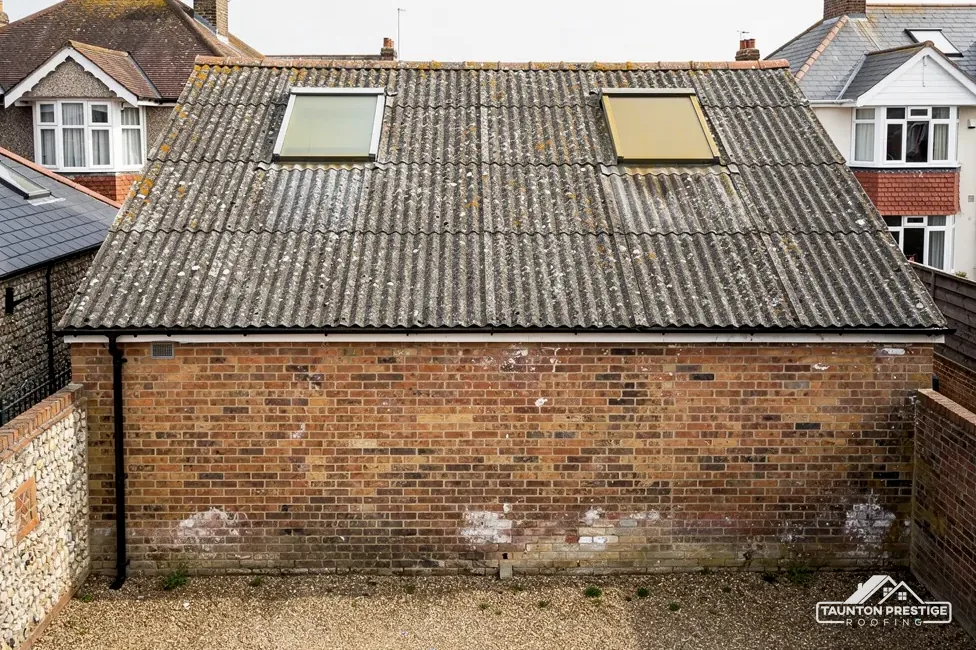
Plenty of Somerset garages still wear their original corrugated roof, the grey wavy sheets that went on in the last century. Sheets of that age may be asbestos cement, a blend of cement and asbestos fibre pressed flat or in waves. Left alone and whole, it sits quietly. The trouble starts when it is cracked, drilled, scrubbed or smashed, because that frees the fibres into the air.
So removal is a process, not a quick strip. The sheets have to be identified, taken off whole where possible, wrapped and labelled, moved by a registered carrier and booked into a waste site on the proper paperwork. This guide follows the job in order: confirming what the roof is made of, what the rules say about careful removal, what a removal day looks like, where the waste goes, what it costs and what comes after. It forms part of our garage and asbestos roof work in Taunton and across Somerset. It is information, not legal advice, and the Health and Safety Executive (HSE) sets the duties that apply to your job.
Step one: is the garage roof asbestos cement?
Your eyes cannot settle it. HSE's starting point is simple: anything built or reworked before 2000 should be assumed to hold asbestos, with a test needed to say otherwise. Somerset Building Control makes a similar point for older buildings in its area. A garage with big corrugated sheets, a shallow pitch and a grey, mossy, chalky surface is a prime suspect, though some modern fibre-cement and bitumen sheets look alike.
How do you confirm what the sheets are?
A small sample goes to a laboratory, taken by a surveyor, and the report names the material. An asbestos survey is typically £325 as a UK price (MyJobQuote, Sep 2026). Where a roof is coming off anyway, many owners plan the work as if the sheets are asbestos from day one, which saves a delay.
Resist the urge to snap off a corner and see. Drilling, cutting, scrubbing or blasting sheets that may contain asbestos puts fibre into the air, and so does a ladder foot set carelessly on a sheet. HSE describes roofs of this type as fragile every time, meaning they give way under body weight, so nobody should climb onto one.
The same survey should cover the rest of the building. Eaves boards and soffits, the boards under an overhanging edge, can be asbestos insulating board (AIB). AIB looks very like the modern boards that replaced it, so a lab result is the only safe test. Taking down AIB soffits can fall into licensed work, depending on HSE's risk assessment rules, so the answer is found early, before the plan for the roof is fixed.
What the rules say about careful removal
HSE sorts asbestos work into three groups: licensed, notifiable non-licensed, and non-licensed. Asbestos-cement sheeting falls into the second or third group, and the way the work is carried out decides which.
When is removal non-licensed work?
Roof sheeting and rainwater goods made of asbestos cement count as non-licensed work provided they are handled with care and taken away without being broken up. That includes sheets that have weathered with age but are still in one piece. A garage roof dismantled one sheet at a time, with each fixing released, each sheet lifted clear and lowered by hand, is in this group.
When does it become notifiable?
If sheets will be crushed or split into fragments, the job joins the notifiable group. HSE's own example is dropping an asbestos-cement roof, which produces large amounts of dust and debris. For notifiable work, a register holding health records has to be kept for 40 years.
That boundary is what separates a careful roofer from a careless one. A roof levered off with a crowbar, with sheets splitting as they fall, becomes a notifiable job by accident. A roof taken apart by someone who has planned how to reach and release every sheet unbroken stays out of it.
Before you accept a price, ask the contractor to describe each step in plain words and to say which HSE group they expect the job to fall into. Listen for the word whole. If the plan is to smash the roof into a skip, that is the wrong answer. Careful removal of the sheets is the first answer, and the survey confirms whether it applies to your garage.
Removal day, in the order it happens
A tidy asbestos removal follows a fixed sequence, and the order matters more than the speed.
- Plan the access. The sheets cannot take weight, so nobody stands on them. Crawling boards or a safe platform spread the load, and the roofer works from the edges and from below.
- Protect the ground. Sheeting goes down where sheets will be lowered, and the area is closed to the family, pets and passers-by.
- Free the fixings. Bolts, hooks and screws are released so the sheet comes away intact. Snapping them with a hammer is the quickest route to a broken sheet.
- Lift and lower. Each sheet is raised clear and brought down by hand, never dropped or thrown.
- Wrap and label. Sheets are stacked on a board, sealed and marked as asbestos waste.
- Clean the site. The ground, the gutters and the roof edges are checked for fragments, which are wrapped with the rest.
How long does removal take?
A small single garage is a short job on its own, but time depends on the roof area, the access, the weather and whether the garage is attached to the house. Wind and rain can stop work, because loose sheets and wet ground make careful handling harder. At the start of each day you are told what is planned, so nothing about the visit is a surprise.
Once the sheets are down, the timbers beneath them are seen properly for the first time, and that is when the true state of the roof appears. Rot at the ends of rafters, a bowed purlin or a wall plate that has moved are all easier to deal with at this stage than once a new roof is sitting on top of them.
Double-wrapping and the waste route
The paperwork matters as much as the removal, and an owner is entitled to ask to see it. HSE's guidance on asbestos waste tells contractors to double-wrap and label it. In practice that means two layers of strong plastic sheeting, sealed, with a clear label on the outside, so nothing escapes while it is handled and anyone who meets the load knows what it is.
Where does asbestos waste go?
No. The household exemption in the hazardous waste rules leaves asbestos out of its scope, so asbestos always travels on a consignment note. That note is a record that follows the load from your property to the site that accepts it. The firm that moves it must be a registered waste carrier with upper-tier registration, and you can ask for the registration details and for a signed copy of the note once the waste has been delivered.
Walk away from anyone who says the sheets can go to the tip with the garden waste, or who offers a very low price to take them off without any paper. A missing note usually means a missing step somewhere else.
GOV.UK publishes hazardous waste consignment note guidance and a register of waste carriers, so a carrier can be checked before work starts. If a contractor cannot name the carrier, the site that will take the waste or the paperwork you will receive, treat that as a reason to ask more questions before saying yes.
What does asbestos roof removal cost?
The figures below come from national cost guides and are published UK ranges. MyJobQuote gives an average of around £2,750 for removing asbestos from a roof (MyJobQuote, Sep 2026). The same site puts a garage roof replacement at £750 to £3,500, averaging £1,500 (MyJobQuote, Oct 2026). That second range covers garage roofs in general, and an asbestos garage adds removal and waste handling to a standard re-roof.
What decides the price of an asbestos garage roof removal?
- The roof area, and how many sheets there are to lift.
- Access, especially where the garage is attached to the house, sits close to a boundary or has a narrow drive.
- The state of the sheets, since sound weathered sheets are simpler to lift than ones already cracked.
- Whether AIB soffits or fascias also have to be dealt with.
- The waste route: transport, the consignment note and the disposal charge.
- The new roof that follows, and any repairs to the structure beneath.
A price well below the figures above should prompt questions. Ask what has been left out: the survey, the carrier, the note, the disposal or the replacement roof. Check whether a quote includes VAT and the new covering, and ask who is responsible for the paperwork.
The price is written after the survey, so the cost of taking the old roof off, dealing with the waste and fitting the new one arrives as one total. That is easier to weigh against another contractor's figure than a string of extras that appear halfway through the job.
What goes on after the sheets come off
With the old sheets gone, the structure lies open and can be checked properly. Purlins, the timbers that run across the rafters and carry the sheets, are examined for rot and bowing. The walls and the plate along the top of them are looked at for cracks or damp where the old fixings went in. Anything that has failed is renewed before the new covering goes on, because a fresh roof laid on tired timber inherits its faults. Guttering and any fascia fixings are checked at the same time, since water that used to run off a corrugated sheet will behave differently on the new covering.
What replaces an asbestos garage roof?
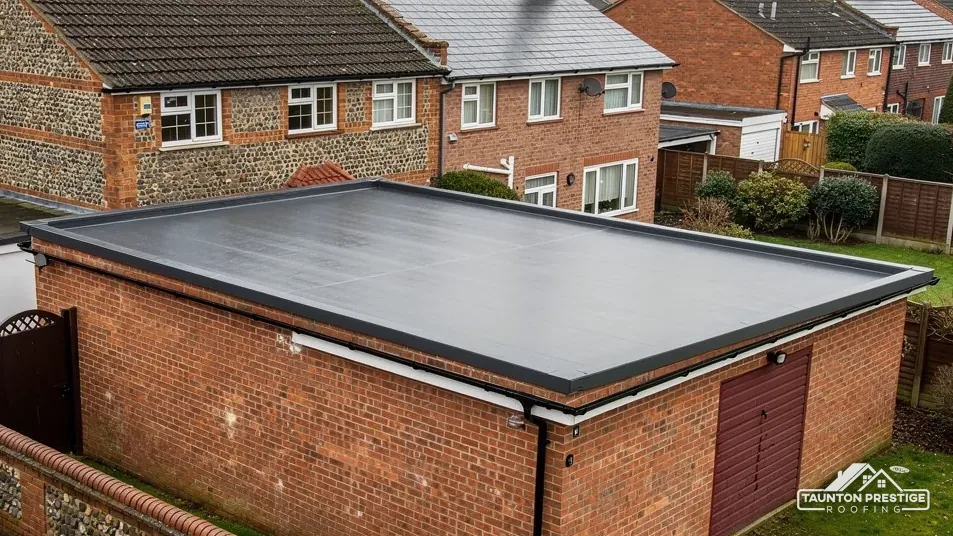
The usual choices are a flat roof in EPDM (a synthetic rubber sheet), GRP (glass-reinforced plastic) or felt, or a sheet roof in box-profile steel or non-asbestos fibre cement. Insulated panels are another route. Each has its own cost, lifespan and look, and the choice depends on the span, the pitch and what the garage is used for. Our guide to replacing a corrugated garage roof with a flat roof covers one common swap, and our page on overcladding an asbestos roof explains why covering over the old sheets is a different thing from taking them away.
If you are thinking about a do-it-yourself job, our answer on removing an asbestos garage roof yourself sets out the issues.
When you are ready to move, we start with a survey covering the sheets, the soffits, the structure and the access, followed by one written price for taking the roof off safely and fitting the new one. You will see photos of your own garage roof before anything is agreed.
Asbestos roof queries
Is an asbestos garage roof dangerous if I leave it?
Whole, undamaged asbestos cement is a low risk if it is left alone, but it is brittle and weathers with age. Avoid drilling, scrubbing or standing on it. Dealing with the roof before it cracks is wise, because broken sheets cost more to remove than sound ones.
Does asbestos roof removal have to be notified?
Careful removal of whole sheets is non-licensed work. If sheets will be badly damaged or broken up, the work is notifiable and a register of work is kept for 40 years. Ask the contractor which group applies to your job, and how they plan to keep the sheets whole.
Can a new roof go over the asbestos sheets instead?
Sometimes the sheets are left in place and covered, but the asbestos then stays on the building, new fixings have to pass through it, and the next owner inherits the problem for good. Our overcladding answer sets out when that is suitable and when removal is the better route.
More on this subject: Garage and asbestos roof replacement in Taunton