Plenty of Taunton garages date from the post-war decades, tucked behind semis and terraces on the town's older estates, and many carry a low-pitched roof of large corrugated sheets. The sheets look like a plain, cheap covering. Some of them are asbestos cement, a mix of cement and asbestos fibre that was sold as roofing and rainwater goods for much of the twentieth century.
If you own such a garage, the first question is not how to get the roof off. It is what the sheets are made of, and what follows if they are disturbed. A sheet left alone is a very different thing from a sheet that has been drilled, scrubbed, stood on or dropped from a ladder.
This post is for owners of garages of that age. It explains the pre-2000 assumption, what asbestos cement sheets look like and why looks are only a clue, how testing works, how HSE sorts the work into categories, what happens to the waste, and what a replacement and the job can cost. Nothing here replaces a test.
Why a 1950s to 1970s garage raises the question
HSE gives a plain rule for any building: if it was built or refurbished before 2000, assume asbestos is present. Somerset Building Control says much the same, writing that in pre-2000 buildings asbestos-containing materials are likely to be met. A garage from the 1950s, 1960s or 1970s sits well inside that window. So does a later garage whose roof was patched using older stock.
Which garage parts might contain asbestos?
Roof sheets are the obvious one, and HSE's guidance names asbestos cement products including roof sheets and gutters. Downpipes in the same material turn up on garages too. Soffit boards under the eaves can be asbestos insulating board, AIB for short, which is a different product from cement sheet. HSE lists external soffits among the places AIB is found, and adds that AIB is easily confused with non-asbestos board.
Does a garage in good condition need action?
Not always. HSE's approach to asbestos in buildings is to manage it in place when it is sound and out of harm's way. A sheet that is intact, dry and untouched is not releasing fibre simply by sitting there. What changes the picture is damage, weathering to the point of breakage, or work on the roof. That is why the rest of this post is about checking before any tool touches a sheet.
Garages around Taunton were built by different hands in different years, so two neighbouring garages can have quite different roofs. Judge each one on its own evidence, starting with the date it was built, any paperwork from a past re-roof and what the eaves look like from the ground.
What an asbestos-cement sheet roof looks like
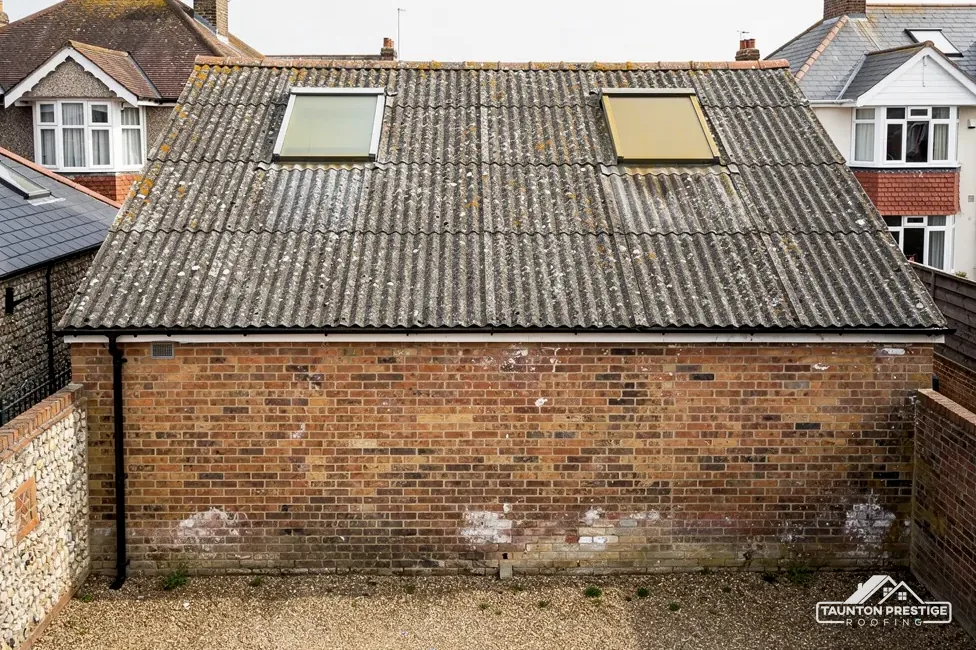
The common picture is a roof of large, grey, wavy-profiled sheets, bolted down through the high points of the waves, with a ridge piece of the same material along the top. Over the years the surface goes pale, gets patches of green moss and lichen, and loses its smooth finish. Where the garage is a single bay, the sheets may run from the front wall to the back without a joint.
Can you tell by looking?
Looks are a clue, not proof. Corrugated sheets in cement, in steel and in bitumen can all be grey and wavy from a distance. A non-asbestos fibre cement sheet looks much the same as an asbestos one. Marks on the underside sometimes help, and a surveyor can read the profile, the bolt type and the age of the building, but the surest route is a sample sent to a laboratory.
What should an owner never do?
Never stand on the sheets. HSE classes asbestos cement roofing as fragile throughout, and falling through one is a danger in its own right, before any dust is counted. Do not drill, saw, scrub, power-wash or sweep moss off the roof, because each of those breaks the surface and sets fibre loose. Do not snap a broken sheet to carry it away. Leave a damaged sheet exactly as it lies and ask for advice.
Our answer on whether it is safe to walk on a garage roof covers the fall risk on every kind of garage roof, and the principle applies with extra force when the sheets might be asbestos.
Testing before anything is touched
A test turns a guess into a fact. A sample is taken from the roof or from a loose offcut by a trained person, sealed in a bag, and sent for analysis. The result says whether asbestos is present and which type. MyJobQuote puts a typical asbestos survey at £325 (MyJobQuote, Sep 2026), which is a national figure and will vary with the number of samples and the site.
Who takes the sample?
It should be someone who knows how to take it with minimum disturbance, in the right protective kit. The cost of a survey is small beside the cost of putting a wrong assumption right. To avoid paying twice, ask the person taking the sample to look at the soffit boards and any outbuilding sheets in the same visit.
What if the test says no asbestos?
Then the roof is an ordinary garage roof and goes through the usual choice of replacement coverings. If the test says yes, the owner has options: leave the sheets in place and manage them, cover them over, or have them removed by the right contractor. Our answer on whether you can overclad an asbestos garage roof explains what is possible and what is not.
Until a result arrives, treat the roof as if it contained asbestos. That means no work, no walking, no pressure washing and no gutter clearing that disturbs the sheets. A leaking garage can often be covered with a temporary sheet laid from the inside or from the edge, without anyone touching the roof surface itself.
How HSE sorts the work
HSE splits asbestos work into licensed, notifiable non-licensed and non-licensed jobs, and which one applies turns on the material and on how it is handled. This is the part that most affects who may do the job and what they must do first.
Is careful removal of asbestos cement non-licensed?
Yes. Taking asbestos cement sheets down whole and unbroken, weathered ones included, falls in HSE's non-licensed group. Non-licensed does not mean unregulated: the workers still need training, suitable protection and a plan for the waste. The sheets come off with their fixings undone rather than snapped, and they are lowered rather than thrown.
What turns it into notifiable work?
Breaking the material up. HSE's notifiable non-licensed group applies once the cement is smashed or heavily damaged during the work, and its own example is bringing a whole roof down in pieces. The registers for that work must be kept for 40 years. A roofer who drops sheets from the roof in fragments has moved the job into a stricter group, with notification and records to follow.
Where do soffits fit?
Soffit boards of AIB are different. Pulling them out can well be licensed work, subject to HSE's risk assessment rules, so they are checked first. Short refurbishment jobs on AIB can fall in the notifiable group instead. A garage with timber soffits, or none at all, avoids the question; one with grey board under the eaves does not.
For that reason a Taunton garage roof job starts with the test and a look at the eaves, not with a quote for taking the sheets off. No price means much until the material is known, because the category sets the method, the crew and the paperwork.
Waste, removal and what it costs
Asbestos waste is not household rubbish. HSE's waste guidance is to double-wrap it and label it. GOV.UK's household exception for hazardous waste leaves asbestos out, so it travels on a consignment note with a registered carrier. It never goes in a skip with ordinary rubble, and it never goes to the council tip in the back of a car without checking the rules first.
Who takes the waste away?
The firm removing the sheets arranges the carrier and the consignment note, and the paperwork should stay with you afterwards. Ask to see it. A tidy site matters more than usual here, with sheets lowered rather than thrown, wrapped as they come off, and the ground swept over every evening.
What are the typical UK costs?
MyJobQuote puts asbestos roof removal at around £2,750 on average (MyJobQuote, Sep 2026). The same guide gives a garage roof replacement between £750 and £3,500, with an average of £1,500 (MyJobQuote, Oct 2026). These are typical UK ranges. Roof area, access, whether the test is already done, the distance to a disposal site and the new covering all move the price, and one written price comes after the survey and the test.
Our guide on asbestos garage roof removal step by step follows a job from test to tip, and the answer on removing an asbestos garage roof yourself sets out why the private route carries risks the owner may not see. Write every question about your roof in a notebook before you phone anyone, and note the garage's age, any earlier repairs and any grey board under the eaves.
What goes on instead, and who to ask
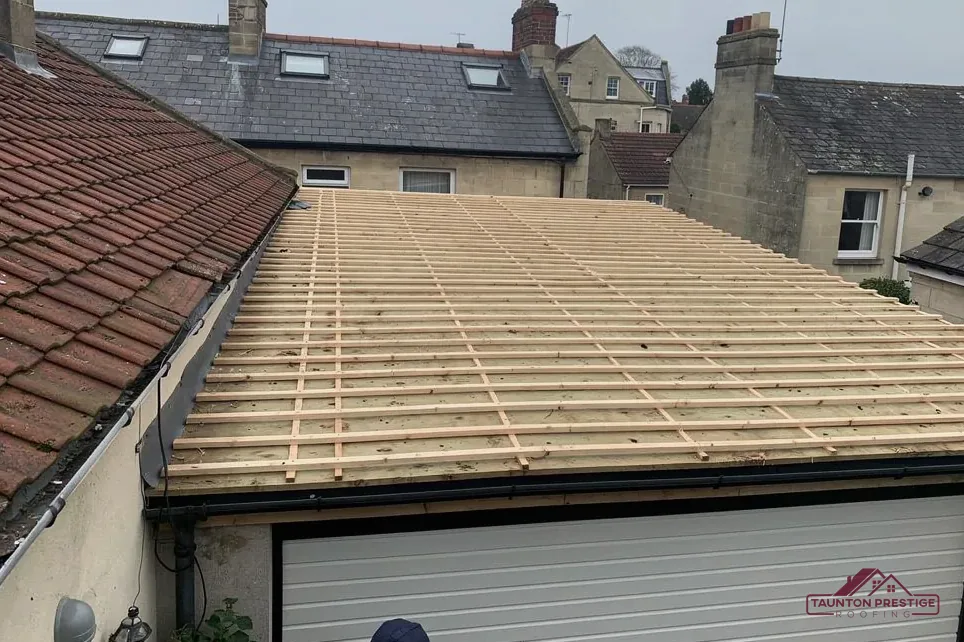
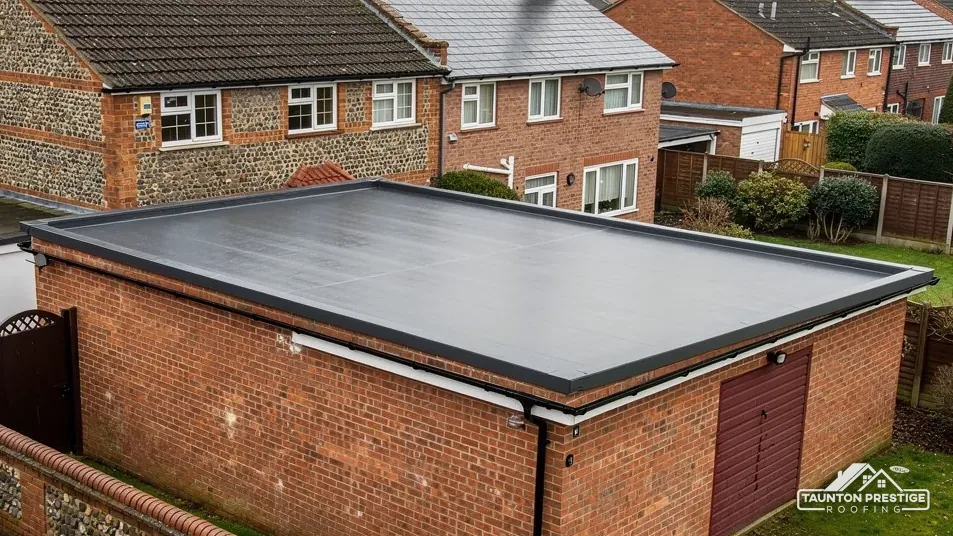
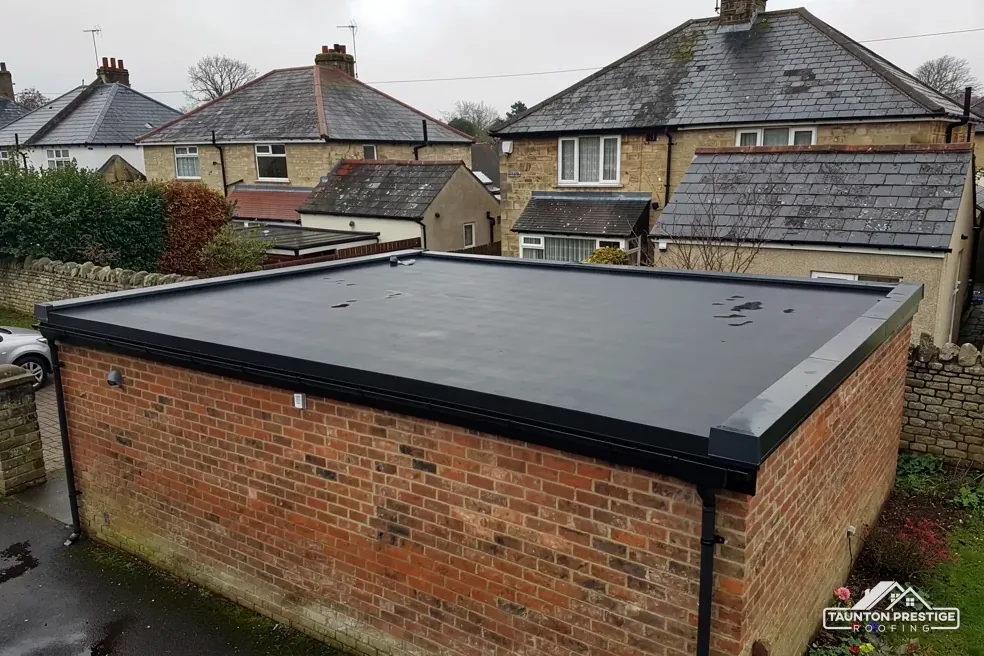
Once the sheets are gone, the garage needs a new roof. The choices are the ones in our guide to garage roof options: EPDM, GRP, felt or sheets. EPDM is a rubber membrane, GRP is fibreglass in resin, and felt is bitumen-based roofing laid in layers. Coated steel or fibre cement sheets are the lightest route when the old rafters are weak or the garage is a long span, and a surveyor can say which suits the frame.
Will the new roof need a different structure?
Sometimes. Old sheet roofs are carried on purlins, horizontal timbers or steel rails, set at wide spacing. A felt or GRP roof needs a continuous deck of boards, which means a new layer of timber and often new falls. The weight, the fixings and the boundary walls all need checking. If the garage is attached to the house or shares a wall with a neighbour, the party wall rules may apply to some building work.
Is planning permission needed?
The answer depends on the size, the position and whether the property is listed or in a conservation area, so check with Somerset Council's planning team before ordering anything. For Building Regulations questions, Somerset Building Control is on 0300 303 7790.
Photographs help a great deal. Send us pictures of the garage, the underside of the sheets and any soffits, and say when it was built. Our garage and asbestos roofs page shows the work we take on, and we talk through the testing route with you before one written price is set after the survey.
Garage roof asbestos questions
My garage roof has cracked grey sheets. Should I cover them with a tarpaulin?
Covering a damaged sheet from the edge or the inside is better than climbing on it, but do not drag a tarpaulin across the surface or fix it through the sheets. Photograph the damage, keep clear, and have the roof tested before a roofer works on it. The test decides which category the work falls into.
Do I have to tell anyone before an asbestos garage roof comes off?
That turns on the HSE category. Taking sheets down whole is non-licensed work. Once they are substantially broken up, HSE puts the job in the notifiable non-licensed group and it must be notified. The firm doing the work should explain which applies and keep the records.
Is a garage built in the 1990s safe from asbestos?
A date before 2000 raises the possibility, and the 1990s sit inside that window, though the risk falls the later the build. HSE's advice for a building dating from before 2000 is to assume asbestos is there. A test settles it, and a garage re-roofed with new sheets after that may be free of it.
More on this subject: Garage and asbestos roof replacement in Taunton