A cast iron gutter can outlast three generations of owners if somebody keeps the paint on it. That is why so many Victorian and Edwardian terraces around Taunton still wear the original rainwater goods, the gutters and downpipes that carry water off the roof. They are thick, they are heavy, and they are made in sections bolted together, which means a failure is usually local: one cracked length, one leaking joint, one rotten bracket. A whole-run replacement is rarely the first answer.
It is also easy to get wrong. Cast iron cannot be bent back into shape. A section that has cracked from frost or a blow stays cracked, and a corroded joint will weep until it is opened up and resealed. This guide covers how the system is built, how to read what is wrong from the ground, what a proper repair involves, when replacement makes sense, and what the rules say about changing the look of a historic house. It sits within our gutters, soffits and fascias work in Taunton and the villages around it.
How a cast iron gutter system is put together
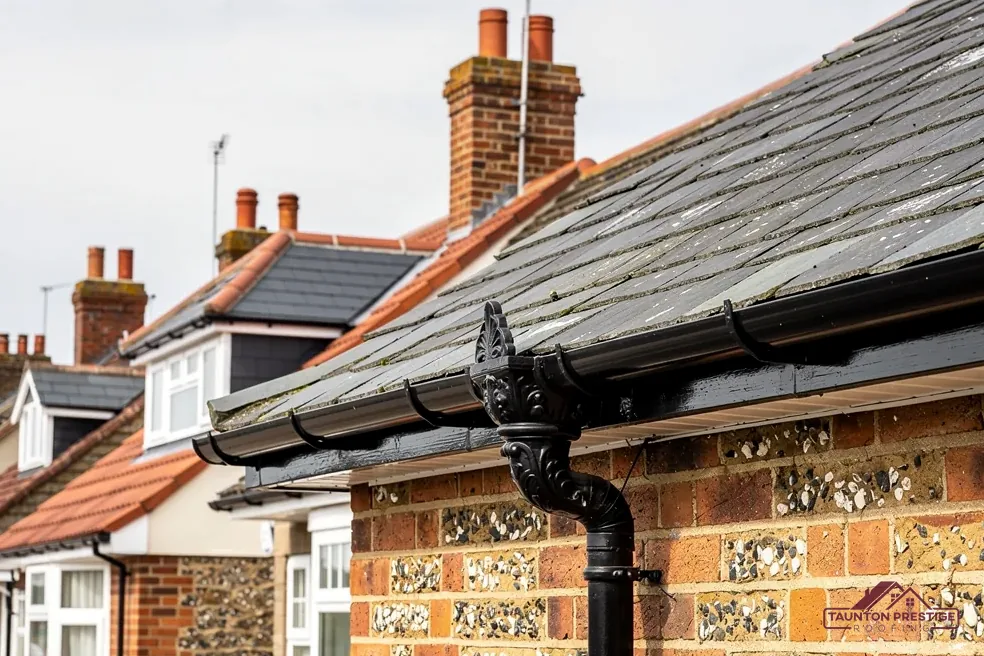
Cast iron guttering arrives in lengths, usually a metre or two long, each with a flange at the end. Neighbouring lengths are bolted together through the flanges, with a bedding material between them to keep water in. Over decades that bedding dries, shrinks and lets go, which is why joints are the first place to leak.
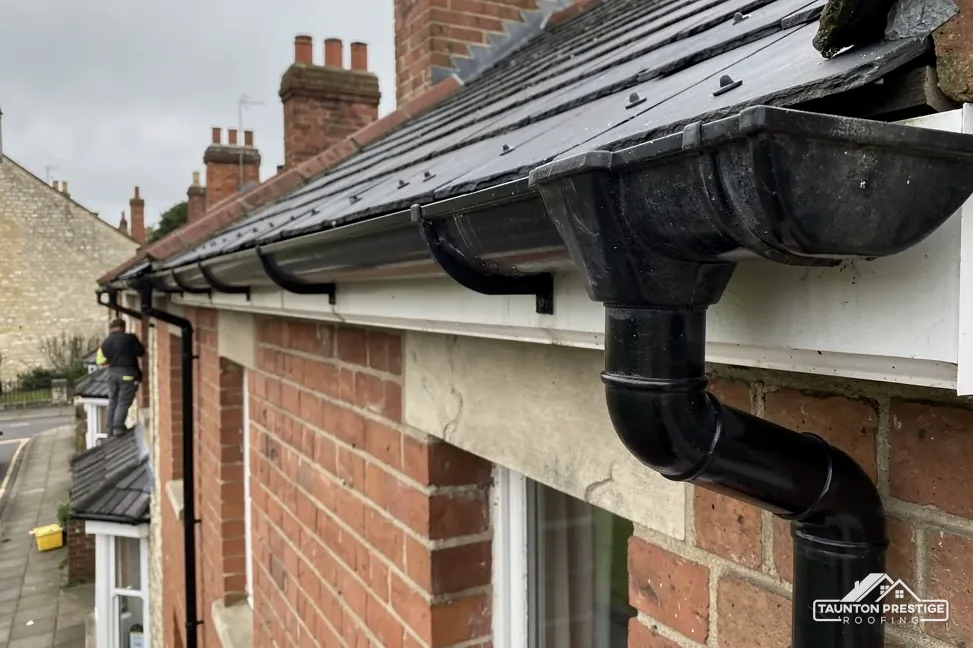
The gutter itself is carried on brackets. On older houses these are screwed or nailed into the fascia, the board along the edge of the roof, or fixed to the rafter ends, the angled roof timbers that stick out under the eaves. Some run on iron brackets that clip around the gutter; others sit in a notch cut into the wood. A downpipe takes the water from an outlet, down the wall, to a drain or gully at the bottom. Where a downpipe starts, a box-shaped hopper often catches the flow from the gutter or from a waste pipe.
What profiles do you find on Victorian homes?
Two shapes dominate. Half-round gutters are a simple curve. Ogee gutters have a moulded front that looks like a classic cornice from the street, and they are the more decorative of the two. Both are made in different widths. Matching a profile matters on a historic house, since a gutter that is a different shape from the original changes the character of the whole eaves line.
Knowing the layout also helps you describe a problem to a roofer. "The joint by the bay window" or "the bracket at the back corner" is far more useful than "the gutter is leaking", and photographs from the ground can help a great deal.
Reading the damage from the ground
Ten minutes with binoculars, once on a dry day and once in the rain, tells you plenty. Rain is the best test. Watch the run during a downpour and see where the water leaves the system.
What do failing cast iron gutters look like?
- Water running down the wall below a joint, leaving a dark streak.
- Rust flaking from the underside, with orange stains on the brickwork or render.
- A run that dips between brackets, or leans out from the fascia.
- A hairline crack along a length, often at the bottom curve.
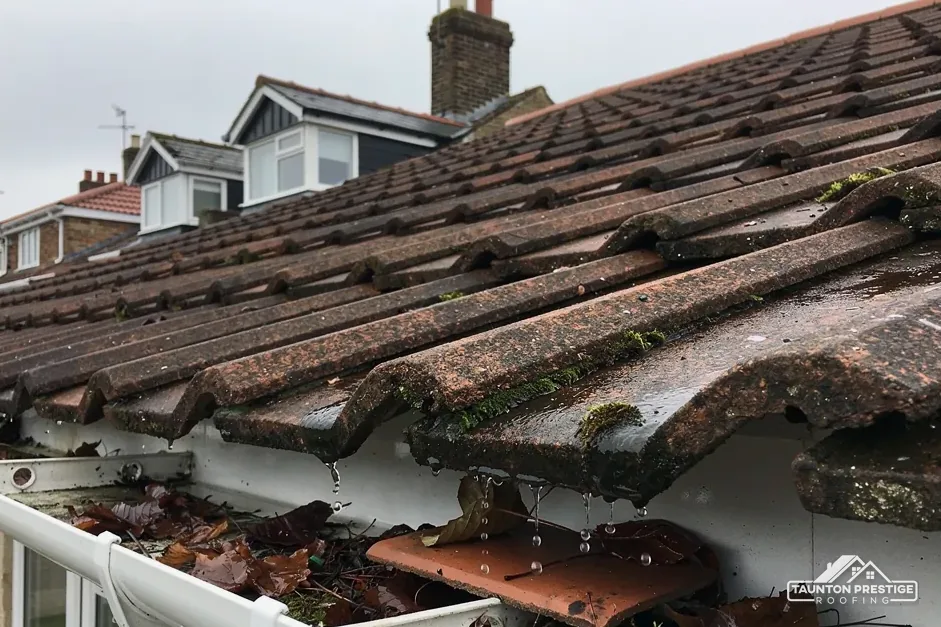
- Plants growing out of the gutter, a sign that it holds debris and standing water.
- Downpipes that bulge, split at the back or sit loose on their fixings.
Staining below the gutter is the clue to follow. A single dark line from one joint suggests a failed seal that can be redone. A wide patch of wet masonry along the wall suggests a sagging or blocked run, where overflow is soaking the wall rather than leaving through the downpipe. Our page on the gutter leaking at the joint covers the common causes.
Is the fall right?
A gutter needs a slight fall towards the outlet so the water keeps moving. Brett Martin, a gutter manufacturer, recommends 1mm for every 600mm of run. Cast iron that has sagged between brackets can hold water in the low spots, and standing water speeds up rust from the inside. Setting the fall properly is part of any repair that involves refixing brackets.
Whatever you notice, avoid leaning a ladder on the gutter itself. Cast iron is strong when sound, but a corroded section can snap under a person's weight.
What a proper repair involves
The principle with cast iron is to repair what is repairable and replace only what has failed. Because it is made in sections, the work can be targeted.
A sensible repair follows this order:
- Clear the run of leaves, moss and debris, so the damage is visible.
- Check the brackets and fixings, and replace any that have rusted or loosened.
- Open up leaking joints, clean the faces, and reseal with a new bedding and fresh bolts.
- Cut out and replace a cracked length with a matching section, new or reclaimed.
- Prime bare metal, then paint inside and out, working a protective coat into the inside of the gutter, where rust starts.
- Test with water and check the fall before taking the access away.
Can a cracked cast iron gutter be repaired?
Sometimes, but the repair has limits. A small crack can be filled and painted, which buys time. A long split or a run of fractures is better replaced with a new length of the same profile. Fillers on a crack that keeps moving soon fail, so a roofer who suggests a replacement section is not being greedy; the crack may simply have taken the gutter's strength.
Painting is part of the repair, not an extra. Cast iron's working life depends heavily on its paint. A neglected gutter can rust through from the inside while the outside still looks reasonable, so the inside coat is the one that decides the lifespan.
Replacing guttering outright runs around £1,000 to £1,600 as a typical UK range, to compare against a repair (MyJobQuote, Oct 2026). That is a general figure for a house, and cast iron prices depend on the profile, the length and the access. A targeted repair makes sense where most of the system is sound.
Repair or replace: where the line falls
The honest answer to repair or replace comes down to how much of the system is beyond saving. A run with two bad joints and one cracked length is a repair. A run where the metal is thin and flaking along its whole length is not.
These are the signs that point to replacement:
- Rust holes across several lengths, rather than at a single point, which shows the metal is thin throughout.
- Cracks that keep returning after repair.
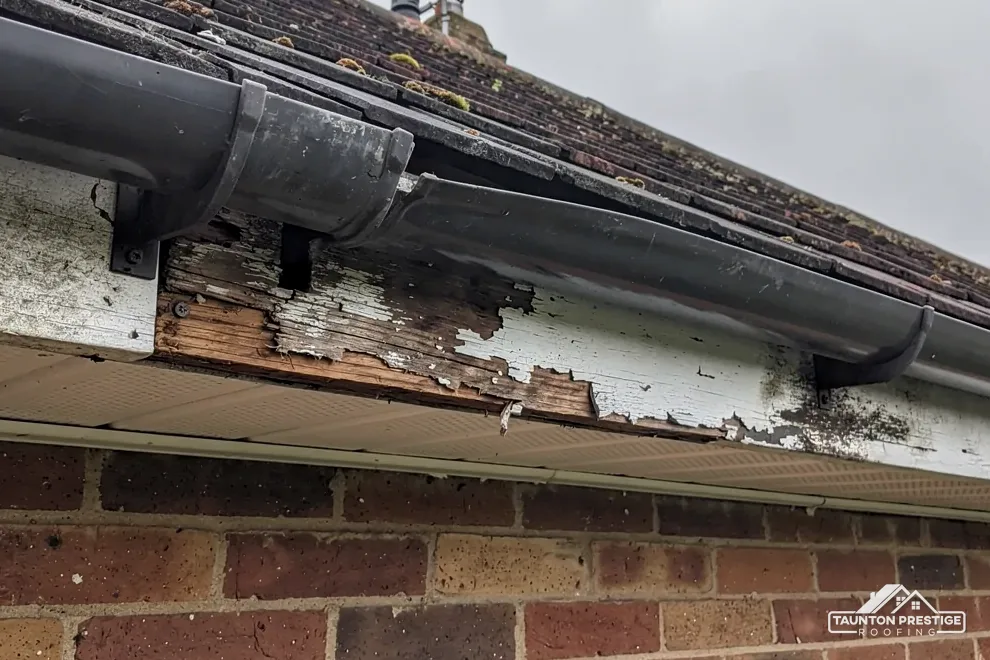
- Brackets that no longer hold because the fascia or rafter ends behind are rotten.
- Downpipes with split backs that cannot be resealed, or that sit loose on rusted fixings.
What about the fascia and rafter ends behind?
A gutter that keeps pulling away may not be the problem. Timber behind it can rot when the gutter has leaked for years, and fresh brackets will not hold in soft wood. The eaves need looking at as one system, and the cure for a dropping gutter may be a sound board first. A cast iron gutter is heavy, particularly when full of rainwater, so it needs strong fixings.
Replacement in cast iron, to match the old profile, is the like-for-like choice. Our page on repairing or replacing guttering sets out how the decision works for any material. Where the house has a lead-lined valley or parapet gutter in place of an iron one, that is a different job, covered under our lead work pages.
The cost of getting it wrong is worth remembering. Gutters that overflow soak walls, and repairing damp brickwork, plaster and timber later is the larger bill.
Like-for-like, planning and listed buildings
Replacing a gutter with an identical one is, as a rule, outside the planning system. The Town and Country Planning Act 1990 s55(2)(a) leaves out work that does not change a building's outward look in any real way, so such work is not development at all. A cast iron gutter swapped for the same profile in the same colour fits that description. A plastic gutter on a Victorian terrace changes the look, so the like-for-like point is the one to protect.
Do listed buildings need consent for gutters?
Under s7 of the Planning (Listed Buildings and Conservation Areas) Act 1990, altering a listed building in a way that touches its special architectural or historic character needs listed building consent. Whether a particular gutter change affects character is a judgement for the council, so ask before you order. Original cast iron can be part of a building's character, so treat it as a feature rather than a nuisance. Replacing it with a different profile or material is the kind of change that tends to raise the question.
Permitted development rights for roof work still exist on a listed house, but consent for works affecting character is separate. Churches follow different consent routes again.
And a house with no listing?
Then like-for-like is your safe course. If you are moving away from the original material or profile, perhaps because a long run has gone beyond saving, check with Somerset Council's planning team before ordering. Within Exmoor, Exmoor National Park Authority handles planning, not Somerset Council. Our fascia planning permission page deals with the same type of question for the board behind the gutter.
Taunton's conservation areas and what to ask first
A conservation area is a place the council has designated for its special character. Somerset Council's table lists several in Taunton, each with a designation date. The Castle Green and Bath Place area carries a designation of 15 January 1975, revised on 26 April 2007. Park Street and Wellington Road, Staplegrove Road and The Crescent were also designated on 15 January 1975, each revised on 12 November 1998. St Mary and St James dates from 1975 and was revised in 2007. Haines Hill and Trull Road is a recent one, designated on 14 March 2023. Mount Street and Vivary Park is also designated, though the council's table gives no usable date.
Other places nearby carry conservation status as well, including Bishops Hull, Kingston St Mary and Wiveliscombe, among others. If your house stands in one of them, assume that the choice of material at the eaves is of interest to the council.
What is an Article 4 direction?
It is a direction that removes specified permitted development rights in an area. Somerset Council's list includes a direction at Staplegrove Road in Taunton, confirmed in 1977, and others at Wellington. What a given direction removes is for the planning team to confirm, so ring them before you assume anything about gutters, windows or roofs.
Our approach is straightforward. We survey the run, take photographs of the damaged sections, and tell you whether it can be repaired or needs new castings. Where the house has a listing, or stands in a designated area, we help you ask the right question of the council before anything is ordered. You then get a single written price for the agreed work.
Cast iron gutter questions
Can I swap cast iron gutters for plastic on a Victorian terrace?
You can, but the look changes, which is why the like-for-like rule matters. Section 55 of the 1990 Act exempts works that do not materially affect appearance, and plastic usually does. With a listed building or a house in a designated area, put the question to Somerset Council's planning team before ordering anything.
Why do my cast iron gutters leak at the joints?
The bedding between the bolted flanges dries and shrinks over decades, and rust works at the bolts. Water then escapes at the seam. Opening the joint, cleaning the faces and resealing with fresh bedding and new bolts usually cures it, provided the metal either side is still thick enough.
How often should cast iron gutters be painted?
There is no fixed interval, because it depends on exposure, shade and the state of the last coat. What matters is catching bare metal early: look for flaking, orange staining and bubbling paint, and repaint inside the channel too when you see them, since that is where rust starts.
More on this subject: Gutters, soffits and fascias in Taunton