The soffit is the board you see when you look up under the eaves, the underside that closes the gap between the wall and the edge of the roof. On many Somerset houses it has hung there, painted every few years, for half a century. Most owners never give it a thought until a gutter needs replacing or a fascia board rots and a roofer says the soffit will have to come down too.
That is the moment to pause. On houses built or refurbished before 2000, soffits can be made of asbestos insulating board, a flat sheet that contains asbestos fibre. It looks like any other painted board, it is safe while it is whole and undisturbed, and it releases fibres when it is drilled, sanded, snapped or scrubbed. This guide explains where the material turns up, why you cannot identify it by looking, how HSE draws the line between licensed and non-licensed removal, what happens to the waste, and how the work fits around the rest of a roofline job. It sits within our gutters, soffits and fascias work for Taunton homes. Treat what follows as background reading and not as legal advice.
Where asbestos shows up on a roofline
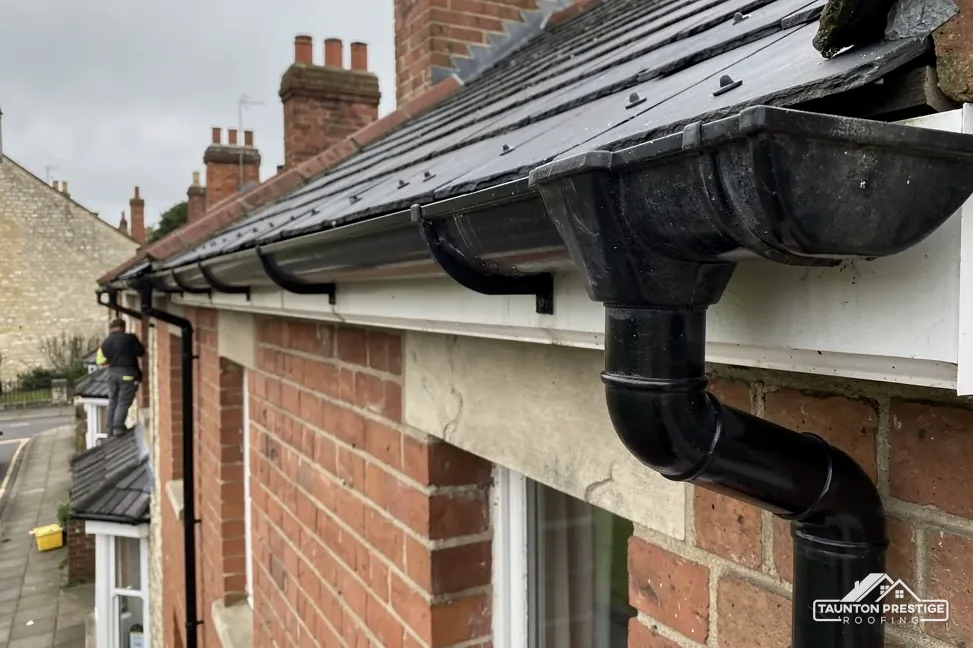
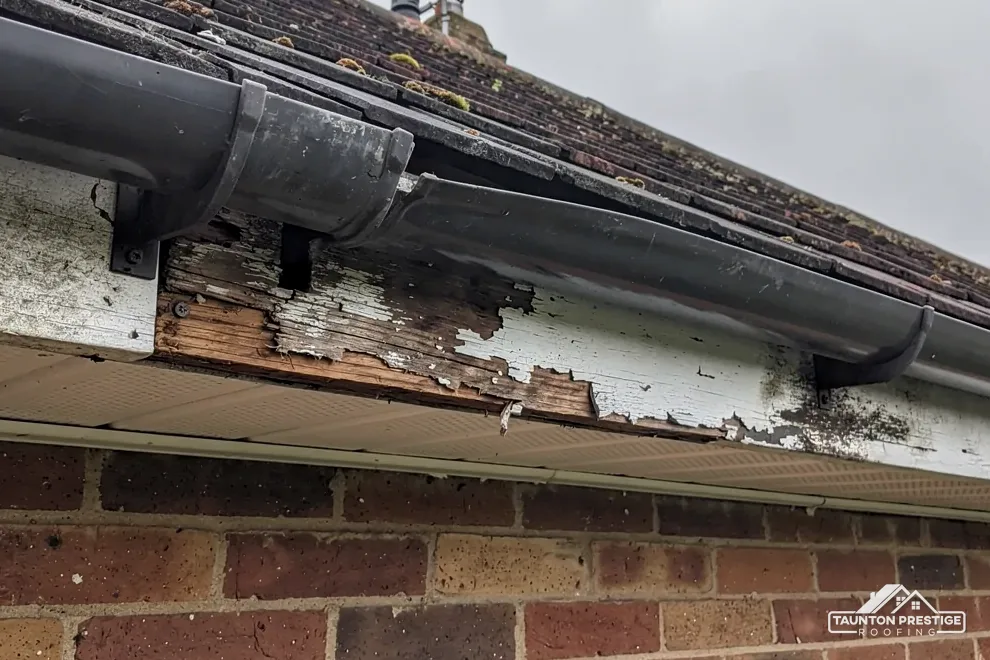
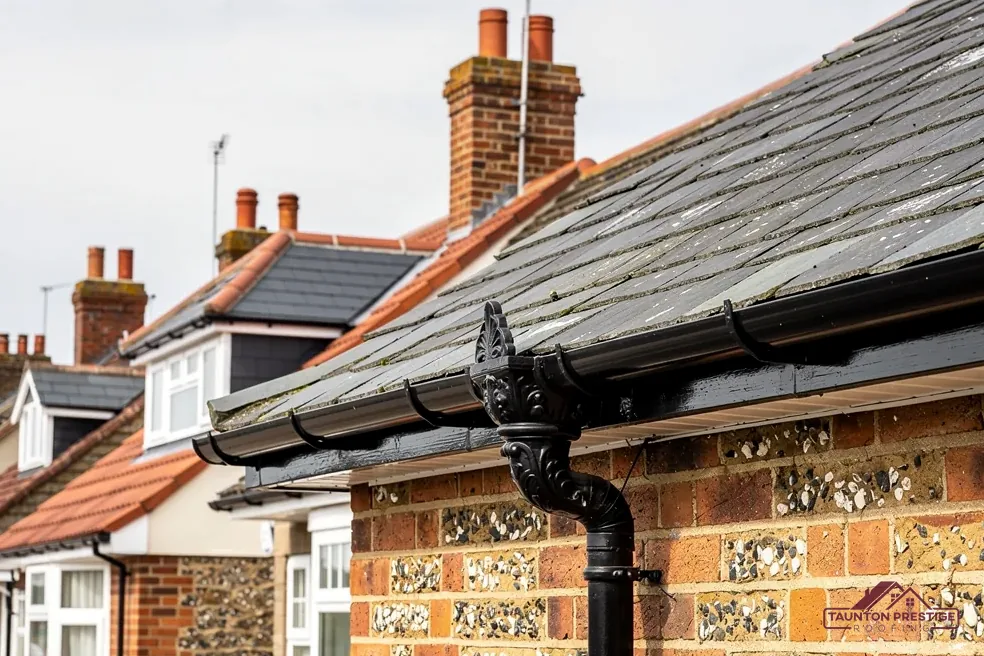
Three parts make up the roofline. The fascia is the upright board along the lowest edge of the roof, with the gutter screwed to its face. The soffit is the horizontal board beneath the eaves. Behind both sit the rafter ends, the angled timbers that hold the roof frame. What a homeowner sees from the ground is mostly paint on the fascia and the soffit, which is why a board's real nature stays hidden for decades.
Asbestos insulating board, often shortened to AIB, is a material HSE says is found in external soffits. Soffits on rear extensions, porches and garages are easy to forget, because nobody looks at them closely, yet they were boarded in the same era as the main house.
Asbestos cement is a different material and is found in other roofline parts. HSE gives roof sheeting and rainwater goods as examples, so an old grey gutter or downpipe on a garage may be asbestos cement even when the house itself has plastic or cast iron. That matters because the rules for the two materials are not the same, as the section on removal explains.
Does a house from the 1990s count?
It can. HSE's guidance sets the year 2000 as the cut-off, so anything built or updated earlier is presumed to contain asbestos until proven otherwise. A 1970s semi that had its soffits replaced in 1995 might have new asbestos board, while a 1960s cottage re-boarded in 2008 might have none at all. The age of the house tells you less than the date the boards were fitted.
Can you tell asbestos soffits by looking?
No, and that is the honest answer HSE gives too. It says plainly that it is hard to tell asbestos insulating board apart from items made without asbestos. Colour, thickness and surface do not settle it. A flat painted board in a pale or grey tone could be AIB, a modern fibre cement board or plywood.
What can you safely check yourself?
- Work out the age of the house, and ask whether the soffits were ever replaced.
- Look for old paperwork, such as survey reports, building control records or a seller's information pack.
- Note the condition: cracked, crumbling, holed or flaking boards need a specialist look sooner.
- Take a few photographs from the ground, with the whole eave visible, for your roofer or surveyor.
What should you never do?
Leave the board alone. Do not drill into it, screw a new bracket through it, sand or scrape it, scrub it with a brush or break a corner off to see what is inside. Power-cleaning the underside is out as well. Each of those creates dust, and if the board is AIB, the dust holds the fibres. Painting the underside is not a safe middle path either, because preparing the surface means scraping and sanding.
The way to settle the question is a sample taken by a trained person and sent to a laboratory, usually as part of an asbestos survey. MyJobQuote gives a typical UK figure of £325 for an asbestos survey (MyJobQuote, Sep 2026). That is a general UK marker, so ask for a written price for your own property.
Until a board has been checked, treat it as asbestos. It costs nothing to leave it alone for a week.
Is removing asbestos soffits licensed work?
Often, yes, though the answer depends on a risk assessment rather than on a blanket rule. HSE separates asbestos work into three groups, and the soffit question lands in the first two.
Licensed work is the most tightly controlled. On insulating board, HSE treats the work as licensable when the risk assessment shows it will run beyond a short job. Short-duration removal of insulating board during a refurbishment project falls into a second group, called notifiable non-licensed work, which has its own duties: the work must be notified, and a register of the work, which doubles as a health record, is kept for 40 years. Nobody should assume the lighter category applies. The assessment decides it, and it is checked before a quote is given.
What about asbestos cement parts?
Asbestos cement is treated more lightly when it is carefully removed. Where sheets and rainwater parts come off in one piece, HSE classes the work as non-licensed, even if the material has weathered over the years. If the pieces will be substantially broken up, the job becomes notifiable non-licensed work. Roofers sometimes meet this on garage roofs and rainwater goods, and our guide to asbestos garage roof removal follows that route.
This split is why nobody should promise a price for removal over the phone. A contractor who treats every soffit as a routine job has the rules wrong. Where the work is licensed, the firm that holds the licence for it carries it out, and the route is agreed with you in advance. You do not have to understand the schedule to follow what happens: you need a clear written statement of who does what, and when.
What happens next on your house
Once a roofline job is on the cards, the sequence of the work matters as much as the materials. A sensible order runs like this.
- Photographs from the ground and a check of the building's age and history.
- A sample, taken by someone trained to take it, where the board's identity is uncertain.
- A decision between leaving the board in place and undisturbed, or removing it under the right controls.
- Replacement with a modern fibre-free board, and a ventilation detail that suits the roof.
- The remaining roofline work: fascia, gutters, downpipes and any repairs to the rafter ends.
Can you just cover the old soffits with new boards?
Fixing new board up against an old one usually means driving fixings through the old board, and that is the disturbance the rules try to avoid. Capping a fascia is a different job, but it too can involve fixings near the soffit. Our page on capping fascias explains the method. If the soffit is suspect, the identity of the board has to be settled first.
Leaving sound board alone is sometimes the sensible answer. It can stay if it is intact, painted and out of the way of the work. That choice has limits: the board still has to be left clear of new fixings, and a gutter replacement that needs to screw into the fascia right next to it may call for a different method. Somerset Building Control makes the general point that, in buildings from before 2000, materials containing asbestos fibres are likely to be met during building work. Ask the same question of any roofer before work starts, and expect a straight reply.
Waste, wrapping and the paper trail
Removed asbestos is hazardous waste, and the route it takes is as regulated as the removal. HSE guidance for the people doing the work is to double-wrap the waste and label it. Pieces are bagged, sealed, bagged again and marked as asbestos before they leave the site.
The household exemption that lets owners take some domestic hazardous waste to a council site does not cover asbestos waste. GOV.UK sets out that it moves under a consignment note, which records what it is, where it is from and where it is going. The carrier must be registered as an upper-tier waste carrier. Asbestos does not go in a builder's skip or a household bin, however small the amount.
Why does the paperwork matter to you?
A consignment note is your evidence that the waste went where it should. A buyer's solicitor, or a surveyor looking at a future sale, may ask what was done about asbestos on the property. A note, a survey and a written description of the work answer that question in a minute. A vague verbal account does not. Keep the papers with the deeds or the house file, where the next owner will find them.
For notifiable work, the duties on the contractor include the notification and the 40-year register mentioned above. You are not expected to run that process, but you are entitled to ask who is, and to see the answer in writing. A contractor who is relaxed about the question is a contractor to ask a second time.
Our page on the soffit vents covers the ventilation side, which is worth planning with any soffit replacement.
Planning the job, the order and the cost
Asbestos soffits rarely arrive alone. They tend to surface during a re-roof, a fascia replacement or a new set of gutters, and the sensible order is to identify first and price afterwards. Our guide to fascias with a new roof describes how the two jobs fit together, and the scaffold usually stays up across both.
What decides the price?
There is no useful national figure for removing asbestos soffits. The MyJobQuote average of around £2,750 relates to removing an asbestos roof (MyJobQuote, Sep 2026), which is a different job on a different scale. For soffits, the price turns on:
- how many metres of eaves are boarded, and on how many elevations;
- whether the boards are intact or crumbling;
- whether the risk assessment makes the work licensed, notifiable or neither;
- how high the eaves are, and what access is needed;
- the cost of waste handling and disposal;
- the replacement board and the ventilation detail.
Capping works out differently, since MyJobQuote gives an average of around £800 for capping fascias and soffits as a general UK figure (MyJobQuote, Sep 2026), but that figure assumes the existing boards are ordinary material.
We start with photographs and a survey of the eaves, so the first conversation is about what the boards are, not about a price. Where a sample is needed, you hear about it at the first visit. Where the job belongs with a contractor who holds a licence for it, we tell you that too and help you plan the rest of the roofline work around it. Once the board is identified, you get one written price for what we do.
Asbestos soffit queries
My house is from 1998 and the soffits look new. Do I still need to worry?
A house finished in 1998 sits inside HSE's cut-off, because the guidance covers anything built or refurbished before 2000. New-looking paint says nothing about the board underneath. Leave it undisturbed, and have it identified by a trained person before any fixing goes through it, whoever does the work.
Who should remove asbestos soffits if the board is confirmed?
That depends on the risk assessment. Work on insulating board that will not be of short duration is licensable, which means a contractor who holds the licence. Shorter jobs may be notifiable but non-licensed. Ask whoever quotes to explain which group your job is in, in writing.
Can I clean green algae off old soffits myself?
Not if the board might be asbestos, because scrubbing and spraying create dust. Wait until the board has been identified. If it proves to be free of asbestos, gentle cleaning is reasonable, and our page on green algae on soffits explains how the growth forms and spreads.
More on this subject: Gutters, soffits and fascias in Taunton