Most roofers who offer to look at a roof are doing a straightforward job. Yet the idea of a stranger on your roof, telling you it needs urgent work, is enough to make anyone uneasy, and there are good reasons for that. Roofs are hard for owners to see, so they are easy to describe in frightening terms, and a worried homeowner is a poor judge of what is true.
This guide is about how to tell a real report from a pressured pitch. It covers what a genuine inspection puts in your hands, the signs that should make you stop, how to check a photograph belongs to your roof, what the law says about cancelling a contract made at home, and where to turn if something goes wrong. It sits within our roof inspections work around Taunton. Nothing here needs special knowledge, only a willingness to ask questions and to wait for a written answer before agreeing to anything.
What a genuine roof report puts in your hands
The simplest test of an inspection is what you are holding when the roofer leaves, and whether you could use it without the roofer there to explain it. A real report gives you things you can check, keep and show to someone else.
- Photographs taken on your own roof, each one tied to a named part of the building.
- A written description of what the photo shows, in words you can follow.
- A list that puts the jobs in order, from the ones that cannot wait to the ones that can be monitored.
- A statement of what was not seen, and why.
- A date, and the name of the person who did the survey.
Does it matter who holds the pictures?
It matters a great deal. If the photos stay on the roofer's phone and you are only told what they show, you have an opinion, not evidence. Pictures that arrive in your own inbox, in order, with each fault named and placed on the roof, can be checked against the building from the garden and shown to a second roofer.
A fair report also says when the roof is fine, and says it without hedging. If every visit ends with a list of urgent jobs, regardless of the roof, something is wrong with the process. A sound roof deserves a sound report, and a short one is better than an inflated one.
Our page on what a roof inspection report holds shows the layout of a full report, and it makes a handy yardstick against anything you are shown.
Signs worth stopping for
None of these proves bad faith on its own. Together, or in a strong form, they are a reason to pause and ask for the paperwork.
- An unrequested approach at your door, or a note through the letterbox, saying a roofer has seen a problem from the road.
- A demand for a decision today, or a price that will vanish tomorrow.
- A refusal to put the findings or the price in writing.
- Photographs that could be of any roof, with nothing that places them on yours.
- Alarming language without detail, such as "dangerous" or "about to collapse", and no named fault.
- A request for a large payment up front, or for cash with no receipt.
- No clear business name, address or phone number you can check.
Why do pressure and speed go together?
Because time to think is the best protection a homeowner has, and pressure takes it away. A fair firm gains nothing from rushing you, and a firm that explains itself calmly has already earned some trust. It can explain the fault, show the evidence, write the price down and leave you to decide, and it knows that a roof that has stood for decades can wait a few days for a second opinion unless a leak is actively pouring in.
If there is real urgency, a good roofer makes the roof safe first and talks about the lasting repair later. That is a very different thing from a pitch that treats the whole roof as an emergency.
Checking that a photo shows your roof
A photograph is only proof if it is yours. Anyone can show a picture of a cracked slate, a collapsed chimney or a rotten batten, and the image can come from a different house altogether, or from a roof in another county entirely. A few quick checks tell you whether it belongs on your roof.
How can you tell the picture is of your house?
Look for something in the frame that you recognise, because familiar detail is hard to fake: the colour and size of your slates or tiles, your chimney, a neighbour's gable or your own gutter bracket. Ask the roofer to say where on the roof it was taken, and then go outside and look. A fault on the left valley of the rear slope can be found from the garden with binoculars, or with the zoom on a phone.
Ask for the original image file with its date. A series of pictures taken in order, working along a slope, reads very differently from a single dramatic shot. If you are shown the roof on a tablet or a phone screen only, ask for copies.
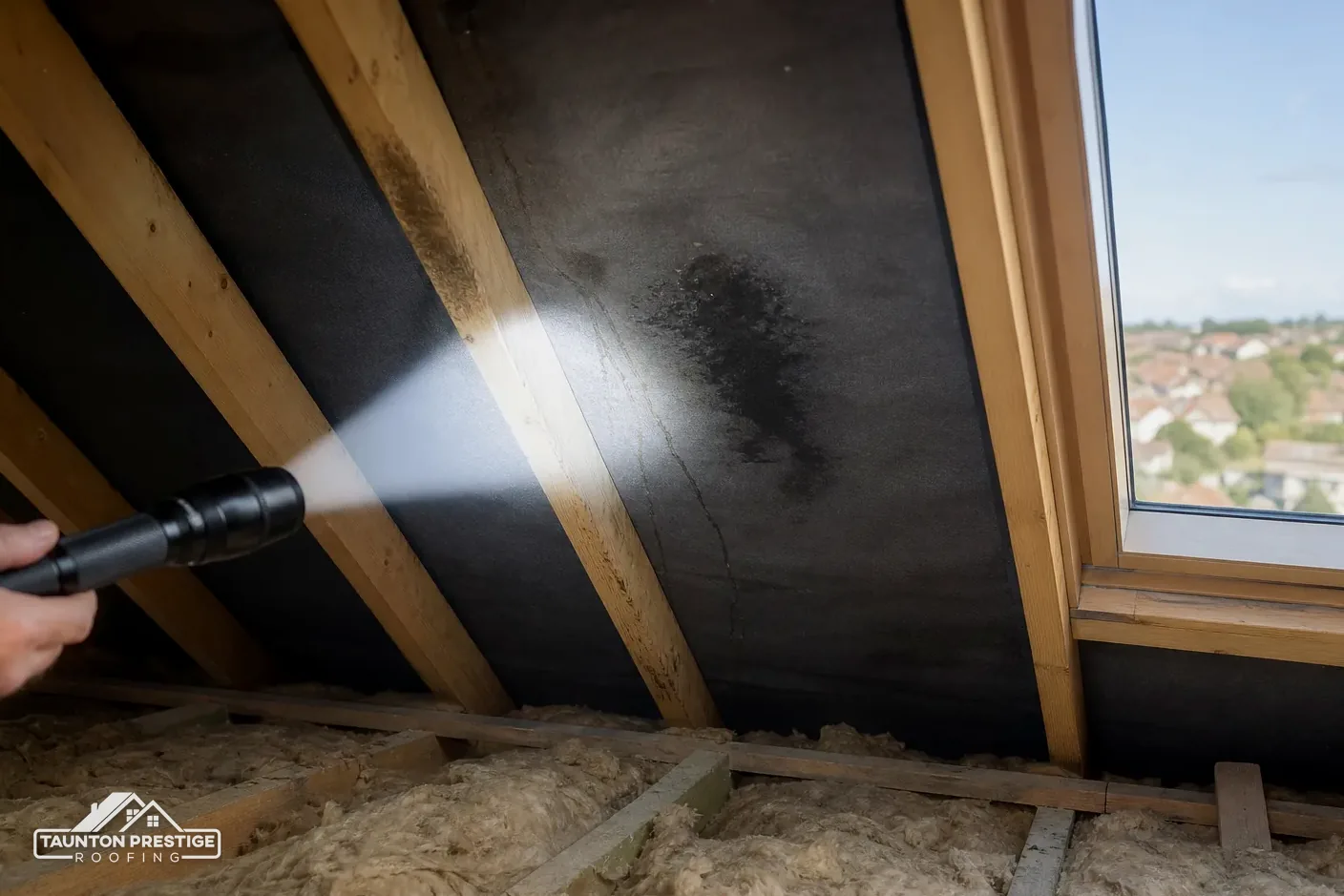
You can also ask to see the loft. A leak or a rotten batten that is real shows up from inside as staining, damp timber or daylight, and you can go up and look while the roofer waits. If the story is real, the evidence is there for both of you to see.
Our answer on whether a roofer should send photos of the problem covers what a useful set of pictures looks like.
Your cancellation rights at home
Signing a roofing contract in your own house brings a legal right to change your mind. It is one of the most useful protections a homeowner has, and worth knowing before anyone puts a form in front of you.
How long can you cancel for?
Any contract signed somewhere other than the trader's premises, your own kitchen table included, can be cancelled with no reason given. For services the period ends 14 days after the day the contract was made (Consumer Contracts Regulations 2013, regulation 30). Where the trader left out the required cancellation information, the window can be extended by up to 12 months.
Should you want the job to start before the 14 days are up, the regulations ask for your request to be recorded, for instance in an email or on a signed form, and not just spoken.
Does the right apply to urgent repairs?
Not where you personally asked for a call-out to deal with urgent repairs or maintenance, because regulation 28(1)(e) leaves that case out. If you rang a roofer about a leak and asked for a visit to make it safe, the 14-day right does not cover that work. That is the reason to be clear with yourself about whether a job is truly urgent.
Separately, section 49 of the Consumer Rights Act 2015 sets reasonable care and skill as the standard for any service, so poor workmanship has a remedy even when the cancellation window has closed.
Getting a second opinion and a written price
When a report or quote worries you, a second opinion is the simplest remedy. Citizens Advice suggests gathering at least 3 written quotes, then deciding with the paperwork in front of you. For an inspection, that means asking another roofer to look at the same roof and give you their own findings in writing.
What should you compare?
Compare the totals and what each one covers: the roof, the faults, the method and the paperwork you get. Does each cover the same roof, the same faults and the same method? Does each say whether VAT and scaffold are included? Does each come with photographs? Where two firms disagree about what is wrong, the pictures will usually show which is nearer the truth.
Beware a price that is much lower than the others with a vague scope, and a price that is much higher with no explanation. Either can mean the findings are not what they seem. Ask each firm to walk you through the biggest item in plain words, and see whose answer holds together best.
You can also ask a firm to explain its reasoning. A roofer who knows the roof will describe why a slope has failed and what will happen if it is left. One who only knows the script will struggle. Our guide to roof inspection cost sets out what a survey should cost, so you can spot a figure that does not fit.
If you want help with a dispute, the Citizens Advice consumer helpline is 0808 223 1133.
What a calm survey looks like
A survey that is done properly feels almost dull. The roofer arrives at an agreed time, explains what will happen, walks round the outside, goes up and looks, checks the loft and goes. Afterwards you get the pictures and the findings. Nothing about it needs a decision on the doorstep. You can sleep on the findings, compare them with a second roofer's, and ring back when you are ready, or not at all.
Our own survey follows that pattern. The roof is read first and priced afterwards. The photographs show your roof, the findings arrive in writing in order of urgency, and the price follows as one total in writing. A sound roof is reported as sound, and a minor fault is described as minor, with a note on whether it is worth mending now or monitoring.
What if I do not want any work done?
Then you do not have to. The report is yours either way. You can use it to plan, to compare with other firms, to satisfy a buyer or to keep on file. The survey is the information, and the decision is yours.
If a dispute stays unresolved, section 308 of the DMCC Act 2024 obliges the trader to say what out-of-court dispute arrangement, if any, you can use. The old ADR Regulations were revoked on 6 April 2026, so that section is now the rule to look for.
Keep every message, photograph and invoice together in one folder. It makes any later conversation shorter and clearer, whether it is with the same firm, a second roofer, an insurer or an adviser.
If a visit has left you uneasy, write down what was said while it is fresh: the name given, the date, the faults claimed and the price mentioned. Notes made on the day carry weight later.
Roof report doubts
Will a roofer find work just to sell me a job?
Some roofers may overstate, which is why evidence matters. Ask for photographs of your own roof, a written ranking of the faults, and time to decide. If the findings cannot be shown, dated and placed on your roof, treat them with caution and get a second opinion.
How do I know the photo is from my roof?
Look for something you recognise in the frame, such as your chimney, your slate colour or a neighbour's gable. Ask where the picture was taken, then check from the garden. A genuine fault can be found, and a real roofer can point you to it.
Is there a cooling-off period for a roofing job agreed in my own living room?
Usually you have 14 days from the day the contract was made, longer if the cancellation information was missing. The right does not reach an urgent repair that you called the trader out to do. Ring Citizens Advice on 0808 223 1133 if you are unsure how your own job would be classed.
More on this subject: Roof inspections in Taunton