Plenty of Somerset roofs are discovered to be failing in the dark months. A ceiling stain appears after a wet week, a slate lands on the path after a gale, and the question comes straight away: should this wait until the weather improves? The answer is not a flat yes or no. Winter does not stop a roofer working, but it changes how the job is organised, what can be fixed in one visit, and how long the programme runs.
This guide explains how a winter re-roof is run. It covers weather days and why a start date is only ever an estimate, how a stripped slope is kept covered overnight, which materials have cold-weather limits and what to ask about them, and what a short winter day does to the timetable. It sits within our wider roof replacement work for owners in and around Taunton who are deciding whether to book now or hold off.
Is winter a sensible time to re-roof?
It can be. A roof that is leaking, sagging or shedding slates is costing you more each wet week than the inconvenience of a winter programme. Waiting for good weather leaves the timbers wet, lets damp spread into the ceilings below and can turn a re-roof into a re-roof plus repairs to the house.
When is it worth waiting?
Waiting makes sense when the roof is sound enough to get through the winter and nothing about it is urgent. A roof that has a few worn ridge tiles, a sagging gutter and no leaks can often be left until the weather settles, with a survey booked now so the date is secured. Our guide to booking a re-roof in advance explains why the diary fills.
If a ceiling is already stained, the first job is a temporary cover or repair that stops the damage spreading. The full re-roof is planned afterwards, once the survey has shown what the structure needs.
Does winter work cost more?
The winter months carry no standard surcharge. The price is set by the same things as in summer: the area, the covering, the access, and how sound the rafters turn out to be when the slates come off. A damp, rotten rafter found halfway through is a cost that no winter table can predict. Winter can add programme days, because weather stops work, and a longer scaffold hire adds cost on a long job. Ask any roofer whether weather delay is built into the price or charged on top, and get the answer in writing before you agree to anything.
Weather days and why programmes stretch
A roof is open to the sky while it is being renewed, so rain, snow and high wind decide what happens on any given morning. A roofer who gives you an exact finish date in November is guessing. A better promise is a start window, a sequence of stages and a clear rule for what happens when a stage has to wait. Ask for that rule on paper.
What counts as a weather day?
Heavy or driving rain stops stripping, because a bare slope can only be covered so quickly. Strong wind stops work at height and makes handling sheets, slates and long lengths of timber dangerous. Ice on the scaffold boards stops anyone getting up there at all. Frost on the roof is another reason to wait, since a crew cannot trust its footing on a glazed slate.
None of these means the job has failed. It means the day is used differently: materials are checked, flashings are cut and made up at ground level, and the next slope is prepared. The crew moves to indoor-friendly tasks where they exist, such as loft clearing or lead patterns.
Why does a winter re-roof take longer?
Because some days are lost completely and others are half days. The scaffold hire and the licence period continue meanwhile, and you may see no visible progress for a day or two. Our page on how long a re-roof takes sets out what drives the overall length.
Temporary covers and sheeting overnight
The safest way to re-roof in poor weather is to open only as much roof as can be closed again before dark. That is the main protection a winter job has, and it is worth asking about before you sign.
How is a stripped roof kept dry?
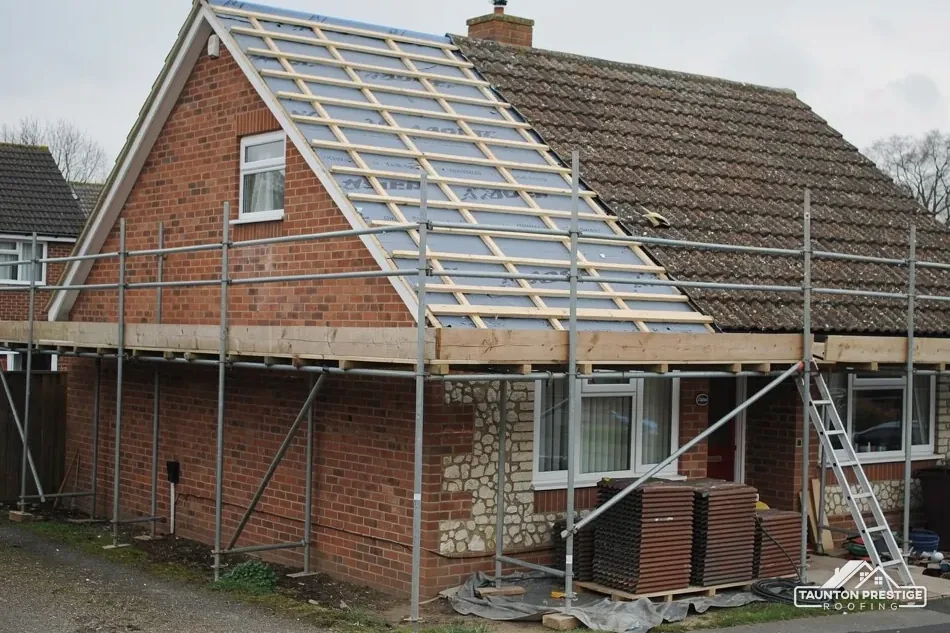
The crew works a slope, or part of a slope, at a time. Once the old covering is off and the timbers have been looked at, underlay and battens go on while the area is still fresh, so that the slope is at least waterproofed in its temporary form before the covering returns. Tarpaulins or heavy sheeting cover whatever is still open when the crew packs up, lashed over the ridge and fixed to the battens so a gust cannot lift them.
Can sheeting fail?
Yes, and the reason is usually wind. A big sheet over a roof acts like a sail, so a poor fixing can let a corner flap, then tear. Careful roofers weigh down the edges, tie off to sound timber and check the sheeting when work stops and again first thing. If a storm warning is out, they plan the stripping so very little is exposed overnight.
Inside the house, a few simple steps help. Move beds and valuables away from the ceilings under the work, cover loft contents with dust sheets, and tell the crew about any damp patch you already know about. We will tell you which rooms sit under the stripped area before it starts.
The point is not to promise a dry loft on every night of a cold month. It is to run the job so that the exposed area is always small, always covered and always checked.
Mortar, adhesives and membranes in the cold
Some roofing products behave differently when the temperature drops. This is where a careful roofer earns the extra time, and where a rushed one cuts corners.
Is mortar a problem for ridge and hip tiles?
Mortar still has a place on a ridge, but a wet bed alone no longer counts as sufficient for ridges and hips. Marley explains that the 2014 revision of BS 5534 made plain that mortar's tensile strength cannot carry those tiles alone, so a mechanical fixing is added. A cold bed of mortar sets slowly and frost can spoil it, which makes the fixing matter more in winter. A dry-fix system built to BS 8612 skips the wet bed altogether. BS 5534 is guidance a careful roofer follows, not an Act of Parliament.
What about membranes and flat roofs?
Flat roofs bring their own limits. Torch-on felt, GRP (glass-reinforced plastic) and EPDM, a rubber sheet that goes down in one piece, each have installation conditions set by the maker. Adhesives, resins and bonding products have their own limits for temperature and surface moisture. A flat roof laid onto a damp deck traps moisture under the covering, which shortens its life. If the weather does not meet the maker's conditions, the right call is to wait for a better day, not to hope.
On pitched roofs, the underlay and the ventilation at the eaves matter in any season. A non-breathable HR underlay leaves the roof space relying on eaves ventilation, and Marley's figures under BS 5250 apply. Cold roofs gather condensation more readily in winter, which is one reason that detail is checked rather than assumed.
Whatever the product, the instruction is the same: ask which conditions the maker sets, and expect the answer to be that some stages wait for a dry, mild spell.
Short days, wind and working at height
In December there are far fewer working hours of light than in June. A crew that would strip, felt and batten a slope in an easy summer day may complete only part of it in winter, because the last hour is spent sheeting the open area while there is still light to see by.
Why do short days matter on a roof?
Because nobody should be working on a slope in poor light, and because covering up takes time. Good sites stop stripping early enough to batten, fix and close the open section before the light fades. That leaves less time for productive work, but it protects the house. The scaffold lighting and the ground below are checked too, since wet leaves and frost make a path hazardous.
How does wind change the plan?
Wind is the winter hazard that matters most. It stops lifting of sheets and long timber, it makes loose slates and tiles dangerous to carry, and it can move scaffold sheeting. On exposed sites, such as hill villages on the Quantocks or Blackdowns, or farm buildings out on the Levels, a forecast gust can be a reason to stand the crew down even when it is dry.
Cold also slows people. Gloves, wet slates and short days all mean fewer courses laid per hour, and a good roofer would sooner finish a slope neatly than rush it.
It helps to plan around this. A winter job is easiest when the property is clear, the loft is emptied and parking next to the scaffold is arranged, so no daylight is lost to moving things. Emptying the loft before the crew arrives saves a surprising amount of time.
Planning a winter re-roof with us
A winter re-roof goes best when the plan is set out before the first tile comes off, and when you know what happens on the days that go wrong.
What do we tell you at the survey?
We go up, take photos of your own slopes and explain the condition they are in. If the work can be done in stages, we say how the stages would run and which can be done in rough weather. If a stage is better left to a dry spell, such as flat-roof membrane work or a bedded ridge, we tell you in plain terms. You see the photos before you decide anything.
What changes about the paperwork?
Not much. The written price is one total for the job. The scaffold licence notice period still applies, and so do the Building Regulations tests for a re-roof: the Planning Portal sets a national test: an application is normally unnecessary while less than 25 per cent of the building envelope and less than 50 per cent of the roof is touched. Somerset Building Control prices a notifiable re-roof as a thermal element renovation. Our page on who notifies building control covers the detail.
Should I wait until spring?
If the roof is sound, a spring start gives the crew more daylight and more settled weather, and booking early secures the slot. If it is failing, a careful winter job in stages is usually better than another season of leaks. Either way, the sequence matters more than the month.
Tell us about any known leaks, loft contents and parking at the survey, and we will build a programme around the winter weather instead of pretending it is not there. Then we agree what happens when a stage has to wait.
Winter re-roof questions
Will my house be open to the rain during a winter re-roof?
Only a small part of it at any time. The crew strips a section, fits underlay and battens, and sheets what is left open before they stop for the day. Sheeting is inspected when work stops and again before it resumes, so heavy rain is a delay and not a flood.
Can ridge tiles be bedded in mortar in cold weather?
Wet mortar is slow in the cold and can be spoiled by frost, and Marley says mortar bedding alone is not enough to secure ridge and hip tiles in any season. Mechanical fixings, or a dry-fix system made to BS 8612, are the sturdier answer, and any bedding that is needed can wait for a milder day.
Does a winter start mean a later finish?
It can, because wet, icy or windy days stop work at height and the light fades early. The better question to put to the roofer is how the stages run and what happens on a lost day. A start window and a clear sequence are more honest than a fixed finish date.
More on this subject: Roof replacement and new roofs in Taunton