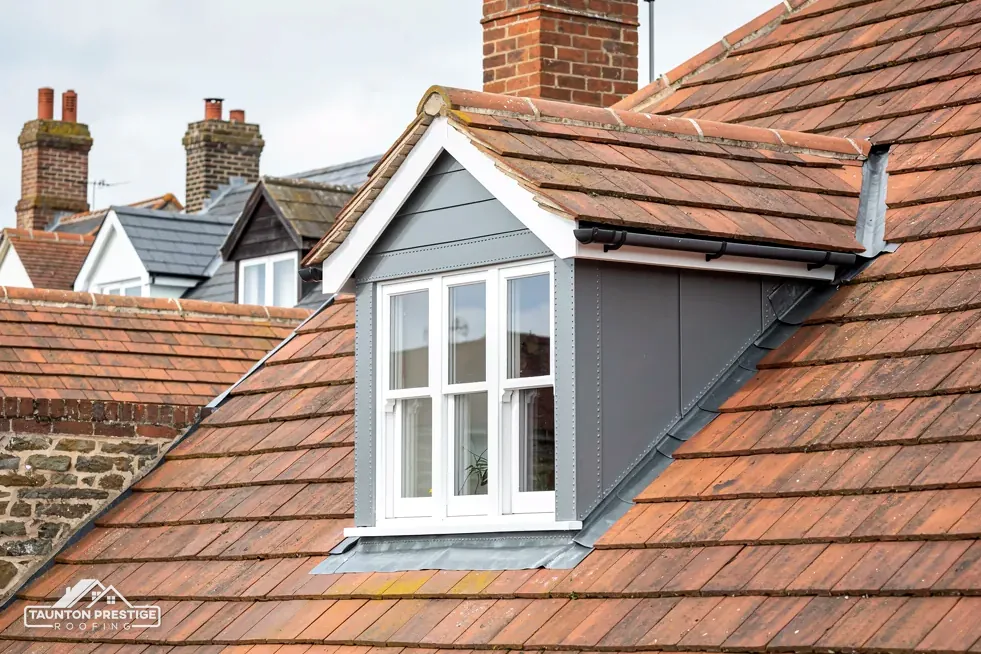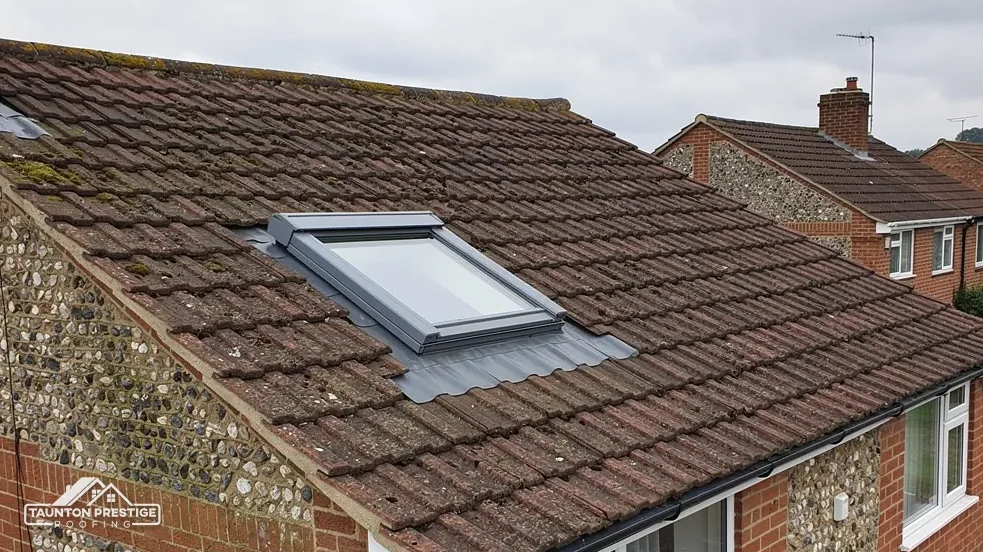
Walk into a loft room and the window is the first thing you notice. A roof window is a glazed unit that lies flush with the roof slope, with its own frame, sash and flashing, rather than a dormer that stands out from it. They are made in more than one way, and the differences are easy to miss on a showroom page.
The main split is where the sash hinges. A centre-pivot turns on a horizontal axis near the middle. A top-hung swings out from a hinge along the upper edge. A conservation-style unit sits low and flat in the slope with slim bars, and any of the opening types can take a blind, a motor or a solar panel. Each choice shows up later, in how the glass is cleaned, how the room ventilates and how the frame sits against the slates or tiles around it. This guide takes them in a sensible order: how the window opens, how it is dressed, how it is powered, then how it looks. It sits within our wider roof windows and skylights work in Taunton and Somerset.
How a centre-pivot window works
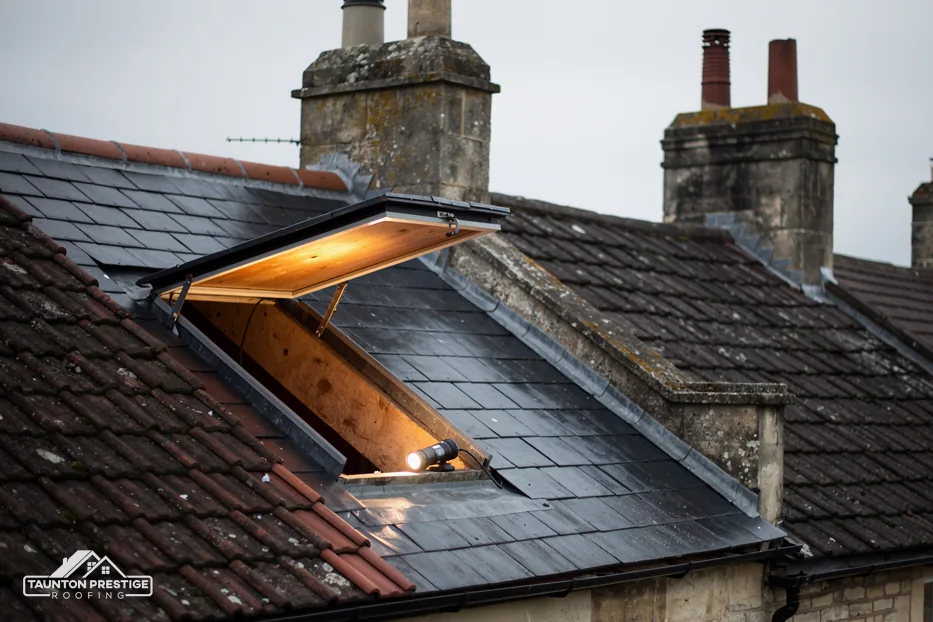
A centre-pivot window turns on a horizontal axis set about the middle of the sash. Lift the bottom of the sash and the top swings out and down, so the glass rotates through the frame like a door laid on its side. Because the pivot sits near the centre, the handle is normally along the bottom edge, where an adult can reach it from the floor.
That reach is the main reason people choose the type. In a loft room with a sloping ceiling the window head can sit high, and a handle at the bottom lets you open it without a chair. The same pivot lets the sash turn far enough for the outer pane to face into the room, which makes it possible to clean the outside of the glass from indoors. The data sheet for the model tells you how far the sash turns and whether it locks in that cleaning position.
Where does the open sash end up?
Half of it moves into the room and half out. A desk, a bed head or a tall lamp near the bottom of the window can be struck by the lower edge as it swings in, so leave clear floor below the sash and mark it out before the position is fixed. Outside, the upper half rises above the slope, so leave it open in a shower and rain can blow in at the gap.
The frame is fixed to the rafters, the sloping timbers that carry the covering, and trimmed in with timber on every side. The unit comes with a flashing kit, the set of metal pieces that seals the frame to the tiles or slates. Our guide to choosing a flashing kit by roof covering explains that part of the job.
Top-hung windows and when they suit
A top-hung window is hinged along the upper edge of the sash. The bottom edge pushes outward and upward, and the sash is held open on a stay, so the whole window lifts away from you like an awning. The handle sits at the bottom, and the opening is wide at the lower edge and narrow at the head.
This is the type to look at when the window will be fitted low in the slope, or over a bed, a desk or a bath. Nothing swings into the room, so the space in front of the glass stays clear. It also gives a view out when open, because the sash rises above eye level rather than cutting across it. On a window in a roof with a shallow pitch, a top-hung sash can be easier to live with than one that rotates through the room.
Is a top-hung window harder to clean?
Usually, yes. The outer pane stays outside, so a long-handled brush or a cleaning pole does the work from indoors, or a roofer or window cleaner does it from outside. Neither is a reason to rule the type out, but it should be a decision rather than a surprise. Ask whether the model you are looking at has a reversing position and, if so, how it works.
Both opening types ventilate the room, and many models also have a small vent in the frame head that lets air in with the sash shut. Whatever the type, the frame, flashing and glazing are fitted by the same steps. Details such as noise from rain on the glass come from the glazing build-up as much as from the way the sash hinges.
Conservation-style roof windows
A conservation-style roof window is made to sit close to the slope with a slim frame and a central vertical glazing bar, so it reads from the street as a small metal-framed rooflight of the kind fitted to Victorian and Edwardian houses. The glass sits low against the slates rather than standing proud of them. Many are finished in a dark colour and are meant to disappear into the roof. The flat glass also means less shadow line on the slope, which is part of the appeal on a street frontage.
People choose them for older homes in streets where the planning team will look closely at what faces the road. They are also a neat choice on a rear slope, where nobody wants a bulky frame breaking the line of the tiles. The trade-off is that the slimmer frame and the central bar mean a smaller clear view than a standard unit of the same outer size. Taunton has several conservation areas, and Somerset Council's table lists them, including the Park Street and Wellington Road area and the one around The Crescent. A conservation-style unit does not by itself settle whether a window is allowed, but it is the kind a planning officer is least likely to object to.
Do you need permission for a roof window in a conservation area?
Class C of the permitted development rules deals with alterations to a house roof, and it carves nothing out for conservation areas. A roof window within its limits therefore stays permitted development unless an Article 4 direction takes it away, and the unit must not project more than 0.15 metres beyond the slope it sits in.
A listed house keeps its Class C rights but needs listed building consent as well for changes that touch the historic character of the house. Ask Somerset Council's planning team, or Exmoor National Park Authority inside the Park, before you order anything.
Blinds, and which ones suit which window
A blind is not a decoration in a roof window. The glass faces the sky, so a bedroom with an unscreened roof window will be bright at four in the morning in June and hot on a sunny afternoon. Blinds come in a few kinds, and each does a different job.
- Blackout blinds block light so a bedroom stays dark.
- Pleated or day-and-night blinds soften the light while leaving the sky visible.
- Roller blinds are simple and wipe clean.
- Outer blinds and awnings sit outside the glass and stop heat reaching it, which a blind inside cannot do.
Blinds are made to fit one window size and, usually, one maker's frame. Fitting an inside blind to an existing roof window is a separate job covered in our guide to blinds for an existing window.
Does a centre-pivot or top-hung window take a blind more easily?
Both can. What matters is whether the blind runs on side rails clipped to the frame, so it stays flat against the glass when the sash opens, or hangs from the sash. Side rails keep a blackout blind from letting light leak round the edges and let the blind stay in place when the window is opened for air. Look at the gap between blind and glass, because a bulky blind can foul the sash or leave a bright slit.
Pick the blind when you pick the window, not afterwards. It is far easier to run a cable or fit a rail before the lining is finished than to open up a plastered reveal later.
Electric and solar operation
An electric roof window opens and closes by motor, controlled from a wall switch or a handset. A solar one has a small panel and a battery, so no mains cable runs to the window. Both are meant for windows that sit out of reach: over a stairwell, above a high bed or in a vaulted ceiling where a pole would be awkward.
What is the difference between electric and solar?
Mains electric units need a supply to the window, which means cables run through the loft and down the lining, and the work is for an electrician. A solar unit does not need that run, so it suits a finished room where re-wiring would mean opening up plaster. The trade-off is that the battery depends on the light the panel receives, so a window on a shaded slope behaves differently to one on a bright south face. Ask the maker how the unit behaves in a run of dull days and how a flat battery is dealt with.
Many motorised windows also take a rain sensor, which shuts the sash when water lands on it, and a motorised blind that runs from the same remote. Those extras help when the room is empty during the day, but they are extra parts that can fail, so ask where replacements come from. Ask the maker how each part is wired and where it is replaced.
Whichever way it is powered, a motorised unit still has to meet the same rules as any other roof window. The motor makes no difference to the heat-loss figure in Part L, covered below, or to the flashing.
Choosing between them for your roof
Start with the room, not the catalogue. Stand in it, look at where the slope falls and note where a person will stand to reach the handle. Then work through the choices in this order: how it opens, how high it sits, how it is dressed and how it is powered.
What does the regulation ask of any type?
Part L, in AD L Volume 1 (2021 edition, 2023 amendments), sets the figure for a new or replacement window in an existing dwelling at 1.4 or Window Energy Rating Band B (Table 4.2), and note 8 says that row includes roof windows. Rooflights take a different figure, 2.2, but a roof window is a window. A revised AD L takes effect on 24 March 2027, with the tables renumbered. Whichever opening type you pick, ask for the figure on the data sheet and the Window Energy Rating band.
If the window will serve as the escape route from a loft conversion, Approved Document B paragraph 2.10 asks for a minimum area of 0.33 m2 and a minimum height and width of 450 mm, with the lowest edge of the openable part no higher than 1100 mm above the floor. Measure the opening in its open position, not the glass. Our guide to a roof window as a fire escape goes through it.
If you are unsure which type suits the slope, we look at the roof and the room together at the survey, show you photos of the slope, and give one written price. Send us the room measurements and we will say which opening type we would fit and why.
Roof window type questions
Can a centre-pivot window be turned into a top-hung one?
Not as a simple conversion. The hinge position is built into the sash and frame, so changing the way a window opens means a different window. If the opening is the right size, the swap is a replacement into the same frame position, with a fresh flashing kit to suit the unit.
Which type is easiest to clean from inside the house?
A centre-pivot, because the sash turns far enough for the outer glass to face into the room. A top-hung sash keeps its outer pane outside, so you need a long-handled brush or someone on the roof. Look up the cleaning position on the model you choose.
Does a conservation-style window cost more than a standard one?
Price depends on the maker, the size, the glazing and the flashing kit, and a conservation-style unit is a different product from a standard one. We price after looking at the opening, the covering and the access, not from a catalogue figure, so send us the room and the slope and we will talk through what applies.
More on this subject: Velux roof window and skylight installation in Taunton