Haydon Farmhouse
Listed Grade II in February 1986, so a change of covering or ridge detail needs consent thinking first.
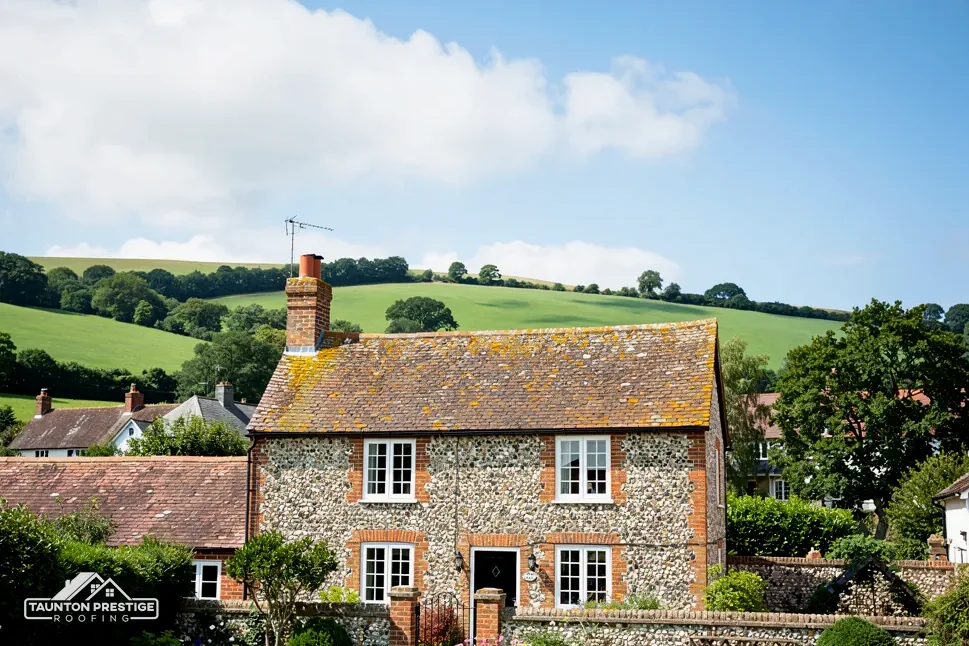
Two Grade II houses, old tile roofs and farm outbuildings
Haydon is a hamlet in Stoke St. Mary parish, with Haydon Farmhouse and Haydon House both listed Grade II. Each roof is looked over and photographed before a price.
Listed Grade II in February 1986, so a change of covering or ridge detail needs consent thinking first.
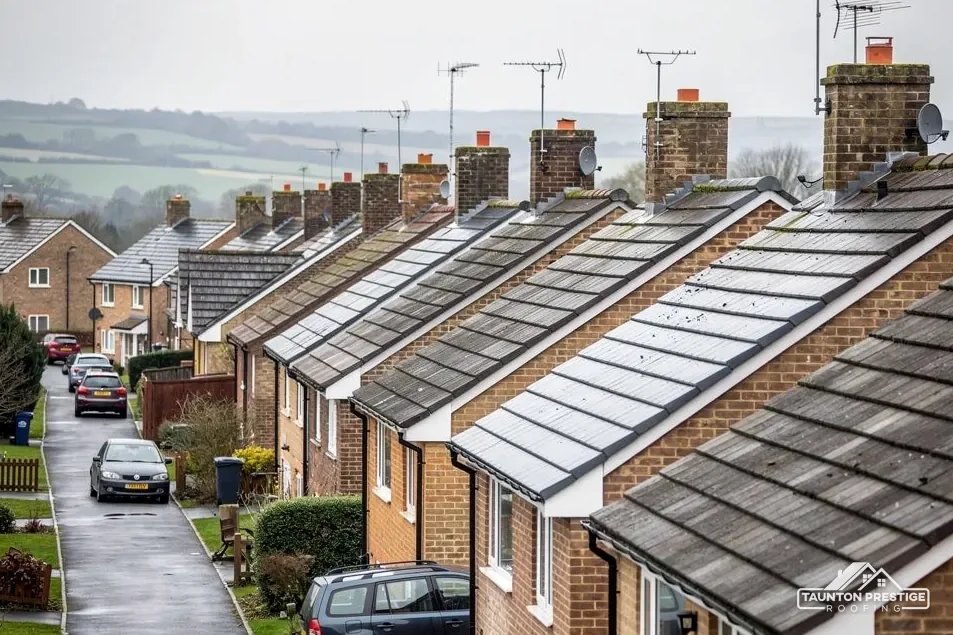
A second Grade II listing in the hamlet, one of five list entries within 500 metres of its centre.
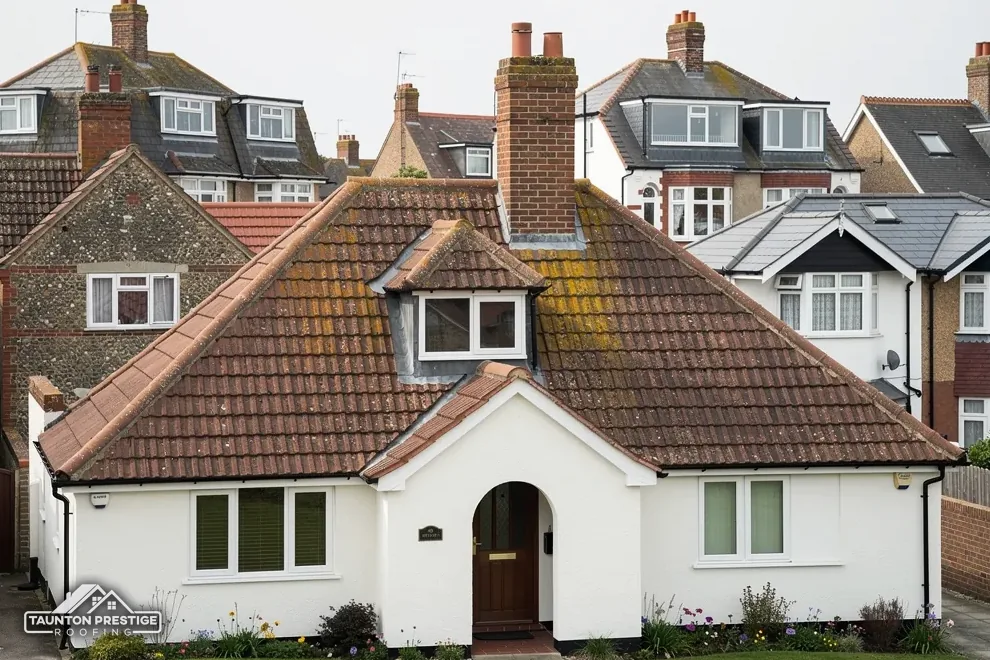
Haydon lies in a parish of 483 residents at the 2021 Census, with Taunton's conservation areas the nearest to it.
Street map of Haydon with Blackbrook, Ruishton, Holway, Halcon marked around it, and Taunton.
Blackbrook lies to the north-west of Haydon and Holway to the west, with Ruishton to the north-east, Bathpool to the north and Creech St Michael beyond.
About 2 miles east of Taunton, Somerset Council (unitary).
Four checks from Haydon House outward
A farmhouse, a cottage or a barn in Haydon: four things we look at, why each one matters, and what moves the price.
Haydon Farmhouse has been listed Grade II since 21 February 1986, and Haydon House carries the same grade. The National Heritage List holds five entries within 500 metres of the centre of the hamlet. A listing leaves ordinary upkeep of the roof alone. Work that changes the special character of the house is what needs listed building consent from Somerset Council, the planning authority here. The test is what the roof would look like afterwards.
Swapping one slipped tile for its twin does not, and neither does clearing a gutter or re-pointing a stack in lime. Replacing a clay covering with a different material does, and so can a new ridge style, a rooflight cut into a slope seen from the lane, or a rebuilt chimney. Where a roof has been patched over the years, we record which parts are original, so that any application can describe the roof as it really is, with the photographs to prove it. Our guide to planning permission for roof work sets out the wider rules.
The nearest conservation areas in the national dataset are three in Taunton, all within about 2.5 km: South Road, St Mary and St James, and Mount Street and Vivary Park. Somerset Council's table gives South Road and St Mary and St James the same history: designated in January 1975 and revised in April 2007. Because house numbers and field boundaries can sit either side of a line, we compare your address with the council's plans before any figure is written down.
A change of covering is the point where a mistake costs most. Asking first is quick, and the answer goes in the survey notes with the photographs, so anyone who later buys the house can see it.
Look for
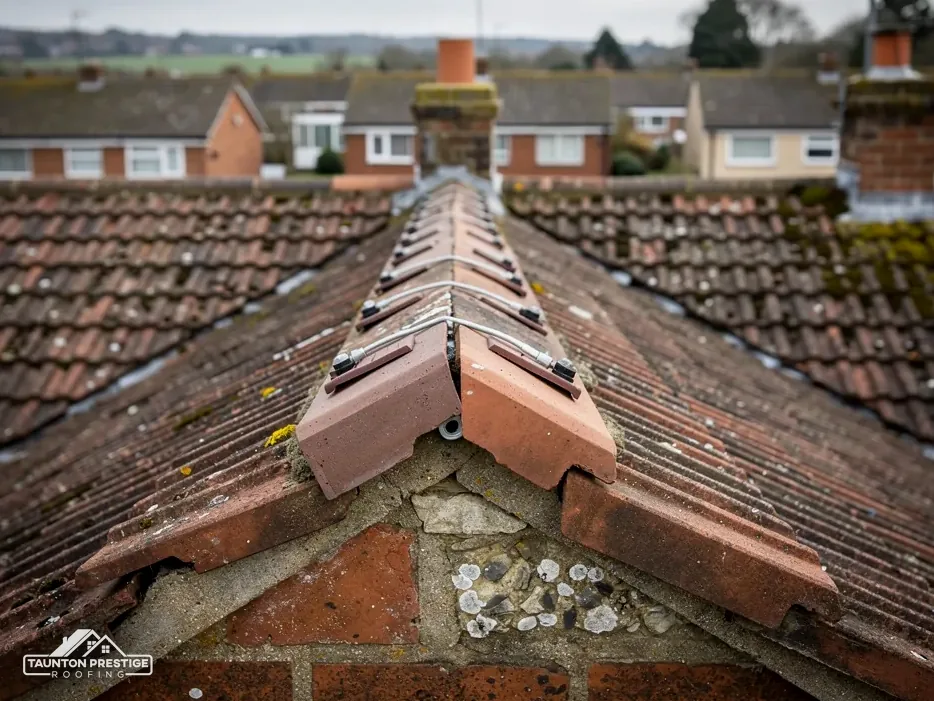
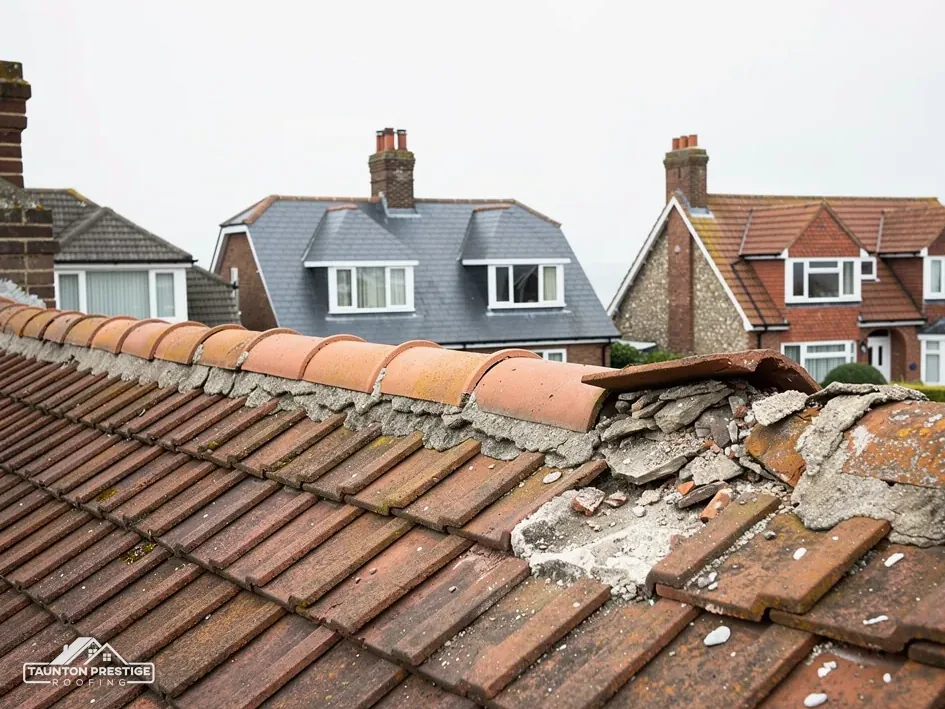
Somerset has its own clay tile story. According to the South West Heritage Trust, the bricks, tiles and terracotta made in Bridgwater gave many Somerset towns their look. Bridgwater's heritage group adds that hand-made plain tiles, crease tiles for ridges and pantiles joined the brick trade there, and that the Double Roman came along later. We read each Haydon roof on the day, slope by slope, and where a roof is clay, the aim is to keep clay on it, matched in colour and profile.
Life expectancy needs care. The BRE gives a minimum of 60 years for clay tiles, a figure Marley ties to clay alone. Building conservation guidance warns that it cannot be trusted for old peg tiles, so we tap, look at and weigh up each tile in turn rather than counting its years. A tile that rings when tapped and shows a clean, even face is a different proposition from one that is flaking, and reclaimed tiles can sometimes make up the difference where a few have gone.
What decides the price
The ridge is the level crest of the roof, and a hip is a sloping crest running down to a corner. Both are capped with ridge tiles bedded in mortar, which cracks as the roof moves. Marley explains that the 2014 revision of BS 5534 meant mortar by itself stopped being enough to hold ridge and hip tiles. Mortar is not banned, but the tiles also need mechanical fixings, and BS 8612 sets the tests that dry ridge, hip and verge kits have to pass.
A verge is where the tiles stop along the top of a gable wall, and a dry verge holds that edge with clips rather than a bed of mortar. Our dry ridge and verge page explains where it suits and where a bedded finish is the right match for an old building.
Around a farmhouse there are often sheds, stores and garages, and some of their roofs may be corrugated sheets of asbestos cement, an old building material that was widely used before 2000. HSE advice is to assume that a building built or refurbished before 2000 contains asbestos. Its guidance A14 adds that asbestos cement roofs are always treated as fragile, so nobody should step onto one, whatever it looks like from below.
Asbestos cement is not a roof to guess at: test it, plan it, then touch it.
HSE treats the careful lifting of asbestos cement sheets as non-licensed work, so long as they come off whole, which is why the order of work matters so much. Sheets that are simply old and weathered still count, unless they are badly damaged. Smashing or dropping them changes the category to notifiable non-licensed work, with extra paperwork. Our approach is to test first, plan the removal, and tell you which category your job falls into before any sheet is lifted. If the sheets turn out to be a different material, the job becomes an ordinary re-cover and we price it that way. Either way you get the reasons in writing, along with the photographs of the sheets that prompted them.
Waste from asbestos work is wrapped twice and labelled, and it travels with a consignment note, never in an ordinary skip. The carrier needs registration for hazardous waste, since the household exemption leaves asbestos out. Our garage and asbestos roofs page covers replacements, and a roof survey can tell you whether your sheets are the sort that need this care.
If a sheet has cracked and you are not sure what it is, keep people off it and leave the sheets alone. Scrubbing off moss and drilling for new fixings both break the surface and can make a small problem larger. Wait for the survey and for any test result, then decide whether to repair, over-sheet or replace.
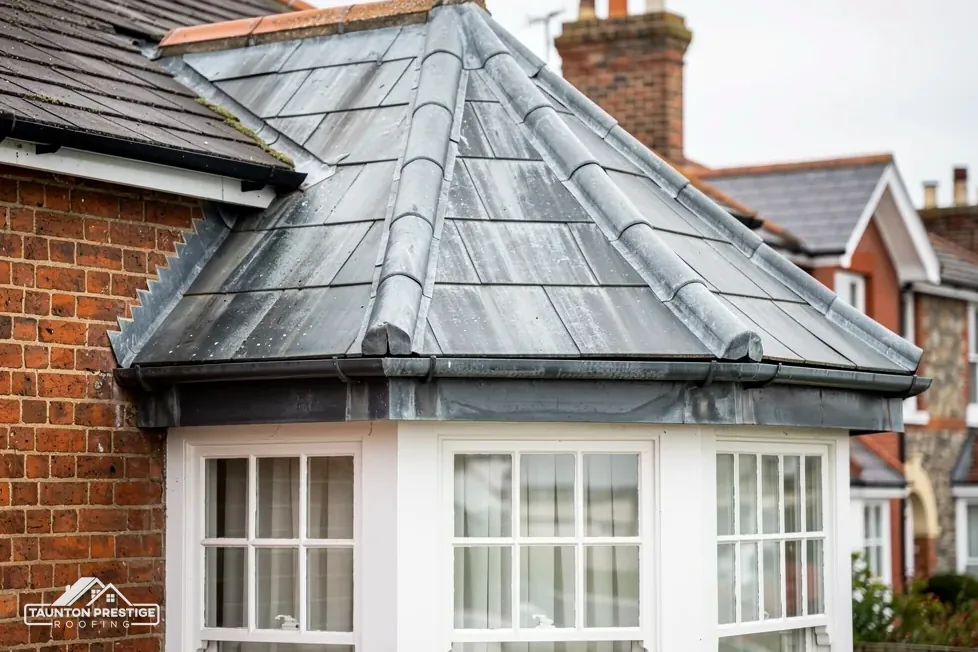
Many roofs in a hamlet like this stand back from the lane, with a drive, a garden or a yard in front. That usually makes access simpler: a ladder, a tower or a scaffold set up on your own ground. Scaffold on private land does not need a highway licence, though a scaffold that stands on the road or footway does. At the survey we tell you which kind of access the job needs and where it will go.
What decides the price
HSE describes a domestic client as an individual who has building work done on their own home, not as part of a business. Where one contractor does the whole job, CDM 2015 hands the domestic client's duties to that firm, and it must also write a construction phase plan before work starts. When several contractors are on the project, extra duties arise, including a principal contractor, and we would tell you if your job were that kind.
We tell you what is planned for each day, keep the site tidy and take every scrap of waste away at the end. If the weather stops work, we make the roof safe before we leave, so a half-finished slope is never left open to the rain overnight. Where the job runs over several days, the tools, tiles and sheeting are stowed on site in a way that keeps the drive or lane clear for you and for anyone else who uses it. Our roof replacement page shows the usual order of a full re-roof.
When the survey is done you are shown your own roof in photographs and given one price, in writing, that covers the whole job. Give us the Haydon address and tell us which part of the roof worries you, and a survey date follows.
Walked the roof?
When you have read the checks, we walk the roof and show you the photos.
It can be re-roofed, but a Grade II house needs care over what goes back. Matching new or reclaimed tiles in size, colour and profile is the simplest route. A change to a different material, or to the ridge or chimney, alters the character of the building and may need listed building consent. Check with Somerset Council's planning team first.
No. Mortar is not banned, but since the 2014 revision of BS 5534 it is not relied on alone for ridge and hip tiles, which also get mechanical fixings. That standard guides good practice and is not itself the law. On an older building we choose between bedded and dry-fix finishes according to what suits the roof.
Keep people off it and do not drill, scrub or break it. HSE's rule of thumb is to treat any building built or refurbished before 2000 as containing asbestos. Intact sheets can be lifted off carefully without a licence, while breaking them up makes the work notifiable. The waste travels on a consignment note.
Not if there is one contractor. Under CDM 2015, a sole contractor takes on a domestic client's duties and must also prepare a construction phase plan. If several contractors will be on the job, the client has to appoint, in writing, a principal designer as well as a principal contractor, so check who is doing what.
Give us your Haydon address and the trouble you can see from the ground, and we book a visit.