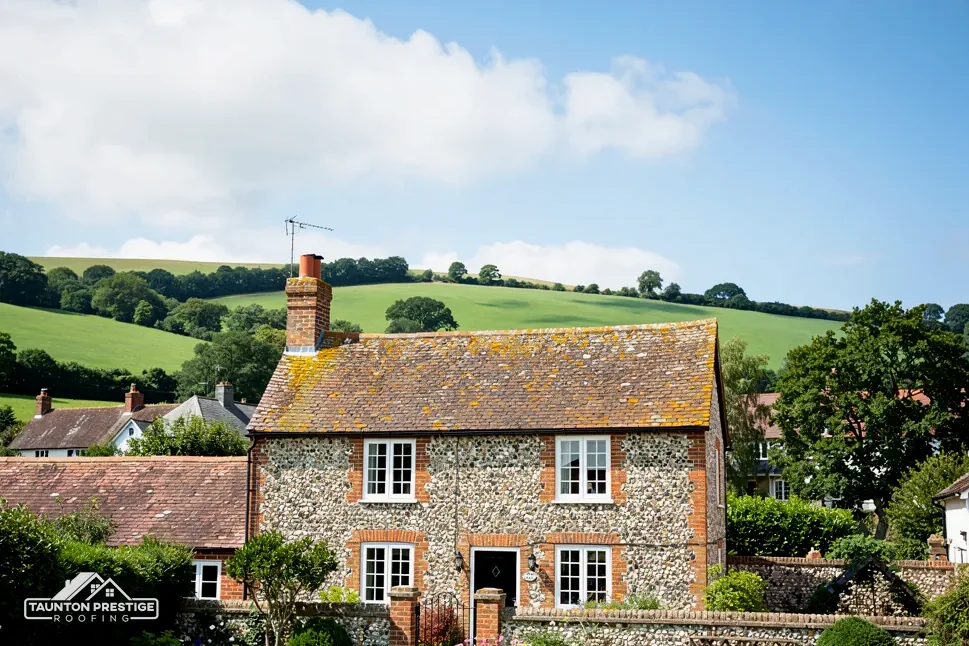
Chapel Leigh Farm House
Grade II since 4 May 1984, so a change of covering waits until the consent question is settled.
Chapel Leigh's farmhouse, its lime kiln and the lanes round West Leigh
Leigh here means the hamlets of Chapel Leigh and West Leigh, in Lydeard St Lawrence parish, with a listed farmhouse and an old limekiln site. Each roof is surveyed first.
Grade II since 4 May 1984, so a change of covering waits until the consent question is settled.
Both appear on the 1839 tithe map, and an Old Limekiln is on the 1888 Ordnance Survey map.
Leigh lies in Lydeard St Lawrence parish, which counted 428 usual residents at the 2021 Census.
Street map of Leigh with Halse, Preston Bowyer, Eastcombe, Milverton marked around it, and Taunton.
Halse lies to the south-east, Milverton and Preston Bowyer to the south, Bishops Lydeard to the east, and Eastcombe and Treble's Holford north-east of the hamlets.
About 7 miles north-west of Taunton, Somerset Council (unitary).
Two hamlets, one set of roof questions
Four spots to inspect on a farmhouse, cottage or outbuilding around Chapel Leigh and West Leigh, and how each finding changes the job.
South of Chapel Leigh, the 1839 tithe map names a Lime Kiln Quarry and a Lime Kiln Orchard, and the 1888 Ordnance Survey map shows an Old Limekiln. Lime was burned in this corner of the parish, which is a good story. It does not tell a roofer what holds the ridge tiles on your house, because the mortar on a roof can be of any date and any recipe, repaired over and over. The only way to know is to look at it, so the survey notes what has been bedded where and photographs it. A ridge that looks the same from the lane can be bedded very differently from one slope to the next, particularly after patch repairs by earlier owners.
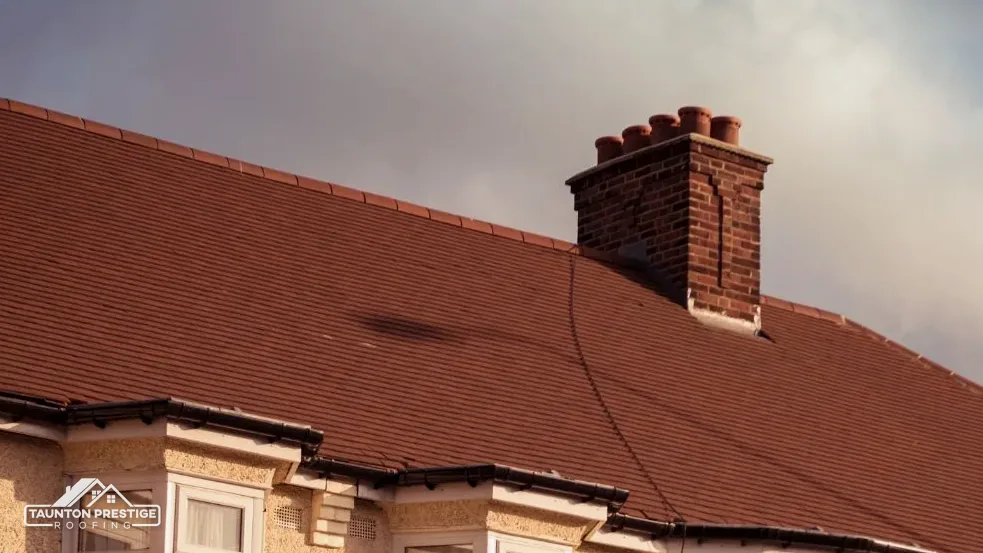
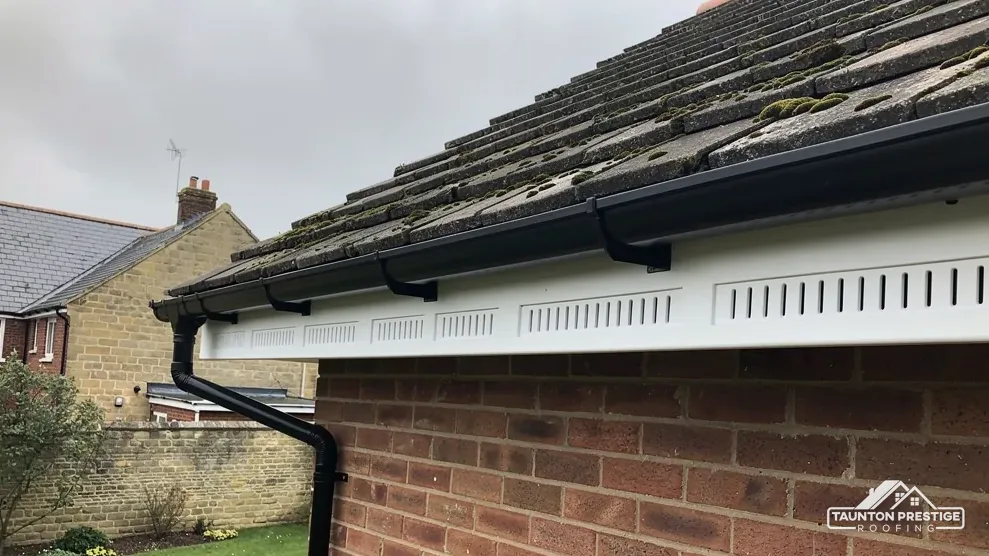
The ridge is the line of tiles that caps the top of the roof. Weather, frost and movement break down the bedding mortar, and when it crumbles the tiles shift and rain can get in. Marley explains that the 2014 revision of BS 5534 ended the assumption that mortar alone would hold ridge and hip capping, so a bedded ridge now needs mechanical fixings as well. That standard is guidance, not an Act of Parliament, and nobody has banned mortar.
On a dry-fix ridge, clips and screws do the holding and mortar carries none of the load. BS 8612 is the test standard that dry-fixed verge, hip and ridge systems are measured against. For a modern roof it is often the tidier answer. On an older house, or a listed one such as Chapel Leigh Farm House, the look of a mortared ridge may matter more, and the consent route decides what is allowed. A good ridge repair on that kind of building keeps the shape and colour of the old line while adding the fixings that the standard now expects.
Either way, the photographs we take at the survey show you the ridge, close up, before you choose.
Look for
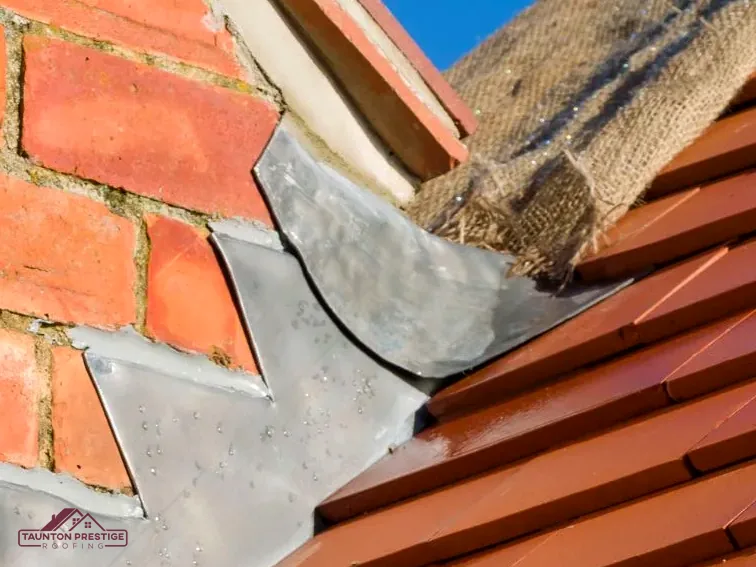
Chapel Leigh Farm House was listed Grade II on 4 May 1984, and the hamlet's centre has no other list entry within 500 metres. If your house is the farmhouse, any work that alters what makes it special needs listed building consent from Somerset Council, and that includes leadwork when the look of it changes. A like-for-like renewal of worn lead is a different case from a switch to another metal, and the difference can be the one that decides whether consent is needed at all.
Sound or needs work
What decides the price
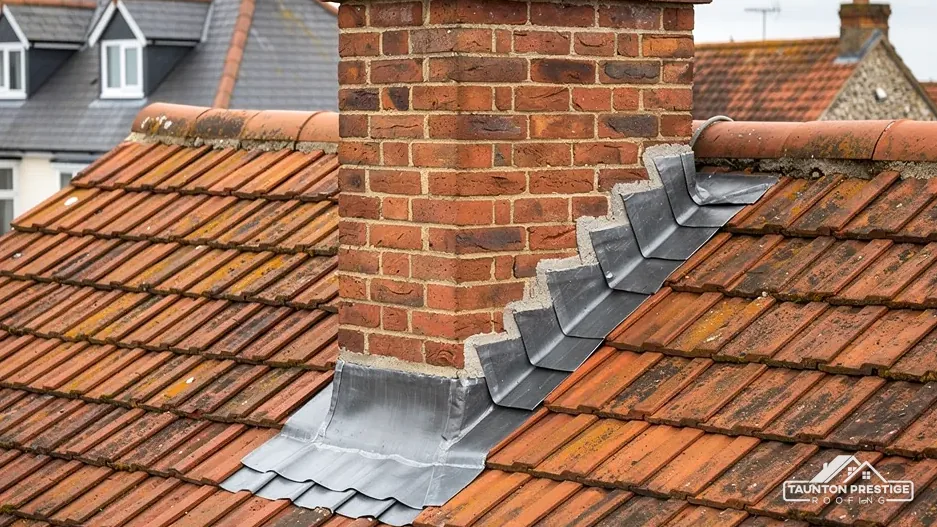
Flashing seals a chimney or a wall to the slope. A soaker is a folded piece slipped under each course next to a stack. A valley gutter, lined with lead, carries water between two slopes. Lead comes in numbered codes by thickness. Royston Lead's brochure lists code 5, at 2.24 mm, for flashings, pitched valley gutters, parapet gutters and dormers, and code 3 for soakers only. Lead flashing can last for over 80 years, which is why an early failure usually traces to its fixing.
A split in one spot can be repaired, but a lining that has creased and cracked along its length wants renewing. Before suggesting either, we lift a corner to look at the timber beneath, because a valley board that has gone soft or stained changes the whole answer. Our lead work page describes the options, including whether a house like yours calls for matching existing lead details.
The survey report records each lead detail with a photograph, which also helps any listed building application, and leaves a future buyer or surveyor with a plain account of the work.
The national dataset puts five conservation areas within about 2.5 km of Leigh: Ash Priors, Combe Florey, Fitzhead, Halse and Lydeard St Lawrence. Somerset Council lists Article 4 directions for both Halse and Combe Florey, each confirmed in 1977. Ask the planning team what those directions cover, and whether any designation reaches your own address, particularly if you want a dormer or roof window. Our guide to planning permission for roof work covers dormers in protected areas.
An opening planned around the rafters costs less than one cut across them.
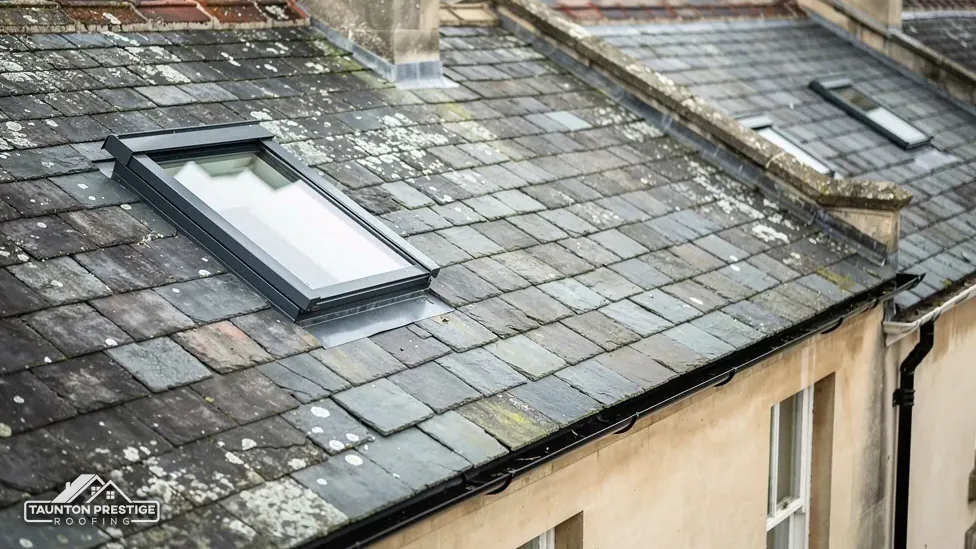
A new or replacement roof window is held to 1.4 or Window Energy Rating Band B in Part L. True rooflights carry a different figure, 2.2. When a roof window is fitted into an existing roof, the flashing kit, the lead or aluminium surround that seals it into the covering, matters as much as the glass. Our roof windows and skylight installation page covers the choices.
Sometimes, but the front slope is where a council looks hardest, particularly near a listed house. If your address is outside a conservation area and not listed, a window within the usual limits may be possible without an application. Check with the planning team, then ask us to confirm the fitting. A roof window also changes the light and the heat in the room below, so think about blinds and ventilation before you pick the size.
The loft is the first place to look, because the position of the rafters, the purlins and any chimney sets what is possible. Photographs from the survey show where the rafters run, so the opening is placed to suit the structure and not cut against it. The size of the opening sets the number of rafters that must be trimmed, and that sets a good part of the cost.
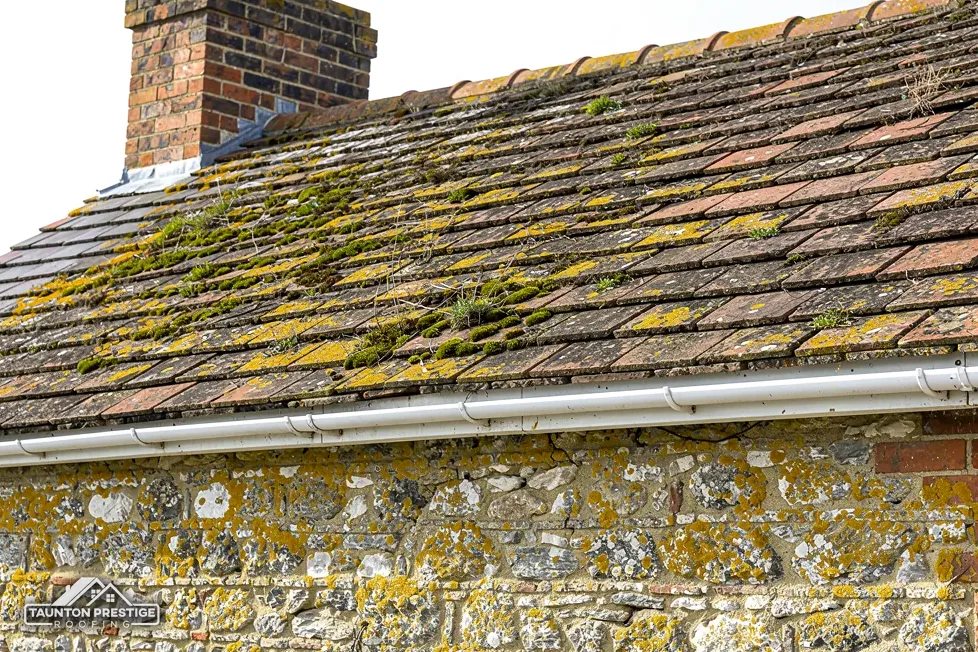
Moss and lichen settle on shaded slopes, and many owners think of a spray lance first. Marley advises against strong jets, which can scour the face of slate and tile. HSE also says the public should never use biocides meant for professional users, and using a non-approved product is an offence. Our roof cleaning and moss removal page explains what we brush and what we treat.
What decides the price
Not on its own. Moss keeps the covering damp and can fall into gutters, but the roof underneath may be perfectly sound. The survey tells you which, and removal then becomes a decision rather than a reflex. Where a slope has been cleaned and the covering underneath proves tired, we say that too, and show you the photographs of the worn pieces.
Until April 2023 Leigh sat in Somerset West and Taunton. Scaffold that obstructs the highway needs a licence under section 169 of the Highways Act 1980. As highway authority, Somerset Council licenses accredited contractors alone, which puts the application with the appointed contractor. The fee is £124.60 per 28-day period (April 2026), and notice is 10 working days.
Somerset Building Control, on 0300 303 7790, also serves that former area. On the Planning Portal's test, where under 25 per cent of the building envelope and under 50 per cent of the roof is affected, an application to building control is not normally required.
After the survey, the price is written down once, as a single total, with photographs of your roof beside it. Name the hamlet, the house and the problem, with a photo if you have one, and the survey goes into the diary.
Walked the roof?
When you have read the checks, we walk the roof and show you the photos.
No. Listing applies to the building named on the list, so a neighbour's roof is not covered by the farmhouse entry. Run your own address through the heritage list, and put any conservation area question to Somerset Council's planning team. If your house is listed, a change of covering or ridge style needs listed building consent.
The 1839 tithe map and the 1888 Ordnance Survey map record the quarry, orchard and kiln; whether anything survives is a question for a look on site. If a ruin or earthwork stands on your land, ask the council whether it needs consent. Roof work on a nearby house is separate and starts from a survey.
Yes, by hand brushing and an approved treatment rather than a jet. Marley warns that strong jets can wear the face of slate or tile. HSE says non-professionals should not use professional-only biocides. We check the covering underneath first, since moss can hide cracked or slipped pieces, and we tell you what the slope needs before anything is treated.
A single split can be patched. A lining creased along its length is better renewed, because patches then multiply and each one is another joint to fail. We lift a corner at the survey to check the boards beneath, show you the photographs, and say which route is the better buy. Lead flashing can last for over 80 years, so a failure is worth tracing.
Tell us which hamlet you are in and what looks wrong, and a survey visit follows.