A garage roof is a simple structure with a long list of possible coverings. Rubber, fibreglass and felt go on flat or nearly flat roofs and form a continuous skin. Steel, fibre-cement and insulated panels go on as sheets, bolted or screwed down in rows. None is best in every case, and the right answer depends on the span, the pitch, what is stored inside and what is there now.
That is why a roofer should look before recommending anything. This guide walks through each option in plain terms: what it is, how it goes on, what the published sources say about its life and cost, and where it fits. The aim is to help you ask better questions of whoever quotes, from replacing worn felt or dealing with old corrugated sheets to simply being tired of a drip over the car. It sits within our garage and asbestos roof work in Taunton and across Somerset.
Start with the garage, not the material
Four facts about your garage narrow the field before price comes into it.
What does the existing roof tell you?
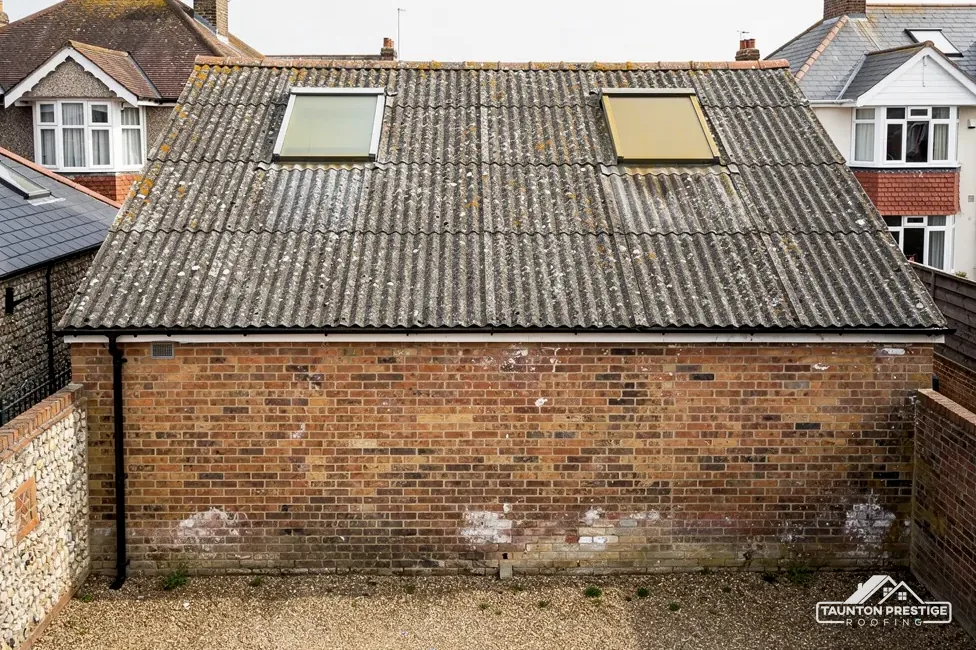
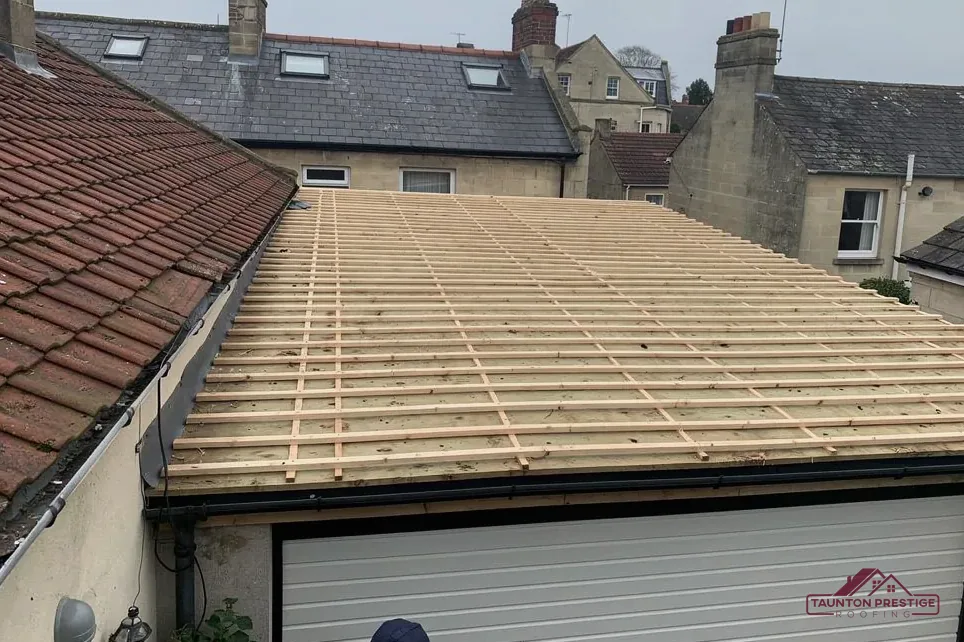
First, the pitch. A roof that is level or nearly level needs a continuous membrane, because sheets need a slope to shed water. A roof with a clear slope can take sheets, though a membrane still works. Second, the span: long gaps between supports suit stiff steel sheets or panels, where a membrane needs a deck beneath it. Third, the structure: an old timber deck that has been wet needs repair first, whichever covering goes on. Fourth, the existing covering. If the garage has grey corrugated sheets, they may be asbestos cement, which has to be identified and removed with care before anything else is decided. Our guide to asbestos garage roof removal sets out that process.
Other questions matter too. Is the garage attached to the house, where a leak turns into a damp wall? Is there a room being planned above or a conversion in view? Will the roof ever be walked on, for a gutter clear-out or a solar panel? Is there a need for warmth, or only for dry?
These answers explain why two neighbours with similar garages can end up with different roofs, and both be right. A proper survey answers all of them on site, with photos of the deck, the supports and the edges, so the choice rests on what is actually there. Ask to see them before you agree to any covering, because a garage roof is cheap to look at and costly to get wrong.
Rubber, fibreglass and felt compared
The three flat roof coverings share a job: they keep water out with a continuous skin. They go about it differently.
What are EPDM, GRP and felt?
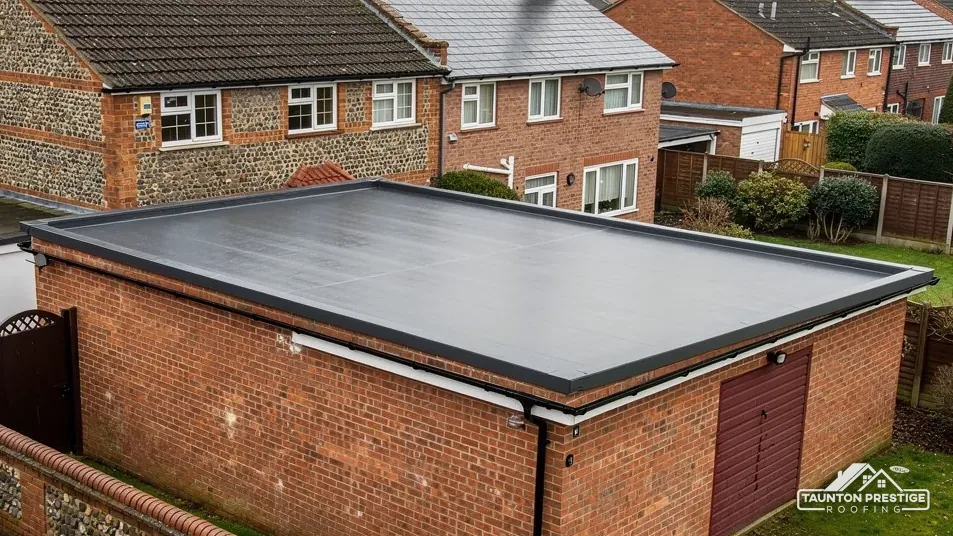
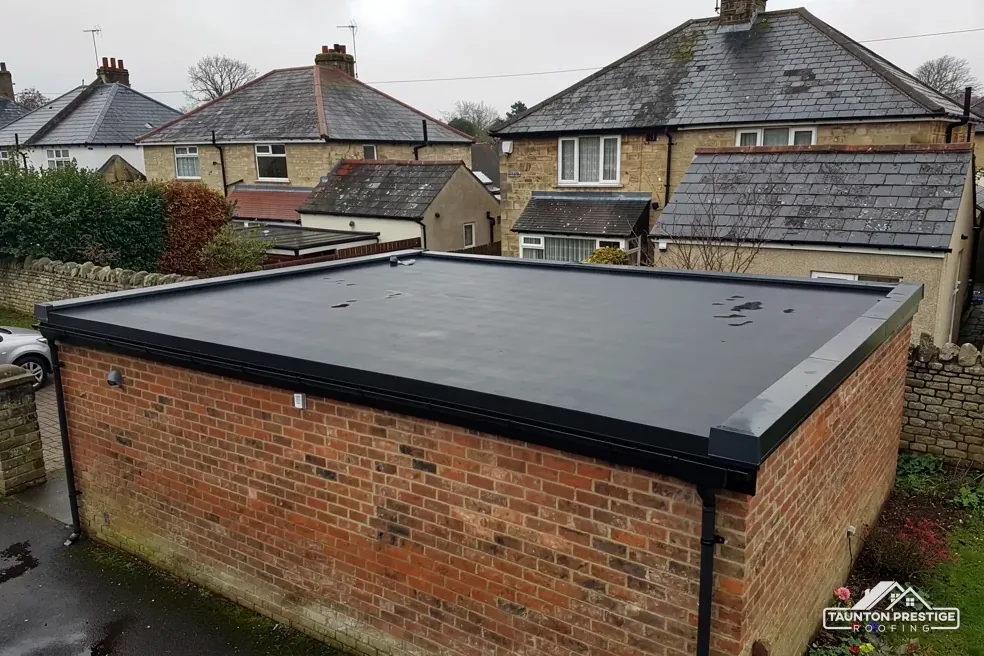
EPDM is a synthetic rubber membrane, often supplied as a single sheet cut to the roof, then bonded down with adhesive and finished with trims at the edges. GRP is glass-reinforced plastic, better known as fibreglass: liquid resin is laid over glass matting and sets hard into one joint-free layer. Felt means bitumen sheets, built up in layers and fused or bonded together. Torch-on felt roofs have their own guide on this site.
Published lifespans are typical ranges and never a promise. GreenSpec gives EPDM 20 to 30 years, while Less gives 30 to 50, so the sources disagree. Less puts GRP at 25 to 40 years and felt at 10 to 20 (Less, Oct 2026), and the spread within felt comes down to workmanship.
On cost, MyJobQuote gives EPDM at around £60 per square metre, with an average rubber roof at £1,050 installed, and a felt roof at around £1,500 on average (MyJobQuote, Oct 2026). Less gives £1,200 to £2,500 for a 15 m² garage (Less, Oct 2026).
Fibreglass is rigid, so it suits a stiff deck and can crack if the timber beneath it moves. Rubber copes better with movement. Felt is easy to detail around awkward corners. Whichever you pick, a sound deck matters most. Rot in the boards, loose fixings or a deck that has sagged between joists will shorten the life of any of the three, so the old covering comes off, the boards are checked, and weak ones are renewed before the new layer goes on. Falls matter too: a garage roof that holds water in a dip will age quicker than one that drains cleanly to a gutter.
Box-profile steel and fibre-cement sheets
Sheet roofs go on in rows, lapped and fixed to purlins, the timbers running across the rafters. They are quick to fit once the structure is ready, and they suit garages with a clear slope and a long span.
Is box-profile steel good for a garage roof?
Box-profile steel is a coated steel sheet pressed with raised ribs, so it is stiff over long gaps. It is light, which helps old walls and timbers, and it sheds water well. Its drawbacks are noise in heavy rain, condensation on the underside in cold weather if the garage is damp, and the cut edges, which can rust if the coating is damaged. Our answer on box-profile steel for a garage roof takes this further.
What about fibre-cement sheets?
Modern fibre-cement sheets are corrugated like the old ones but contain no asbestos. They look right on a traditional garage or farm outbuilding and are quiet in the rain. They are heavier than steel, brittle if walked on, and they need care in handling. They also need the right supports, because a long unsupported span can crack.
One safety point: the new sheets look much like the old asbestos ones. If the garage has an older roof, the old sheets are identified before work starts, and the two are never assumed to be the same.
Both sheet types suit a garage that stays unheated, and both need a gutter or a clear drip line so that the water leaving the roof does not run down the wall below. Neither gives warmth. If the garage will be used as a workshop or gym, an insulated option is worth considering.
Insulated panels: when warmth is the aim
An insulated panel is a sandwich: a core of rigid insulation between two outer skins, usually steel on the outside and either steel or a plain lining on the inside. The panel goes on in one piece, so the covering and the insulation are fitted together and the underside is already finished.
When is an insulated panel worth it?
When the garage is turning into a room. A workshop, studio or gym needs to hold heat and avoid dripping condensation, and a panel roof does both without a separate ceiling. It also works on a long span with few supports. Its drawbacks are weight, a higher price than a plain sheet, and the need for the walls to carry it. Joints between panels and the edges at the walls are where detailing counts.
If the garage is being converted, the Building Regulations come into play. Insulation values for a renovated roof are set by Approved Document L, and Table 4.3 gives a threshold of 0.35 and an improved value of 0.16, with a 15-year payback test that can relax it. For a garage that is staying a garage, plain sheets or a membrane without insulation are the usual choice.
The price of insulated panels depends on the panel thickness, the span, the supports and the access, and the written quote settles it after the survey.
A side-by-side table
Published figures are national ranges from the sources named, set out here as published. Where a source gives nothing for a material, the cell says what decides the price.
| Covering | Published life | Published cost | Best suited to |
|---|---|---|---|
| EPDM rubber | 20 to 30 years (GreenSpec); 30 to 50 (Less) | Around £60 per square metre (MyJobQuote, Oct 2026) | Flat roofs that move a little |
| GRP fibreglass | 25 to 40 years (Less) | Garage of 15 m²: £1,200 to £2,500 (Less) | Stiff decks, tidy edges |
| Felt | 10 to 20 years (Less) | Around £1,500 average (MyJobQuote) | Awkward shapes, shorter horizons |
| Box-profile steel | Depends on coating and care | Set by area, span and access | Clear slope, long span |
| Fibre-cement sheets | Depends on exposure and care | Set by area, span and access | Traditional outbuildings |
| Insulated panels | Depends on skin and joints | Set by thickness and span | Garages in use as rooms |
Published lives are typical figures, not promises of any kind. A covering with a long published life still depends on a sound deck, tidy edges and working drainage, and a short-lived one that is laid well can outperform a long-lived one that is laid badly.
Maintenance counts as well. Rubber and fibreglass need their outlets and gutters kept clear and the surface checked for splits. Felt needs its laps and edges looked at. Steel needs its coating and fixings inspected. A yearly look from the ground, with binoculars, catches most small faults while they are still cheap to mend.
Hold each row up against your own garage. Rows with a figure show what national guides publish, and for the others the survey decides.
Choosing, and what moves the price
With the facts laid out, the choice usually comes down to a few plain questions.
Which covering should I choose?
- Flat, small, awkward in shape: felt or rubber, depending on how long you want the roof to last.
- Flat, with a stiff deck and a tidy outline: fibreglass is worth pricing against rubber.
- Clear slope and a long span: ribbed steel sheets or non-asbestos fibre-cement.
- Garage being used as a room: insulated panels or a warm flat roof with insulation above the deck.
The price depends on the roof area, the covering, the state of the structure under the old roof, access and any scaffold, and the waste to be taken away. If the old sheets are asbestos cement, careful removal and the waste route add steps to the job. The typical UK range for any garage roof is £750 to £3,500, averaging £1,500 (MyJobQuote, Oct 2026), and our guide to garage roof cost shows what sits behind that spread.
Longer life is not always worth paying for. If the garage is due to be rebuilt in ten years, a covering with a ten-year life might be the sensible pick.
Ask for the covering named in writing, the build-up beneath it and what happens at the edges. Our price is written after the survey, and the photos from it show the deck you are paying to protect.
Choosing a garage roof
Is rubber or fibreglass better for a garage?
Neither wins every time. Rubber copes with a deck that moves and has few joins. Fibreglass makes a hard, joint-free skin but needs a stiff deck and can crack if the timber shifts. Published lifespans overlap, so the deck and the shape of the roof usually decide.
Can I put new sheets over my old corrugated roof?
That depends on what the old sheets are. If they may be asbestos cement, the first step is identifying them, and covering over leaves the material on the building. If they are sound non-asbestos sheets, a roofer can judge whether the purlins will carry the extra weight.
Does a garage roof need insulating?
Only if the garage is used as a living or working space, or if condensation is a problem. A store for cars and tools stays dry with a plain covering. If you plan to convert it, Part L sets insulation values, and the conversion needs a Building Regulations check.
More on this subject: Garage and asbestos roof replacement in Taunton