Nobody replaces a garage roof for fun, and the instinct to find the lowest price is a sound one. Garages do not earn their keep like a house, and a covering that keeps the car and tools dry is all most owners want. But roofs punish a price chosen on its own. A thin felt laid fast over a damp deck can be gone in under ten years. A rubber sheet that costs a little more can run for decades. Over the life of the garage, the quote with the lower figure is sometimes the dearer one.
This guide is about getting a dry, lasting roof for the least sensible outlay. It compares felt, EPDM rubber and sheet coverings on the published UK figures, explains when mending beats replacing, and lists the savings that do not hold up, such as skipping deck repairs or hiding the cost of asbestos removal. It sits within our garage and asbestos roof work in Taunton and across Somerset, and it uses only national cost guides, named and dated, never our own prices.
A low price against a low cost
The price on a quote and the cost of owning a roof are different sums. The first is what you pay on the day. The second is that figure divided by the years the roof lasts, plus whatever repairs it needs on the way.
How do you judge value, not just price?
Three questions do most of the work. How long is the covering expected to last, as a published range and not a promise? How much of that range does the workmanship protect, since the same sheet laid well and laid badly can differ by years? And what has to happen before the covering goes on, because a rotten deck or a leaking edge will undo any material?
Cost guides help with the first question and the roofer's survey answers the other two. For a garage, MyJobQuote gives a typical UK range of £750 to £3,500, with an average of £1,500 (MyJobQuote, Oct 2026). That is a wide spread, and the gap between the ends is made up of the things listed in the next sections: the size of the roof, what it is made of, the structure underneath and how easy it is to reach. Less gives £1,200 to £2,500 for a garage of 15 m² (Less, Oct 2026).
A quote that sits at the very bottom of such a range needs a closer look, and a quote at the top deserves the same question about what it includes. It may be a good price for a simple, sound roof, or it may leave out the deck, the edge trims, the waste or the VAT. The sensible response is a question, not a suspicion.
Felt: low up front, wide in what it delivers
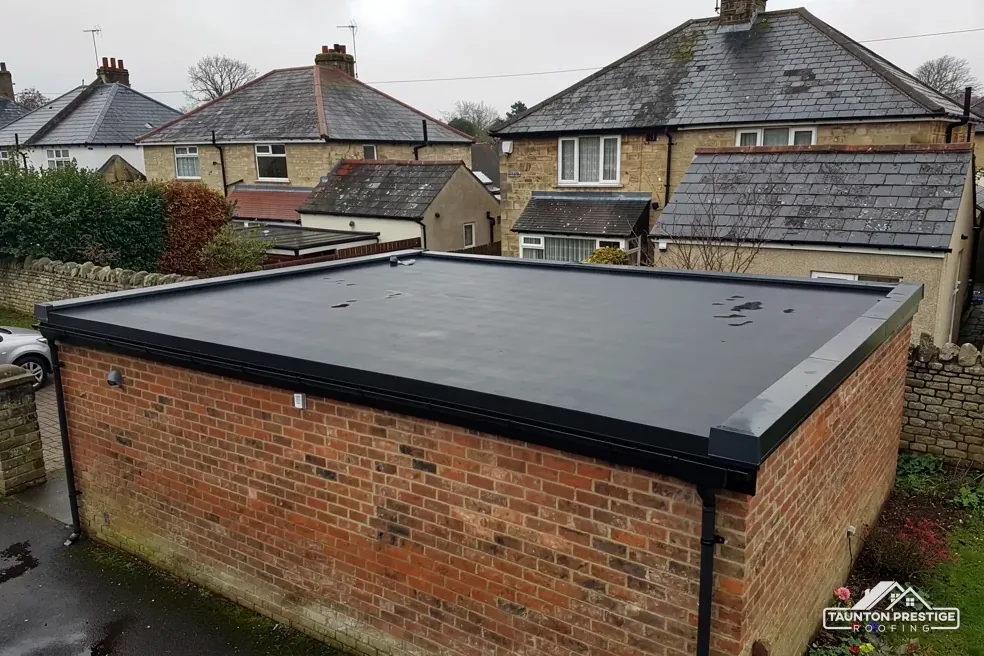
Felt is the covering most often chosen when the aim is a low outlay. MyJobQuote puts an average felt roof at around £1,500, and a 15 m² garage in SBS felt, a polymer-modified bitumen sheet, at between £1,200 and £1,800 (MyJobQuote, Oct 2026).
The lifespan is where felt gets difficult. Less gives torch-on felt 10 to 20 years, and adds that careful work can reach 20 years while a poor job might not see year 10 (Less, Oct 2026). Read that as two very different roofs under one name. The price does not tell you which one you are buying, but the specification does.
What should a felt quote say?
- The number of layers, because two or three layers outlast one.
- Whether the deck is being checked and repaired.
- How the edges, trims and any upstands are finished.
- Whether the old layers come off or stay as a base for the new ones.
A felt roof also asks for a little care afterwards, and the owner can do most of it from the ground. A look at the outlets and gutters once a year costs nothing and keeps water from sitting on the surface.
Felt is a fair choice for a simple garage where the owner expects to rebuild or sell within ten to fifteen years. It is less attractive where the roof will be hard to reach later. Our guide to how long a garage roof lasts sets out the typical lives for each covering.
Rubber: costs a little more and lasts longer
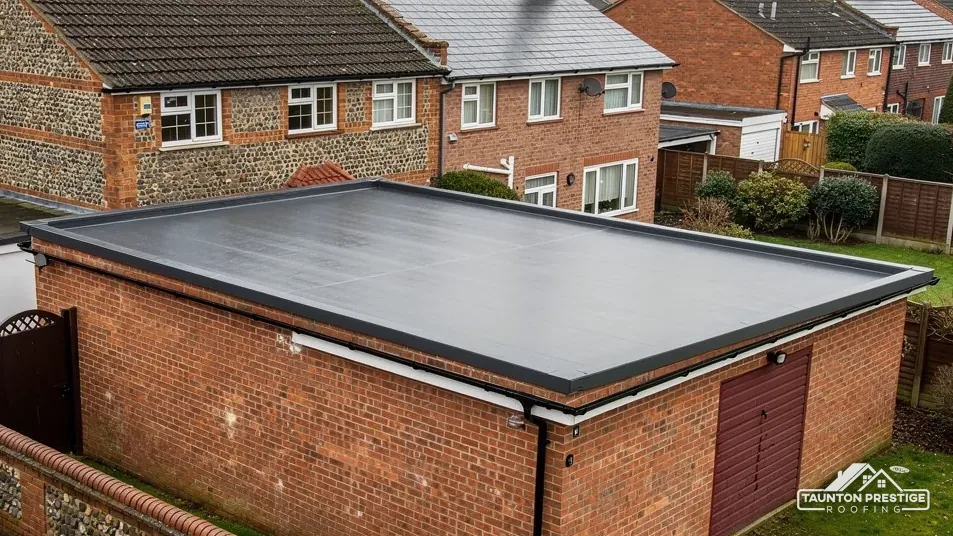
EPDM, a rubber sheet laid on flat roofs, is normally supplied in one piece and bonded to the deck. MyJobQuote gives it at around £60 per square metre and an average rubber roof at £1,050 installed (MyJobQuote, Oct 2026). Compared with the felt figures above, that average is lower, which surprises people who assume rubber is the dearer choice.
Published lifespans differ. GreenSpec puts the expected service life of EPDM at 20 to 30 years, while Less gives 30 to 50 years, so the sources disagree and the safe reading is the lower figure (GreenSpec; Less, Oct 2026). Even on the lower figure, rubber is expected to outlast most felt.
Why does rubber often make sense on a garage?
One sheet has few joins, so there are fewer places for water to find. The membrane flexes with the deck, which suits timber that moves with the seasons. And it can be fitted without a naked flame, which matters where a garage joins the house or sits close to a boundary fence.
It is not a perfect answer. Rubber needs a sound deck, clean edges and the right trims. A garage with a very awkward outline takes more cutting and more joins, which narrows the gap with felt. And the roof must be walked on with care, because sharp objects and ladders can puncture it.
For a garage that will be around for twenty years, rubber is often the covering that gives the lowest cost over its life. The survey confirms whether your deck suits it.
Sheets: where they save and where not
Sheet coverings, such as box-profile steel and modern fibre-cement, go on quickly once the structure is ready. They suit a garage with a proper slope, and that is where they can keep the bill down: the labour is brief and there is no deck to board over if the purlins are sound.
When do sheets cost more than they seem to?
When the existing roof is flat. A flat garage roof cannot take sheets without a new frame to give it a slope, and that frame is a job of its own. When the span is long and the supports are poor, the sheets sag. And when the garage joins the house, flashing and drainage at the wall need careful work.
Steel sheets can be noisy in rain and can attract condensation on the underside, which drips onto whatever is stored below. Fibre-cement sheets are heavier and brittle underfoot. Neither is the right answer for every garage, and both are worth pricing when the roof already has a pitch. Their gutters and drip lines need thought too, since a sheet roof sheds water quickly and in one place, and a garage wall that is splashed every storm will stain and, in time, go damp.
What sheets cost turns on the roof area, how far they must span and how easy the roof is to reach, and the survey fixes the figure.
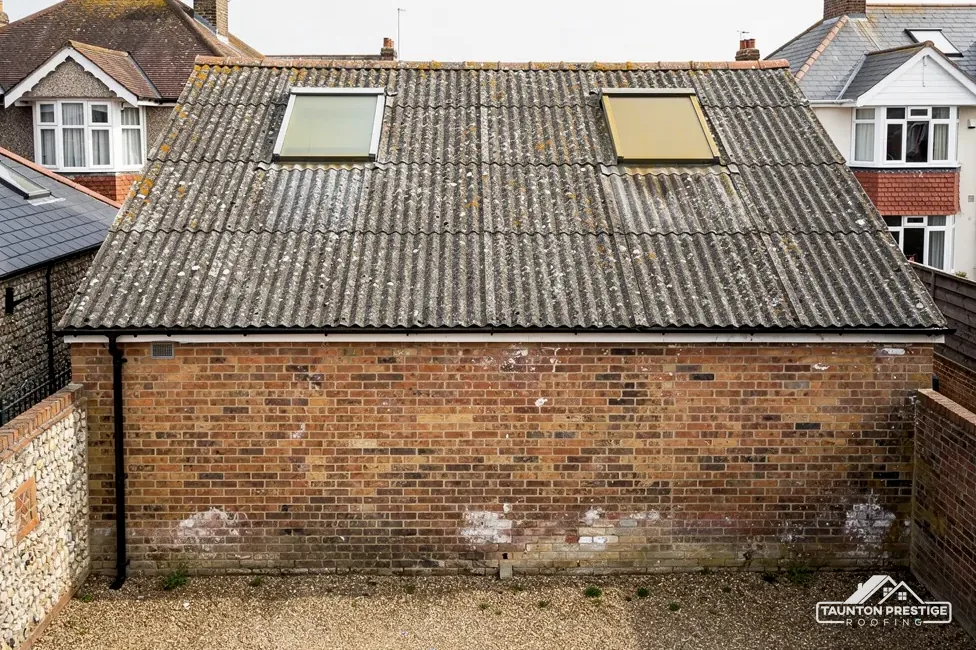
If the old roof is corrugated and grey, check what it is made of first. Our guide to what a new garage roof costs covers how asbestos changes the sum.
When mending beats replacing
The lowest-cost roof is sometimes the one you already have. If the covering is basically sound and the fault is local, a repair can buy years for a fraction of the price of replacement.
How do you tell if a garage roof can be repaired?
Look for the pattern of the problem. A single split, a lifted corner or a failed seal around a pipe is a local fault. A roof that is blistered across its whole surface, soft underfoot, or leaking in several places at once is failing everywhere, and patching it only moves the leak along. Money spent on repeated patches can add up to a large part of a new roof without ever delivering one. A sagging roofline points to the structure underneath and not to the covering.
Ask the roofer to show you the fault in a photo and to say what caused it. A repair is worth doing when the deck is dry and firm, the covering has a good number of years left, and the fault is something a roofer can describe and fix. It is a poor use of money when each patch is followed by another leak a few months later. MyJobQuote gives an average roof repair of around £650 (MyJobQuote, Oct 2026), a national figure for repairs in general and not for garages specifically.
Roof paint and sealants have their place on a sound surface, but they are not a cure for a failing roof. Our guide to whether to repair or replace a garage roof sets out how to weigh the two, and it is a useful read before you accept a quote for either.
False savings to avoid
Some savings look sensible and cost more later. Most come down to skipping a step that cannot be seen once the roof is finished.
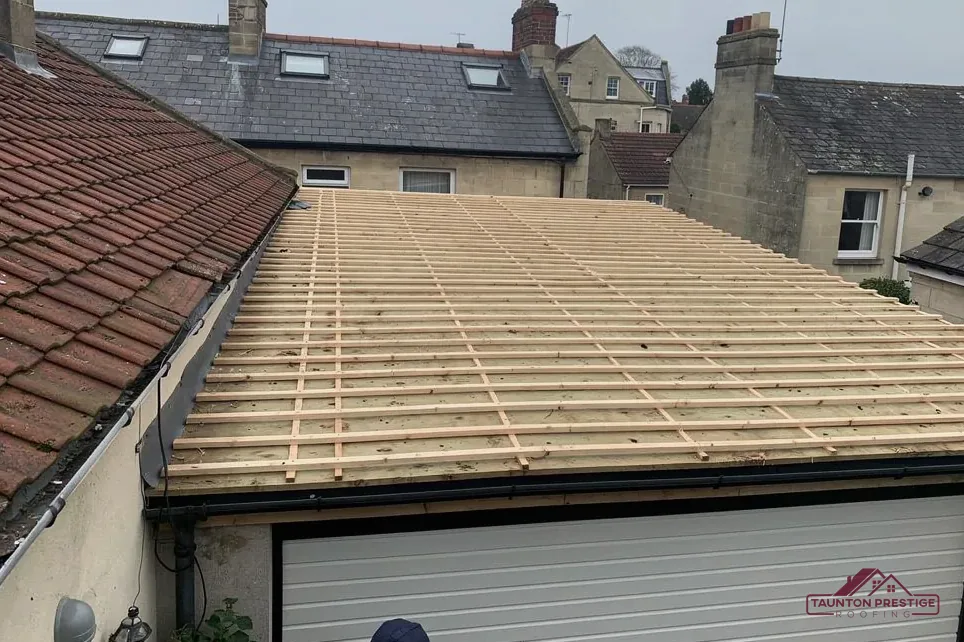
- Leaving a damp deck in place. New covering on wet or rotten boards fails early, whatever it is made of.
- Covering over asbestos sheets without a plan. The material stays on the building, fixings go through it, and the next repair is harder.
- No scaffold or poor access. A safe way up matters, and the cost of an accident is far higher than the cost of a platform.
- Unfused laps or thin edge trims. These are the first places a flat roof leaks.
- No proper waste removal. Old roofing materials must go to the right place, and asbestos waste always needs a consignment note.
What decides the final price of a garage roof?
The roof's shape and area, the covering you pick, the state of the deck and walls, how the roof is reached, whether scaffold is needed, whether asbestos is present, and the disposal of old material. Ask whether a quote includes VAT, the waste and any deck repairs, since a figure that leaves these out is not the whole price.
The best way to find the sensible price for your own roof is to have it looked at. A survey of the roof comes first, with photos of your own deck and edges, and then a single written total. You decide once you have seen what is up there.
Garage roof savings
Is felt always the lowest-cost option for a garage?
Not always, though it often is on a first price. MyJobQuote's published averages put an installed rubber roof at around £1,050 and a felt roof at around £1,500. Prices shift with the size, shape and deck, so compare the written specification and the expected life, not just the headline figure.
Can I keep the old garage roof and just add a new layer?
Sometimes, when the existing layers are dry, firm and well stuck down. A wet or blistered roof only hides its problems under a fresh layer, and the leak returns. Corrugated sheets that may contain asbestos need identifying first. A roofer can judge on site whether an overlay is sound.
Is a short-lived garage roof ever the right choice?
Yes, when the garage will be rebuilt, sold or converted within a few years, or when the budget is tight and the structure is sound. A covering with a shorter published life then costs less overall, as long as the boards are dry and the edge trims are done properly. Where the garage will stay for decades, a longer-lived covering usually repays the difference.
More on this subject: Garage and asbestos roof replacement in Taunton