Ask five people when to take moss off a roof and you will hear five months. The truth is less tidy. Moss is a plant that lives on damp, shaded, slow-drying surfaces, and Somerset gives it plenty of those: mild, wet weather, north-facing slopes, trees along the lanes and hills that hold the damp. It can be there all year, so the date matters less than the conditions on the day and what is living on or under the roof.
This post goes through the questions in the order we would ask them on site. Is the roof safe to work on, and is the covering sound enough to be cleaned at all? Is anything nesting or roosting in the roof? How does a treatment need to be timed so that it works? And why do we avoid the pressure washer that so many cleaners still bring along? We will also say when moss removal is not the answer, because a roof that is crumbling under the green needs a different conversation.
Why the date matters less than the weather
People like a season to put in the diary, but a roof does not read the calendar. What counts is whether the surface will dry out soon after the work, because a wet slope holds treatment and debris in place, whether ladders and scaffold can stand on firm ground, and whether anyone has to work on wet, slippery tiles. A bright, breezy week in a damp month beats a still, drizzly week in a month that looks perfect on paper.
Does moss only grow in winter?
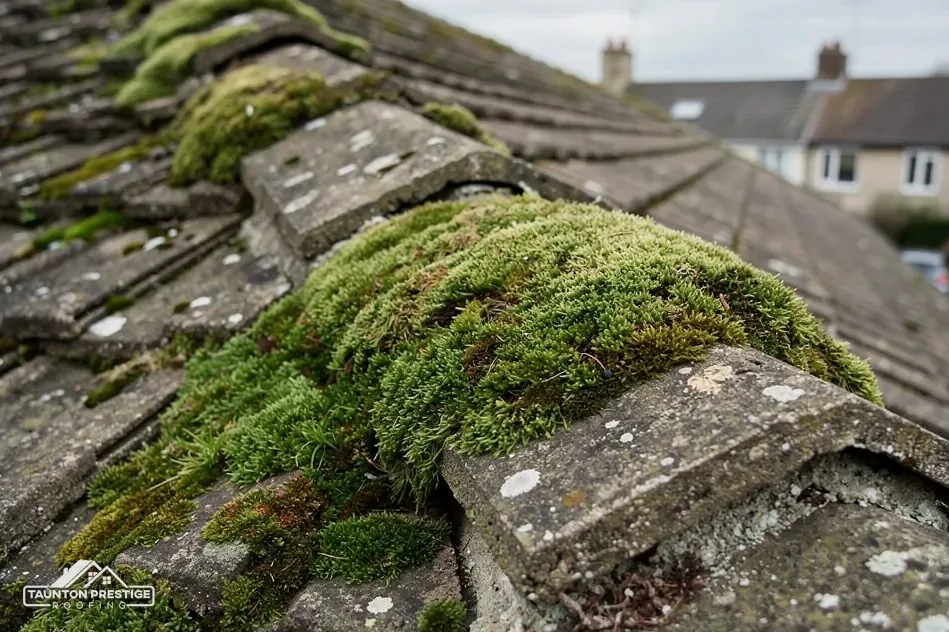
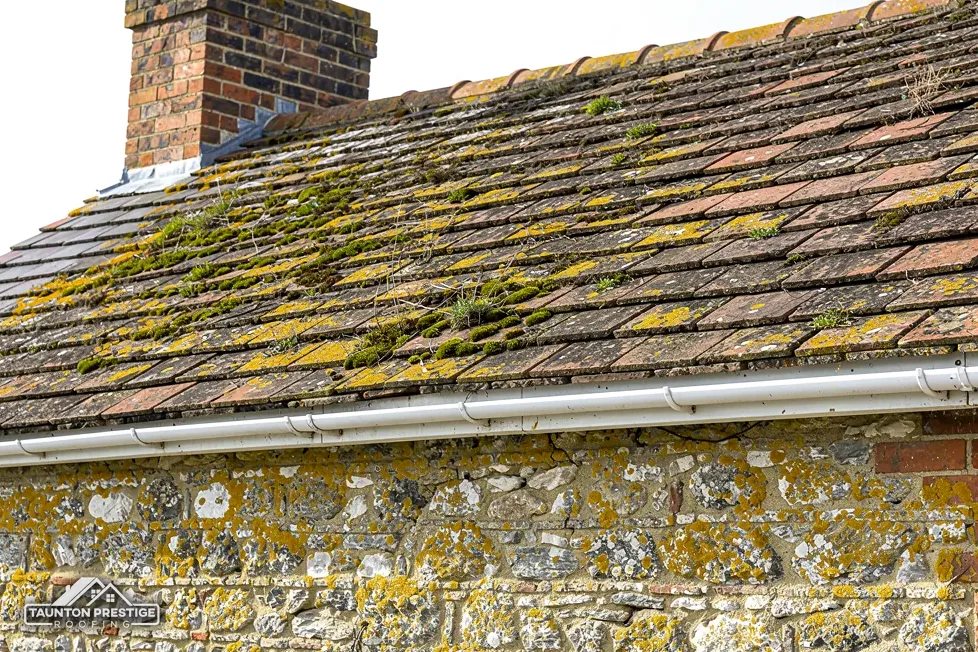
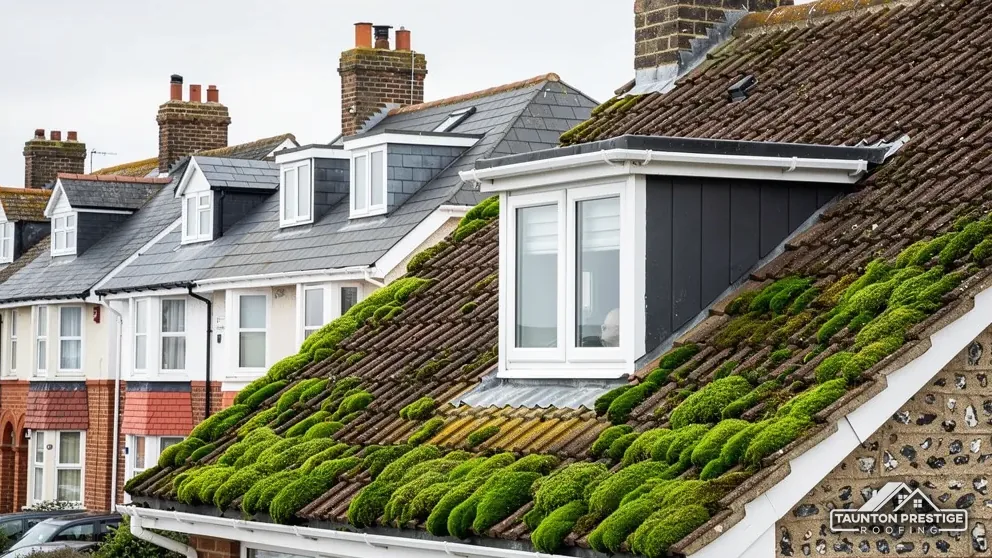
No. Moss holds water like a sponge and keeps growing wherever the surface stays wet. It builds on the shaded side of a roof, under overhanging branches, along the lower courses where water lingers and in valleys where leaves collect. What changes through the year is how fast the roof dries, and that is the practical thing to plan around.
A day when the roof will dry soon matters for two reasons. A wet roof is dangerous underfoot, and many treatments want a spell without rain after they go on.
Is a wet Somerset autumn a bad time?
It can be, if the forecast is a run of rain with no break. But a dry day in October is as workable as a dry day in May. We would rather wait for a proper gap than push on in the wet. A short delay costs nothing; a rushed clean in the rain can cost the treatment.
Leaves are a separate point. Clearing moss while branches are still shedding means gutters fill up again quickly, so we look at the trees as well as the tiles.
Check for nests and bats before any work
Roofs are homes for wildlife as well as people, and this check comes before any date is fixed. Birds nest on and under roof coverings, in gaps at the eaves, along the tops of walls and between the tiles and a gable. Bats can use the same spaces, and they may be present with no sign at all.
Is it an offence to clear a nest?
Under section 1(1) of the Wildlife and Countryside Act 1981, anyone who intentionally interferes with a nest in use, by taking, damaging or destroying it, or one still being built, commits an offence. Building work does not earn anyone a licence for that. So an occupied nest means the work waits. We look before we start, and if a pair is using a gap at the eaves we leave that stretch alone and re-plan the visit around it.
What about bats?
The rules for bats run on two tracks, and GOV.UK lists roof work among the jobs that can affect them. Under section 9(4) of the 1981 Act, intentionally or recklessly unsettling a bat in its roost, or shutting off its way in, is an offence. Wrecking the roost itself falls under regulation 43 of the Habitats Regulations 2017, where intent is not part of the test.
Moss removal rarely needs anyone to lift tiles, but a roof with gaps at the ridge or under the eaves gets a careful look first. Droppings, staining or a bat mean we stop at once, and you would need specialist advice before anyone goes further. Our guide to roof cleaning, bats and birds covers how that works.
How biocide timing and product rules work
Many moss treatments rely on a biocide, a chemical that kills the plant along with the algae and lichen that grow beside it. Unlike a brush or a scraper, it is not instant. The product goes on, it is left to work, and the dead growth is then brushed off, rinsed away or allowed to weather off. So timing is about the days after the work as much as the day itself.
How long must the roof stay dry?
The answer sits on the product label, and it differs between products. Article 17(5) of the Biocidal Products Regulation ties every use to the product's authorisation, so contact time, rain-free period and method come off the label, not from habit. Rain that arrives too early can wash a treatment out of the moss before it has done its work. A good contractor can name the product going on your roof and say what its label requires. If they cannot, that is worth knowing before you book.
Can I buy the same stuff myself?
Not always. HSE advises that the stronger, professional-only biocides stay with trained contractors; applying an unapproved product is a separate offence. Garden-centre products are made for householders, but the stronger solutions are not. That is why a product bought at a shop and one used by a contractor are not interchangeable.
Run-off matters too. Treated water ends up in gutters and downpipes, and some homes have water butts or a pond. Tell us about them at the survey so the visit is planned around them, with butts disconnected for a spell if needed.
Why we do not jet wash a roof
A pressure washer looks like the obvious answer, but it is the tool we avoid. It is fast, it is loud and the roof is visibly paler within minutes. The trouble is the damage done to the covering underneath.
Why does a jet wash harm tiles?
Marley, a major tile maker, does not recommend jet washing: the blast can score the top layer of a tile or slate, and with it the covering's expected life. That is the manufacturer's own position, and it matters if you ever need to argue a defect. A concrete tile carries a surface layer, and a jet can strip it. Water forced sideways can also drive under the laps, soak the underlay and battens, and flush grit and moss into the gutters.
There is a further problem. Cleaning too hard leaves a rougher, more open surface, which can hold moss spores and let moss grow back faster. You can pay for a cleaner roof and end up with one that needs doing again sooner.
What do you use instead?
We prefer to work lightly. That means brushing or scraping off the thick growth by hand where the roof allows, then treating what is left with a product used to its label. Dead moss is much lighter than live moss and comes away easily once the treatment has worked. It takes longer than a lance and costs for the time. Our guides on pressure washing a roof and soft wash roof cleaning explain why the first can damage tiles and what the second does instead.
MyJobQuote gives an average of around £475 for a semi-detached house (Sep 2026) on its pressure-washing page, but that is a method Marley does not recommend. Ask any cleaner how they plan to do the job.
When the roof needs repair first
Moss often hides problems, and a proper survey looks for them before any cleaning is booked. Cleaning a roof that is failing can speed up the failure, because you take away the growth that was masking the damage, and the first heavy rain finds every gap.
What should I look for before cleaning?
Study the covering from the garden or pavement, using binoculars if you own a pair. Slipped tiles, cracked tiles, crumbling mortar along the ridge and verge, gaps in the mortar collar around a chimney and lifted lead all need dealing with first. The ridge is the capping along the crown of the roof, and the verge is the tile edge that stops short of a gable wall. Loose or soft material can come away under a brush.
A valley is the gutter-like fold between two slopes, and moss there can dam the channel and push water sideways under the tiles. That is why we clear valleys and gutters on the same visit. Where a valley is lined with lead, we look at the lead before anything is brushed or treated, because a split channel needs repair, not cleaning.
Is the roof beyond cleaning?
Sometimes. If tiles are crumbling or soaking up water, or the underlay has perished, cleaning only delays a larger job. MyJobQuote gives a typical UK range of £225 to £550 for ridge tile replacement (Oct 2026), which is often the sensible fix to book before the clean.
A low roof can be treated from a ladder or a platform. A taller house may need scaffold, and MyJobQuote puts a week of front-elevation scaffold at £550 to £750 (Oct 2026). When quotes arrive, see whether each one includes it, and read our overview of roof cleaning and moss removal for how a clean is scoped.
Gutters, drains and what happens afterwards
Whatever method is used, moss and grit come off the roof and land somewhere. That somewhere is usually the gutter, so a roof clean that leaves the gutters full has made one problem and moved another.
What happens to the debris?
Loose moss gets raked or scooped from the lower courses and the gutters, bagged and taken away. Left in a gutter, it swells, blocks the outlet and overflows down the wall. Treated water also runs down the drains with the next rain, which is one more reason to mention butts and ponds at the start. Clear gutters after the roof, not before, so that nothing from the slopes lands in a clean channel.
Will the moss come back?
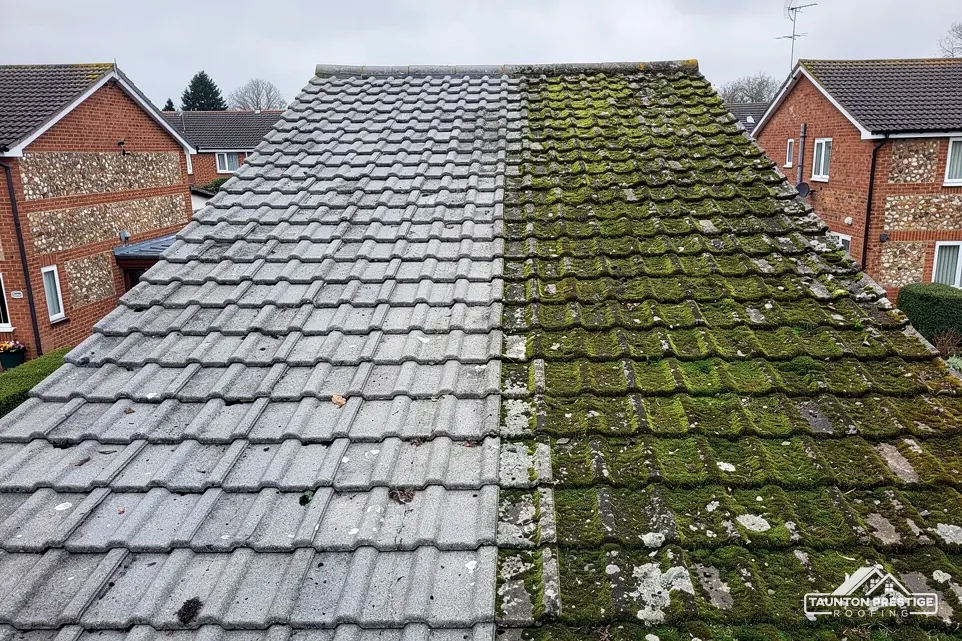
Probably, in time. A shaded slope and a damp climate suit moss, and nothing makes a roof immune. A clean roof stays clearer for longer if the trees are cut back, the gutters flow and the surface has not been scoured rough.
If your roof has the conditions moss loves, ask for the survey before you choose a month. We note the age and type of covering, which way the worst slope faces, where the trees stand and whether anything is living in the roof, and take pictures of the slopes to show you at the kitchen table. The cleaning, the checks and the finished state of the roof then come in one written total.
To get that started, tell us which slope is worst and whether branches overhang it, and we can book the survey into the first dry gap that also passes the wildlife check.
Before you book a moss clean
Can I remove moss myself with a stiff brush?
You can brush moss from a low roof you can reach safely, but roofs are slippery and falls from ladders cause serious injuries. Stiff bristles can also scrape the tile surface. If you can reach it from firm ground or a proper platform, work lightly. Otherwise call in a firm that works from proper scaffold or a roof ladder.
Should I clear moss before a house sale?
A tidy roof reads well, but a buyer's surveyor will look at the condition under the moss. Have the covering checked first, repair what needs it, then clean. That order stops you paying to clean a roof that a survey later marks down for loose or cracked tiles.
Does moss on a roof mean the tiles are failing?
Not by itself. Moss grows on sound tiles too. What matters is the tile underneath: whether it is crumbling, holding water or lifting. Photographs of your own slopes, taken close up, separate a surface problem from a covering that is near the end of its working life.
More on this subject: Roof cleaning and moss removal in Taunton