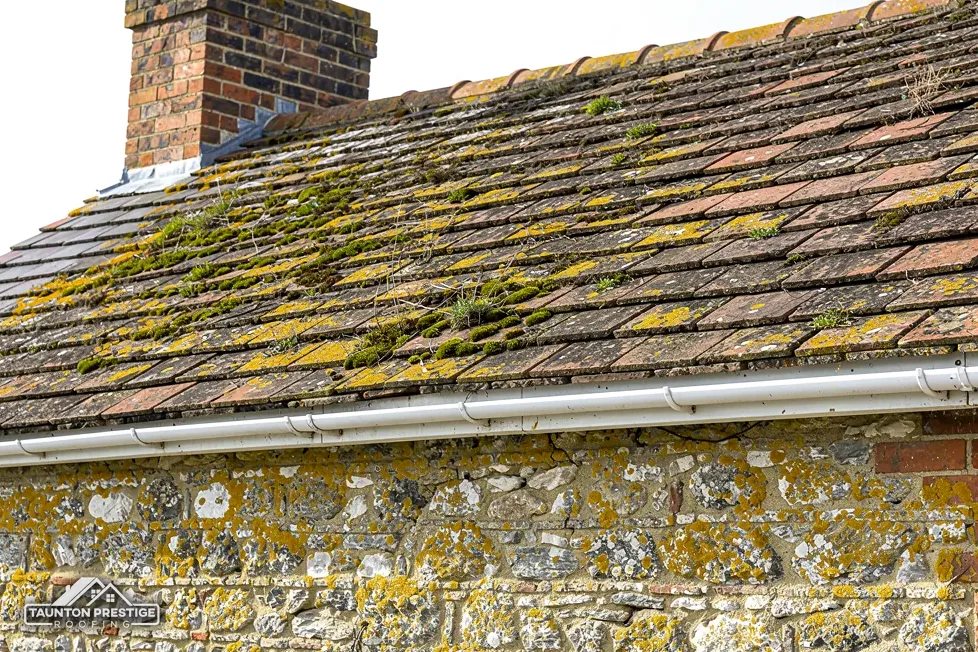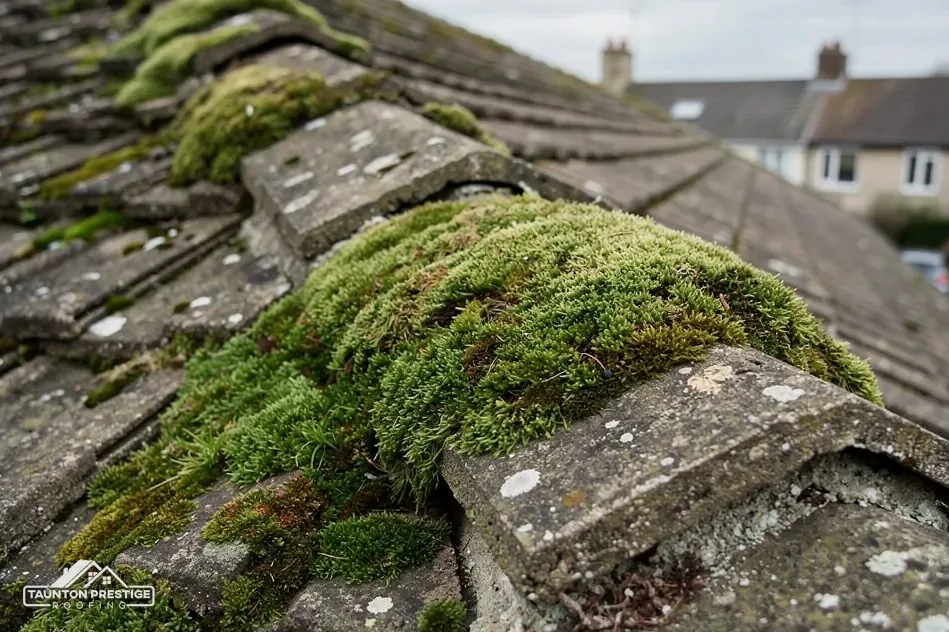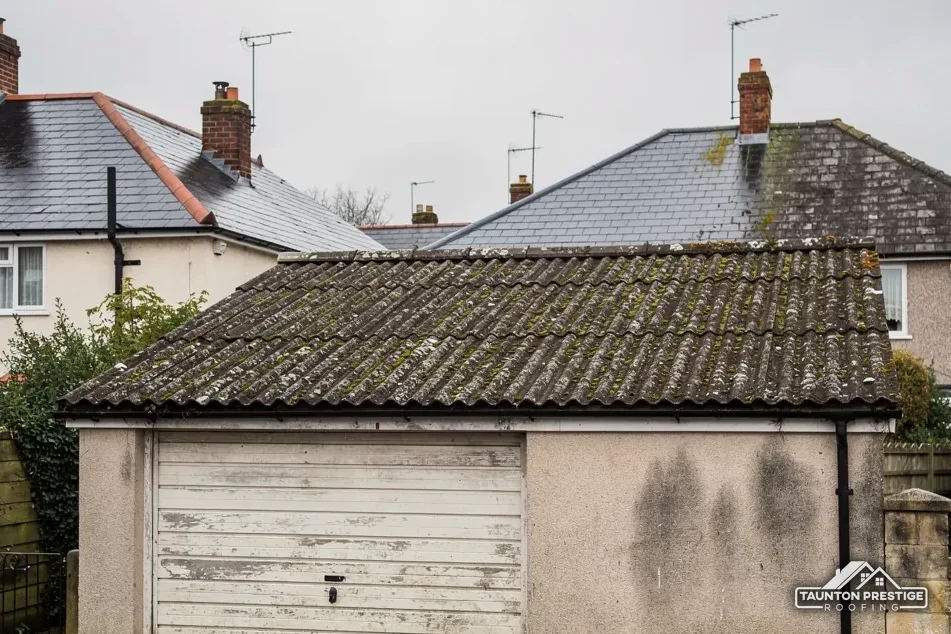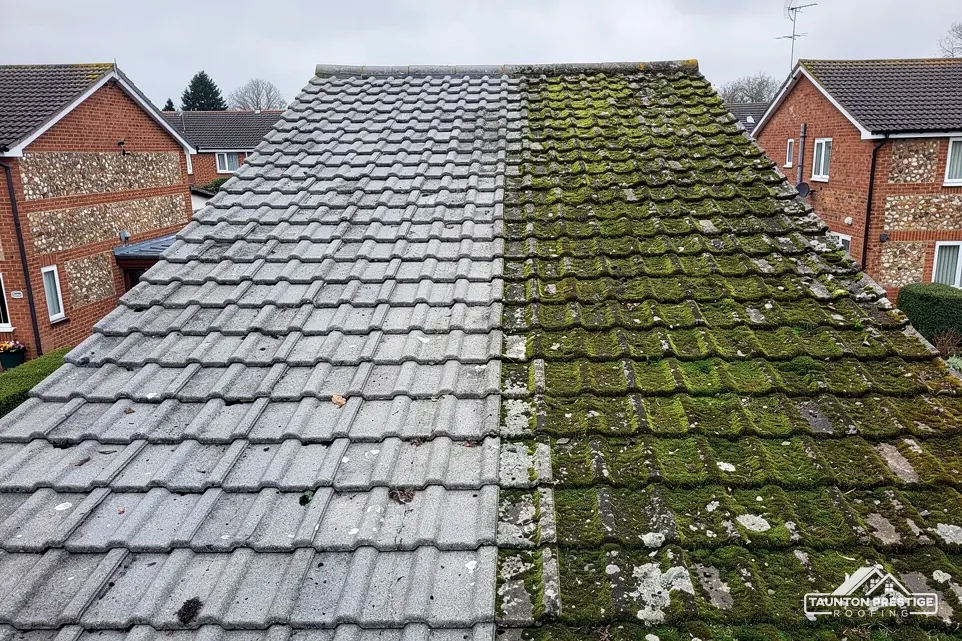
The appeal is easy to see. A narrow jet of water at high pressure takes green and black growth off a roof in satisfying stripes, and the before-and-after photographs look impressive. Hire a machine for a weekend, or answer a leaflet through the door, and the roof is clean by teatime.
The trouble starts after the clean. A tile or slate is a weathered surface, and the jet that clears the growth also removes some of that surface. Water is pushed upwards and sideways into the overlaps that were built to shed rain downhill. Fixings, pointing and flashing take a battering they were never designed for. Marley, one of the largest tile makers in the country, does not recommend high-powered jets on its slates or tiles. This guide explains why, how the damage happens, what the common myths get wrong, and what a safer clean involves. It sits within our roof cleaning and moss removal advice for Taunton and the surrounding villages.
What the manufacturer actually says
Opinions about jet washing roofs are plentiful and often wrong, but the most useful voice is the maker of the tile, not the person selling the clean. Marley does not recommend powerful jets on a roof, and gives its reason in plain terms: the force can scour the outer layer of a covering and shorten its working life by a wide margin. That is a manufacturer's position, set out for its customers, and it covers slate as well as tile.
Notice what the statement is about. It does not say the roof will leak the next day. It points to wear on the surface and a shorter working life. The harm is slow, and that makes it easy to miss, because a freshly cleaned roof looks wonderful for the first few months.
Why does the surface matter so much?
A concrete tile has a dense outer skin, and a clay tile has a fired face. Both help the tile shed water, resist frost and hold their colour. Remove that skin and what is left is rougher and more porous. It soaks up more rain, it freezes and thaws more aggressively, and it gives moss and lichen a better grip next time. A scoured roof can turn green again sooner than it did before.
The slower damage is easy to overlook, because nobody connects a tired roof ten years on with an afternoon of spraying. If you want the full picture of what growth does and does not do, our guide on whether moss damages a roof shows why the cure should never be worse than the problem.
How pressure damages tiles and slates
High pressure does four kinds of harm, and they tend to occur together.
- Scouring: it cuts through the protective face of concrete and clay tiles, leaving a coarse, thirsty surface.
- Cracking: a hard jet at close range can crack a tile that was already sound, or finish off one with a hairline fracture.
- Dislodging: loose tiles, slipped slates and rusty nail fixings are knocked out of place.
- Stripping: the granular or painted finish on some tiles is cleaned away along with the growth.
Does slate survive pressure better than tile?
CORC says well-maintained slate can last 100+ years, because the stone itself is dense and durable. That does not make it immune. Old slates fixed with ageing nails are held far more lightly than people assume, and a jet aimed up the slope can lift a slate edge. Nail sickness, where the nails have rusted, makes the risk higher still. A thin or laminated slate can split along its layers.
Hand-made clay and peg tiles are the most vulnerable of all, as old ones vary in hardness from one tile to the next. Those are the tiles for which the cleaner needs a light hand and a patient method. Our page on cleaning a slate roof covers the approach we take for slate.
Concrete tiles are common, and their dense outer skin is exactly what a jet takes off first. Once it goes, the tile soaks up water like a biscuit in tea and is more likely to flake in the next hard winter.
Can jet washing damage and soak a roof?
This is a question we hear often, and the answer is yes, it can. A roof is built to shed water that falls from above and at a modest angle. A pressure washer, which does not respect those limits, fires water at force, often from below and from the side, into the places the design keeps closed.
Every tile overlaps the one below it. Behind the tiles sits the underlay, the felt or membrane layer whose job is to catch the odd drop that gets through and send it to the gutter. Behind that are the battens, the timber strips that carry the tiles, and the rafters. A jet pushes water up through the overlaps, past the tile nibs and onto the underlay, where it can run sideways, tear at laps and soak into timbers.
How do you know whether water has got in?
The signs often show a few days later, because wet timber and insulation take time to reveal themselves.
- Fresh brown stains on loft rafters, battens or the ceiling below.
- A damp smell in the loft after a dry spell.
- Wet or compressed insulation near the eaves.
- Drips at the edge of the underlay.
A little water on the underlay is not a disaster, because it is designed to cope with some. Sustained spray is another matter, particularly on an older roof where the underlay is already tired or missing. Where the loft has no felt at all, as with many older houses, water meets bare timber straight away. If damp appears after a clean, tell the firm and ask us to look at the loft.
Other things a jet can undo
Tiles are not the only part of the roof in the line of fire. The details that make a roof watertight are often small, and they are the first to suffer.
Ridge and hip tiles, the capping along the top and the sloping corners of the roof, are traditionally bedded in mortar. Mortar that is already weathered can be blasted out of the joint, leaving the capping loose. Since the 2014 revision of the slating standard, Marley says, bedded ridge and hip tiles also need mechanical fixings, because mortar by itself has stopped being trusted to hold them. A pressure wash that loosens the mortar can damage the bedding and leave a ridge that nothing holds.
What about flashings, pointing and fixings?
Flashings are the strips of lead or other metal that seal the joint between a roof and a wall or chimney. A jet aimed at the edge of the strip can lift it, or push water behind it. Pointing round a chimney stack is another weak spot. Cement or lime mortar that has softened with age crumbles easily under the spray.
Windows and roof lights, the glazed units set into the slope, rely on seals and flashings that are also vulnerable. They are the last place anyone should point a nozzle.
Then there are the surroundings: garden plants, pond water, parked cars, and the paint on neighbouring walls. High pressure throws fine spray and grit a long way. Neighbours rarely enjoy being on the receiving end, and moss debris plus any chemical in the water ends up in the drains.
Why avoid pressure washing a roof?
For driveways, patios and garden walls, certainly. For the roof covering, we would not choose it, and the manufacturer's advice is on our side. Some owners point to the price. MyJobQuote's pressure-washing page puts the average at around £475 for a semi (MyJobQuote, Sep 2026), which is a modest sum but no reason to risk the tiles. But a low price for a method that wears the surface of the tiles is a poor bargain if the roof has to be replaced sooner than it should.
What do the cheap offers leave out?
The risks sit mostly in what the quote does not mention: the method, the pressure, who is liable if a tile is cracked, how the moss and runoff will be collected, and what happens to the gutters afterwards. A firm that pushes for a decision on the doorstep, offers a discount for starting today or gives no details of its method is one to turn down.
If you signed anything on the doorstep, the Citizens Advice consumer helpline, 0808 223 1133, can talk through where you stand. The 14-day cancellation right covers contracts agreed at home following a survey, though a repair visit you asked for as urgent is treated differently.
There are legitimate uses for water in roof cleaning, but at low pressure and with a rinse, not a blast. Where water is used, it is the carrier for a treatment and the rinse after it, never the tool that does the scrubbing.
What a gentler clean looks like
The alternatives are slower and less dramatic, which is exactly why they are kinder to the roof.
Hand scraping uses a soft tool to lift the moss off the tile face in sheets, working downhill so that nothing is forced under the courses. The moss is bagged and removed, and the surface underneath is left intact. Our page on soft wash roof cleaning explains the second approach: a low-pressure application of a treatment that is left to work, then rinsed. Soft washing relies on the product and time rather than force.
What about the chemicals in a soft wash?
The treatments used are biocides, which are regulated. Under the Biocidal Products Regulation they must be used according to their authorisation, and the HSE advises householders to avoid products meant for professional use only. It is an offence to use one that has no approval, so we choose treatments suited to your roof, and we explain what is going on the tiles.
After the clean, we check the roof again from the ground and the ladder. Slipped tiles, cracked ridge pointing and tired flashings are written up with photographs, so you can see the condition of your own roof. The quote that follows is one total price in writing, and it is yours to accept or leave.
Ask any firm quoting for a clean what pressure it uses, whether it uses a rinse or a scrape, and how it deals with the gutters. If the answers are vague, the work will be too. A good firm is glad to explain, and happy for you to watch from the garden.
We also look at whether the roof needs cleaning at all. A thin film on sound tiles may be better left, and the survey says so plainly.
Roof washing questions
Can a pressure washer damage roof tiles?
Yes, particularly at close range or on tiles that already have hairline cracks. It can also scour the surface of sound tiles and knock slates and old fixings loose. Marley advises against high-powered jets for that reason, because the damage reduces the working life of the covering.
Why does my roof not stay clean after jet washing?
A pressure wash can damage and roughen the surface of concrete and clay tiles, which gives moss and lichen a better grip and lets the tile hold more moisture. A cleaned roof on a shaded slope will regrow in time whatever method is used, but a scoured tile makes it quicker.
What should I do if pressure washing may do harm to my roof?
Check the loft after the next heavy rain for stains, damp insulation or drips. Look at the ridge and chimney pointing from the ground, and for slipped or cracked tiles. If anything looks wrong, take photographs and have a roofer inspect the roof before winter sets in.
More on this subject: Roof cleaning and moss removal in Taunton