Look into a gutter that has not been cleared for a while and you will often find a dark, spongy mat packed along the bottom, sometimes with grass or small seedlings growing out of it. That is moss, together with leaves, grit and the granules that wear off tiles, all compacted into a dam. It holds water, it weighs far more wet than dry, and it stops rain reaching the downpipe.
The pile did not start there. Most of it arrived from the roof above, carried down by rain and wind, with a share from overhanging trees and from birds. That is why clearing a gutter and then watching it refill within weeks is such a familiar experience. Treat the gutter alone and the cause stays on the slope. Treat the roof alone and the loosened moss lands in the channel. This guide explains how moss gathers, how gutters and downpipes are cleared properly, what to look at while you are up there, and what keeps the problem from coming straight back. It forms part of our roof cleaning and moss removal work for Taunton homeowners and the villages around.
Why moss collects in a gutter
A gutter is a narrow channel with a slight slope towards the outlet, where the downpipe begins. Anything that falls into it travels towards that outlet, and anything that cannot get through stops. A clump of moss is wider than the outlet, so it lodges there and traps the next lot behind it.
Once a little organic matter has settled, the channel behaves like a plant pot. It stays damp, a thin layer of dust and leaf mould builds up, and moss spores from the air take hold. Within a season a gutter that looked clean can turn green along its length.
Shape plays a part too. Half-round plastic gutters hold a little water in the bottom curve, while deep box profiles hide a build-up until it is well advanced. Flat-bottomed sections and shallow joints are the first places to silt up, and a gutter with no fall at all becomes a long, shallow pond.
Where does the moss come from?
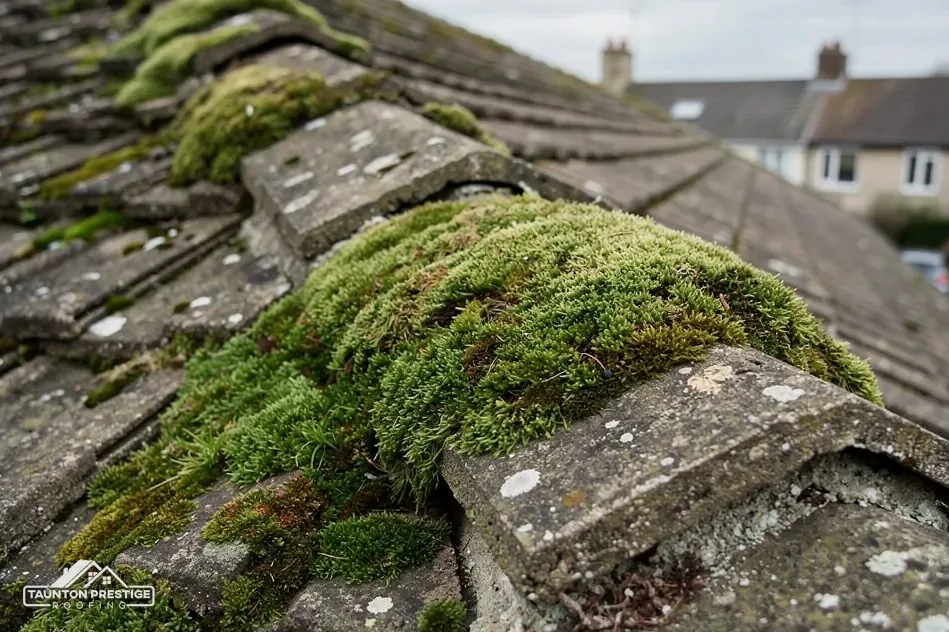
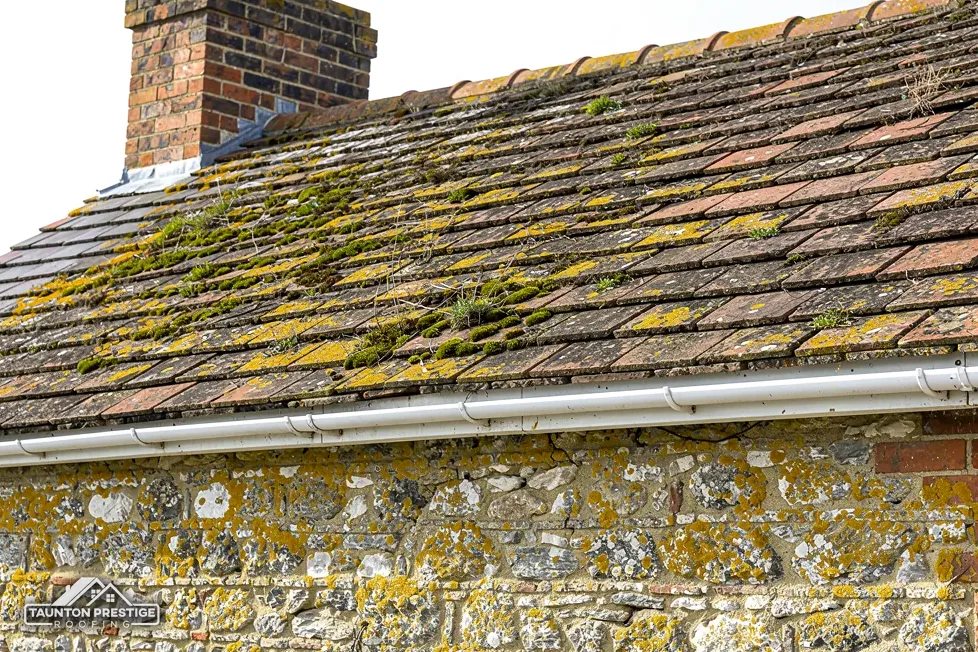
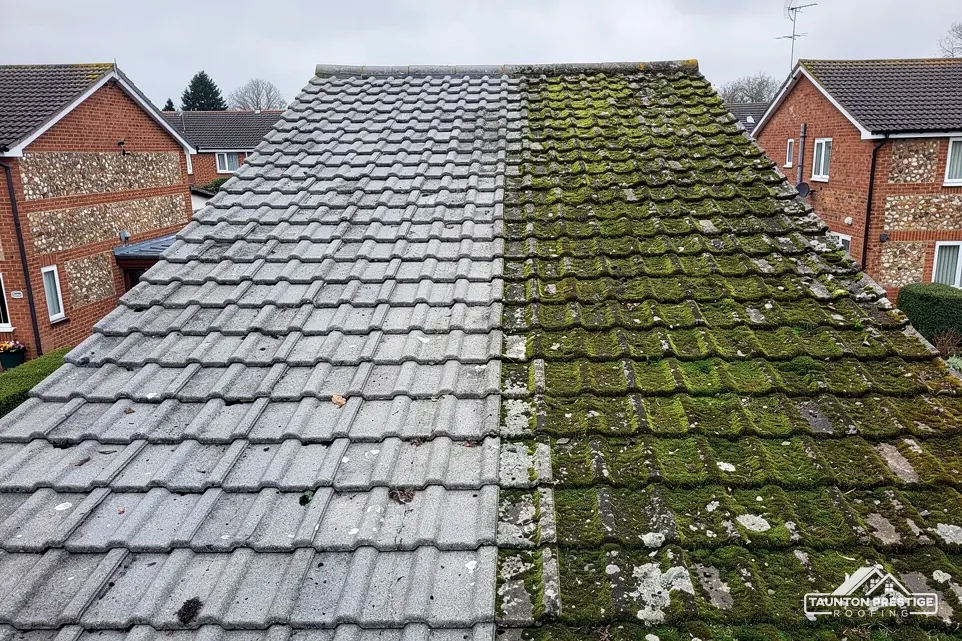
The roof is the main source, particularly on a shaded slope that has been green for years. Each shower rinses loose fragments off the tile faces and down into the gutter. Gulls, crows and jackdaws tear at moss on the roof in search of insects and drop the strips close to the edge. Trees add leaves, twigs and seeds that keep the mat topped up.
Knowing the source tells you the fix. If your slopes are heavily green, our guide on whether moss damages a roof explains what to do about the cause, and clearing the channel then becomes a one-off job instead of an annual chore.
What blocked gutters do to the house
A full gutter cannot carry the water it was built for, so rain spills over the front edge or backs up under the lowest row of tiles. The effects creep in slowly, which is why they are often missed until something rots.
- Fascia boards, the timber strips that the gutter is fixed to, soak up water, blister and soften.
- The wall below stays wet and may show green staining or, inside, damp patches.
- Soffits, the boards under the roof overhang, can darken and warp from the spray and drip.
- Heavy wet moss drags the gutter brackets, so the run sags and holds standing water.
- In winter, water frozen in the channel can force joints apart.
Can a gutter really overload its fixings?
Yes. Wet moss is heavy, and old brackets and fascia screws are only designed for the weight of the channel and its normal flow. Where the gutter has been loaded for years, the back of the run can pull away from the board. If you see a gutter that dips in the middle, bows outwards or has slipped away from the fascia, a clear-out will not cure it and a repair is needed.
A sagging run also changes the fall. Brett Martin's guidance for installing rainwater systems is a fall of 1mm for every 600mm of length. A gutter that has slumped below that holds water in its low spots and grows more moss there, so the fault feeds itself.
Frost adds to the damage. Water trapped in a full channel turns to ice and expands, which can split a joint or crack an old section. The leak that follows often shows up the next time it rains, not when the ice forms, so the cause and the symptom can be weeks apart.
Clearing gutters and downpipes properly
Gutter clearing is simple work that is easy to do badly. The common mistakes are raking the moss out and leaving it in the downpipe, or flushing it down where it jams a bend.
The order we follow is deliberate:
- Check the access. Ladders must be footed and level, and a scaffold or tower is used where the height or the ground makes a ladder unsafe.
- Clear the roof edge first, so loosened moss does not drop into a clean gutter.
- Scoop the gutter by hand into a bucket, working away from the outlet.
- Flush the run with water from a hose and watch it travel to the downpipe.
- Check that the downpipe runs freely, and clear it from the top or the base if it does not.
Why check the downpipe separately?
The downpipe is the upright pipe carrying the water from the gutter to the drain, and a blockage can sit anywhere along it, usually at the first bend or where it meets the drain. If water backs up while the channel above is clear, the pipe is the culprit. Poking a rod down from above can pack the blockage tighter, so we work from both ends where we can.
Everything lifted out goes in a bag and leaves with us, not into the garden border or the drain. Moss soaked with roof runoff is not something to tip beside a pond.
Where the downpipe feeds a soakaway or a combined drain, we also look at the gully at its foot. A gully clogged with silt and leaves sends water back up the pipe, and the gutter appears to overflow when the true blockage is at ground level.
What to check while you are up there
A clear gutter lets you read it. This is the best time to look at the things that moss was hiding, and most of them can be spotted without special tools.
Which faults show up once the channel is clear?
- Joints that weep or drip, where two sections meet.
- Rust, flaking paint or pinholes in an older steel or iron run.
- Brackets that are loose, missing or spaced too far apart.
- Cracks in plastic sections, especially near the outlets.
- Standing water in the bottom, which points to a fall that has been lost.
- Fascia timber that is soft, stained or pulling away behind the gutter.
These are small jobs if found early. A joint reseal or a pair of new brackets costs little compared with a rotten fascia board. If the run is beyond saving, MyJobQuote puts a typical UK range at around £1,000 to £1,600 for replacing guttering (MyJobQuote, Oct 2026), and what you are quoted depends on the length, the height, the material and what the boards behind it need.
If the house has an older cast-iron or concrete gutter, repair can be the better choice over replacement, and the gutters service page covers the options, from gutters, soffits and fascias in general to the specific faults. We photograph what we find, and you will see each problem in your own pictures before anything is agreed.
Do not forget the end stops and the corners. Those are the places where a gutter changes direction, and the places where moss packs most tightly and water hangs about longest.
Doing it with the roof clean
The sequence matters more than any single task. If the roof is cleaned after the gutters, the tiles drop moss into a clear channel and undo the work. If the gutters are cleared after the roof, the debris is gone in one go.
We therefore take the roof first, working from the ridge down to the eaves so that nothing is pushed back up under the courses, and clear the gutters last. The same ladders or scaffold do both jobs, which saves you paying for access twice. When the tiles and the gutters are done in one visit, the results last longer than either alone. It also means one set of photographs shows you both, and one conversation covers what, if anything, still needs repairing.
Do you need scaffold for a gutter clear?
Not for every house. On a two-storey home with level ground, a good ladder with a stand-off is often enough for clearing. A scaffold or tower becomes the safer choice for tall houses, sloping or soft ground, or when the roof work and the gutter work together need two people on the slope. MyJobQuote lists a front-elevation scaffold at £550 to £750 for a week-long hire (MyJobQuote, Oct 2026), so we say at the survey whether access will be needed.
The same visit is a good moment to look at valleys, the lead-lined troughs where two slopes meet, because moss packs there just as it does in the gutter. Our page on moss in a roof valley explains what to look for.
Stopping moss returning to the gutter
Nothing keeps a gutter clean for good, but a few steps slow the rebuild a long way.
- Clean the moss off the roof, so the supply stops.
- Trim back overhanging branches, which drop leaves and keep the roof damp.
- Check the fall and re-fix sagging sections, so water does not pool.
- Fit gutter guards or leaf screens if trees are the main source.
- Look at the channel after storms and in autumn.
Are gutter guards worth fitting?
Sometimes. A guard is a mesh or a brush laid across or inside the channel to keep leaves and large debris out. It helps where leaves are the problem. It does less with fine moss debris and grit, which can pass through or sit on top and grow a new mat. Whether it suits your gutters depends on the profile and the trees nearby, so ask a roofer before you buy.
Where roof runoff goes into a water butt, a clean gutter protects the butt too, and it is wise to disconnect the butt before the roof is treated. Our page on roof cleaning and water butts covers the safe way to do it.
Many owners fit guards to every run and then forget them, which lets a thin film of moss and grit build on top. They need a look once or twice a year like anything else.
After the work, the best habit is a quick look from the ground after heavy rain. Water pouring over the lip of the gutter is the first sign that the channel is filling again.
Gutter moss questions
How often should gutters with moss in them be cleared?
It depends on the trees and the state of the roof. A gutter under a mossy slope or a large tree can fill within a season, while one on a clean roof with open ground may go longer. Look after storms and in autumn, and clear whenever you see water spilling over the front.
Can I clear moss from the gutters myself?
From the ground with a safe extension tool, perhaps. Anything that needs you to climb is a risk, because ladders slip and gutters are not designed to take your weight. If the gutter is above a first floor or the ground is uneven, have a roofer use proper access.
Does moss in the gutter mean the roof needs cleaning too?
Usually it does, since most of the moss came from the tiles. A quick look at the slopes above the worst-affected stretch will show whether they are green. If the roof is clean and the gutter is not, the source is more likely trees, so cutting back branches matters more.
More on this subject: Roof cleaning and moss removal in Taunton