Two phrases turn up in almost every roof cleaning quote: soft wash and biocide. They sound technical, and some firms lean on that to avoid explaining what they are actually putting on your roof. The ideas are simple enough. A biocide is a chemical product made to kill living things, and on a roof that means moss, algae and lichen. Soft washing is a way of applying it at low pressure, so the roof surface is left alone while the growth is dealt with.
What is less well known is that biocides are regulated, that some of them are restricted to professional users, and that using a non-approved product can be an offence. This guide explains the vocabulary, sets out the rules in plain terms, compares soft washing with high-pressure washing, which can damage slate and tile, and gives you questions to put to any firm that offers to treat your roof. It forms part of our roof cleaning and moss removal advice across Taunton and Somerset.
What is biocide, and why is it used?
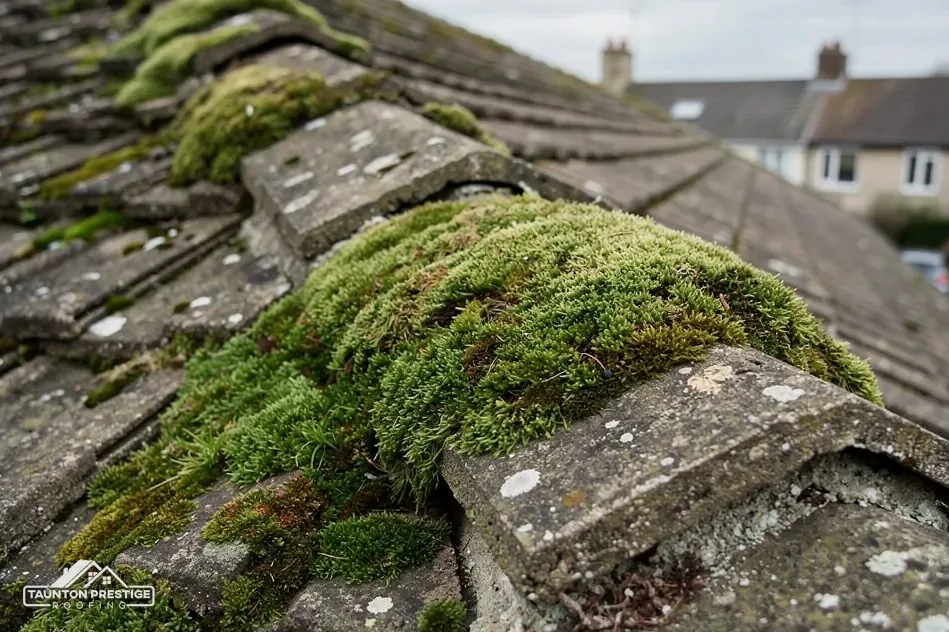
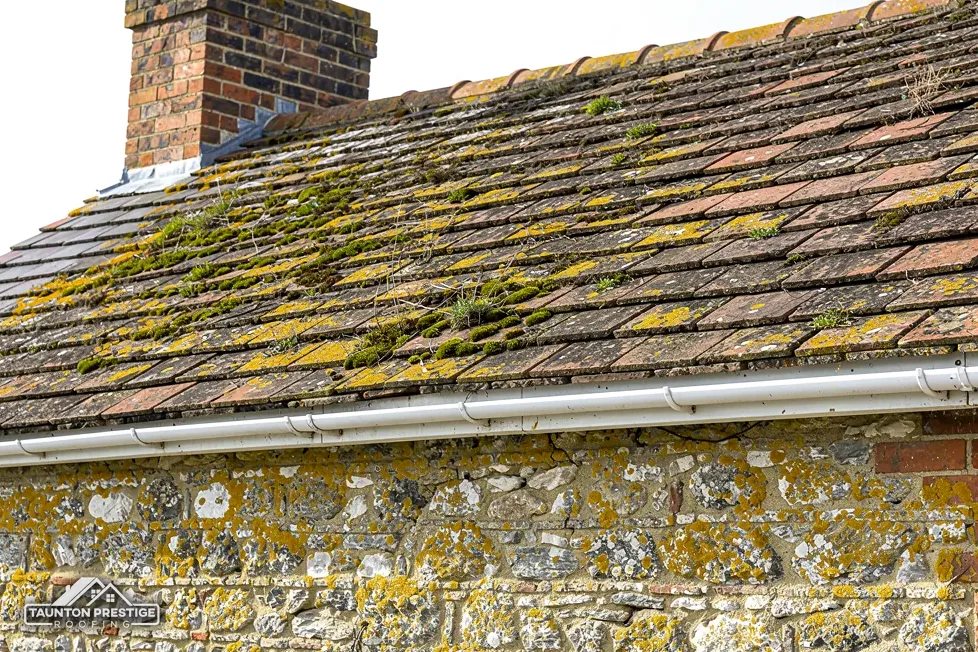
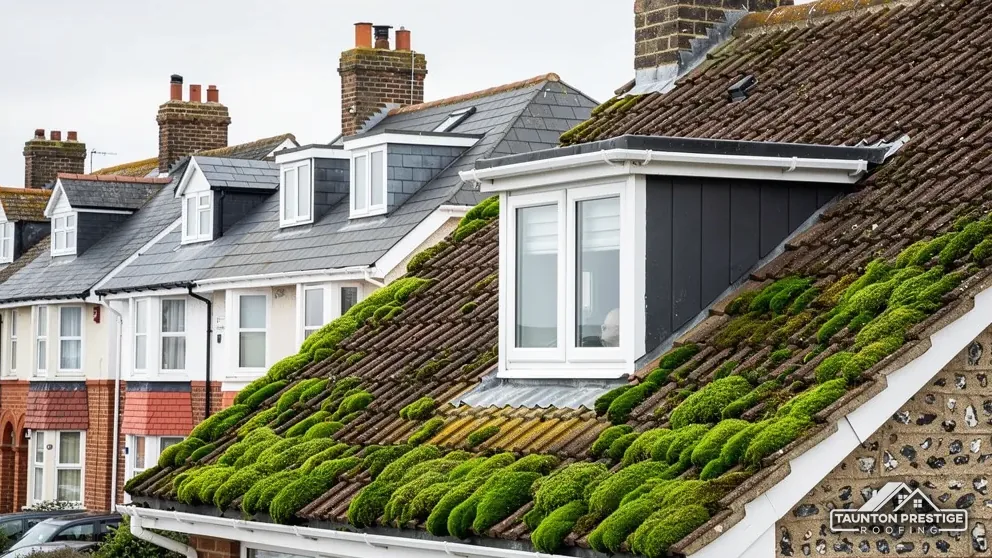
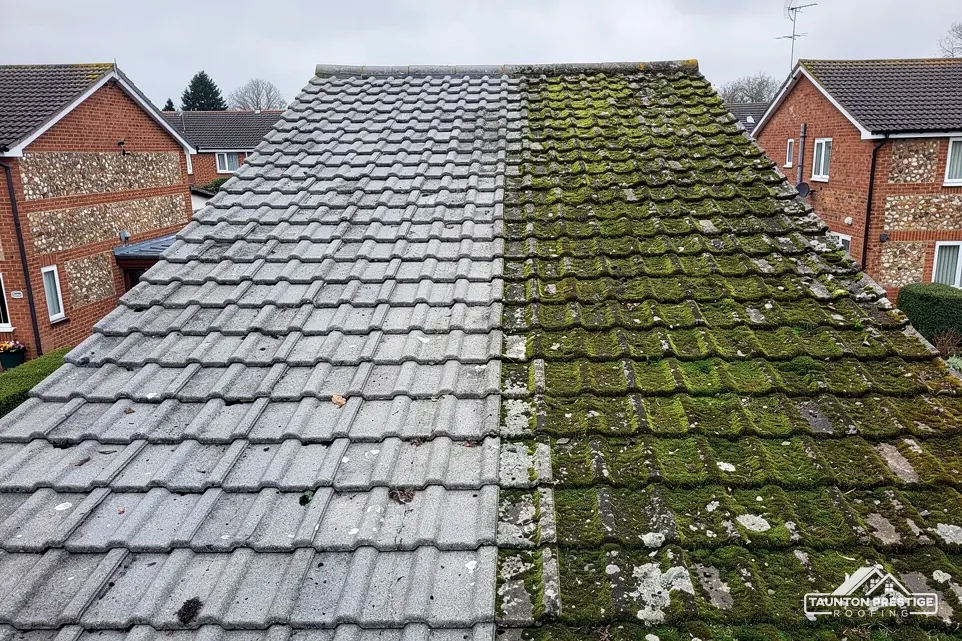
Moss, algae and lichen live on the roof surface, and each one holds on differently. Moss sends down fine roots that grip the joints between tiles. Algae form the dark film that streaks a north slope. Lichen bonds to the covering itself and sits tight, which is why a quick brush rarely shifts it. Scraping removes the visible growth, but it leaves roots, spores and the damp film that algae live in. A biocidal treatment is applied to kill what remains, so the surface is clean for longer than scraping alone would leave it.
Biocidal products cover a wide range, from the cleaner you buy for patios to products made for professional use. What they have in common is that they are designed to destroy or control organisms, which is why they come with legal conditions. A product that is gentle enough for a garden path may not be the product to put on slate, and a strong professional product is not meant to be sold over the counter to the general public.
Does a treated roof stay clean for good?
No. A treatment slows regrowth. It does not remove the conditions that moss and algae like: shade, nearby trees, a north-facing slope and damp air. Expect growth to return in time, sooner on shaded slopes, which is why firms recommend an occasional look at the roof. Our guide on whether moss grows back after cleaning explains what to expect, and how long a clean usually holds depends on the roof and the setting.
Soft washing set against blasting the roof
Jet washing uses water at high pressure to blast growth and surface dirt off, a method to avoid on slate and tile. It looks dramatic and works fast, and the water can also strip the face of the covering. Marley advises against powerful jets on slate or tile, because they can damage the face of the covering and reduce how long it lasts.
Soft washing turns that around. The treatment goes on through a pump and a low-pressure lance, a little like using a garden sprayer in place of a power tool. The product does the cleaning work, and any rinsing afterwards is gentle, so nothing is blasted off the roof. The idea is to leave the surface of the tile or slate intact, so the covering keeps its protective face and its expected life.
Soft wash or pressure washing: which avoids harm to my roof?
For slate, clay and concrete tile, the maker's own advice points away from high pressure, and that settles the question for a sound roof. Where a roof is already fragile, brittle with age or covered in lichen that grips hard, hand scraping may come before any treatment. Whatever the method, ask the firm what it will use and why, how the roof will be reached, and who is responsible if a tile or slate cracks underfoot. A firm that has thought about those points will answer without hesitation, and one that hasn't will tell you a lot by the pause. It is also worth asking whether the plan changes if the roof turns out to be more fragile than it looked from the ground.
Our guide to pressure washing a roof covers the case against it in more detail, and our notes on whether roof cleaning is safe for tiles look at the surface damage side.
The rules on using a biocide
The Biocidal Products Regulation, kept in force in Great Britain, sets the main rule in article 17(5): a product has to be applied within the conditions that came with its authorisation. Put plainly, a product is authorised for certain uses, in certain ways, by certain users, and it must be used that way. The label and the authorisation set those conditions.
HSE adds a warning aimed at householders: biocides made for professional users alone are not products for a householder to buy and spray. Some strong moss and algae treatments fall into that group, and that is a reason to let a professional apply them, not to buy a trade product from an online seller and apply it yourself.
Is it an offence to use the wrong product?
The Control of Pesticides Regulations (COPR) apply to these products, and HSE's explanation is blunt: an unapproved product is not one you may use, sell, supply, store or advertise. That is the reason to ask any firm for the product name and to read the label, particularly if the firm describes it as a home-made or industrial mix.
We name the product and give you the data sheet on request, and we apply it as its authorisation says. Nothing here is legal advice. It is a reminder to ask, because a firm that is happy to name what it uses is a firm you can talk to.
Questions to ask before a firm treats your roof
Questions are the best protection, and they cost nothing. A sensible firm will answer all of them without fuss, and a firm that dodges them has told you something.
- What is the product called, and can I see its label or data sheet?
- Is it a product for professional users, and who applies it?
- How is it applied, and at what pressure?
- What happens to the wash-off, and how are gutters, drains and water butts protected?
- Are plants, ponds and pets kept clear while it works and dries?
- Is the roof checked for nesting birds and bats before any treatment goes on?
Where does the run-off go?
Water that carries a biocide off the roof reaches the gutters, the downpipes and then the drain or the garden. Responsible firms disconnect or protect water butts, shield planting and keep the product away from ponds. Our notes on roof cleaning and water butts and garden damage set out what protection looks like. Treatment is also a question for households with pets.
Wildlife is a legal point too. A treatment day is not the moment to find out whether a roof is occupied, so the checks come before the first spray goes on. Section 1 of the Wildlife and Countryside Act 1981 applies when someone intentionally damages or destroys an active or half-built nest, and bats are protected along with their breeding sites and resting places. A careful firm looks for both before any spray goes on. Our page on roof cleaning, bats and birds covers the checks.
What soft washing can and cannot do
Soft washing suits most coverings because it leaves the surface alone, and that is the main reason makers prefer it to blasting. It is well matched to moss, algae and the dark streaks on tile and slate, particularly across a wide, shallow slope where scraping every patch by hand would take days. It is well matched to moss, algae and the dark streaks on tile and slate. It does less for thick moss mats, which still need to come off by hand, and for lichen, which is attached more firmly. In those cases the treatment is one step in a sequence and not the whole job.
It also cannot repair anything. If a clean reveals broken slates, a dropped ridge or a leaking valley, those need fixing, and it is better to know before the treatment than after. That is the argument for a survey before the clean, and for photographs of the roof.
Will soft washing work on a flat roof?
It depends on the membrane, and the membrane maker's cleaning advice comes first. Moss on a flat roof is often a sign of ponding and slow drainage, and the first job is to find out why water sits there. Our page on moss on a flat roof goes through it, and a membrane maker's advice on cleaning should come before any treatment.
For slate in particular, there are extra points to check. Slate is brittle underfoot and the treatment affects the way you walk on it. See cleaning a slate roof for the approach that protects the slates and the roofer.
Cost, timing and weighing the options
Soft washing is not always cheaper than jet washing, and it should not be chosen on cost alone. MyJobQuote gives an average of around £475 for pressure washing a semi (MyJobQuote, Sep 2026), a typical UK figure for a method that Marley does not recommend. A soft wash price depends on the same things as any roof clean: area, pitch, access and the amount of growth. Our guide to roof cleaning cost sets out what drives it.
Timing matters because treatments need dry spells to be applied, and a roof is a bad place to work in wind or frost. Spring and autumn suit many jobs, but the weather on the day decides, and a good firm will move a booking rather than spray into a gale. Treated growth may take time to darken and fall away, so a roof does not always look clean on the day. If you are selling, plan the clean well ahead of the photographs and the viewings.
Soft wash, hand scrape or leave it?
Each has a place, and a single roof can need more than one: hand scraping on the thick patch above the porch, a gentle treatment across the rest. Soft washing suits wide areas of light growth. Hand scraping suits thick moss and fragile coverings. Leaving it alone suits a sound roof with a little surface growth and no blocked valleys or gutters, where the growth is not doing harm. Our guide to whether moss damages a roof helps you decide.
If you want a view on your own roof, book a survey. We photograph the slopes, show you what the growth is doing, and tell you which method we would use and why, with the product named, in the written price.
Soft wash and biocide questions
What is biocide, and why do we use it?
A biocide is a chemical product designed to kill living organisms, which on a roof means moss, algae and lichen. It goes on after scraping so spores and roots are treated too. It is regulated, so it must be used as its authorisation states, and some products are restricted to professionals.
Does soft wash avoid the harm pressure washing can do?
For slate and tile, usually yes, because it protects the surface. Marley advises against it, since powerful jets can damage the face of the covering and reduce its life. Soft washing also suits light growth, while thick moss and lichen still need hand scraping first.
Can I buy and apply a roof treatment myself?
You can buy consumer products, but HSE warns householders off biocides meant only for professionals. Read the label, follow its conditions, and remember that using an unapproved product breaks the Control of Pesticides Regulations. A roof is also a risky place to work from a ladder.
More on this subject: Roof cleaning and moss removal in Taunton