Owners of an ageing flat roof tend to face the same choice after the second or third leak: mend it again, or start afresh? What tips the balance is how much of the membrane has life left, what the deck beneath looks like, and how old the membrane is against its published life.
A repair can be the sensible buy when one detail has failed and the rest is in good order. It becomes poor value when faults are spreading, because each patch buys less time than the one before. A new covering is a bigger job, and on a house in England it brings Building Regulations into play, since Part L treats re-covering a flat roof as renovation work and can ask for better insulation with it.
This post sets out the signs that point each way, the typical UK costs from named guides, the rules that apply to a re-cover, and the extra choices (overlay, tapered insulation, warm roof) that shape the decision. It is written for house roofs on garages, extensions, porches and dormers around Taunton.
Signs a flat roof is past patching
One leak at a known weak point tells you about that point. A roof that leaks in two or three unconnected places tells you about the whole roof. The signs below, taken together, point towards replacement.
What does an end-of-life flat roof look like?
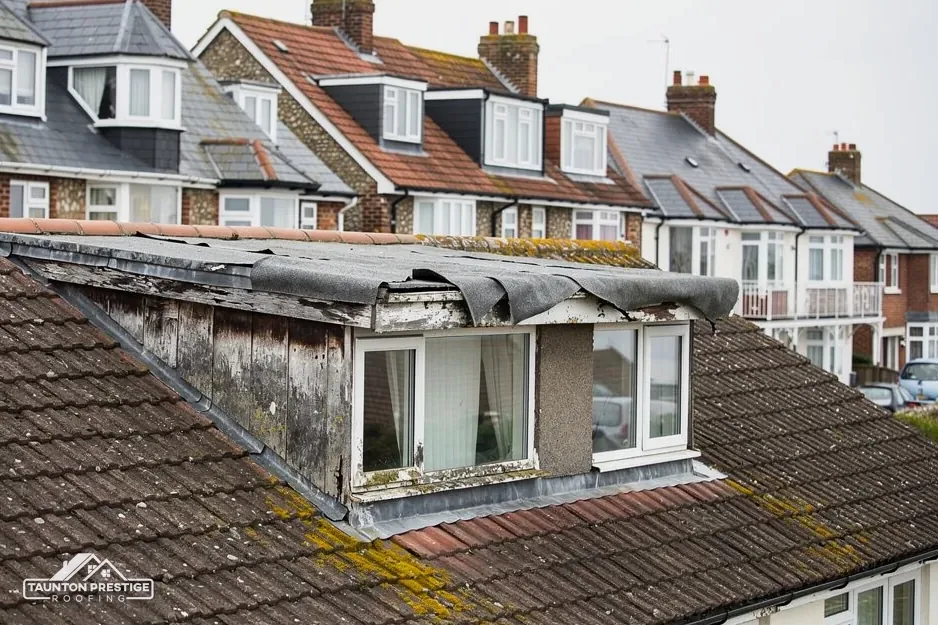
Look for a surface crazed with fine cracks, felt that has gone shiny, brittle or bare of its mineral finish, blisters in several places, and seams that have opened. Look for standing water that stays for days. Inside, look for stains that come back after a repair, or turn up in a new place each winter. A bounce underfoot points to a deck that has taken in water, and testing that is a roofer's job, never the owner's.
How old is too old?
Published lives help. Less gives torch-on felt 10 to 20 years, GRP 25 to 40 years and EPDM 30 to 50 years, while GreenSpec puts EPDM at 20 to 30 years. A felt roof of 18 with new splits is near the end of its range, whereas a GRP roof of the same age has time in hand. These are typical ranges, never guarantees, and the guides differ from one another.
Our answer on how long a flat roof lasts sets the numbers beside the causes. A roofer who reads the roof puts the age of the covering next to the state of the deck, because a young covering on a rotten deck is not worth saving.
When a repair is enough
Repair wins when the fault is single, local and understood. A split along one board joint, a lifted trim, a blocked outlet, a tired sealant bead at a wall junction or a cracked patch of GRP at one corner can all be put right without disturbing the rest. If the covering is well within its published life and the boards beneath are dry and solid, a repair buys several more years for a modest outlay.
What does a repair cost?
MyJobQuote gives around £650 as the typical outlay for a repair in 2026 (MyJobQuote, Oct 2026). That is a typical UK figure across all roof types, and a flat roof patch may land well below or above it depending on access and the area involved. We fix the price after the survey and give it as one written total.
Do patches and sealants last?
It depends on what they are applied to. Bitumen paint and brush-on sealant over a tired surface can stop a drip for a season. They do not renew a covering, and a stain that returns after a coat of sealant says the cause is somewhere else. Our answer on whether flat roof patches and sealants work covers where they help and where they hide a fault.
A repair also suits an owner who has bigger plans. If an extension is going to be rebuilt in two years, laying a new covering that will be lifted again makes little sense. Mention it at the survey, and the roofer can price a sound short-term fix and be plain about its limits. A neat repair on a sound deck is never wasted money.
What replacement costs
National guides put flat roof replacement in a wide band because roofs differ so much in size and detail. MyJobQuote shows between £1,500 and £6,000, with an average of £2,400 (MyJobQuote, Oct 2026). Less gives a 15 m² garage roof £1,200 to £2,500 (Less, Oct 2026). Both are national ranges from the guides, so treat them as a rough guide to scale.
Which coverings cost what?
MyJobQuote puts EPDM at around £60 per square metre, an average rubber roof at £1,050 installed, and a felt roof averaging about £1,500, with a 15 m² garage roof in SBS felt between £1,200 and £1,800 (MyJobQuote, Oct 2026). SBS is a modified bitumen felt with a rubber-like additive. HomeBuilding's scaffolding estimate for a three-bed semi is about £1,000 with permits included (HomeBuilding, Sep 2025), although a single-storey flat roof sometimes needs far less access equipment.
What decides the price on your roof?
The size of the roof, which covering you pick, how much boarding has to be renewed, access, the number of outlets, upstands and rooflights, and whether insulation has to be added. Find out if VAT and the scaffold are inside each total, because work on an existing home carries VAT at the standard 20 per cent (GOV.UK).
Our guide on what a flat roof replacement costs goes through the bands in more depth. Judge a quote on what it covers, not on the headline figure alone. A low price for a thin covering over a damp deck can cost more in the end than a higher price that includes the deck repairs, the edge trims and the outlets.
A new membrane counts as renovation
This is the point owners often miss. Approved Document L, Volume 1 is the part of the Building Regulations on saving fuel and power in homes. Part L treats a new waterproofing membrane over a flat roof as renovation work, not routine maintenance. The 2021 edition, with its 2023 amendments, took effect on 15 June 2022 for use in England.
What does that mean for insulation?
Table 4.3 deals with existing elements that are renovated. For a roof it gives a threshold of 0.35 and an improved target of 0.16, both measured in watts per square metre per kelvin. A roof that falls short of 0.35 is brought up towards 0.16 where that can be done. Paragraph 4.13 allows a fallback. If the full upgrade cannot be done, or would take more than 15 years to pay back, the roof gets the best improvement that is both possible and repays within 15 years.
Which edition applies when?
The 2026 edition of Approved Document L takes effect on 24 March 2027, and its tables are renumbered 3.2 and 3.3. Until that date the 2021 tables apply. Which route applies at your address is for your building control body to confirm.
That is why a quote for a new flat roof usually names insulation and a vapour layer. Our guide to flat roof replacement and Building Regulations explains the steps. Somerset Building Control's fee calculator includes a heading covering re-roofs and insulation upgrades on one dwelling, and its team is on 0300 303 7790. Keep the completion certificate with your house papers for any later sale.
The 25 per cent test, planning and weight
Not every re-cover needs a building control application. The Planning Portal sets the bar: if under 25 per cent of the building envelope and under 50 per cent of the roof is touched, an application is not normally required. Envelope here means the whole shell of the house, windows and rooflights included. Somerset Building Control publishes no threshold, which leaves the Planning Portal test as the yardstick.
Does a heavier covering change things?
Yes. A covering that weighs 15 per cent or more than what it replaces needs approval under the Building Regulations, and the Planning Portal suggests an engineer's or surveyor's check first. A switch from felt to a heavier system on an old deck is the kind of change that triggers it. The deck, joists and walls all have to carry the extra load, so the weight of the new system is checked against what the old one weighed.
Is planning permission needed?
Class C of the permitted development rules normally allows a new covering on a house roof without a planning application. A block of flats, or one flat inside it, is not covered by the dwellinghouse rules, so raise it with the council planners at the outset. Listed houses keep their permitted development rights but also need listed building consent where the work touches their character. In a conservation area or the National Park, check before you start; in Exmoor that means Exmoor National Park Authority, not Somerset Council.
Our answer on whether a replacement flat roof needs planning permission goes through the usual cases, and the rules for each address are set by the council or park authority that covers it, so a phone call to the council planners ahead of buying materials is sensible.
Overlay, insulation and the decision itself
Some owners ask whether a new layer can simply go over the old. An overlay saves stripping time, but it hides what lies beneath and adds weight, and it traps wet insulation or damp boards. Where the old covering is dry and well bonded, some systems allow it. Read our answer on laying a new flat roof over the old before agreeing, and let a survey check the deck.
Should insulation be added at the same time?
Usually yes, because the renovation rules ask for it where feasible, and because an open roof is the best time to improve it. Tapered insulation can also cure ponding by adding fall in the same operation. The choice between a warm roof (insulation above the deck) and a cold roof (insulation between the joists, with a ventilated void) is made on the building, not on a preference.
How do you make the call?
Weigh four things: the age of the covering against its published life, how far the faults have spread, the deck's condition and whatever other building work is coming. If three of the four point to wear and the deck is soft, replacement is the straight answer. If only one thing has failed and the rest is sound, repair the one thing.
We read the roof first, and the photographs of your own roof include the deck wherever it is exposed, so the call rests on evidence. A repair that is the better buy gets quoted as a repair. If you want a flat roof assessed, the flat roofing page lists what we repair and renew on house roofs.
Repair or replace questions
Can a flat roof be replaced a section at a time to spread the cost?
Sometimes, where the roof has separate areas with their own outlets and falls. Joining a new section to an old one makes a seam that must be detailed carefully, and the Planning Portal's 25 and 50 per cent tests still decide whether building control is needed. A survey shows whether a phased job is practical.
Is it worth patching a flat roof that is nearly worn out?
Only for a short, tidy fix. A covering at the far end of its range has more weak points than the one you can see, and each patch is likely to be followed by another. If a bigger project is planned within a year or two, a modest repair can make sense until then.
Will a new flat roof covering mean I have to add insulation?
Under Part L a fresh waterproof layer is renovation, so the roof may need upgrading towards 0.16 where that is technically and functionally feasible. Paragraph 4.13 gives relief where it is not, with a 15-year payback test. Your building control body confirms the route for the address.
More on this subject: Flat roofing in Taunton