No other part of the house is battered by the weather quite like the chimney stack. It stands clear of the roof, wet on every face, with the wind pushing at it and the rain finding every joint. Most of the time that is manageable: pointing renewed, a pot rebedded, a flashing replaced. Now and then the brickwork itself has gone, and spending money on the surface only hides the fault until the next hard frost.
This guide is for owners deciding between a repair and a rebuild. It explains what we look for at the survey, the signs that tip the balance, why an unstable chimney can be treated as a dangerous structure by Somerset Building Control, and what a rebuild involves from scaffold to final pot. It sits within our chimney repairs service. A rebuild is not the default answer here. If a repair makes better sense than a rebuild, we tell you that straight and show the photographs behind that advice.
Signs that repair has run out of road
A stack can appear in worse shape than it is, or in better shape than it is. We read it from the roof or a platform, never just from the ground, because the top courses of brick are the ones that matter and the ones you cannot judge from the garden.
Is the stack leaning?
A stack that has moved out of plumb is the clearest sign. A slight lean on a very old chimney can be long settled and stable. A lean that has appeared recently, or is getting bigger, points to movement, whether the mortar bed has failed, the base has loosened or the brick has softened. Our page on a leaning chimney sets out how we separate a harmless lean from a worrying one.
What do cracks and crumbling brick tell you?
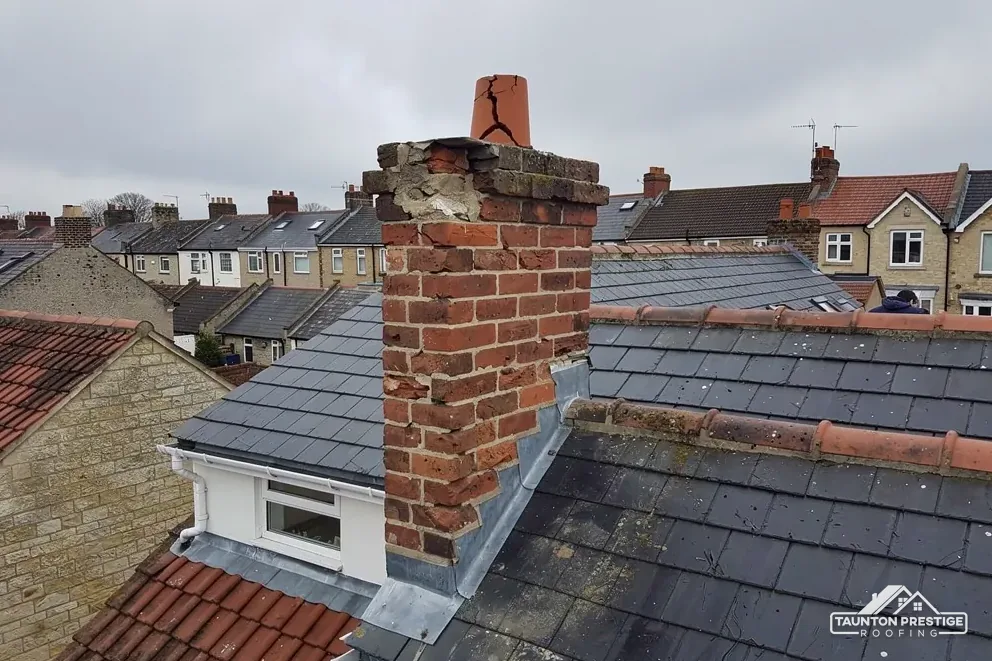
Hairline cracks in the mortar are routine. Cracks that run through the bricks, steps that follow the joints from top to bottom, or bricks that have split or lost their face are different. When the face of a brick comes away, the soft body behind it takes in water faster, and the next frost makes it worse. Replacing a handful of bricks is a repair. Replacing a third of a stack course by course is a rebuild by another name. Our guide to crumbling chimney bricks covers the middle ground.
Loose pots, gaps around the flaunching and a flashing lifting from the brick are all repair jobs on their own. They become a rebuild argument only when they sit on top of brickwork that cannot hold a new mortar joint.
Debris on the roof or in the gutter below, bits of mortar and grit, tells you the stack is shedding. Bring a few pieces down, and show us.
How we decide between repair and rebuild
We do not start from the price of a rebuild. We start from what the stack will accept.
Will the brickwork hold new mortar?
Repointing only works if the bricks either side of the joint are sound enough to grip it. We press and tap the top courses, look for brick that crumbles, and check whether the joints have been raked out too far by an earlier repair. If the bricks are good, pointing and a new flaunching can add many years. If the surface is gone, new mortar falls out again.
How far down does the damage go?
Damage in the top few courses is a partial rebuild: the stack is taken down to sound brick, those bricks are set aside and the top is rebuilt on a good bed. Damage that runs to the roofline, or into the part inside the loft, is a full rebuild and sometimes goes beyond a chimney job.
Is a repair now going to cost twice?
It can. A typical UK range for repointing is £450 to £1,200 (MyJobQuote, Oct 2026), and the scaffold is a big part of any chimney job. If the stack will need rebuilding within a few winters anyway, paying for access once is cheaper than paying for it twice.
We take photos of each course, show them to you before any price is set, and set the choice out in plain terms. If the answer is a repair, the quote says so. If it is a rebuild, you will have seen exactly why.
Sometimes the decision is not ours or yours alone. If the house is up for sale or a buyer's survey has flagged the stack, send us the report and we will read the stack against it.
When an unstable chimney is a dangerous structure
Somerset Building Control has a dangerous structures service for buildings that threaten people or property. Among the examples it gives are "Unstable chimneys" and loose roof tiles that threaten to fall. It adds that a building turning dangerous leaves its owner liable for every cost of putting it right.
What should I do if my chimney looks unsafe?
Keep people and vehicles away from the area beneath it, and stay out of any room against the breast if the stack is moving. If you are worried, ring Somerset Building Control on 0300 303 7790. For a loose or leaning stack you can see from the pavement, tell your neighbours as well, since a fall can reach their land.
Then call us. Our first move on a leaking or loose roof is to make it safe, which for a chimney may mean taking the top off, bracing the stack or fixing a safe barrier, and we talk through the rebuild once there is no immediate risk.
Does the owner pay if a council steps in?
The building control page puts the costs of making the building safe on the owner. That is a good reason to deal with an unstable stack yourself before anyone has to do it for you.
A stack that moves in the wind, drops brick or leans visibly is not a job to leave until the weather improves. Make the area safe and book a survey.
Rain and frost loosen a failing stack gradually, and then a gust finishes the job. That is why a stack that has simply started to look odd deserves a survey before the next storm, not after it.
What a rebuild involves, step by step
A rebuild follows a tidy order of work, and understanding it helps when you read a quote.
- Scaffold goes up, with a working platform around the stack and a toe board so nothing falls.
- The stack is photographed course by course, then taken down to sound brickwork, with good bricks stacked and cleaned.
- The base is checked for water paths, and the damp proof tray and flashings are inspected or renewed.
- The stack is rebuilt in the same bond, with pots bedded on fresh flaunching, the mortar bed that holds each pot.
- Lead flashings seal the stack to the roof, and the area is swept and left clear.
Who arranges the scaffold licence?
Public ground under the scaffold, whether footway or carriageway, needs consent from the highway authority under section 169 of the Highways Act 1980. On the Somerset Council page, applications are completed by the appointed contractor, the fee is £124.60 for each 28-day period (Somerset Council, April 2026) and the council asks for at least 10 working days' notice. Outside Somerset, ask your scaffolder who applies, because each highway authority words it differently.
A rebuild is dry work for the most part and rarely takes more than a few days. We tell you the plan for each day before the scaffold arrives, take rubbish away at the end and leave the roof as watertight as the day we started.
Keep an eye on the loft side too. Once the stack is down to roof level we can see whether water has been running down the breast, and that tells us whether the repair has to reach further than the brickwork.
Bricks, mortar and old stacks
What goes back matters as much as how it goes back. A stack rebuilt in the wrong brick or the wrong mortar looks wrong and, worse, can wear badly.
Can the old bricks be reused?
Often, the sound ones can. Bricks taken from the upper courses may be cleaned and put back in the same pattern. Where there are not enough, reclaimed brick of similar size and colour is better than new, and a good supplier will let you match size and colour in daylight.
Does the mortar matter?
Yes. Older brick generally calls for a softer lime mortar so the joint, not the brick, takes the wear. The survey notes name the mix, and on a listed or conservation-area house we ask whether the council wants it specified.
What changes for a listed house, or one within a conservation area?
Taking a stack down and rebuilding it is the sort of work that can affect the look of the house, so check first. Listed buildings need listed building consent for works that affect their character, and a conservation area can bring an Article 4 direction. Our guide to chimney work on listed and conservation-area homes sets out the routes.
A rebuild in matched brick can be indistinguishable from the original, and that is the target. The neighbours should not be able to tell which stack was done.
Where an old stack carries several pots, each flue stays as it was unless you have agreed otherwise. A rebuild keeps the proportions, because a shorter or fatter stack changes the whole elevation.
What decides the price and what happens next
A rebuild has no single price, because every stack differs. What moves the cost is easy to name.
- How many courses come down, from the pots alone to the whole stack above the roof.
- Whether the old bricks can be reused or reclaimed brick is needed.
- The state of the flashings, the damp proof tray and the flaunching.
- How tall the stack stands, how it is reached, and whether the scaffold needs a highway licence.
How much is scaffold likely to add?
Two published guides give a sense of scale. MyJobQuote puts a front-elevation scaffold at £550 to £750 for a week's hire (Oct 2026), and HomeBuilding (Sep 2025) allows approximately £1,000 covering permits for a three-bed semi. Both are typical UK figures, not our price, and a taller or more awkward house costs more.
Is there a cheaper step before a rebuild?
Sometimes. Capping and making safe holds a failing stack while you decide, and a partial rebuild may save a full one. Chimney leadwork has its own range, from £150 to £250 for a patch to £350 to £920 for a full job (MyJobQuote, Sep 2026).
After our survey visit at roof level, a single total price reaches you in writing. Your next step is to book that survey, and we will send you the photos of each course with a plain recommendation.
If you are comparing quotes for the same job, check that each one includes VAT and the scaffold, and that each says how many courses come down. Those two checks catch most of the gaps.
Rebuild questions
How long does a chimney stack rebuild take?
A straightforward stack above the roofline usually fits in a few days once the scaffold is up, with extra time for mortar to set and for weather. A tall or complex stack takes longer. We give you the plan for each day before work begins, so there are no surprises on site.
Can I rebuild only the top part of the stack?
Yes, if the brick below is sound. The stack is taken down to good courses, those courses are checked and the top is rebuilt on a firm bed. We open up the stack and send you photographs of what is inside before deciding how far down to go.
Do I need building control for a chimney rebuild?
Ask your building control body. A like-for-like rebuild is often straightforward, but removal of a chimney breast always needs Building Regulations approval, and a shared stack can bring the Party Wall etc. Act 1996 into play. Somerset Building Control is on 0300 303 7790. Ask first, before a date is fixed.
More on this subject: Chimney repairs in Taunton