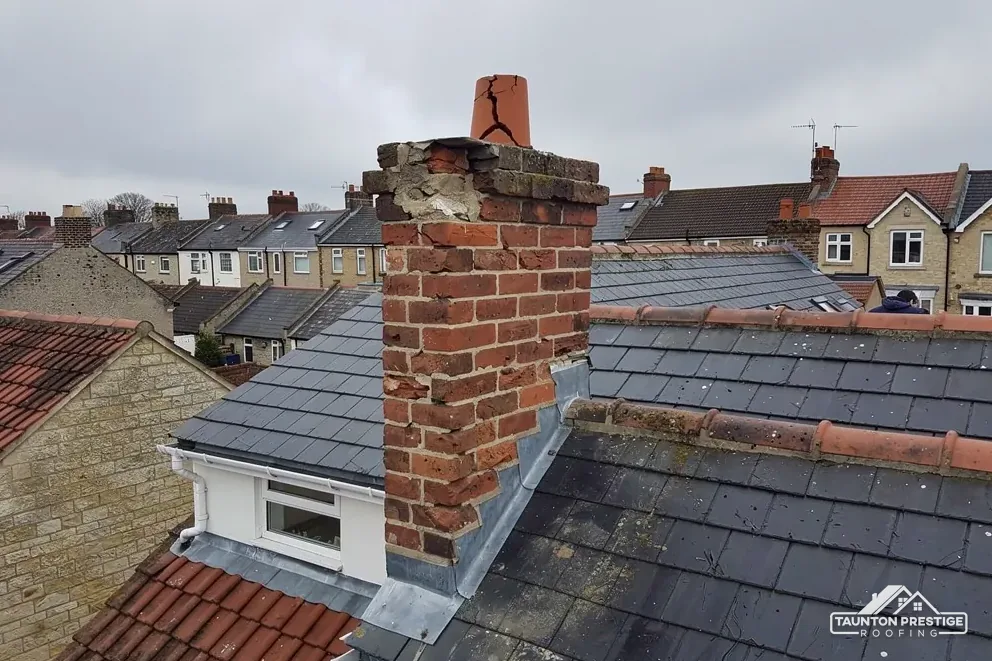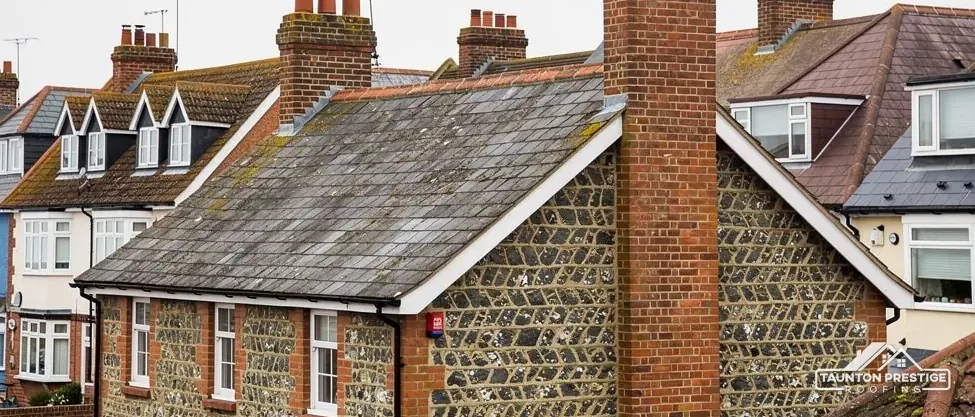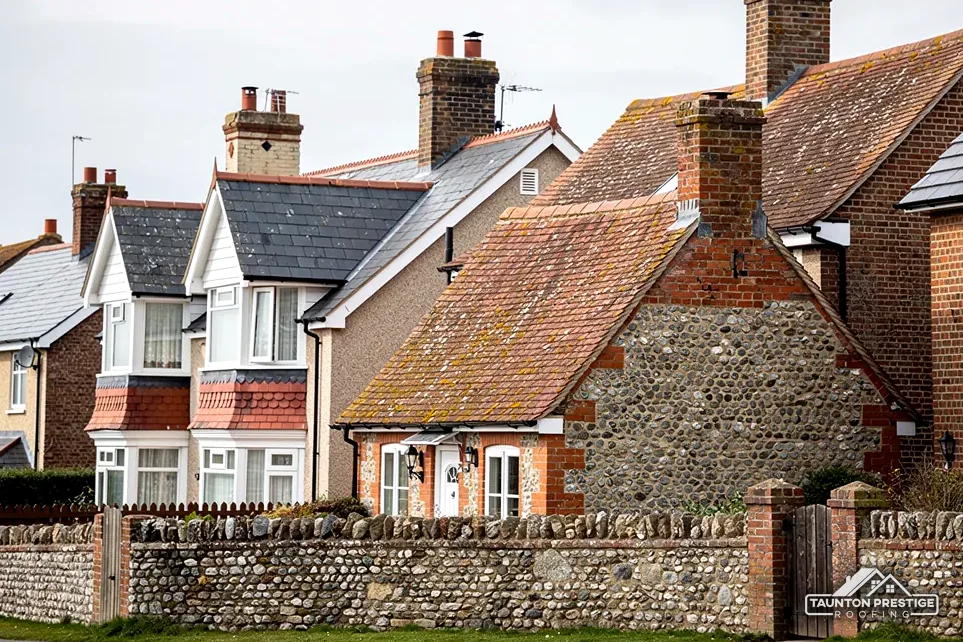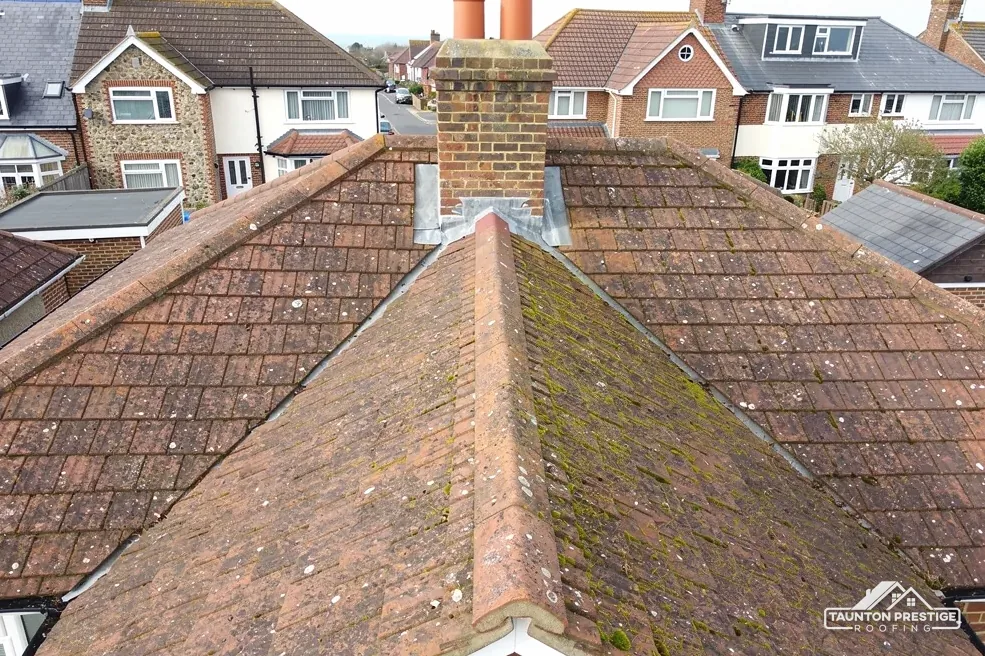
Plenty of Taunton houses have a chimney that has not carried smoke for decades. Gas central heating arrived, the open fire was boarded over, and the stack kept standing, shedding the odd brick and letting in a little rain. Sooner or later its owner asks the sensible question: is it worth keeping, capping or taking away?
There is no single right answer. A stack that is sound and well flashed can simply be left to do its work, as it often supports a neighbour's flue or keeps the look of the street. A leaning or crumbling one may be cheaper to remove than to rebuild. What matters is knowing which pieces of the job are roof work and which are structural, because the paperwork follows the structure. This guide compares capping and removal, explains what ventilation a closed flue still needs, and sets out when building control, planning and the party wall rules come into it. It belongs to our chimney repairs service.
Leave it, cap it or take it down
Think of three levels of response, from least to most.
Can I just leave a disused stack alone?
Yes, if it is sound. A stack that is pointed, flashed and capped costs little to keep. It also keeps the roofline as it was, which matters on a terrace where your chimney sits in line with the neighbours'. Leaving it does not mean forgetting it, though, and an annual look from the ground is enough to catch trouble early.
When is capping enough?
Capping fits a flue that will not be used again. A cap seals the top of the pot or the stack against rain while still letting air move through the flue, so damp does not settle inside. It is the least disruptive route, and we cover it on our page about capping a chimney.
When does removal make sense?
When the stack is failing and would need a rebuild, when it leans over a neighbour's roof, when it blocks a planned roof window or solar array, or when you simply want the loft or the room below cleared. Removal can be sensible, but it is a bigger step than capping and it cannot be undone without a rebuild.
We set out all three routes once we have surveyed, using pictures of the stack, so the choice rests on what we found.
Whichever you pick, do it with the weather in mind. A stack coming down in January is a hard job to make watertight, and spring or early summer is kinder to the roof and to your plans.
If the house is on the market, tell us. A buyer's surveyor often flags a disused stack, and a clear record of the decision helps.
Capping a flue and letting it breathe
A closed flue is not a dead space. Air moves through it, and that movement carries off the damp that builds up inside a cold, unused chimney. Seal the top with no way for that air to escape and the moisture can only soak back into the brick, where it can show up as damp patches on the breast inside.
What is a ventilated cap?
It is a cover, usually a clay hood or a metal cap with gaps, fixed over the pot so rain cannot fall in but air can pass. Some flues also get a vent at the bottom, in the room, for the same reason. BS 5250 is the standard behind moisture control in buildings, and it is why cold, closed spaces are ventilated rather than sealed.
Can I just fill the flue?
We would not seal it solid. A flue that is blocked at both ends, or packed with insulation, can trap damp air against the stack. Our capping page explains when a cap is the better first step.
If the flue still serves a boiler, a stove or a gas fire, leave the work on the flue itself to a qualified fitter, and make sure any cap suits the appliance. We deal with the roof end only and tell you when a heating engineer is needed before we start.
Where a stack is capped, it still needs its pointing, flaunching and flashings kept sound. Capping the top does not make the rest of the stack waterproof.
Treat any flue as live until a heating engineer has said otherwise. A flue that looks dead may still serve a boiler in another room.
Taking the stack down above the roof
Removing the part of a stack that stands above the roof is the more straightforward half of the job. The roofer scaffolds the stack, takes it down brick by brick, lowers the debris safely, and then closes the gap in the roof so it is as watertight as the slope around it.
What happens to the hole in the roof?
The roof covering is made good: rafters trimmed and supported where the stack passed through, battens and underlay renewed, and new slates or tiles set to match the slope. Lead flashings and soakers, the thin lead sheets that seal the joints, go in where the old stack met the roof. A tidy job leaves no sign of where the stack stood.
Does it need planning permission?
Taking a stack off the roof changes how the house looks from outside, so check with Somerset Council's planning team first, and press the point harder for a listed home or one inside a conservation area. The Planning Portal's guidance covers the inside work, and the outside question is for the planning team to answer for your address.
Many stacks also carry weight lower down. The brickwork sits on a breast inside the house, often supporting pots, a gather and sometimes a flue shared with the room next door. Taking the stack off at roof level is one job. Taking it all out is another.
Remove anything you want to keep, such as old pots, before the scaffold arrives.
A scaffold is almost always needed, with a platform and proper edge protection, and its cost is a large part of the job. A scaffold that takes up pavement needs the highway authority's licence, so ask the scaffolder about it early and allow for the notice period.
When the chimney breast comes out too
The breast is the brickwork that juts into the room, and it can run from the ground floor to the roof. It carries weight within the building, and that is why this half of the job brings in rules the roof half does not.
Does removing a chimney breast need building control?
The Planning Portal says approval under the Building Regulations always applies to taking out a breast, because a breast belongs to the structure. Your building control body decides how it wants the work assessed. For a Somerset address, that is Somerset Building Control on 0300 303 7790.
Who looks after the support?
If the breast carries the stack above it, or the floors on either side, something has to take its place. This is a structural calculation, normally a steel beam or a gallows bracket, and the figures come from a structural engineer, not from a roofer's guess. We work with the engineer's design and do not make it up on site.
It also helps to treat the whole job as one project, in this order: the engineer, building control, then the stack, then the breast. Removing the breast first and the stack later can leave brickwork unsupported in the middle of the work.
MyJobQuote gives breast removal as £1,200 to £3,500, with an average of £2,500 (MyJobQuote, Aug 2026), and that is for the breast alone, not the roof work above it.
Keep the paperwork. A completion certificate from building control matters when you sell, because a buyer's solicitor will ask what was done to the breast and who signed it off.
Party walls and shared chimneys
In a terrace or a semi, the breast is often bonded into the wall shared with your neighbour, and the flues serving both houses run side by side in one stack. Taking your part out affects theirs.
Must my neighbours be told?
Very likely. Section 2(2)(g) of the Party Wall etc. Act 1996 allows an owner to cut a projecting breast, jamb or flue back out of a party wall. Section 3 expects the party structure notice to be served at least two months ahead of the start date. GOV.UK treats taking chimneys out of a party wall as notifiable work, and warns that no reply from a neighbour cannot be read as a yes.
Who settles a disagreement?
A party wall surveyor, not building control. Where you and the neighbour disagree, GOV.UK says a surveyor has to be appointed. Our page on party walls and chimneys explains the notice process.
Do this before booking the scaffold. A two-month notice period shapes the whole timetable, and a neighbour who heard about it early is far easier to deal with than one who finds a scaffold on a Monday morning.
Even where the stack is detached from the party wall, a courteous word with the neighbours is good practice, since scaffold, dust and noise reach them too.
Do not forget the loft. If the breast runs up through it, work out early whose side of the wall each part stands on.
Where there is no agreement, nothing should start. A short delay to get the paperwork right is cheaper than a dispute with the people next door.
Is removal worth it, and what decides the price?
Removal earns its cost when the stack is the problem. If it leaks, sheds brick, leans or needs frequent repairs, taking it away ends the maintenance. If it is sound, a cap and good pointing may leave you better off.
What drives the price?
Several things sit behind the figure.
- How much comes out: the stack above the roof, the breast inside, or both.
- The structural support needed and the engineer's fees.
- Roof repair where the stack stood, which depends on the covering.
- Scaffold, and any highway licence it needs.
- Building control, party wall costs and decoration after the breast is out.
What does the room look like afterwards?
Taking the breast out gives back floor space but leaves a patched wall, a gap in the ceiling plaster and often a hole in the floor where the hearth stood. Plan for plastering and decorating, and allow dry time before painting.
There is also the loft. A stack removed from the roof leaves the breast in the loft in place unless it is taken out too, so say which you want. That keeps the survey, the engineer and building control all talking about the same job.
After the survey, a single written total covers the roof work, and we tell you what the engineer, the council and the neighbours will want before the scaffold goes up. Your next step is a survey, and then a choice between capping and removal made with your own photos in front of you.
Insulation is a quiet benefit. With the breast gone from the loft, there is one less cold bridge to wrap, and the space can be insulated more simply.
Removing a disused stack
Will removing the stack leave a hole in my roof?
No. The opening is closed with rafters, battens, underlay and matching slates or tiles before we leave, and flashings seal the edges. The slope should be as watertight as the rest of the roof. We photograph the stack beforehand and afterwards, so the finished repair is there for you to see.
Can I take out just the stack and leave the breast?
Yes, and many owners do. Taking the stack off at roof level and capping or closing the flue below avoids the structural work of removing the breast. You keep the room as it is, and the roof ends up with no chimney to maintain. Ask us to show you both.
Is a capped chimney better than a removed one?
It depends on the stack. A sound one is cheaper to cap and keeps the roofline, while a failing one may cost less to remove than to repair. We weigh both against pictures of your own stack, then put a single written price on the route you pick.
More on this subject: Chimney repairs in Taunton