When a fireplace has been boarded up for years, the chimney above it is easy to forget. The pot may be gone, the stack may carry a slab of concrete or a few bricks, and nobody has lit a fire in the room since the central heating went in. Yet that tall brick tube still passes through the house, takes rain from above, and sits against walls that warm up and cool down every day.
The mistake is to treat a disused chimney as dead space. Rain gets in at the top, moisture rises from the room below, and a flue that has been shut at both ends has no way to dry. The brickwork soaks it up and shows it as brown stains, peeling paper or white salts on the chimney breast, the part of the wall that projects into the room. This guide explains what a proper cap does, why ventilation matters, what a vent at the bottom of the flue is for, and when a stack needs more than a new lid. It sits within our wider chimney repairs work across Taunton and Somerset.
What happens inside a flue that is sealed shut
A flue is a brick or clay-lined passage, and old ones were built to carry smoke upward with fresh air flowing through. Once the fire is gone, rain can still enter through the pot or a failing cap, and warm damp air from the room can still find its way into the flue through cracks in the fireplace opening. Block both ends tightly and there is nowhere for that moisture to go.
Moisture then does what moisture does. It moves into the brickwork, carries salts to the surface, and shows on the chimney breast as patches that come and go with the weather. In an older house with lime-based plaster the effect can be dramatic. In a newer house with modern gypsum plaster the stain may only appear after several wet months.
Is a damp chimney breast always a roof fault?
No, and that is why capping matters. A leaking flashing, a cracked cap or eroded mortar joints can all let water into the stack, but so can a sealed flue that has no air movement. Treating one without the other leaves the stain in place. Our guide to a damp chimney breast explains how to tell the causes apart.
Why does ventilation help?
Moving air carries moisture away before the brickwork absorbs it. BS 5250:2021 covers moisture in buildings and is listed as current, though under review. The principle it rests on is simple: a space that can breathe stays drier than one that cannot. A flue that is capped but vented does that job on a small scale.
Condensation inside a stack is also a reason to avoid filling a flue with insulation or rubble. Either blocks airflow and traps whatever damp is already there, so leave the void clear unless a competent person has designed something else.
Vented caps and the other top-of-stack options
The cap sits on the stack, in the place where the pot or flaunching would be. Flaunching is the sloping mortar fillet that holds a pot in place and sheds water off the top, and it is its own subject, covered in our guide to chimney flaunching. When the pot comes off or the stack is shortened, something has to close the top while letting air through.
What does a vented cap look like?
A vented cap is a lid with a gap or louvre around its edge, so rain runs off the top but air can pass underneath. Some are clay or terracotta, in keeping with an old stack. Others are a concrete slab raised on small blocks, or a metal or plastic cap with a mesh against birds. Any of these can work if the flue is left with an opening that is shielded from rain and cannot be blocked by a nest.
Is a solid slab a good idea?
A solid slab that fully closes the flue stops rain but also stops air. Where a flue is no longer used it can be the right choice only if the bottom of the flue is ventilated through a grille or air brick, as described below. A slab with no ventilation at either end is the pattern that produces damp problems.
You may also meet a cowl, a cover that sits over a working pot and keeps wind and rain from the flue. A cowl on a chimney that is still used is a different job, and our page on chimney cowls covers it.
Why does the cap need to be checked from time to time?
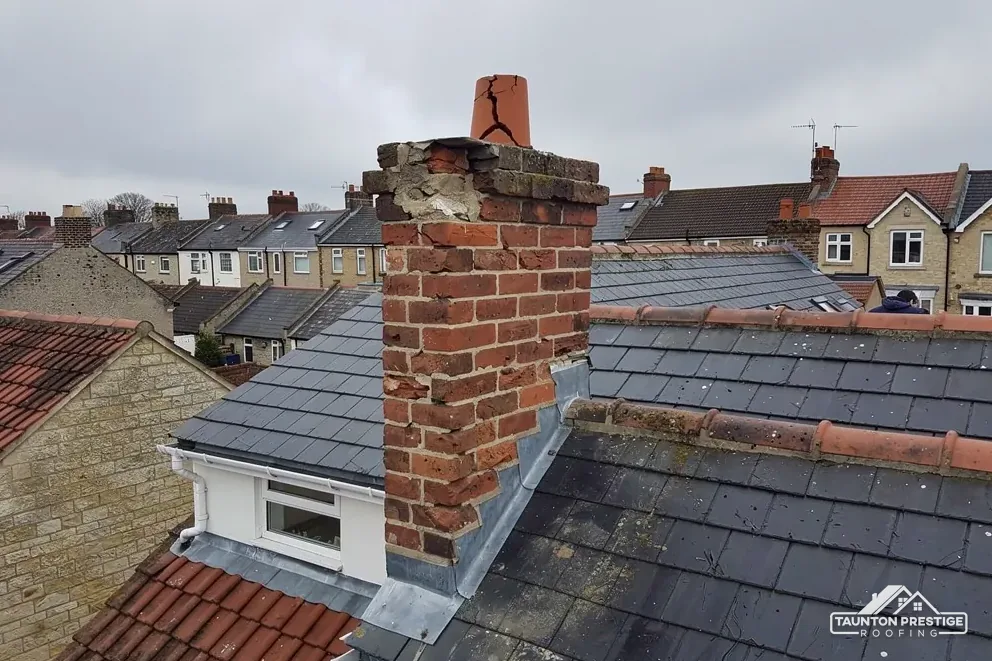
Because it sits at the top of the building in the full weather, and mortar fails there first. A cracked cap or loose mortar is easy to see from the garden with binoculars, and cheap to fix before water gets in. A cap that is cracked, tilted or gone is the cue to look at the stack as a whole.
Air bricks, grilles and the vent at the bottom
The other half of the arrangement is the lower end. When a fireplace opening is closed, a sound way to ventilate the flue is to leave a vent at or near the bottom, either as a grille set into the board or plate across the opening, or an air brick built into the chimney breast. The idea is that air enters low, passes up the flue and leaves at the cap. Together, the two openings make a draw, even a weak one, and it is enough to keep the brickwork from sitting wet.
Where should the vent go?
Low in the chimney breast is the usual place, since air moves up the flue by itself. A small vent set in the infill panel works. A grille in the fireplace plate is a common alternative. Position matters less than keeping it open, so never let a decorator paint it shut, cover it with furniture or let the plasterer skim over it.
What if there is a gas fire or a boiler flue nearby?
Then stop. Gas appliances rely on a correctly working flue, and carbon monoxide is a real risk if one is blocked. A flue that serves a gas appliance should only be altered by a qualified gas engineer, and a chimney that is shared with a neighbour's heating needs the same caution. If you are unsure whether a flue is live, ask before any cap goes on.
Does the flue need to be swept before capping?
Usually, yes. Soot and debris absorb moisture and hold it against the brickwork, and loose material can fall into the room when the flue is opened. Our guide to the difference between a roofer and a chimney sweep explains who does what.
The vent can also be useful for checking. A damp smell, a dark stain on the breast or a draught that was not there before points to a problem at the cap, and the grille lets you feel whether air is moving.
Signs the cap or the stack needs attention
Many chimney faults can be seen from the ground or from inside the house. They are worth recording with a date and a photograph, so you can see whether they spread.
- Brown or yellow staining on the chimney breast that changes with the weather.
- White powdery salts on plaster or brick, a sign that moisture is carrying minerals to the surface.
- Paint or wallpaper that blisters or peels near the breast, or in the bedroom above it.
- A musty smell near the fireplace opening.
- A cap that is cracked, tilted or missing, or flaunching that has split.
- Bricks near the top that are crumbling, or mortar that has washed out of the joints.
Can you test whether the flue is breathing?
A vent grille helps: hold a tissue near it on a breezy day and watch whether it moves. If nothing stirs, the cap may be blocked by a nest or by debris. Do not poke around in the flue yourself, and never go up on the roof to look.
When is a cap not enough?
If the stack leans, the bricks are spalling or the mortar has gone, a new cap will not hold on a failing structure. Rebuilding some courses may be needed first, and the work is described in our guide to a chimney rebuild. Where a stack is no longer needed at all, taking it down may be better than maintaining it, and we cover that under chimney stack removal.
Birds also like capped stacks. Under section 1 of the Wildlife and Countryside Act 1981, a person who intentionally takes or damages an occupied nest commits an offence, so a stack with a nest in it is left until the young have flown.
Planning, scaffolding and what decides the price
Fitting a cap to an existing stack usually does not change the building's appearance, but a listed house is different. Listed building consent covers works that affect a listed building's character, and a cap, pot or lid on a visible stack can do that. In a conservation area the planning team also takes an interest in the stack as part of the street. Ask Somerset Council before changing the look of a chimney on a listed or older house. Our guide to listed building consent for chimneys sets out the route.
Does capping need scaffolding?
Normally some form of access is needed, because a stack is a high, awkward place to work from a ladder. The access might be a roof ladder and edge protection, a tower, or a full scaffold. Where the scaffold stands on the pavement, the highway authority issues a licence, which for Somerset is Somerset Council, and the contractor applies. Our page on scaffolding for chimney repairs goes through the choices.
What decides the price of capping a chimney?
The height of the stack, the access needed, the type of cap, the state of the brickwork and whether the flue needs sweeping or a vent fitted below. A stack in sound condition with easy access is a short job. A stack that needs flaunching, repointing or a few courses rebuilt is a bigger one, and the survey tells us which you have. We give one written price after that survey, with photographs of your own chimney.
For reference, MyJobQuote (Oct 2026) shows chimney repointing in a typical UK range of £450 to £1,200, which gives a sense of the scale when mortar needs renewing beside a cap. Your own price depends on the factors above, and the survey is how we find out what is happening at the top of your stack.
Capped chimney queries
Can I just seal the top of an unused chimney?
Sealing the top alone leaves a flue with no air movement, which tends to hold damp. A better arrangement is a cap that sheds rain but lets air through, together with a vent at the bottom, so air can pass up through the flue and keep the brickwork drier.
Where should the air brick for a capped flue go?
Low in the chimney breast, or as a grille in the board or plate across the fireplace opening. Air enters at the bottom, passes up the flue and leaves under the vented cap. Keep it clear of paint, plaster and furniture, or it stops working.
Is a damp patch on the chimney breast caused by the cap?
It can be. A cracked cap, failed flaunching, a leaking flashing or a flue with no airflow can each cause it. The way to tell is to look at the stack from outside and at the breast from within, and to check whether the staining follows the rain.
More on this subject: Chimney repairs in Taunton