Winter storms test a roof from the top down, and the chimney is the top. It stands clear of the ridge with wind pushing on every face, and the weak points are the same on most houses: the pots, the mortar that holds them, the lead flashing at the roofline junction, and the brickwork where old joints have opened. When one of those goes, the damage usually shows up as slates on the lawn, a stain on a bedroom ceiling or a pot lying in the garden.
This guide covers the parts of a stack that fail in high winds and why, how to judge from the ground if a stack is merely damaged or truly unsafe, what Somerset Building Control says about unstable chimneys, and how a home insurance claim usually runs. It is written for the morning after a storm, when you need to know what to do first. It sits within our chimney repairs service, and it is general information rather than advice on any particular policy.
What high winds do to a chimney stack
Wind does not pull a stack apart at random. It finds the parts that were already loose.
Why do chimney pots come loose?
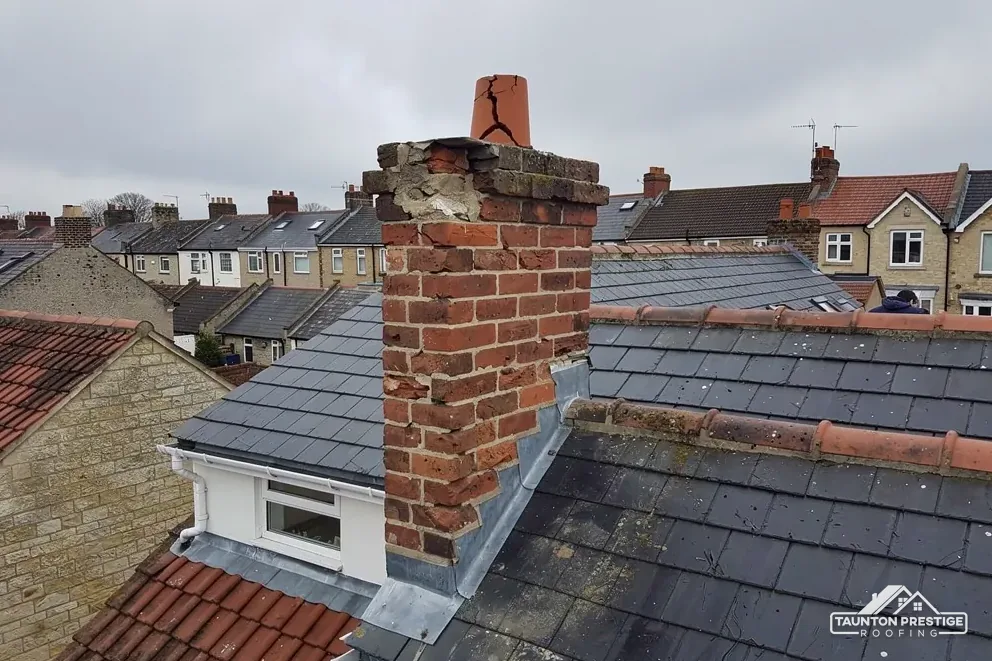
Each pot caps a flue, and it sits in a bed of mortar called flaunching, which slopes away to shed water. Over the years frost cracks the flaunching, the pot rocks and a strong gust finishes the job. Our page on a loose chimney pot explains what to look for.
What happens to flashings in a gale?
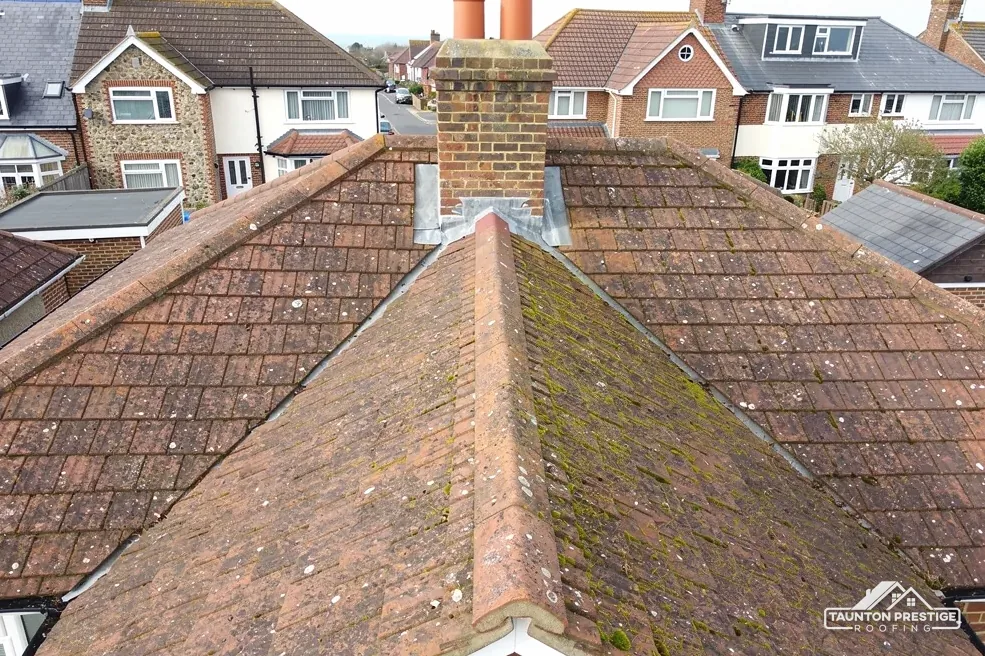
Flashing is lead sheet dressed round the foot of the stack to keep rain out. It is held in a groove in the brickwork and dressed down over the tiles or slates. If the groove has lost its mortar or the lead has crept, wind lifts it, rain gets behind it and you may first notice a damp patch on the ceiling near the chimney breast.
Can the brickwork itself fail?
Yes. Old, soft bricks and tired joints take rain on every face, and storms push that rain in sideways. The top courses can loosen, and in a bad case part of the stack can shift. Aerials and satellite dishes strapped to a stack add leverage, and a bracket can pull the brickwork with it.
Most storm damage to chimneys is the end of a slow failure, not a sudden one. A recent survey photo, from before the storm if you have one, is the best evidence of that.
Chimney cowls, the metal or clay hoods fitted over a pot, can also be wrenched sideways, and a heavy cowl on a weak pot makes the failure worse. Check that anything fixed to the top of a stack suits the pot beneath it.
Checking a stack from the ground after a storm
You can tell a surprising amount without a ladder. Wait until the wind has dropped, stand well back from the house, and look at the stack from a safe place such as the garden or the opposite pavement. Never climb up to look yourself.
- A pot that is tilted, missing or sitting at an angle that differs from the pots beside it.
- A stack that no longer stands true, or a crack running across the brickwork.
- Bricks, mortar or pieces of pot in the garden, the gutter or on a flat roof.
- Slates or tiles displaced around the stack.
- Lead flashing hanging loose or curled.
Should I check inside as well?
Yes. Look at the ceiling around the chimney breast in the rooms and in the loft, if you can reach it safely. A fresh stain or drip after heavy rain means water has found its way in, and the loft is where it tends to show first. Take dated photos of anything you see.
Keep people and pets off the ground beneath the stack until someone has looked at it. A pot or brick can fall without warning, and a chimney that looks only a little out of true can still be unsafe.
Send us what you have noted. Pictures taken from the garden are often enough for us to judge whether this is a repair or an emergency.
If the wind is still gusting, leave the check for another day. A calm morning gives a safer and clearer view.
Unsafe stacks and the council
Somerset Building Control handles buildings that put people or property at risk. Its page on dangerous structures names "Unstable chimneys" among the examples. It adds that safety costs for a dangerous building fall to its owner.
How do I know if mine counts?
A stack that leans, moves in the wind, has dropped brick or shows a new crack across its width is a candidate. If part of it could fall on a path, a road or a neighbour's property, treat it as urgent. If you are unsure, Somerset Building Control can be reached on 0300 303 7790.
What do I do first?
Make the area safe. Keep people away from the foot of the chimney, shut off any rooms directly beneath if the stack is moving, and cone or cordon the ground if it is outside. Tell your neighbours if the stack could reach their land.
Our first move is to make a leaking roof safe, and for a chimney that may mean taking down the unstable part, tying it in, or covering the opening so water stays out. A permanent repair is planned afterwards, once the danger has passed and you have seen photos of the damage.
If a stack is moving, falling apart or threatening a public place, do not wait for a quote. Clear the area and arrange a make-safe first.
After a make-safe, the rest of the repair can be planned at a steadier pace.
If the stack backs onto a neighbour's roof, ring them as well. Debris from a pot can land on their slates before it reaches your lawn, and they may have damage to report.
Making safe first, repairing properly second
Storm repairs come in two stages, and it helps to see them as separate jobs.
What does a make-safe involve?
It stops the damage getting worse and removes the danger. That might be taking off a loose pot, strapping or taking down the top courses, laying a tarpaulin or board over an opening, or securing lead that is flapping. It is temporary by design, and the aim is to buy time for a proper job.
What does the permanent repair involve?
That depends on what the survey finds. A pot rebedded in fresh flaunching is a small job. New lead flashings, a repointed stack or a partial rebuild are larger ones. Our guide on insurance and chimney repairs covers how the two stages sit with a claim.
What might it cost?
Typical UK figures from MyJobQuote (Oct 2026) put an emergency roofer's call-out at £150 to £300, and storm repairs at £1,200 or more. Those are national guides, not our price. What moves a chimney repair is the damage found, the height and access, whether scaffold is needed, and whether the stack can be repaired or must be rebuilt.
A rebuilt stack in matching brick suits older houses best, and a repair in poor weather may need a second visit to finish. We tell you honestly if the temporary fix needs to stay for a few weeks.
A written note of what was done on the day, and why, is worth asking for. It helps with any claim and gives the permanent repair a clear starting point.
Does house insurance cover chimney repairs?
It may, and it depends on your policy. We cannot say whether yours will pay, and nobody can until the insurer has read the claim. What we can do is explain the steps that usually matter.
What should I do before anything else?
Tell your insurer first, before you arrange repairs, so they can tell you what they need. A temporary repair should make the damage safe, and every photograph and receipt is worth saving. Structural engineers' professional body, the Institution of Structural Engineers, points out that photographs hand an insurer visual evidence of the damage, so they matter to any claim.
What counts as a storm?
The Financial Ombudsman Service describes its approach to the question this way: a storm usually means violent winds, usually accompanied by rain, hail or snow. A chimney that fell on a calm day, from long wear, may be treated differently from one brought down by a gale, so read your policy wording and ask your insurer how it applies.
Will the claim be paid?
Not always. Which? reported that "only 32% of storm-related claims made in 2024 resulted in a payout". We can supply a plain written description and survey photos for you to send, and a clear receipt for the make-safe.
Do not agree to a full repair before your insurer has seen the damage, unless the stack is unsafe and has to be made safe at once. Photos taken before and after cover you in both cases.
Keep any broken pot or brick you can safely collect. The insurer may want to see it, and it shows the repair copied what was there.
If the insurer says no, and preparing before winter
A refusal is not always the end. If you disagree with the insurer's decision, start with its own complaints process. The Financial Ombudsman Service accepts a complaint when no final response letter has arrived after eight weeks, and also within six months of the date printed on such a letter. Its service is free, and Citizens Advice runs a consumer helpline on 0808 223 1133 if you want to talk it through first.
What can I do before the next storm?
Prevention is cheaper than a claim. A yearly look from the garden costs nothing, and a second look after any big storm costs nothing either. If the stack has not been looked at close up in years, a survey from the roof picks up loose pots, tired flaunching, flashings that have lifted and joints that have opened.
Which repairs matter most?
The ones at the top. Rebedding a pot, renewing flaunching and refixing flashings are small jobs that protect the whole stack. Our page on loose chimney pots shows what to check, and the pointing guide covers the joints below.
Lead flashing "can last for over 80 years" as a lower bound (MyJobQuote, Sep 2026), so a good one rarely needs replacing, and a sound one is worth keeping.
You receive one written price after the survey, with photos of the faults. Your next step is to book a survey before the autumn gales, and we will tell you which jobs are worth doing first.
Plan the visit for a dry spell where you can, and tell us if the stack serves a boiler flue, so the heating engineer can be brought in at the right time.
After the gales
Is a chimney pot on my lawn an emergency?
The pot itself is not, but the stack may be. Keep people and pets clear, photograph the pot and the stack from the ground, and call us. We will tell you whether the opening needs covering and whether the flaunching or the brickwork also failed.
Can I use my fireplace after a storm?
Not until the stack has been looked at. A loose pot, a cracked flue liner or a stack that has shifted can let smoke or fumes into the house. Leave the fire unlit, and have a roofer check the stack and a sweep or heating engineer check the flue.
Will the insurer want a quote before the make-safe?
Not for an urgent make-safe. The usual advice is to tell your insurer, make the damage safe, and hang on to photos and receipts. For the permanent repair, ask what they need, since some want to see the damage or a written description first. We can describe the work in writing for them.
More on this subject: Chimney repairs in Taunton