A drip onto the lawnmower or a stain creeping across a ceiling board is the first sign most owners get. The roof is out of sight, so the temptation is to throw a tarpaulin over it and hope. A better first step is to understand what kind of roof you have, because felt and sheet roofs leak in different ways and for different reasons.
A felt roof is a flat or nearly flat deck with a bitumen-based membrane on top. It tends to fail at seams, edges and where the surface has cracked or blistered. A sheet roof, the corrugated kind, is a series of overlapping panels bolted to rails. It tends to fail at the laps, the fixings and the ridge. Both can suffer from water that sits on them. This guide covers the commonest causes, how to look safely, what you can do yourself, and the point at which repairing is no longer sensible. It is part of our garage and asbestos roofs advice for Taunton and Somerset.
Start with the safe checks from the ground
Do not climb onto a garage roof to look for a leak. Many are fragile, and a fall from even low ground can injure badly. If the sheets might be asbestos cement, HSE describes such roofs as always fragile, and a hairline crack can give way underfoot. From the ground, the garage can tell you a great deal.
What can you see without a ladder?
Pick a bright, dry day and walk slowly round the building, then go inside and look up with a torch.
- Dark staining on the walls under the eaves, which suggests water running down rather than dripping in.
- Gutters that are full, sagging or pulled away from the fascia, the board that carries them along the roof edge.
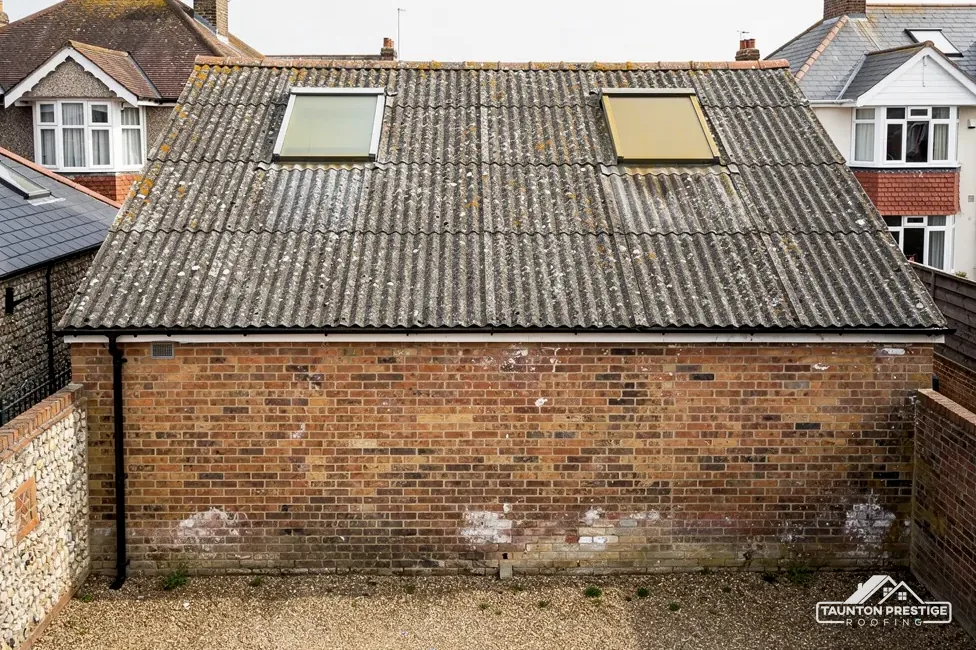
- Sheets that have slipped, bowed or cracked along the corrugations.
- Daylight showing through the roof inside the garage.
- Wet or dark patches on the lining, the boards or the back of the sheets.
- Rust trails running from bolt heads.
Take photos from several angles, with and without the torch on. They help you spot change over time and give a roofer a head start. Note whether the leak follows heavy rain or appears in dry weather. If it drips on cold, dry mornings, you may be looking at condensation, which our guide to garage roof condensation explains.
Last of all, clear what you can from the floor beneath the leak, and slide a bucket or a tray under the drip so the slab does not stay wet. Water ruins cardboard, tools and anything electrical, and moving valuables out of the drip line costs nothing.
Splits, blisters and worn felt
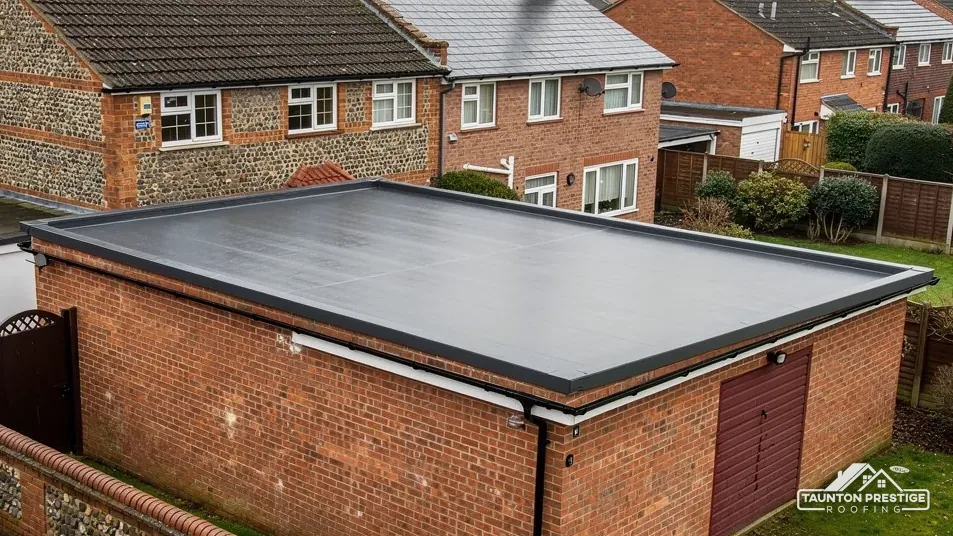
Felt roofs age from the top. Sun, frost and foot traffic dry out the surface, and over time it cracks, lifts or blisters. Once the top layer is open, water reaches the layers below, and a roof that looked intact starts to let it through.
Why does felt split?
Felt moves with the temperature, expanding on warm days and shrinking on cold ones. A membrane that is old, thin or poorly stuck cannot follow that movement, and it opens along its weakest line. The weakest lines are the seams where strips overlap, the edge where the felt is carried up the brickwork, and places where it was stretched over a ridge in the deck. Less gives felt 10 to 20 years and notes that careful work can reach 20 while shoddy work can give out in under 10, which is why age alone is a poor guide.
A blister is a bubble where moisture or air is trapped between layers, and on a hot day you can sometimes see it rise. A small, intact blister does not always leak; a split one will. A bare, crazed surface with the grit gone and the bitumen showing has little life left.
If the damage is local, a patch or a repaired seam can bring the roof back for some time. If the felt has cracked widely, patching is money spent on a covering that is finished. Our guide on garage roof felt lifting shows what to do when the edges or seams start to peel, and the next section covers water that cannot get away.
Ponding and falls
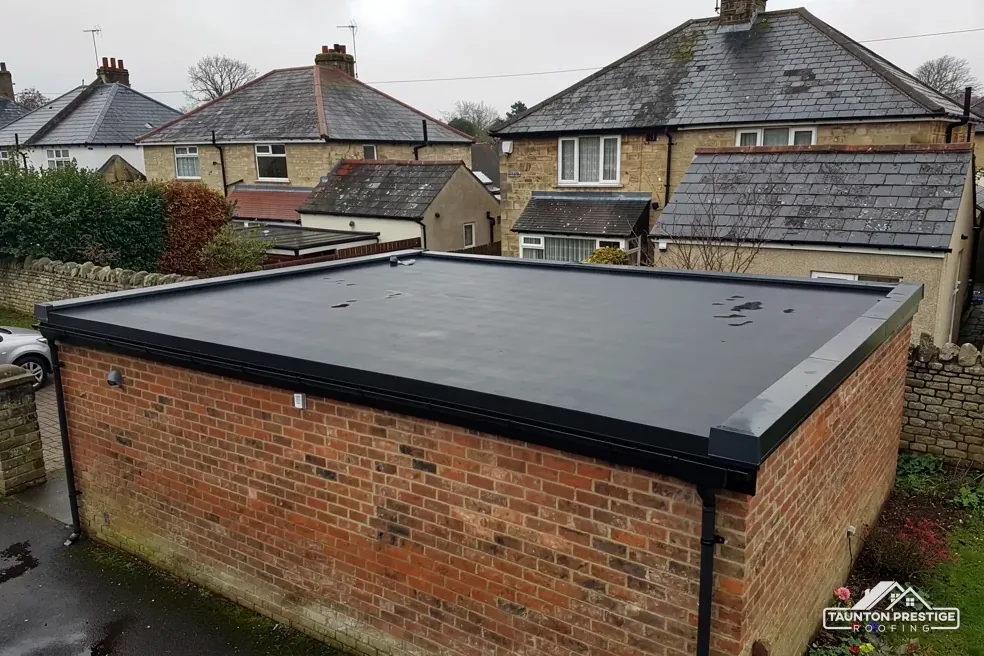
Water that lies on a flat roof for long after the rain has stopped is called ponding, and a roofer reads it like a map of where the roof has sagged. It is a cause of leaks and also a symptom of a deeper fault: the roof does not have enough slope, or the deck has sagged, or the outlet is blocked.
How much slope should a flat garage roof have?
The current code of practice is BS 6229:2025, covering flat roofs with continuously supported flexible coverings. The lowest finished slope it allows on the main areas is 1:80; to be sure of reaching that, IKO advises designing for 1:40. The older BS 6229:2018 was withdrawn on 16 December 2025. These falls are small, which is why a dead-flat or slightly sagging deck can leave puddles behind.
Standing water does harm in several ways. It sits on joints and laps, which are the thinnest parts of the roof. It freezes in winter and thaws, and the repeated movement opens seams. It carries leaves and dirt that block outlets. And its weight adds to the load on a deck that may already be weak.
- Look for tide marks, rings of dirt that show where a puddle used to sit.
- Look for moss and algae, which grow where water lingers.
- Inside, look for a bowed ceiling or a dip in the deck.
A little ponding on an old roof is common, and does not always mean failure. Deep, long-lasting ponds that return after every shower point to a fall problem that a fresh covering by itself cannot correct.
Laps, fixings and corrugated sheets
On a sheet roof the water gets in at the joints between panels and at the holes made for fixings. Each lap relies on an overlap, with the upper sheet shedding onto the lower one. If the overlap is too small, the sheets have lifted, or the roof is very shallow, wind and rain can push water uphill under the edge.
Why do sheet roofs leak at the bolts?
The bolts or screws that hold the sheets pass through the crest or the trough of the corrugation, and each has a washer or seal to keep water out. With time the seal perishes, the metal corrodes, the hole widens and the sheet works loose in the wind. Water then runs along the bolt shank into the garage. Rust trails below a bolt head tell you where to look.
Other common faults on a sheet roof include:
- Cracks around the fixings where the sheet has been over-tightened or has aged.
- Sheets that have split along a corrugation after a branch or a fall of snow.
- Open or lifted ridge pieces at the top, where the two slopes meet.
- Gaps where the sheets meet a wall, with failed or missing flashing, the strip of metal or lead that seals the joint.
Fresh sealant on a bolt can be a fair short-term fix on a sound sheet. It is not a cure for a roof that has loosened throughout. If the sheets might be asbestos cement, do not drill, scrub, sand or break them, and arrange testing first. HSE treats careful removal as non-licensed work, while breaking sheets up substantially makes it notifiable.
Edges, abutments and gutters
Many leaks start at the edge of a roof, not in the middle. Edges are where the covering is cut, turned or terminated, and where wind and water work hardest.
Where do garage roof edges fail?
A felt roof needs a neat edge detail: a trim, a drip edge or an upturned lip that throws water clear of the wall and into the gutter. If that detail has gone, water runs back under the felt or down the face of the fascia. Our page on garage roof drip edges shows what a good edge looks like.
At a junction with a wall, the join needs flashing, with the covering turned up the wall and sealed. When mortar fillets crack, sealant dries out or a flashing lifts, water runs behind it. Check around any rooflight, vent pipe or flue that passes through the roof too, since every penetration is another joint.
Gutters matter more than they appear to. A gutter that overflows can spill water over the eaves, and a gutter with the wrong slope holds a puddle against the felt. Brett Martin suggests a gutter fall of 1mm for every 600mm. Clean gutters twice a year if trees overhang the garage, and check the outlets are clear.
Water in the wall below the roof edge is as likely to come from a blocked gutter as from the roof, so check the gutter before you blame the covering.
When the edge is the problem, the repair is usually small and local, which is good news for your budget.
Patch it or start again?
Once you know where the water gets in, the next decision is what to do about it. The right answer depends on the share of the roof that is failing, not only on where this winter's drip appears.
When is a repair enough?
A repair suits a roof whose general condition is good and whose fault is local: one split, one failed seam, one rusty bolt, a loose trim. It buys time at modest cost, and we tell you so when that is the sound answer. If the same roof leaks in a new place every winter, the repairs are chasing a failing roof, and a replacement becomes the better buy. Our guide to repairing or replacing a garage roof goes through the balance.
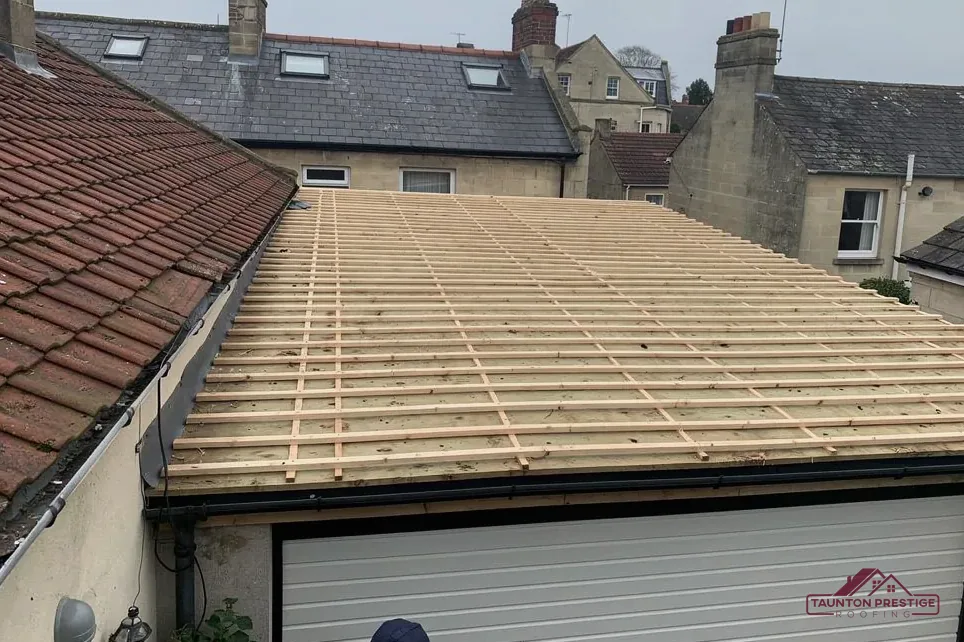
Replacement is the right call when the felt has cracked widely, the deck is soft or sagging, the sheets are brittle and rusted at the fixings, or water has pooled for years. We strip back to a sound base, repair the timber, build the fall into the deck, fit the new covering and finish the edges and gutters properly. Asbestos cement sheets are lifted off whole, double-wrapped and consigned as hazardous waste, with the method agreed before work starts.
Until anyone arrives, you can limit the damage: move belongings, catch drips and photograph the damage. If you plan to claim, tell the insurer before anything else, make a temporary repair only if it is safe, and keep every photo and receipt. When we attend, we stop the water coming in before anything else, then lay out the options with photos.
A survey finds where the water is entering, and the findings come back to you as photos plus a single total price in writing.
Garage roof leak questions
Why does my garage roof leak only in heavy rain?
Heavy rain pushes water through small gaps that light rain passes over: open laps, hairline splits, loose bolt holes and failed edge details. Wind-driven rain makes it worse, because it forces water sideways and uphill. A leak in a single spot after storms usually points to one fault you can trace.
Can I fix a garage roof leak myself?
Small jobs such as clearing a gutter or sealing one visible bolt from a safe position are reasonable. Anything on the roof is risky, and sheets that could be asbestos cement should be left alone and tested first. A roofer can repair a split or seam properly and tell you whether the roof has much life left.
How long does a felt garage roof last before it leaks?
Less gives torch-on felt 10 to 20 years, adding that good work can last 20 and poor work may fail inside 10. Falls, the deck and the edge details matter as much as age, so a roof's condition, not its birthday, decides whether it is time to repair or replace.
More on this subject: Garage and asbestos roof replacement in Taunton