A leaking garage roof looks like a small job until you stand under it. A damp stain near the door may come from one split in the felt, or from years of water soaking into the boards the felt is stuck to. The first deserves a repair. The second is a replacement waiting to happen, and a patch laid over soft boards only hides the problem for a winter or two.
The decision turns on three things you can learn without paying anyone. How is the roof built, what age is the covering, and what does the deck underneath feel like? The deck is the flat layer of boards or sheets that the waterproof covering sits on, the way a floor sits on joists. This guide takes the three questions in turn. It explains what a patch can and cannot do, how to look at the underside from inside the garage, why asbestos cement sheets change the answer, and what the published price ranges say about each route. It belongs to our wider garage and asbestos roofs work, and it points on to the page about a leaking garage roof.
Start with what the roof is made of
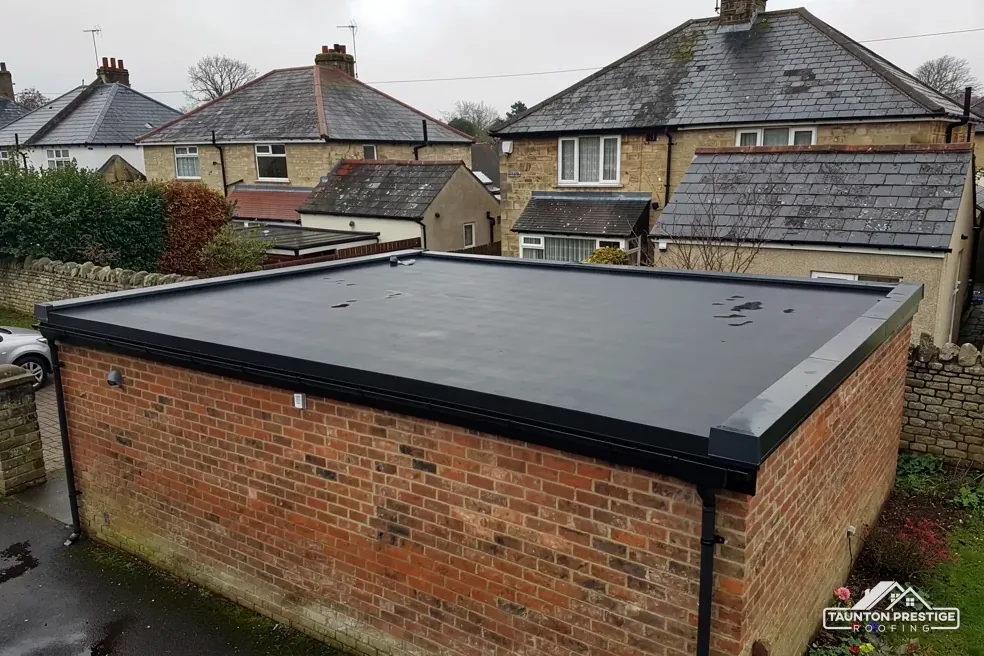
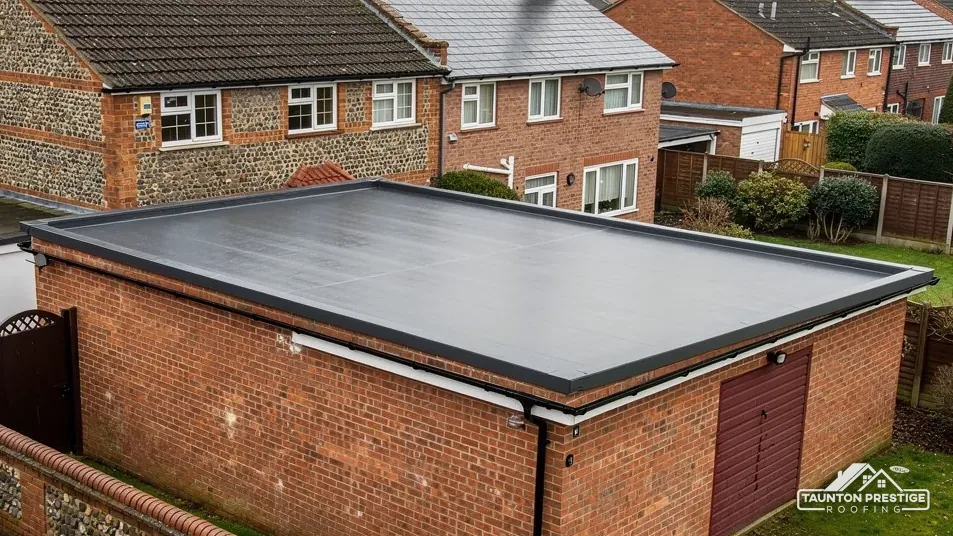
Garages carry a surprising mix of roof types, and the right answer for one is wrong for another. Most flat garage roofs are a waterproof covering stuck down on a timber deck. The covering might be felt, which is bitumen-soaked fabric laid in sheets, often bonded with a gas torch; EPDM, a synthetic rubber membrane laid in one piece; or GRP, a fibreglass resin laid wet. Older garages often have corrugated sheets bolted to timber purlins, the horizontal beams that carry them. Some have concrete sections lifted into place. A few have a pitched slate or tile roof like the house.
Each type fails in its own way. Felt blisters, splits at the laps and lifts at the edges. EPDM tends to fail at its seams and corners rather than across the middle. Corrugated sheets crack, and their fixings rust. A pitched garage roof loses slates for the same reasons as any pitched roof.
What age is the covering?
Age matters because every covering has a typical working life. Less gives torch-on felt 10 to 20 years, with the longer end reached by careful fitting and the shorter by rushed work (Less, Oct 2026). Those are typical ranges, never promises, but they show where on the curve your roof sits. A felt roof laid recently that has one split is a repair. A felt roof patched three times and close to the end of its working life is another case.
Old paperwork, or a note from a previous owner, can narrow the age down. If neither exists, the surface will do the talking: grit gone, cracked bitumen, moss in the laps.
What a felt patch can and cannot fix
How do you fix a garage roof?
The answer depends on the cause, but the usual patch on a felt roof follows a set order. The roofer finds the entry point, which is often some way from the stain, since water travels across the boards before it drips. The damaged area is cut out or cleaned back, the deck beneath is dried and checked, and a new piece of felt is bonded over the gap with generous laps onto sound felt around it. Edges and any trims are sealed so the patch does not simply peel off in the next gale.
On other coverings the fix differs. An EPDM tear is mended with bonding adhesive and a repair strip. A cracked corrugated sheet may take a sealing patch, but a sheet that is cracked in several places should be swapped. A slipped slate on a pitched garage is replaced like any other, as our guide to replacing a single slate explains.
For a general roof repair, MyJobQuote gives an average of around £650 as a typical UK figure (MyJobQuote, Oct 2026). That covers all kinds of roofs, so treat it as a rough marker only.
Where a patch stops working
A patch fixes a hole in the covering. It does not fix wet boards, standing water or a covering that is tired everywhere. If the deck has absorbed water for years, the new felt has nothing firm to grip, and the next split opens beside the patch. Our page on flat roof patch repairs covers it.
The test is simple. If a roofer lifts the damaged piece and the boards underneath are dry, firm and flat, a patch is a fair buy. If they come away soft, dark or crumbly, the question has changed from patching to replacing.
Judging the deck from inside the garage
You can learn a lot about the deck without climbing anywhere. Take a torch, wait for dry weather, and study the ceiling line from the floor. In most garages the boards or sheets are visible between the joists, the timbers running across the span.
What does a failing deck look like from below?
- Dark tide marks or black staining on the boards.
- Boards that sag between joists, or a ceiling line that dips in the middle.
- Rusty or lifted nail heads along the joists.
- Pale, powdery or fuzzy patches that point to damp and mould.
- Daylight at the joints, which means the covering above is already open.
- Fungus or a musty smell, particularly in a corner or along one wall.
Press a screwdriver tip gently into a stained board from below. Sound timber resists. Rotten timber lets the point sink in, or flakes away in damp fibres. Do this only where you can reach safely from the floor, and keep clear of any wiring.
Do not walk on a garage roof to check it. Many are not designed to carry a person, and a soft deck can give way without warning. A roofer with the right access can check the surface safely.
What can the deck be made of?
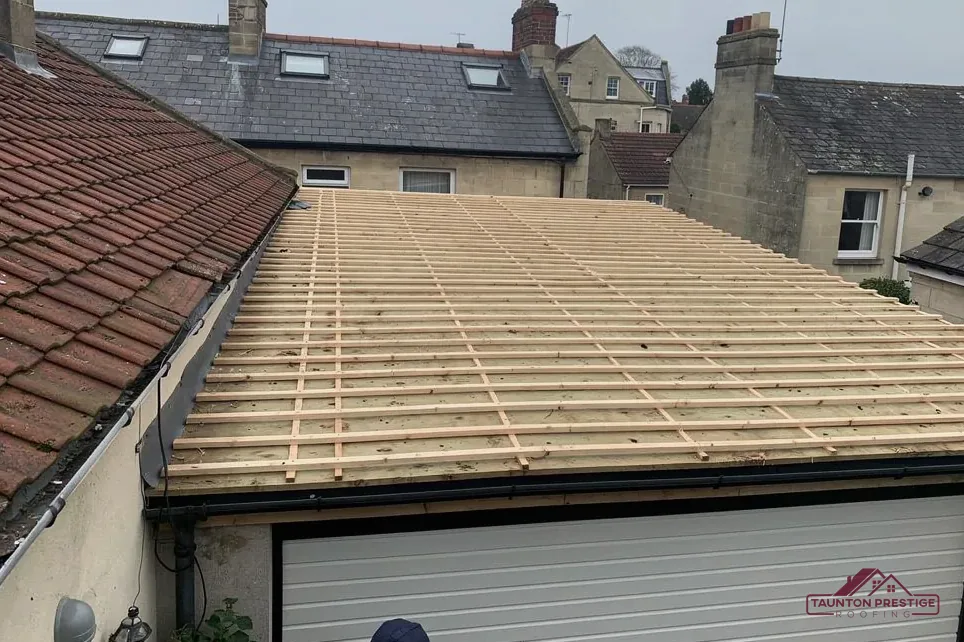
Older decks are often plain boards or plywood, and newer ones may be OSB, which is compressed wood chips. OSB swells and breaks down quickly once wet, so a deck of it that has taken water for a season may need replacing even where the roof looks recent. Stripping and relaying the deck is a bigger job than a patch, and it is usually where patching ceases to be the smarter spend.
When replacing becomes the sensible buy
A repair is worth doing while it still buys several dry years. It stops being good value when the roof is failing in more places than it is holding. These are the signs that tip the balance towards a new covering, and often a new deck with it:
- Blisters or splits across the whole surface, not just one corner.
- Soft boards in more than one place.
- Water standing on the roof for days after rain.
- A history of patches, each one next to the last.
- Edges and trims lifting or rotten.
Why does ponding matter so much?
Water that cannot drain stays on the covering and speeds up its ageing. BS 6229:2025, the standard for flat roofs with continuously supported waterproof coverings, keeps a minimum 1:80 finished fall, which is a drop of 1 part in 80 along the length of the roof. Designers aim for 1:40 so the finished roof still reaches 1:80 after settlement. If your garage roof holds pools, the falls may be too shallow, and a patch will never cure that. A replacement lets the roofer lay the deck to a proper fall, with tapered insulation if the roof is to be insulated. Our page on the minimum fall for a flat roof goes further.
What do published guides say replacing costs?
For a garage roof replacement, MyJobQuote lists a typical UK range of "between £750 and £3,500", with an average of £1,500 (MyJobQuote, Oct 2026). For a 15 m² garage roof, Less quotes £1,200 to £2,500 (Less, Oct 2026), and MyJobQuote puts felt on the same size at £1,200 to £1,800 (MyJobQuote, Oct 2026). Size, access, the state of the deck, the covering you choose and the edge trims decide where a job lands in those ranges.
Why asbestos cement sheets change the answer
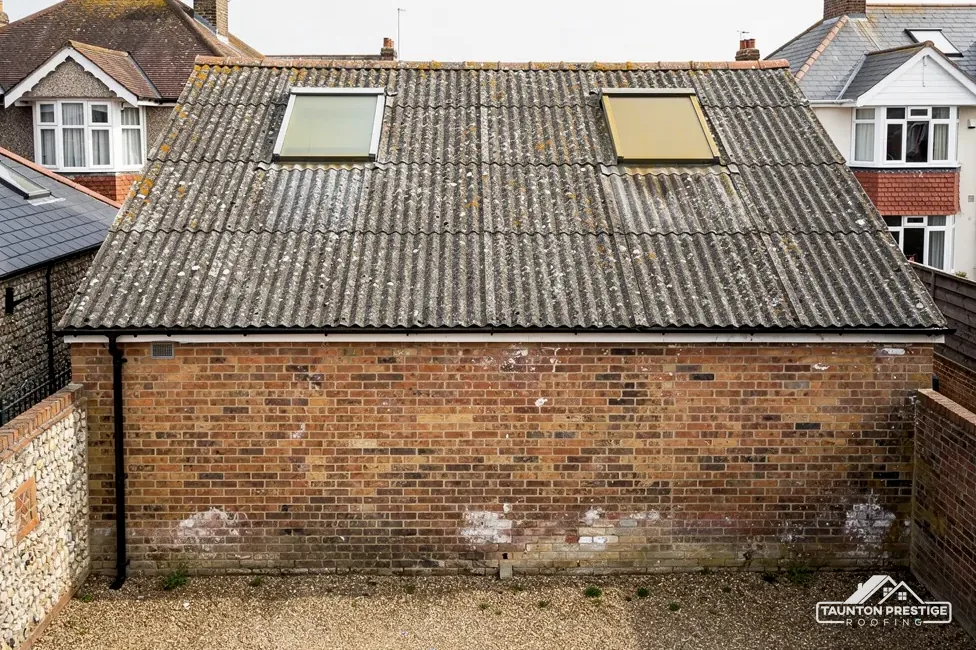
If your garage has grey corrugated sheets and was built or refurbished before 2000, treat them as asbestos cement until testing proves they are not. HSE expects owners to presume asbestos in a garage of that age, and the cut-off it gives is the year 2000. You cannot tell by eye, because the sheets look the same as modern fibre-free ones.
That changes the repair-or-replace question in two ways. First, HSE guidance describes asbestos cement roofs as fragile, so nobody should walk on them or rest a ladder on the sheets. A repair that involves drilling, scrubbing or cutting them creates dust, which is what the rules aim to prevent. Second, the options narrow to leaving the sheets alone, covering over them with a new sheet system, or removing them.
What do the rules say about taking them off?
HSE counts careful removal of asbestos cement as work that needs no licence, provided the sheets are lifted off whole and handled gently. Smashing them substantially, as in dropping a roof to the ground, becomes notifiable non-licensed work with extra duties attached. The waste never goes in an ordinary skip: it moves on a hazardous waste consignment note with a registered carrier.
Overcladding means fixing a new roof system over the old sheets without taking them down. Full removal is covered in our guide to asbestos garage roof removal. MyJobQuote gives an average of around £2,750 for asbestos roof removal and a typical £325 for an asbestos survey (MyJobQuote, Sep 2026), both UK ranges rather than prices for your roof.
Rules to check before you commit
Replacing a garage roof is rarely a planning question, but the Building Regulations deserve a short check. Part L of the Building Regulations, the part on saving fuel and power, treats re-covering a flat roof with a new membrane as renovation. It is written for dwellings, so ask Somerset Building Control whether your garage roof needs an application, and which insulation figures apply. Their number is 0300 303 7790.
The same check applies when the garage is joined to the house, shares a wall with a neighbour, or is heading for conversion to a room. Insulation and ventilation choices change once people spend time under the roof, and our page on insulating a garage roof follows that thread.
What happens at the survey?
We look over the covering and deck, take pictures of your own roof, and talk you through what they show. Where the covering is sound but the deck is soft in one patch, we recommend a repair. Where a patch would only delay a full replacement, we tell you that too.
A garage roof that leaks a little is not an emergency, but it rarely improves by waiting. Water in the deck spreads, and a cheap patch today can turn into a deck replacement by next winter. If you cannot tell which side of the line yours sits on, the survey ends with a single written price and the photos that explain it. Tools, bikes and boxes stored beneath the weak spot get covered or moved first, so nothing gets wet while the work goes on.
Garage roof decisions
Can I just put new felt over old felt on a garage?
Sometimes a roofer can, if the old felt is dry, flat and well stuck down and the deck beneath is sound. Laying over wet, blistered or lifting felt traps moisture and hides rot. Only a look at the surface and the boards settles it, and the written price then says whether the old layer is stripped.
How long should a garage roof repair last?
A repair on sound boards can give several more dry years, but no roofer can promise a number because the covering around the patch keeps ageing. Less puts good felt work at up to 20 years and poor work at under 10, so a roof near the end of that range may need replacing soon.
Does a leaking garage roof ruin what is stored inside?
Slow leaks cause damp, mould and rust well before anything drips. Lift stored items off the floor, cover them, and place a bucket or tray below the worst spot while you arrange a survey. Keep ladders off the roof, above all where the sheets could be asbestos cement.
More on this subject: Garage and asbestos roof replacement in Taunton