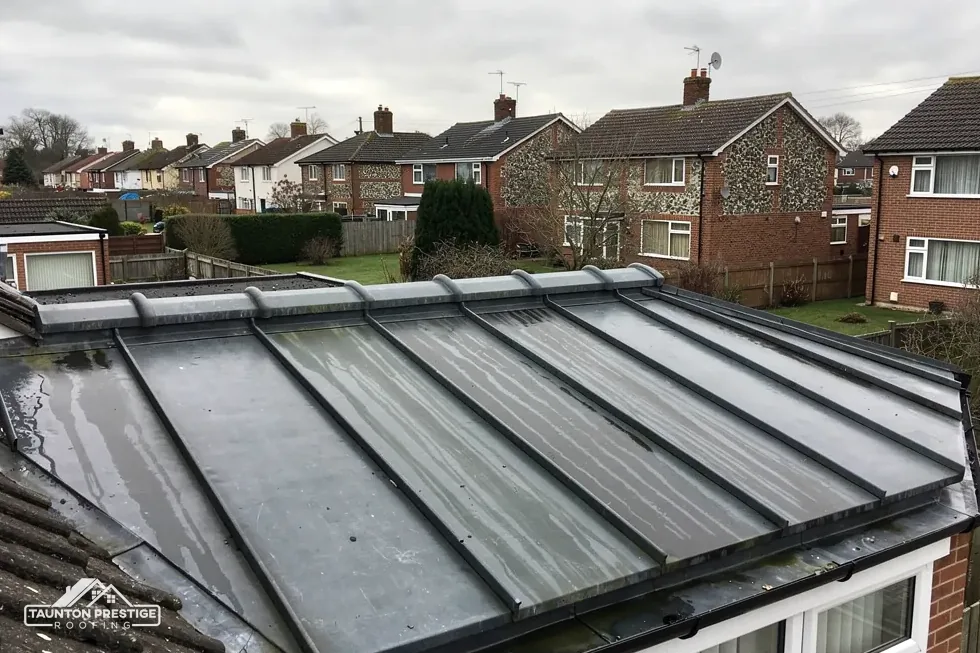
Flashing is the roofer's word for a strip of waterproof material that seals the joint between a roof and something that sticks up through it or runs alongside it. Chimney stacks, side walls, dormers and bay windows all create joints like this, and water will find any weak spot in them. Lead has been the usual material for centuries because it is soft enough to be shaped into corners and tough enough to last.
Roofers talk about flashings as if everyone knew the names, and the names do vary between trades. This guide goes through the main pieces one at a time: soakers, step flashings, aprons, cover flashings, back gutters, dormer cheeks and valley gutters. For each we explain what it does and where on a Taunton roof you are likely to spot it. If you can name the part that is leaking, a conversation with any roofer gets shorter and clearer. It belongs to our wider lead work section.
Soakers: the pieces you cannot see
Picture a soaker as a flat lead tab folded into an L. One leg of the L lies on the roof beneath a slate or tile, and the other climbs up the wall or stack. They are fixed one per course of slates, interleaved with the covering like pages in a book, and the lead flashing above them hides the top edge.
Because soakers are tucked under the slates, you rarely see them. You only know they are there when a leak appears beside a gable wall or chimney and a roofer lifts a slate. Soakers are cut from the thinnest codes of sheet; Royston Lead's brochure lists code 3 for soakers only and code 4 for soakers as well as flashings, at 1.32 mm and 1.80 mm thick.
Where do you find soakers on a house?
Wherever a slate or tile roof runs up against a wall. That means the side of a chimney stack, the edge of a gable wall and the junction where an extension roof meets the house. On a slated Victorian or Edwardian terrace you may find them along the party walls between houses. Other coverings call for other methods, so a roofer reads the roof before choosing.
Our page on lead codes sets out the thickness and weight for each grade, if you want to see the table. A soaker that has slipped, split or rusted its fixings is hard to spot, which is why a leak beside a wall so often proves to be a soaker problem.
Step flashings and cover flashings
Where a sloping roof runs up to a wall that climbs with the pitch, such as a gable end or the side of a chimney, the join steps up in line with the brick courses. A step flashing follows it. Each stair of lead is tucked into the mortar joint above the soaker below, so the soakers shed water onto the roof while the step flashing covers the joint between the soaker and the wall.
A cover flashing does a similar job at a different height. It hangs down over the top of another piece, for example the upturned leg of a soaker or an apron, to stop water getting behind it. The cover flashing is the lid; the piece below is the tray.
What holds a step flashing in place?
Its upper edge sits in a chase, a slot cut into the brickwork, and lead wedges hold it there until it is pointed. If the pointing perishes the whole run can lift, and that is why the wall matters as much as the lead. Our guide to why sealant won't fix failed lead flashing shows how the joint is made and what happens when it isn't.
Flashings are cut from codes 4, 5 and 6 in the Royston brochure. Thicker codes suit longer, more exposed runs, thinner ones small, well-supported pieces. Which you need depends on the position, which is why we look before we quote.
On a gable end the step flashing, the cover flashing and the soakers often appear together, three layers that all have to be intact for the wall to stay dry. Repairing one while another has failed leaves a path for water.
Aprons: the lead at the foot of a chimney
An apron flashing is a single piece of lead that lies across the front of a chimney stack, or the bottom of any upstanding wall, where the roof slopes down away from it. It runs from the wall down over the slates or tiles below, shedding the water that runs down the face of the chimney onto the roof and away.
The top edge is chased into the masonry in the usual way. At each end it turns around the corner to meet the step flashings along the sides. That turn is the weak point of many chimneys: the corner has to be folded, not cut, and a split at the fold lets water run behind the lead.
How do you spot a failing apron from the ground?
Look at the front face of the stack, where it meets the slope. A bright slit above the lead, a lip that curls away from the brick or a dark streak running down from the joint is a warning. A stain on the ceiling directly below the chimney is a stronger one.
Aprons are also found at the foot of a dormer's front face, and where a lean-to extension roof meets the main house wall. In each case the principle is the same: the lead sheds water forward, away from the wall, onto the covering.
Binoculars from a safe spot on the ground show more than most owners expect.
Where the stack is wide, the apron may be made in two pieces with a lapped joint, and that lap is another place to look. A roofer checks that the upper piece sits over the lower and not the other way round.
Back gutters and dormer cheeks
A chimney stack sits in the middle of a sloping roof, so water running down the slope hits it and has to go somewhere. On the uphill side, the answer is a back gutter: a small lead-lined channel behind the stack that collects the water and carries it round both sides to the slope below. Royston lists codes 4 to 8 for pitched valley gutters, and a roofer picks the grade for a back gutter on the same logic: the wider the channel, the heavier the sheet.
Where the back gutter meets the side flashings, the lead is folded at the corners to turn the water round the stack, and those folds are the parts that crack first. A good back gutter has a clear fall so water does not stand behind the chimney.
What are cheeks?
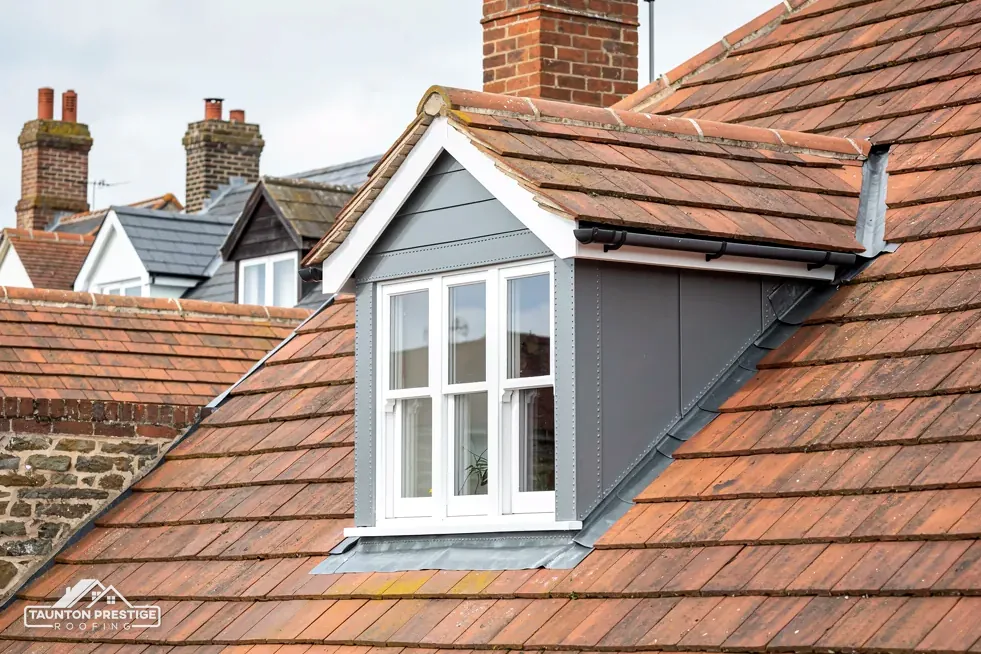
The cheeks of a dormer are its two side walls. They are often covered in lead, cut from the middle codes, and joined to the main roof by flashings. Dormers appear against codes 4 to 8 in the Royston table because several elements of different thickness meet in one small structure.
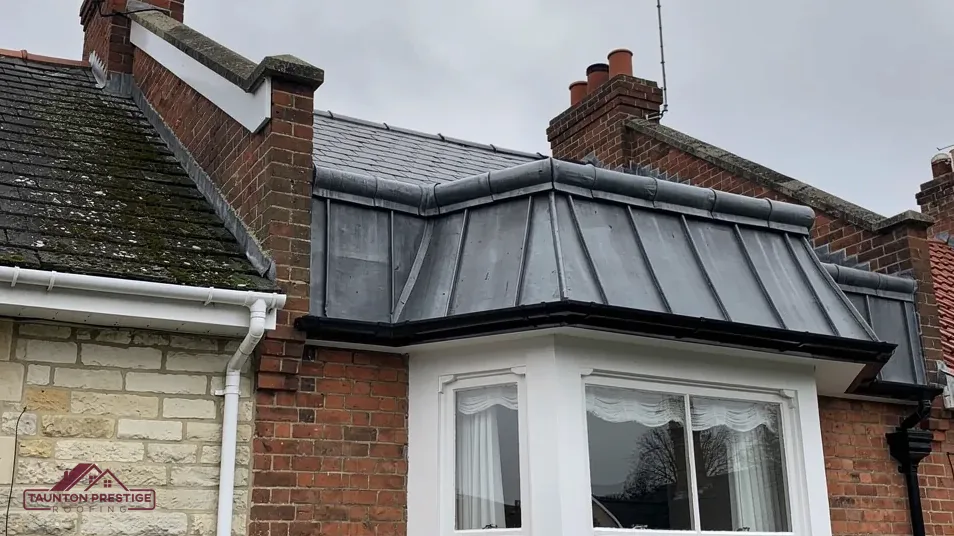
On a Taunton house with a bay or dormer, the cheeks, apron and flashings are all lead and all meet at the corners. When we survey, we trace the water path through each piece, not just the one that is leaking. Our page on lead on bay windows and dormers follows the same trail.
Valley gutters and parapet gutters
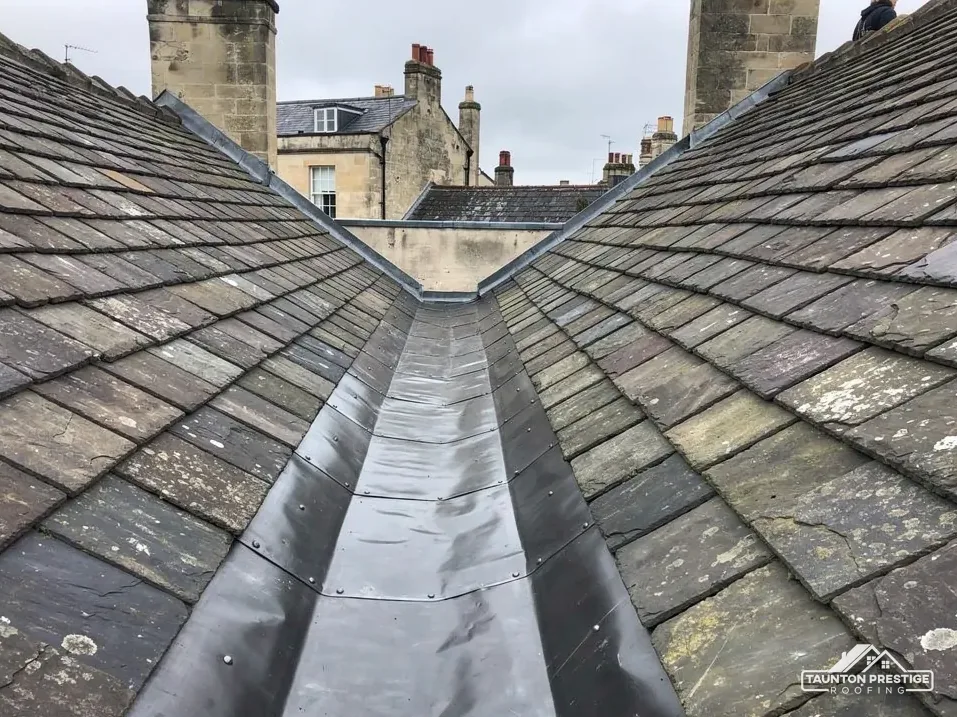
In roofing, a valley is the inside angle formed where two sloping planes join. A lead valley gutter lines it, so the water from both slopes runs down the middle onto the lower roof or into the guttering. The slates or tiles on either side overlap the edges of the lead, leaving a strip of exposed metal in the middle.
The Royston brochure lists pitched valley gutters against codes 4, 5, 6, 7 and 8, and the heavier codes tend to be used for wider valleys and longer runs. MyJobQuote's guide gives around £540 as the typical UK average for a full valley (MyJobQuote, Sep 2026).
What is a parapet gutter?
It is a lead-lined channel behind a low wall, called a parapet, at the edge of a roof. It is common on terraces where the party walls rise above the slates, and on larger old buildings. A box gutter is a similar channel hidden between two roofs or alongside a wall. Both take a lot of rainwater, so the brochure lists them against codes 5 to 8 only.
Gutters of this kind are hard to inspect from the ground, and a blocked outlet at the end can send water back over the edge into the building. That is why a roofer checks the outlet as carefully as the lead.
Standing water in a gutter is a sign that the outlet or the fall needs attention.
Putting it together on your own roof
Now the names are clear, you can walk round a house and read it. Start at the chimney and look for the apron at the front, the step flashings down the sides and the back gutter behind. Check where a side wall meets the roof for steps and soakers. Look at the bay or dormer for cheeks, aprons and the lead on the roof above. Finally look along the valleys.
Which flashing fails first?
There is no fixed order, but the joints that take the most weather and the most movement give way first. Corners, the ends of aprons and the top edges where pointing has perished are the usual places. The metal itself is often fine. Lead can last for over 80 years (MyJobQuote), and a failure is generally in the joint.
When you ring a roofer, describe the leak by position. "The stain is below the chimney, on the front slope" tells a roofer to look at the apron and front corners first. "Water drips beside the party wall" points to step flashings and soakers.
Take photos of any stain inside, with a note of the date and the weather. They help a roofer find the entry point faster.
At survey we show you photos of each piece on your roof and name them as we go. Knowing the names also helps when you read a quote: you can check that each element on your roof is covered by the work.
Lead flashing questions
What does lead flashing actually do?
It closes the gap between a roof and a chimney, wall, dormer or bay. Water that runs down the roof or the wall is shed over the lead onto the covering instead of finding a way into the house. Each piece in the family has a different place in that path.
How do a soaker and a flashing work together?
A soaker is a small L-shaped piece laid under each slate or tile, and the flashing sits above it, tucked into the wall. The soaker sheds water onto the roof, and the flashing covers the joint between soaker and wall. They work as a pair along gables and chimneys, and a failure in either lets water in.
Can I tell which flashing is leaking from inside?
Sometimes. A stain just below a chimney points to the apron, back gutter or step flashings, and a stain along a party wall to the soakers and steps. It only narrows the search. Water travels along timbers, so a roofer checks the whole run, and the loft side as well as the outside.
More on this subject: Lead work in Taunton