Ask three people what makes a good lead job and you will hear about skill, detailing and fixings. Ask a roofer to order the sheet and the first question is always the same: which code? A lead code is simply a number from 3 up to 8 that names the thickness and weight of the sheet. A higher number means thicker, heavier lead, and thicker lead is chosen where the sheet has to span more, take more movement or carry more water.
The code matters because the wrong one fails in a predictable way. Lead that is too thin for a valley gutter, the trough where two roof slopes join, will crease and split as it warms and cools. Lead that is far heavier than a small flashing needs costs more and is harder to dress tight into a chimney corner. This guide sets out the codes in a table, shows which jobs each one is put to, and explains how a surveyor or roofer decides. It forms part of our wider lead work pages, written with Taunton roofs in mind.
What a lead code really tells you
Lead sheet is described by a code number rather than by a thickness in millimetres, because the code also fixes the weight. Each code covers a thickness in millimetres and a weight in kilograms per square metre, and the pair stay linked: when you know one you know the other. Manufacturers also give each code a colour, which makes it easy to see at the merchant or on a delivery that the right grade has arrived.
Royston Lead publishes the figures in its cast-lead brochure, and the table in the next section uses them. Other makers may differ a little, so a roofer should always read the data sheet for the product actually being fitted.
Is a higher code always better?
No. A higher code is thicker, but thicker is not automatically right. Lead is heavy: code 8 weighs 40.26 kg for every square metre, nearly three times as much as code 3 at 14.97 kg. Over a large flat area that adds real load, and a roofer working on an older timber roof has to think about what the structure can carry. On a narrow soaker, extra thickness only makes the metal stiffer to bend around a slate.
The aim is the lightest code that does the job without stress, set against how wide the sheet is, how much it can move and how hard water will run over it. Those three questions drive every choice in the rest of this guide.
A short word on the term itself: when roofers say lead "code" they mean the numbered grade of rolled sheet. It is not a regulation and it is not a code of practice, so there is nothing to look up in a statute. It is a trade shorthand with figures behind it, and the figures are what a roofer carries in their head when they look at a roof and name a grade.
Codes 3 to 8: thickness, weight and colour
Here are the six codes in the Royston Lead brochure. The last column shows the uses Royston lists for each, in plain words.
| Code | Thickness | Weight | Colour | Listed uses |
|---|---|---|---|---|
| 3 | 1.32 mm | 14.97 kg/m² | Green | Soakers only |
| 4 | 1.80 mm | 20.41 kg/m² | Blue | Soakers, flashings, pitched valley gutters, dormers |
| 5 | 2.24 mm | 25.40 kg/m² | Red | Flashings, dormers, parapet and box gutters, tapered valley gutters, pitched valley gutters |
| 6 | 2.65 mm | 30.05 kg/m² | Black | Dormers, flashings, parapet and box gutters, pitched valley gutters, tapered valley gutters |
| 7 | 3.15 mm | 35.72 kg/m² | White | Dormers, parapet and box gutters, tapered valley gutters, pitched valley gutters |
| 8 | 3.55 mm | 40.26 kg/m² | Orange | Dormers, tapered valley gutters, parapet and box gutters, pitched valley gutters |
How do you read the table?
Run your eye down the thickness column and you see each step adds roughly half a millimetre, give or take. The weight climbs with it. The uses column shows the pattern: the thin end is for small pieces that tuck under slates, the middle codes cover flashings that run along walls, and the heavy end is kept for gutters and for roofs where the lead is the weatherproof layer itself.
Notice that code 3 appears for soakers only. It is the lightest sheet in the range and the brochure does not list it for anything bigger. If a quote or a repair note mentions code 3 on a chimney flashing or a valley, that is worth a question.
Which code for soakers and flashings?
A soaker is a small, flat piece of lead bent to an L shape. One leg lies on the roof and sits under a slate or tile; the other leg runs up the face of the wall or stack. Soakers are interleaved with the slates, course by course, and that is why they are cut from the thinnest codes. The brochure lists code 3 for soakers only and code 4 for soakers as well as for flashings, so these two are the working grades for the job.
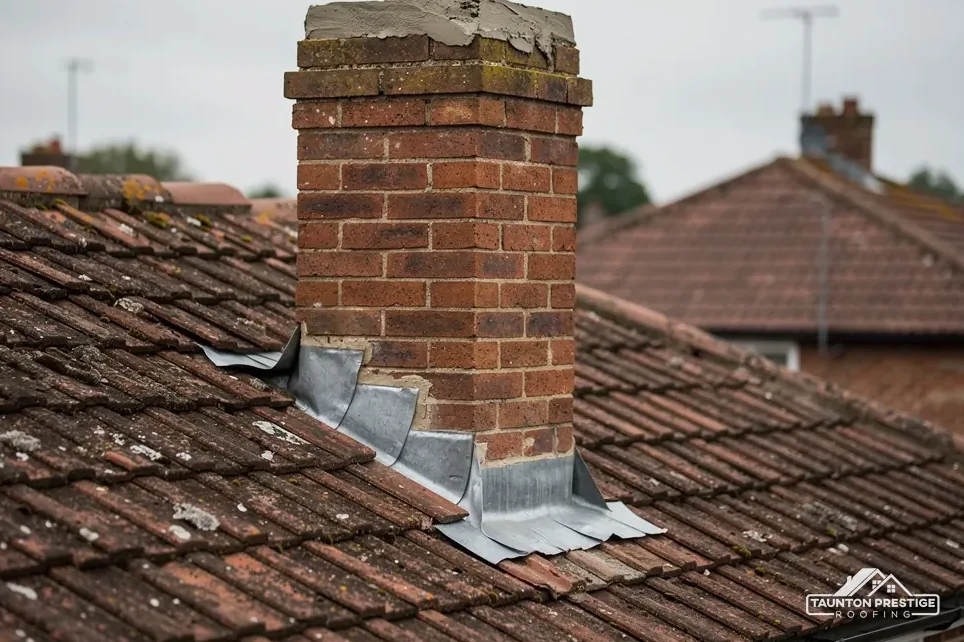
Where a roof meets anything that rises out of it, such as a chimney stack, a gable wall or a dormer cheek, a flashing is the lead laid across that join to keep water out. A step flashing follows a sloping wall in a staircase of small steps. An apron flashing runs along the foot of a wall or chimney. A cover flashing hangs over the top of another piece to stop water getting behind it. You can read more in our page on the types of lead flashing.
Why does the flashing code go up from 4 to 5 or 6?
The brochure lists codes 4, 5 and 6 for flashings. The lighter code suits short, well-supported runs. The heavier codes suit longer pieces, exposed positions and walls where the lead has to hold its shape for decades without sagging. Code 4 is the lightest grade the brochure lists for flashings, and a roofer thinking about a long run along a gable end may well reach for something thicker.
If you want to check a job, ask your roofer to name the code. Talk of "lead" alone leaves the thickness open, and thickness is exactly what you are paying for.
Valleys, gutters and parapets
Water collects wherever lead forms a channel, and the codes rise to meet it. The brochure puts pitched valley gutters, parapet gutters, box gutters and tapered valley gutters in the middle and upper codes: pitched valleys from code 4 upward, and the gutters behind parapet walls from code 5 upward.
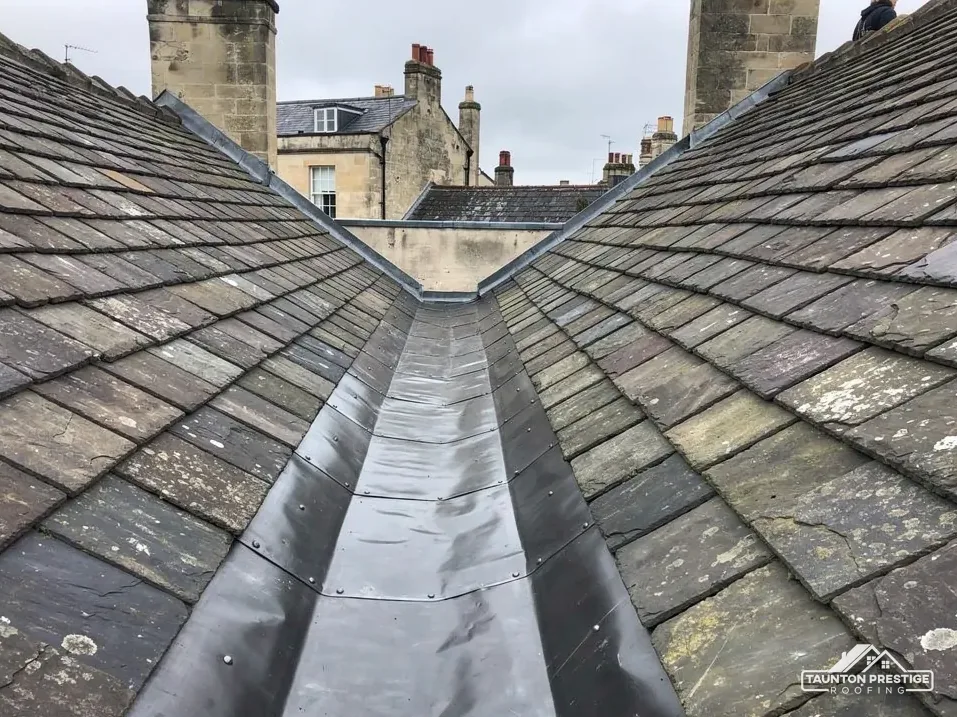
A pitched valley gutter is the lead-lined trough where two sloping roofs meet at an angle. A parapet gutter sits behind a short wall at the edge of a roof and sends the water away to a downpipe. A box gutter is a rectangular channel lined with lead, often hidden between two roof slopes or between a roof and a wall. A tapered gutter is built with a changing width so that water is shed along its length.
Why use heavier lead in a gutter?
Because the lead is doing more. A flashing is protected by the slates or masonry above it. A gutter takes the rainwater of a whole roof, it can hold standing water after heavy rain, and builders and cleaners step into it. The extra metal in codes 5 to 8 gives it a longer life under that wear and more resistance to creep, the slow downhill stretch of lead as it warms and cools.
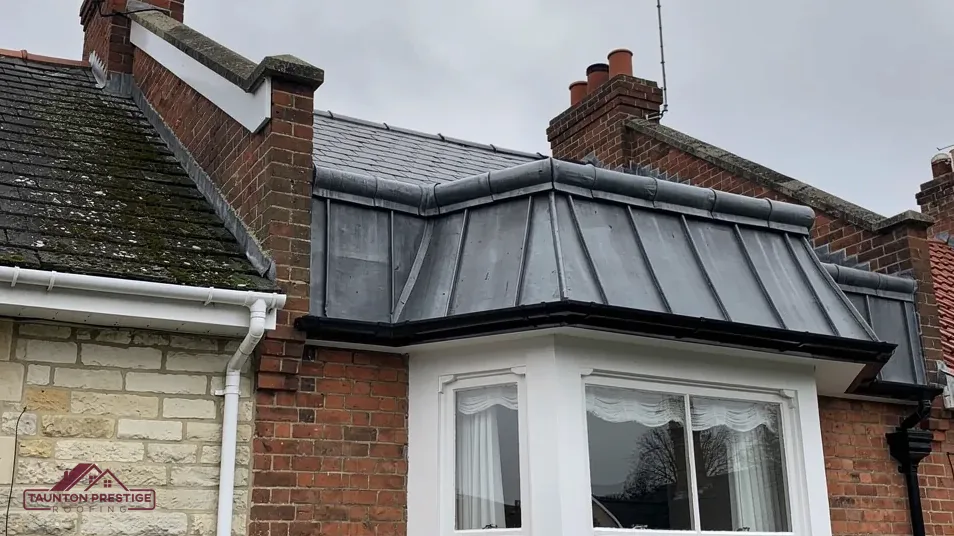
Many older Taunton houses with valleys, chimneys and bay windows carry lead in all these positions. Our guide to lead on bay windows and dormers shows how several of these elements sit together on one property.
Dormers, flat lead roofs and cheeks
Dormers appear against codes 4, 5, 6, 7 and 8 in the brochure, which is the widest spread of any use. That makes sense, because a dormer holds several different lead elements at once. The flat or low-pitched roof on top, the cheeks down each side, the apron at the front and the flashings where it meets the main roof can each call for a different thickness.
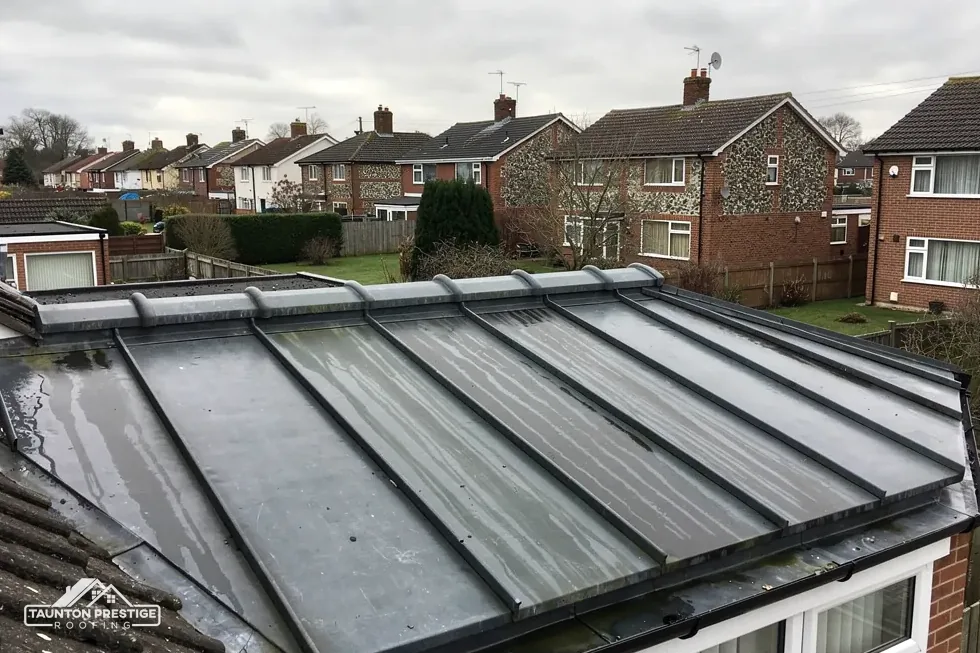
The cheeks are the vertical side walls of a dormer. They are often lead-clad and are cut from the middle codes. The top of a dormer or a bay is nearer to a small flat roof. There the lead is the weatherproof layer, not just a trim, and the heavier codes come into play.
Can a flat lead roof be done in the same code as a flashing?
Not sensibly. A flashing tucks into a wall and gets cover from the slates above. A lead-covered bay roof has to deal with rain, sun and foot traffic across the whole sheet, and it is laid in bays, or panels, with rolls or drips that allow for movement. The roofer measures the width of each bay and chooses the code and the joint spacing together.
BS 6229:2025, the flat roof code of practice, covers flexible waterproof membranes. Lead sits outside its scope, so a lead roof is specified some other way.
For the flat roofs themselves, the lay-out of falls, drips and rolls is decided on the day, once the deck is open and the roofer can see what the carpenter left. A good price allows for that, so the structure is checked at survey.
Choosing a code and its effect on price
The code is set by four things: the job, the width of sheet, the exposure and the structure underneath. A roofer reading a chimney checks how long and how exposed each flashing is. On a valley they measure the gutter width and the pitch of the roof. On a flat or dormer roof they set out the bays and look at the deck. Only then does a code go on the order.
Does a thicker code cost more?
Yes, because lead is sold by weight and a heavier code simply contains more metal. The sheet is only part of a leadwork bill, though. Access is the swing factor: MyJobQuote's guide to chimney leadwork gives a typical UK range of £350 to £920 for a full replacement, depending on scaffold (MyJobQuote, Sep 2026). Our leadwork cost guide goes through the figures.
What should you ask for?
- The code for each type of lead on the job, named in the survey notes.
- Which parts are soakers, which are flashings and which are gutters.
- Whether any existing lead is being kept, and why.
- How the lead will be fixed, since fixings matter as much as thickness.
Photos of the finished work, taken before the scaffold comes down, are a useful record for the next owner of the house. We show our customers pictures of their own roof at survey stage, so the code, the position and the reason for it can all be pointed to. A plain-English answer about each code is a fair thing to expect from any roofer, and it costs them nothing to give.
Lead code questions
Which lead code is used for a chimney flashing?
In the Royston Lead brochure, flashings are listed against codes 4, 5 and 6. Which one a roofer picks depends on how long and how exposed the run is. Soakers sit under the slates and are cut from code 3 or 4, so a chimney often carries more than one code.
Does a higher lead code last longer?
A heavier code gives more metal to wear and more resistance to movement, so it suits gutters and flat areas. It is not a promise of life. Lead can last for over 80 years (MyJobQuote), a lower bound that depends on the detail, the fixings and how well the roof is looked after.
Can I see the lead code once the job is finished?
Not easily, since the sheet is dressed into place and the colour coding is on the roll, not the roof. That is why it helps to have the code for each element written in the survey notes alongside your photos before the work starts.
More on this subject: Lead work in Taunton