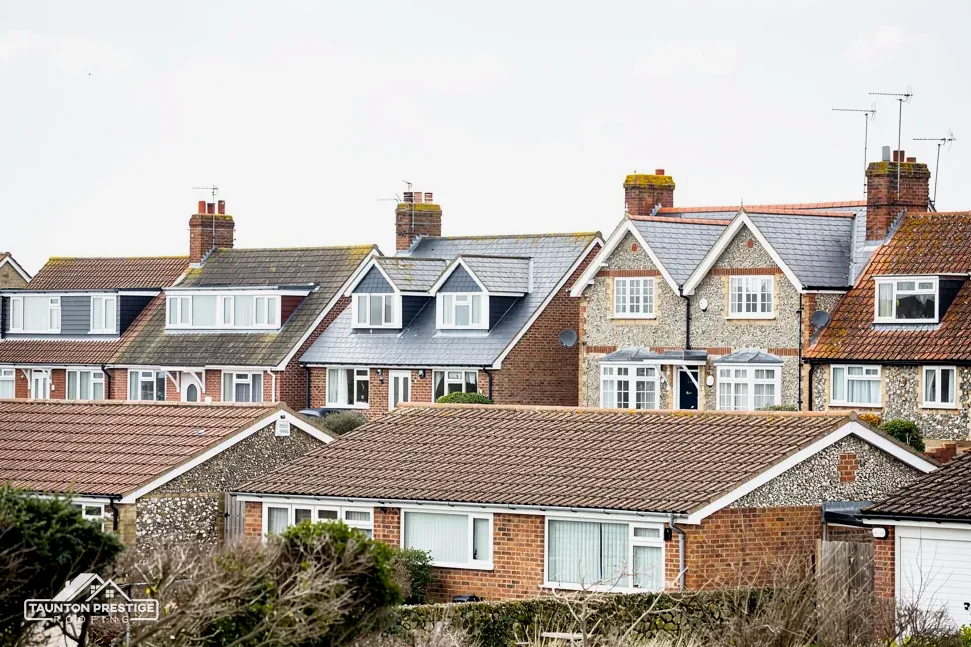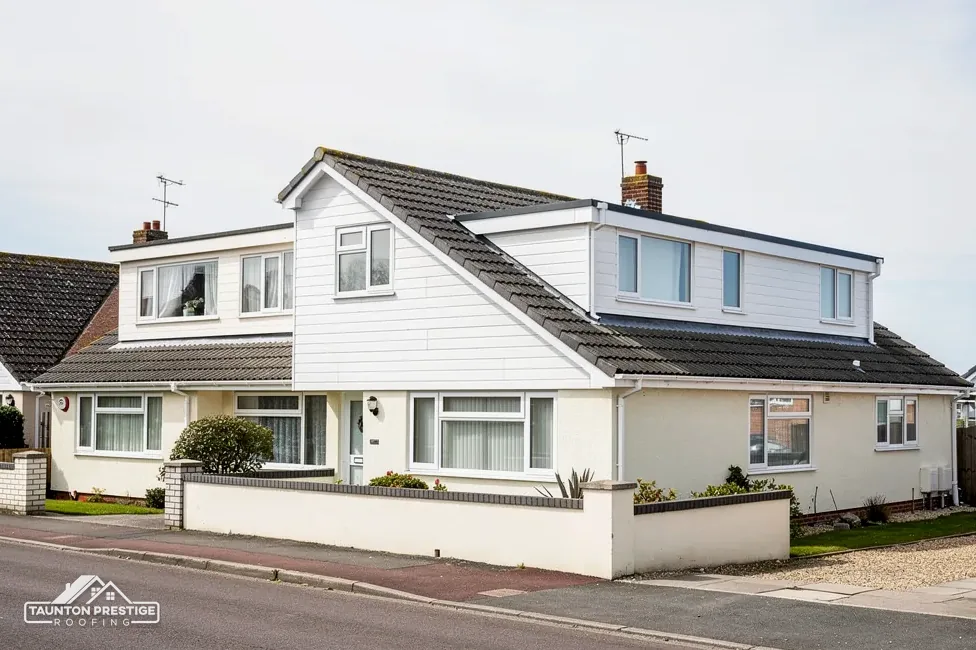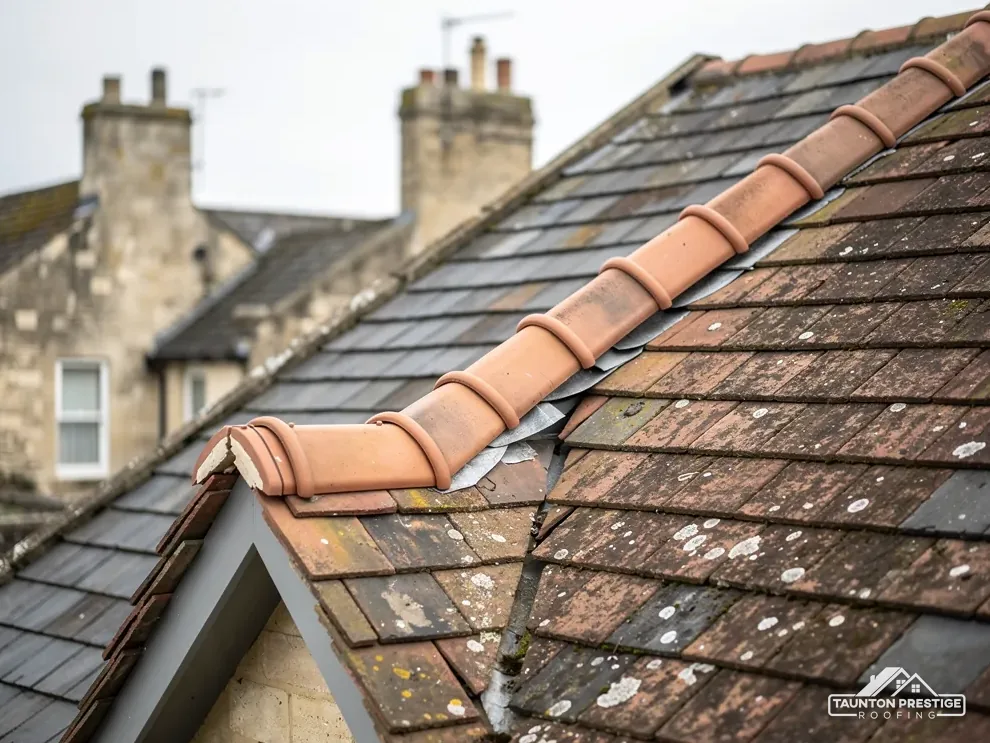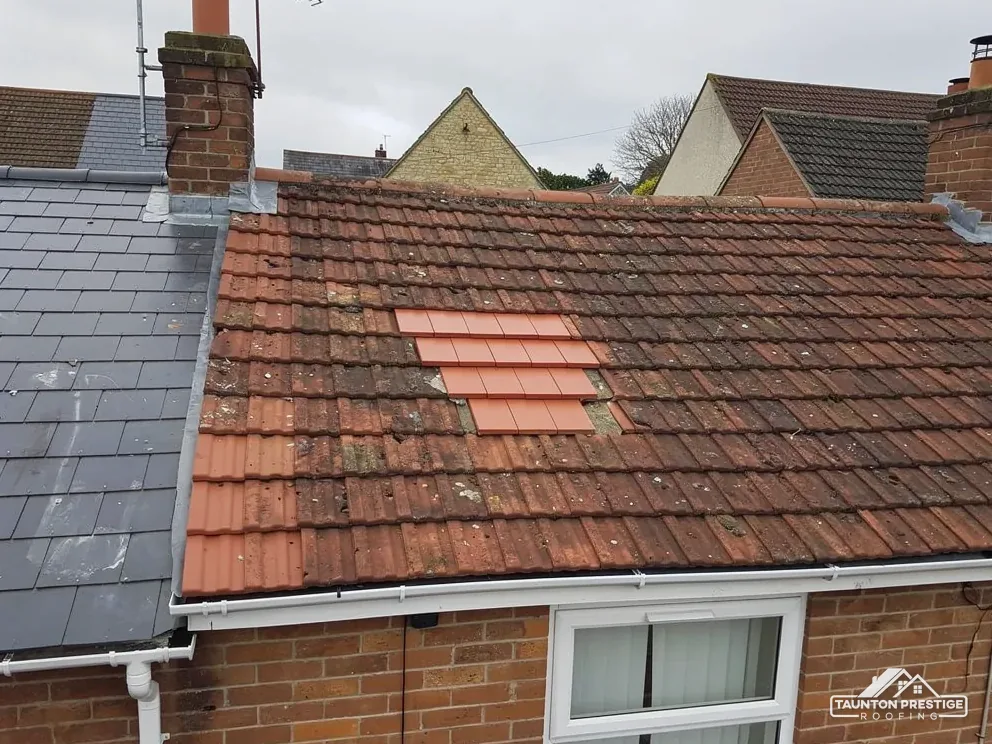
Look along a Somerset street and the roofs are not all cut from the same pattern. Some are made of small flat tiles laid in overlapping rows. Some are broad tiles with soft curves across each one. Some show a long wave running from the eaves to the ridge. These are different profiles, and a profile decides far more than the look. It sets how steep the roof must be, how the tiles lock together, and which tiles can ever sit beside each other.
This guide describes plain tiles, Double Roman tiles and pantiles, gives the manufacturer's minimum pitch for each, and says where each one suits. It also explains why a slope has to stay in a single profile, which is the point that catches people out when they try to patch a roof with tiles from a builders' merchant. It sits within our pitched roofing work, next to the guide to minimum pitch for roof tiles.
What the three profiles look like
A profile is the cross-section of a tile: the shape you would see if you sliced one through the middle. It governs how rain runs off and how one tile overlaps the next.
What is a plain tile?
The plain tile is the small one: flat, rectangular and bowed very slightly along its length, so that the tail of each tile lifts clear of the course below it. Laid correctly, every part of the slope is covered by at least two thicknesses of tile. Plain tiles are made in clay and in concrete. Old clay ones were shaped by hand and vary from tile to tile in colour, which gives a well-worn roof its soft, uneven texture and is the quality people mean when they say a roof has character. Each carries a couple of small nibs that hook over a batten, the timber strip it hangs from.
What is a Double Roman?
A Double Roman is a big tile that locks into its neighbours, and its face carries two broad curves side by side across the width. Because each tile is big and locks into its neighbour along the edge, fewer are needed to cover a square metre, and the finished roof reads as wide horizontal bands of light and shadow.
What is a pantile?
A pantile has a single S-shaped wave. Laid side by side, the waves overlap and make a continuous ripple from eaves to ridge. Pan tile is the old name for it, and a Bridgwater heritage leaflet lists pan tiles among the things the town's yards made by hand alongside plain tiles and ridge tiles.
Minimum pitch for each profile
Pitch means how steeply the roof rises, as an angle taken from level. Each make of tile carries its own minimum pitch, the shallowest rise at which its maker will stand behind it. Below that angle, water can creep sideways and backwards under the laps instead of running down, particularly when wind drives rain at the roof.
| Tile | Minimum pitch |
|---|---|
| Concrete plain tile | 35° |
| Concrete Double Roman, smooth | 22.5° |
| Clay Lincoln pantile | 15° |
| Clay Canterbury | 40° |
| Clay Ashdowne | 35° |
Marley's other clay ranges, Hawkins and Acme Single Camber, are listed at 30°. These figures belong to the named Marley products. Another maker's Double Roman or pantile may differ, so the maker's data sheet for whichever tile is going on your roof is what counts. A merchant can supply it, and we ask for it before ordering.
Notice how wide the spread is. The distance from 15° to 40° is the distance between a barn lean-to and a steep gable, and that is why one profile cannot simply stand in for another. When a covering is renewed, the pitch is measured again and not assumed from the old tiles.
How steep is my roof?
You can get a rough reading from a phone app held against a rafter in the loft, though a roofer measures it properly at the survey. The number matters because it sometimes rules a tile out. A shallow rear extension, a porch or a dormer cheek may be too flat for a plain tile that is perfectly right for the main roof beside it.
Where each profile suits
Pitch does most of the choosing, so it is worth knowing before you shop for tiles. Plain tiles need a steep roof, 35° for the Marley concrete plain tile and 30° to 40° for the clay ranges above. They suit steeper main roofs, tall gables and the pitch of an older house. Their small size also lets a roofer take them round hips, valleys and awkward curves without cutting every one.
The Double Roman manages from 22.5°, so it suits the moderate pitch of a common semi or bungalow roof, and its large size covers ground quickly, which can shorten the time the roof is open to the weather. The clay pantile at 15° is the shallowest of the three. It makes sense on a low-slung outbuilding, a farm barn or a lean-to where a plain tile would fail, and it suits the long, simple roof lines of agricultural buildings.
Does the choice affect how long the roof lasts?
Material matters more than profile for lifespan. For clay tiles, the BRE sets a minimum life expectancy of 60 years, a figure that applies to clay alone. On old peg tiles, buildingconservation.com warns that the 60-year number is no dependable guide, since hand-made tiles vary so much. Concrete is a separate case, and Marley's own page on tile life is the place to read about it.
Local matching often outweighs all of this. A street built in one tile looks best repaired in that tile, and in a conservation area the council will expect it. Listed houses go through listed building consent when the work changes how they look. Our guide to how long a tiled roof lasts goes further into age and wear.
Somerset's own clay tile heritage
Tiles were a local product here, not only a local sight, and the evidence is in the museum and the archives. South West Heritage Trust says Bridgwater turned out bricks, tiles and plaques in terracotta in great variety, and that this output shaped the appearance of Somerset towns. The trust runs the Somerset Brick and Tile Museum on the old Barham Brothers' yard on East Quay, where one kiln was last fired in 1965 and is now a Scheduled Ancient Monument.
A Bridgwater heritage leaflet adds more detail. It records plain tiles, pan tiles and ridge tiles (known then as crease tiles) being made by hand in the town, and says that the well-liked Bridgwater Double Roman was added to the growing list some years afterwards. It also reports that around 1850 there were 16 brick and tile works within 2 miles of Bridgwater Bridge.
Does a Somerset house have a Somerset tile?
Not necessarily, and we would not guess from the street. Plenty of tile has travelled into the county over the years, and a re-roof or repair may have swapped the original. The reliable route is to examine the tiles, their edges and their nibs, and to compare them with the survey photos from your own roof.
That is why we photograph the covering up close and show it to you before specifying anything. When the original is a clay Double Roman or pan tile, we look for salvaged matches or a close current range, and we explain what a near-miss would look like on your slope.
Why profiles cannot be mixed on one slope
It is tempting to patch a few missing tiles with whatever the merchant has in stock. With a different profile, the patch fails for reasons you cannot see from the ground.
What goes wrong when profiles are mixed?
First, the laps differ. Each profile overlaps its neighbour by a set amount, and gauge, the distance between batten centres, is worked out from the tile length and that lap. A tile with the wrong length breaks the batten spacing, so the course sits proud or sags.
Second, the sides do not interlock. A Double Roman's side channel is shaped to take its own neighbour. Set a pantile or a different Double Roman beside it and the gap lets rain run under the join.
Third, minimum pitch comes into it. A tile suited to 15° is not proven at the angle of a steeper roof, and one rated for 35° will be wrong on a flat extension, so a mixed slope can never be certain to shed water everywhere.
Fourth, the ridge and hip tiles follow the profile. A ridge shaped for a plain tile will not sit properly on a pantile, and the gaps are where wind lifts the tiles.
Fifth, looks. Even where a mismatched tile technically works, the join shows from the road for years, and in a conservation area that alone can draw an objection from the council. Matching the profile is the way to avoid every one of these problems at once.
Our page on roof tile gauge goes through the batten setting-out step by step.
Do you install tiled roofs?
Yes, in clay and in concrete, and in each of the profiles above. A job starts with a survey, so we know what is there before we say what to do.
How do we choose the right tile?
We read the existing profile from the roof itself, measure the pitch and the batten gauge, and check how sound the battens and underlay are. Underlay is the sheet that sits beneath the battens and catches whatever water gets past the tiles. We then walk you through photos of your own tiles and loft, and set out the options in plain terms.
Sometimes the answer is to reuse the tiles. Sound tiles can be stripped, sorted and laid back, with new battens and underlay beneath them, which keeps the roof looking as it always has. Sometimes the answer is new tiles in the same profile, ordered in good time because clay tiles can have a long lead time. Where a profile is no longer made, we look at salvaged stock or the nearest current match, and we tell you plainly what the join will look like.
Clay stays clay where it matters, particularly on older and listed homes and in conservation areas. For a change of profile or of material on a house in one of those, we point you to Somerset Council's planning team for the consent route, or to Exmoor National Park Authority inside the Park.
Fixing matters as much as the tile itself, and a fine tile badly fixed will not stay put through a winter. We fix tiles to the standard in BS 5534, and the ridge and hips are secured mechanically, either with fixings or with a dry-fix system tested to BS 8612, never with mortar by itself.
Questions on tile profiles
How can I tell which profile my roof has?
Stand back and look at the surface. Flat, small tiles in tight rows are plain tiles. Two broad curves on each large tile means a Double Roman. A continuous S-shaped wave is a pantile. A photo of a loose tile, held against a ruler, helps a roofer confirm it.
Can pantiles go on a low-pitched extension?
Some can. Marley lists its clay Lincoln pantile at a minimum pitch of 15 degrees, so a fairly low roof may still be within range. Other makes differ, so the maker's sheet for the exact tile decides, and a survey measures what your roof really is.
Is a clay tile better than a concrete one?
Neither wins outright. The BRE minimum life expectancy of 60 years is a clay figure only. Concrete tiles have their own manufacturers' guidance. The better choice is usually the tile that matches your existing roof, suits its pitch and satisfies any conservation or listing needs.
More on this subject: Pitched roofing in Taunton