Ask five people whether moss ruins a roof and you will get five confident answers. Some say it eats tiles, some say it is harmless, and a few say it is fine because it keeps the roof warm. The truth sits in between, and it depends on where the moss is growing, how thick it has become and what is underneath it.
Moss is a living cushion that soaks up rain like a sponge and releases it slowly. On its own that rarely wears through a sound tile. The trouble comes from what a thick mat does around it: it lifts the edges of tiles, clogs the valleys, which are the sloping channels where two roof slopes meet, and drops clumps into the gutters. It also keeps a damp patch against the roof covering long after the rain has stopped, which matters once the temperature falls. This guide walks through each of those effects, shows you what to look for from the ground, and explains how we deal with it as part of our roof cleaning and moss removal work in Taunton and across Somerset.
What a moss mat is doing on the surface
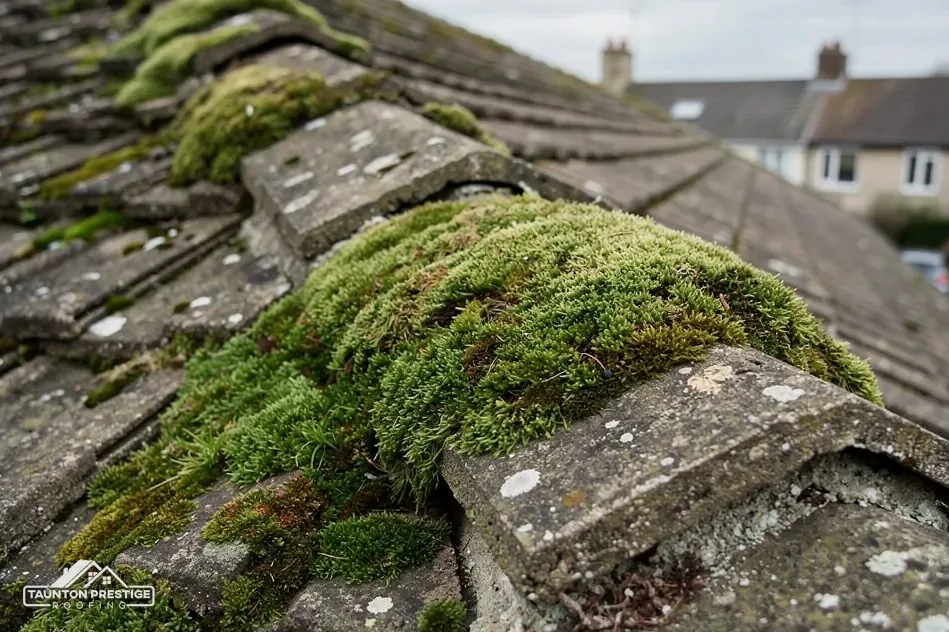
Moss has no true roots. It anchors itself with fine threads that grip the rough face of a tile or slate, and it takes its water straight from the air and from rain. A new patch is a thin green film. After a few seasons it becomes a thick, springy mat, and that is the point at which it starts to matter.
A dense mat behaves like a wet towel laid on the roof. It stays heavy and damp for days after a shower, long after the bare tiles beside it have dried. Where moss spreads across a whole slope, the covering is rarely dry at all through the winter months.
Is the moss itself eating into the tile?
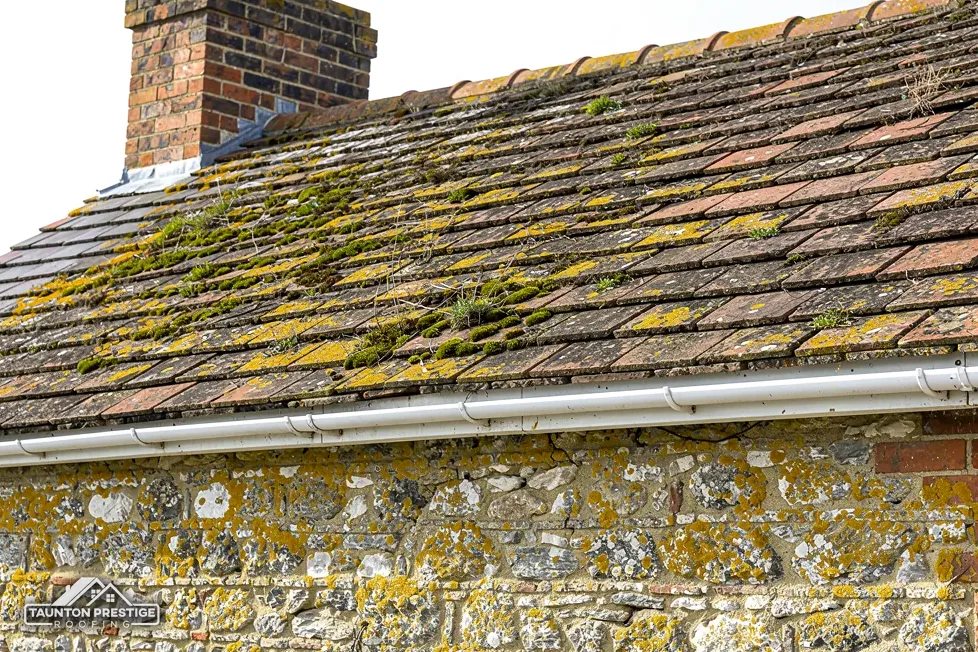
Not in the way people fear. A sound slate or clay tile is hard and dense, and a green film on its face does little harm by itself. Concrete tiles and older, softer clay tiles are more open to the weather, so a constantly wet surface on those is less welcome. The real difficulty is indirect. Moss gives the weather a way in, by holding water where it should run off and by building up in the places where water needs to travel freely.
So the useful question is not whether the moss is alive, but where it sits. A little moss on a flat area of a tile face is a cosmetic matter. A thick mat packed into the overlap between two courses, or into a valley, is a repair waiting to happen.
Lifted tiles and slipped edges
Tiles and slates overlap, so each course sheds water onto the one below. That overlap, called the headlap, only works if every unit lies flat against the one beneath it. When moss grows thickly along the lower edge of a tile, it acts like a wedge. It props that edge up a fraction, and the gap lets wind-driven rain climb higher than the design allows.
The mat also catches on the edge of the course above. When the moss dries out in a spring breeze and shrinks, or when a gull or crow tears a strip away to look for insects, it can drag the tile with it. Tiles held by only a single nail, or by clips that have rusted, are the ones that move first.
What can you see from the garden?
From the garden, look along each slope at a low angle. Courses that should run in dead-straight lines but wave or step are a sign that tiles have shifted. Fragments of tile or slate on a path, or a dark patch on a gable wall below the roof edge, tell the same story.
- Moss bulging at the lower edge of tiles rather than lying flat.
- A tile sitting visibly higher than its neighbours.
- Slivers of broken tile in the gutter or on the lawn.
If you spot those, avoid raking at the moss yourself. Pulling it off can strip the loose tile with it, and a ladder against a slippery roof edge is the wrong place to find out.
Blocked valleys and clogged gutters
This is where moss does its most expensive damage. Picture the dip between two roof slopes that join at an inward corner: that dip is the valley, lined with lead or a made-up trough. Both slopes empty into it as one stream, so it takes more water than any other stretch of the roof, and it has the least room for a blockage.
Moss and the debris it traps, such as leaves and bird droppings, narrow that channel. Water that cannot pass freely backs up and spills over the side of the valley, sliding under the tiles instead of running down them. The leak then appears in a bedroom ceiling nowhere near where the moss is growing.
How does moss reach the gutters?
Rain, wind and birds carry loose moss and its grit down the slope to the eaves, where the gutter is. A gutter is the channel along the lower edge of the roof that takes the water away, and the pipe that drops it to the drain is the downpipe. Moss fragments settle in the bottom of the gutter and form a dam, and once seeds from trees land on the damp pile they sprout there too. Our guide to moss in gutters covers clearing that side of the job, and the page on moss in a roof valley goes through the valley itself.
When a gutter overflows, the water runs down the face of the fascia, the timber board that carries the gutter, and then down the wall below. Timber that stays wet rots, and a wall that stays wet can show damp inside the room. That can do far more harm than the moss on the tiles ever did.
After heavy rain, watch where the water goes. If it pours over the front lip instead of draining to the downpipe, something is sitting in the channel.
Water held against the roof into frost
Water expands as it freezes. A saturated mat of moss pressed against a tile holds a lot of water against that surface, and when a hard frost arrives, that water turns to ice inside and on the face of the tile. Repeated freezing and thawing through a winter can flake the surface of a tile that is already soft or porous.
The effect is gradual, and it varies a lot with the tile. Slate is dense and takes freeze and thaw well. Concrete tiles and older clay tiles are more at risk, particularly at the edges where moisture sits longest. Marley, a major tile maker, advises against powerful jets on roofs, because the force can scour the surface of the covering and shorten its life. That is one reason we never blast moss off. Stripping the protective face of a tile to remove a green film leaves it worse off for the next frost.
Why does the north slope suffer most?
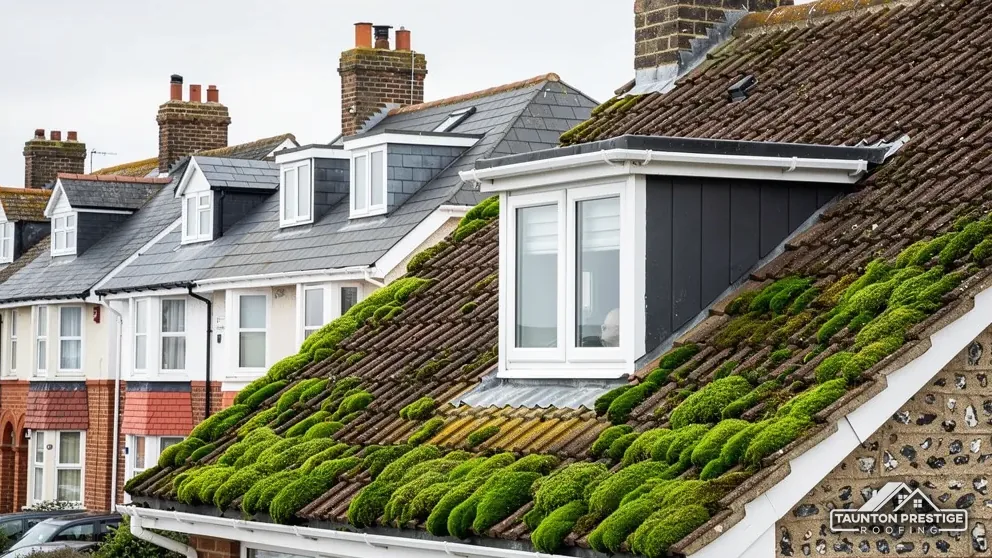
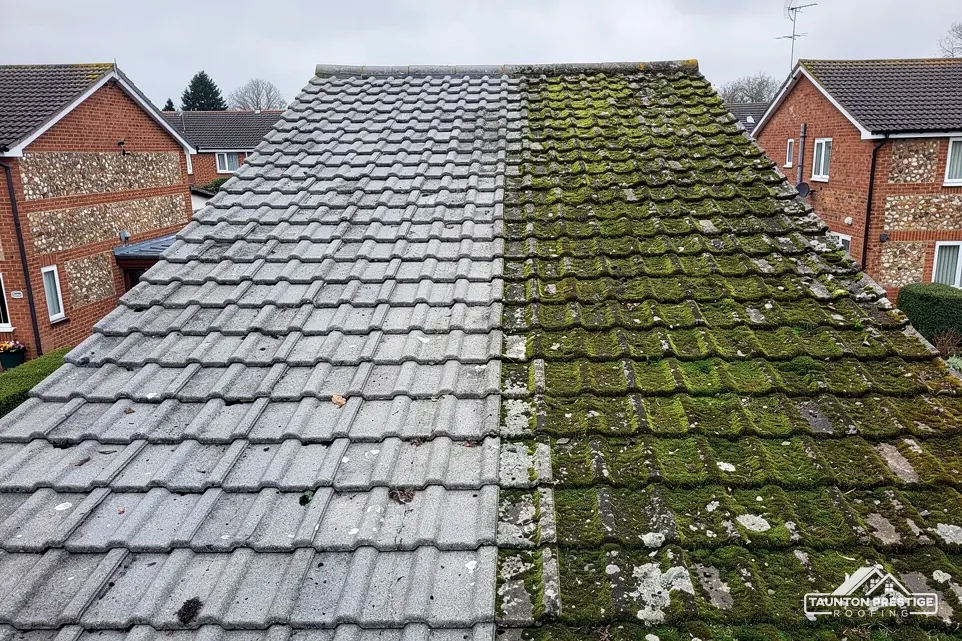
The side of the roof that faces away from the sun stays damp longest, so moss gets a head start there. Frost lingers longer on that side as well. If one slope is green and the other is clean, the shaded one is the one to inspect. Trees overhanging the shaded side make it worse, because they drip long after the rain stops and drop leaves that feed the moss.
Frost also reaches the places where water has been trapped by a blocked valley or a clogged gutter. Ice in a gutter can force the joints apart or crack a brittle section, so a blockage that began as a tidy-up job can turn into a repair.
When it is fine to leave moss alone
Not every green patch needs removing. A light covering on a sound roof, growing on the faces of tiles rather than in the valleys, the gutters or the overlaps, is mainly a matter of looks. Plenty of roofs across Somerset carry some moss from one winter to the next without a leak, and cleaning those on a fixed timetable only spends money.
We would leave it, and say so on the survey, in situations like these:
- The moss is thin and sits on the flat face of well-fixed tiles.
- The valleys, gutters and eaves are clear and draining freely.
- There are no lifted or slipped tiles anywhere on the slope.
- The loft is dry, with no staining under that slope.
When does removal become sensible?
Move from watching to acting once any one of these appears: moss bridging a valley, gutters that overflow, tiles that have started to lift, or water marks on loft timbers beneath a mossy slope. At that stage the cost of waiting is higher than the cost of cleaning, because the next repair will be bigger than the clean.
The other trigger is a roof that is about to be worked on anyway. If a ridge needs rebedding or a chimney needs new lead, the moss is in the way, and clearing it first lets the roofer see the true state of the covering. Scaffold or other access is already up, so the clean adds little to the visit.
A roofer who recommends cleaning every roof, or none, has not read yours. The slope, the tiles and the drainage decide.
Our page on whether roof cleaning is worth it sets out how to weigh that up for your own house.
How moss is removed without harming the tiles
The method matters as much as the decision to clean. We scrape moss off by hand with a soft tool where that is enough, working downhill so nothing is pushed under the courses, and we collect it rather than rinsing it into the gutter. Scraping by hand is slower than blasting, but it leaves the tile face intact and puts the moss in a bag rather than in your drains.
Where a roof needs a treatment to slow regrowth, the product has to be used exactly as its authorisation allows. Biocides are chemicals that kill moss and algae, and the HSE is plain that some are meant for trained professionals only and should be kept away from the general public. It also treats using a product that has no approval as an offence. Check the label and the HSE biocides pages before buying anything off a shelf.
Should the tiles be checked as the moss comes off?
Yes, and this is where cleaning pays for itself. A roof under moss hides cracks, slipped tiles and failed pointing, which is the mortar line along the ridge, the top edge of the roof. Once the surface is clean we photograph the problem spots, so you see the actual condition of your own roof, and we can tell you which are small repairs and which belong in a bigger plan.
Tiles that are lifted, cracked or missing can be dealt with while the ladders or scaffold are in place, so a defect uncovered by the cleaning does not need a second visit to fix. Where the damage is larger than a quick repair, we tell you before any work goes ahead.
Moss damage questions
Can moss make a roof leak?
Indirectly, yes. Moss that fills a valley or sits along the lower edge of tiles can send rain under the covering instead of down it. A leak caused this way often appears in a ceiling some distance from the moss itself, which makes it easy to blame the wrong thing.
Is a little moss on a roof anything to worry about?
Seldom. A thin film on the face of well-fixed tiles, with clear gutters and valleys, is mostly a cosmetic issue. It becomes a concern when it thickens, spreads into overlaps and valleys, or starts to coincide with slipped tiles and damp patches in the loft.
Does moss on the roof make the house colder or damper inside?
A mossy roof does not by itself make the rooms below damp, but if a valley or gutter blocks and water gets in, the loft insulation and timbers can get wet. A survey from the loft and the roof shows whether water is actually coming through.
More on this subject: Roof cleaning and moss removal in Taunton