Cleaning a roof is one of those jobs where the sales pitch and the real need can be miles apart. Some firms knock on doors telling every owner the roof is failing under its moss. Others will tell you moss is natural and to leave it. Neither is a reading of your roof, and neither helps you decide where your money should go.
A fair answer starts with two questions. Is the growth causing a problem, such as water backing up in a channel, tiles lifting or gutters overflowing? And is the roof sound underneath it? If both answers are no, cleaning is mostly about appearance, and that is a perfectly good reason to do it, as long as you know that is what you are paying for. If either answer is yes, cleaning is part of looking after the roof. This guide sets out the cases, the typical UK prices to weigh against them, and how coatings and gutter work fit in. It is part of our wider roof cleaning and moss removal advice for homes around Taunton and across Somerset.
When cleaning protects the roof
There are a handful of situations where we would say cleaning is a sound buy, because leaving the growth in place leads to a larger bill later.
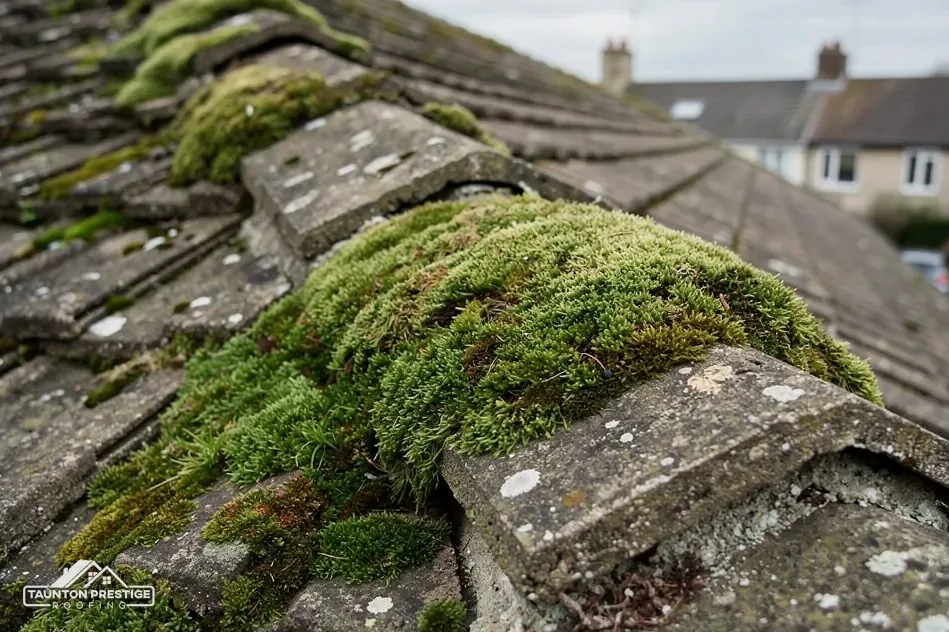
- Moss packed into a valley, the inward-angled channel where two slopes meet, so rain spills over its sides.
- A thick mat along the lower edge of tiles that is propping them up and letting water creep under the course above.
- Gutters and downpipes that fill with fallen moss every few weeks and overflow onto fascias and walls.
- Moss on a flat or low-pitched section, where water has little slope to carry it away.
Does a cleaned roof last longer?
Cleaning does not add years to a covering that is already worn out, and nobody can promise it will. What it does is remove the things that cause avoidable damage: pooled water, ice held against tile faces and overflowing drains. Marley expects its concrete tiles to last around 60 years, and adds that this is a typical figure and no warranty. A roof that drains freely has a better chance of reaching that sort of age than one that spends every winter soaked.
The test is simple. If you can point to the place where growth is changing how water moves across the roof, cleaning has a job to do there. If you cannot, read the next section before you spend anything.
One more reason to act early is access. A roof that is clear of growth is also easier and safer to walk, inspect and repair, because roofers are not working on a slippery, spongy surface. Small repairs found at that stage, such as a cracked tile or a loose ridge, cost far less than the same fault left through another winter.
When it is a cosmetic job
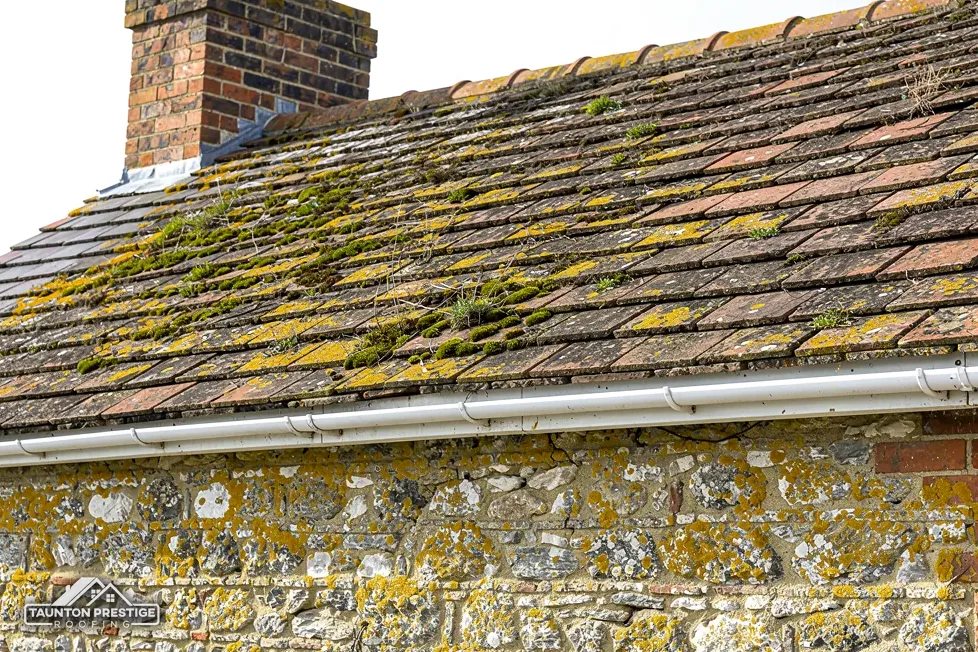
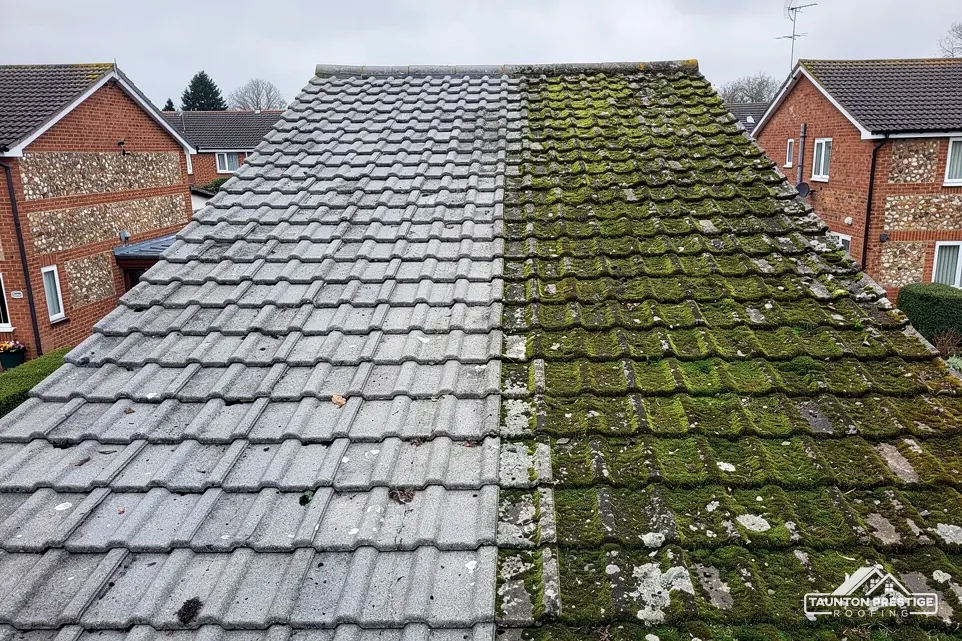
A thin, even layer of green or grey on tiles that are firmly fixed, with clear gutters and no loft staining beneath, is a matter of looks. That does not make it worthless to clean. Buyers notice a mossy roof from the road, and so do neighbours. If the front of your house looks tired because of the roof, a clean can change how the whole property reads.
It just needs describing for what it is. A cosmetic clean is a choice about the appearance of the house, in the same way as repainting a front door, and you should weigh it that way. There is nothing wrong with paying for looks, provided nobody dresses it up as a repair.
How do you tell cosmetic from structural growth?
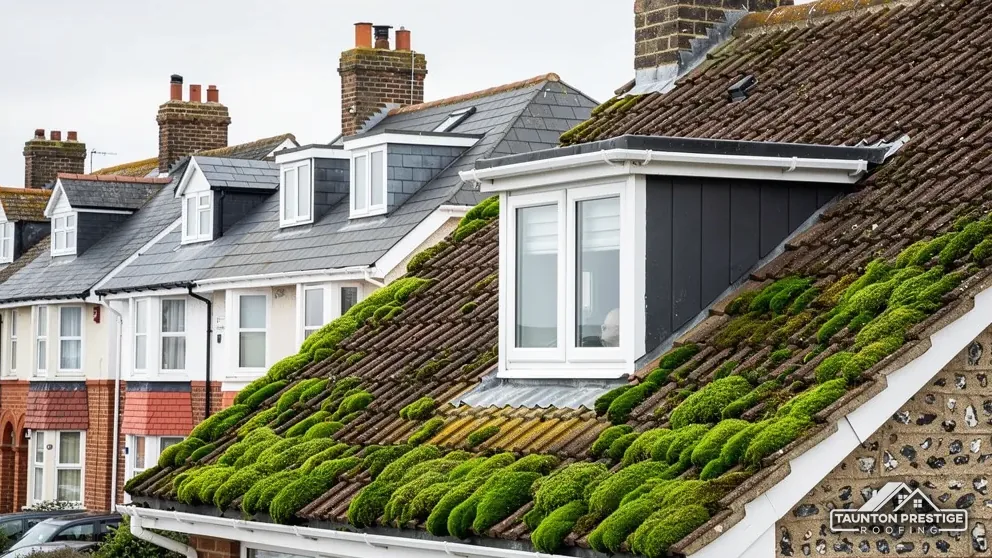
Look at where the growth sits and how thick it is. Thin film spread over open tile faces is cosmetic. A deep cushion bunched along edges, around chimneys or in channels is the kind that interferes with water. Moss lifts tile edges and blocks channels, which is the mechanism that matters.
If you are selling, a clean can be a reasonable step before photographs and viewings, as long as the survey underneath is clean too. A buyer's surveyor will lift the same tiles you would, and a roof that looks tidy but has slipped tiles hidden beneath the green will still be flagged. For that reason the covering gets inspected before any cleaning is quoted.
The same goes for the other direction. A roof sale where the survey flags the roof is a common reason owners ring us, and a clean followed by a short list of repairs often settles the matter better than either one alone.
A clean roof that hides a failing one is the worst result. Always inspect first, and clean second.
What cleaning costs against what it saves
National cost guides give a sense of scale, though your own price depends on the roof. MyJobQuote's roof cleaning guide gives an average of around £475 for a semi-detached house (MyJobQuote, Sep 2026). That is a typical UK figure for a single clean, and the method it prices is not one we would choose for tiles, for reasons the last section covers.
What the figure leaves out is access. MyJobQuote lists a front-elevation scaffold at £550 to £750 for a week-long hire (MyJobQuote, Oct 2026), so a roof that needs a tower or scaffold to be worked on safely can cost more in access than in cleaning. A single storey, or a roof reachable from a safe platform, avoids that.
What is the cost of not cleaning?
Set those figures beside the repair side. MyJobQuote gives an average of around £650 for a general roof repair (MyJobQuote, Oct 2026), and a typical UK range of £1,000 to £1,600 for replacing guttering (MyJobQuote, Oct 2026). If moss has been feeding an overflowing gutter that rots the fascia, or a blocked valley that has soaked the timbers, you are into those figures rather than the cleaning figure.
None of that means cleaning always pays for itself. It means the comparison is worth making roof by roof, with the figures in front of you. What moves a cleaning price is the area of the slopes, their steepness, how thick the growth has become, the access needed and whether repairs turn up underneath. A roof that is steep, tall or hemmed in by trees takes longer and needs more equipment than a low bungalow roof with open ground around it.
The written price follows the survey, so you see the total before you agree to anything.
Coatings, treatments and the regrowth question
Many owners ask whether a coating or treatment is the answer. The straight answer is that it depends on the roof and the product, and that none of them is a one-off cure.
A biocide is a chemical that kills moss, lichen and algae on the surface. The law requires biocidal products to be used as their authorisation sets out. The HSE warns that anything labelled for professional use only must stay out of the hands of householders, and it treats the use of an unapproved product as an offence. A bargain tub from a market stall is no shortcut.
Is a roof coating worth adding?
A coating is a paint-like layer applied to the tiles after cleaning, mainly to refresh the colour and to give the surface a smoother, more water-shedding finish. It can make a faded concrete tile look new again. What it cannot do is repair a cracked tile, replace a failed nail or fix a blocked valley, so it makes sense only on a roof that has already been checked and made sound. Our page on roof coating covers how it is applied and what to expect.
Growth will come back on a shaded slope whatever has been applied, because the conditions that feed it have not changed. Plan for the roof to be looked at again rather than treating a single clean as permanent. A roofer who promises moss will never return is selling something he cannot control.
Whether to coat at all is a fair question to put to anyone who recommends it. Ask what the coating is for, what the roof looks like underneath and what the plan is for the next clean.
Gutters: the part owners overlook
When people weigh up a roof clean, they think about tiles. In practice, the most expensive consequences often turn up lower down, at the gutters. A gutter is the channel fixed at the eaves, the bottom edge of the slope, and moss loosened from tiles lands in it. If nobody clears it, the channel fills.
This is why a roof clean and a gutter clear belong together. Clearing the roof and leaving a full gutter means the first rain washes the remaining debris into the downpipe, the vertical pipe to the drain, and blocks it. Clearing the gutters and leaving the roof means the next shower refills them.
Should gutters be cleared at the same visit?
Yes, where the access allows it. Ladders or scaffold are already in place, and the tiles have just shed whatever they were holding. We also look at the joints, the brackets and the fall of the run, because a gutter that holds standing water has a fault no clearing will cure. Our page on moss in gutters covers that side of the job.
If a gutter has sagged, split or rusted through, replacing it is a separate decision, and the cost guide figure above shows why it is worth catching early. A clean at least gives you photographs of the true state of the run, so you can plan the work instead of reacting to an overflow in January.
Fascias and soffits, the boards under the gutter and under the overhang, show the effects of a long-running overflow as peeling paint and soft timber. Check them from the ground as part of the same look.
How to judge a quote for cleaning
Cleaning attracts more cold-callers than almost any other roof job, because the pitch is easy: your roof is green, we can fix it today. The best protection is to know what a proper job involves.
A good quote tells you the method. Hand scraping and soft washing, which uses low-pressure water, are the approaches suited to tiles and slates. Marley, which makes both clay and concrete tiles, does not back the powerful jet approach, and our page on pressure washing a roof explains why. A firm that proposes blasting the roof is working against the manufacturer's advice.
What should be on the table before work starts?
- The method, and how moss and runoff will be collected.
- Whether the price includes scaffold or other access, and VAT.
- What happens to gutters and downpipes.
- What will be done if cracked or lifted tiles are found.
Ask to see photographs of your own roof before and after. A roofer who does not offer them cannot show you what was done. We show you the condition of the tiles, valleys and gutters as part of the survey, so the decision is yours to make with the facts laid out.
If anyone presses for a decision on the doorstep, say no. A genuine firm can come back after you have had time to think. The Citizens Advice consumer helpline, on 0808 223 1133, can talk through your rights if a contract was signed at home.
Worth-it questions
Is it worth cleaning a roof that only has a little moss?
Often not on practical grounds alone. Thin growth on well-fixed tiles with clear gutters is mainly cosmetic. It becomes worth doing when the moss sits in valleys, bunches along tile edges or keeps filling the gutters, or when the roof is being worked on anyway.
Can cleaning a roof be a waste of money?
It can, if the roof underneath is worn or if the method harms it. Cleaning a roof with slipped tiles and failed pointing only makes the problem easier to see. Methods that scour the surface, such as strong jets, can shorten the life of the covering, so the way it is done counts as well.
Should I clean the roof or replace the gutters first?
Clean the roof first if the gutters are sound, then clear them. If a gutter has already split or sagged, clearing it will not cure the fault, so deal with the roof growth and the failing section in the same plan. A survey shows which one is driving the overflow.
More on this subject: Roof cleaning and moss removal in Taunton