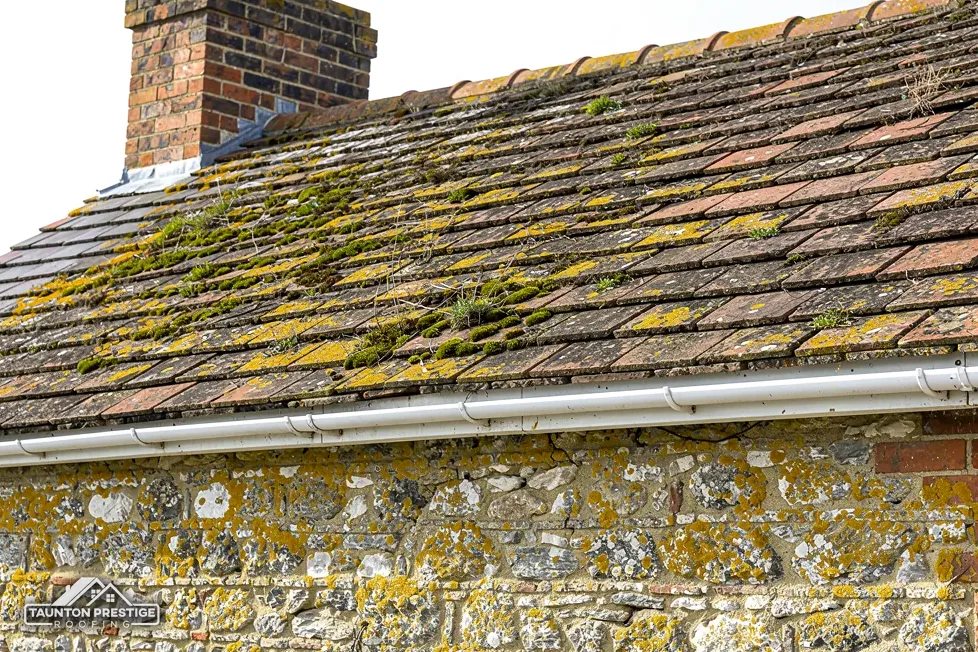
Most owners meet lichen as a rash of pale grey discs, or bright orange and yellow flecks, on the roof they thought was merely dirty. It sits tight against the tile, it does not brush off, and it makes the roof look older than it is. Naturally the first thought is to scrub it away.
Hold that thought. Lichen is a different organism from moss, it grows more slowly, and it rarely does what moss does to a roof. It does not build up thick cushions that block valleys and gutters. It does not lift the edges of tiles. In many cases the tile underneath is no worse for it. Yet there are times when lichen is worth removing, and a handful of ways of removing it that cause far more trouble than the lichen ever did. This guide tells the two growths apart, explains what lichen actually does, and sets out when to act and when to leave a roof alone. It belongs to our wider advice on roof cleaning and moss removal for homes across Taunton and Somerset.
Lichen or moss: how to tell them apart
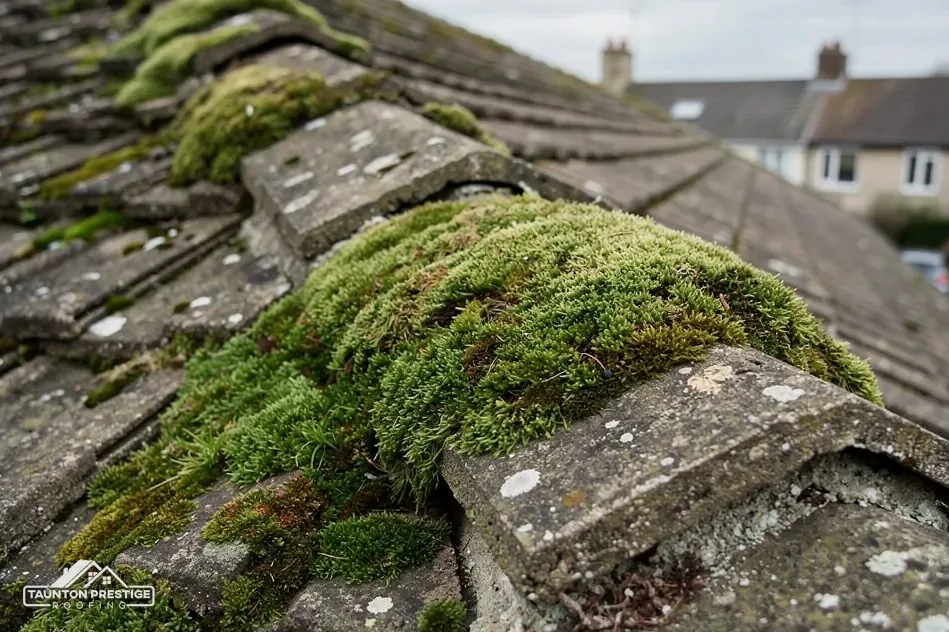
The easiest way to separate them is to touch the patch, or at least to look at it closely from a ladder you can trust. Moss is green and soft, with tiny stems and leaves, and it forms tufts or cushions that you can peel up with a fingernail. Lichen is flat, crusty and firmly attached, as though it had been painted on.
- Moss: green to brown, springy, raised above the tile face, easy to scrape.
- Lichen: grey, white, yellow or orange, flat and crust-like, hard to lift.
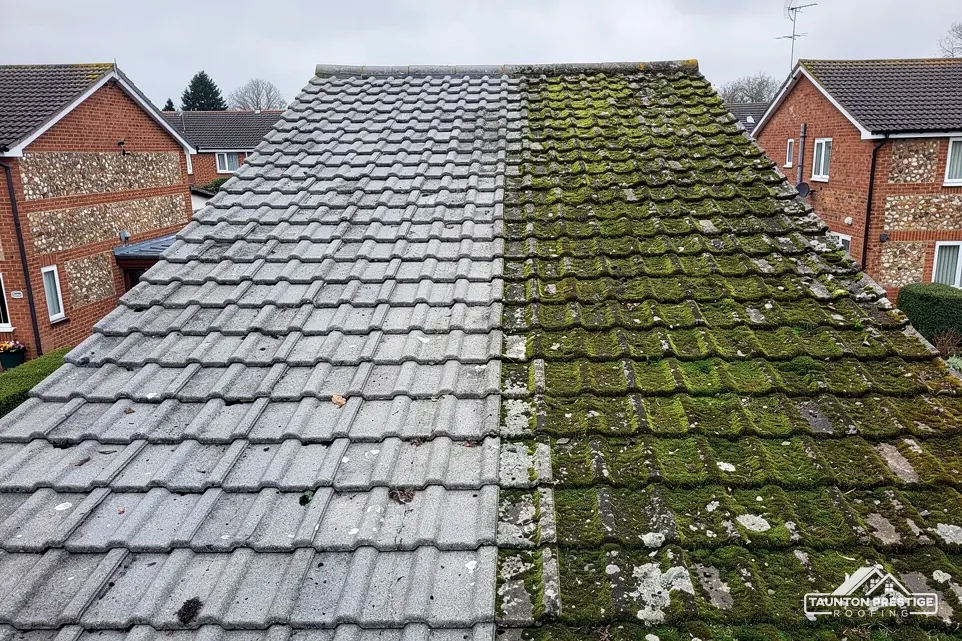
- Algae: a dark smear or streak, with no texture at all.
Why do the colours vary so much?
Lichen is not one plant but a partnership between a fungus and an alga, and many species exist. Some are pale and powdery. Others show up as vivid orange rings on a south-facing slope. Several different kinds often share one roof, which is why a single slope can look like a patchwork.
Black streaks below a ridge or chimney are usually algae and not lichen, and need their own treatment. If you are not sure what you have, photograph it close up and send it in. We can tell the difference at a glance on a survey, and what is growing decides the treatment.
Working out the type matters because they respond differently to cleaning, and because a method that is fine for soft moss can scar a tile when used on lichen.
A quick field test is to run a dry finger over the patch. If it catches and lifts in a soft tuft, you have moss. If it stays put, rough and dry, you have lichen.
What lichen does to a tile
Lichen takes what it needs from the air and from rain, and it grips the tile with threads that work into the pores of the surface. On a hard, dense tile that makes very little difference. On a softer or more porous surface, such as an old concrete tile or a weathered clay one, the threads can bed in more deeply, and pulling the lichen off may take a fleck of the surface with it.
Because it grows slowly and lies flat, lichen does not usually cause water to back up. A tile covered by it still sheds rain downhill. It does not carry the weight of a soaked moss mat, and it does not wedge the course above up from the one below.
So is lichen harmless?
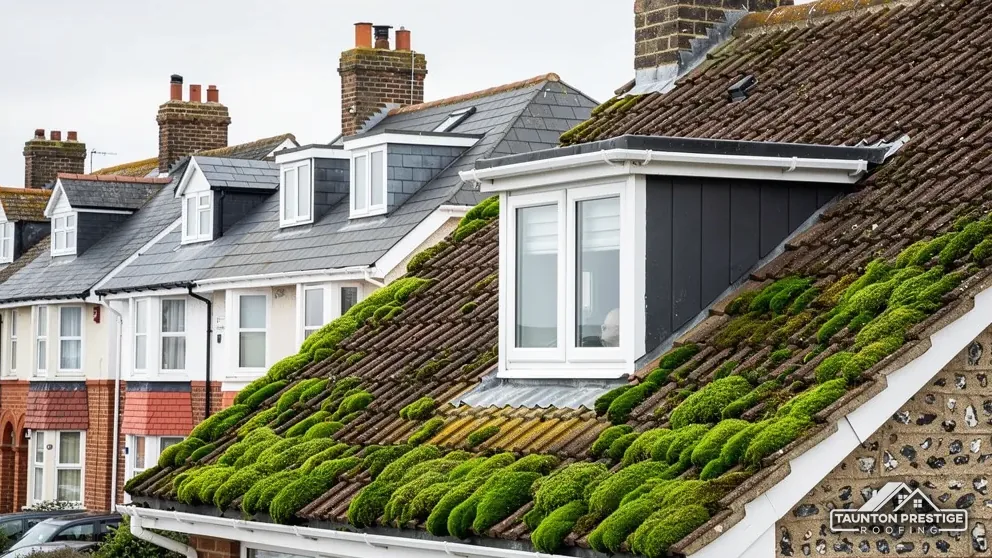
Largely harmless is a fairer description, and it comes with two caveats. First, lichen often arrives together with moss, because both like the same damp, shaded conditions. When they share a slope, the moss is the problem and the lichen is a bystander. Second, a heavy covering holds some moisture against the surface for longer, which on a vulnerable tile is not ideal during a hard frost.
On a sound roof, a flat grey or orange crust is a sign of age and weather, not of failure. Our page on whether moss damages a roof covers the case where growth does cause trouble, and it is moss that causes it.
Where tiles are failing, the lichen is not the cause. A crumbling surface or a hairline crack tells you the tile itself has aged, and that is something for a repair or a replacement plan, not for a brush.
When removal helps
There are good reasons to take lichen off, and most of them are about looks or about the roof beneath. We would suggest it in these situations:
- Appearance matters: you are selling, or the front slope is plainly blotched.
- Lichen and moss are mixed, and the moss needs clearing from valleys, gutters or tile edges.
- The roof is about to be worked on, and a clear surface lets the roofer see cracks, slipped tiles and weak pointing.
- A survey has asked for the roof to be inspected properly, and the crust is hiding the tile faces.
How is lichen removed safely?
Gently, and slowly. Soft washing is the usual approach for a surface that is firmly stuck: it uses low-pressure water and a suitable cleaning solution, applied and left to work, then rinsed away. The aim is to let the treatment loosen the crust, not to blast it off. Our page on soft wash roof cleaning goes through the process.
Treatment on a lichen-covered roof is not instant. The crust dies back over weeks and rain washes it away, so a clean roof may not appear the day the work ends. That is normal, and the cleaner you see after a few months is what the treatment was always going to produce.
With the surface clear, we photograph the tile faces and the ridge and verge lines, the top and side edges of the roof, so you can see your own covering as it really is. Anything cracked or loose goes on the list before it turns into a leak.
When removal does more harm than good
The common mistake is to attack lichen with whatever is nearest. A wire brush, a hard scraper or a power hose can strip the surface off the tile along with the crust. Marley, which makes clay and concrete tiles, advises against powerful jets, since the force can scour the tile face and shorten its working life. A tile that has lost its surface holds new growth faster, and that costs more in the long run than the lichen ever did.
Tiles that are already in poor condition fare worst. Where the surface is flaking, scaling or crumbling, scrubbing does not rescue it. It speeds up the loss, and a tile that sheds its face can start letting water through into the batten below, the timber strip that carries it.
Should you ever leave it alone?
Yes. On a roof that is sound, drains freely and has no moss problem, lichen is often best left. Many owners also like the weathered look on an older roof, particularly a clay tile or a stone slate that has taken on its colours over time. Leaving it is a legitimate choice, and nobody should push you to pay for a clean that your roof does not need.
We also hold off in these cases:
- The tile surface is breaking down and would not survive being treated.
- Access is unsafe and would call for scaffold that costs more than the benefit.
- The roof is nearing the end of its life and a replacement is planned.
Chemicals, treatments and the law
Garden centres sell moss and algae killers with confident labels, and online shops sell stronger ones still. Before you buy, know that these are biocides, which are regulated chemicals. Under the Biocidal Products Regulation, which still applies in Great Britain, a biocidal product must be used in line with the terms of its authorisation.
The HSE spells out the practical points. Some products are sold for trained professionals only, and householders should leave those alone. Using a product that lacks approval is itself an offence, which catches imported tubs sold online with no clearance for UK use.
Can you treat lichen yourself?
You can use a product that is approved for general use and follow the label exactly. That means the dilution, the contact time and the protective gear, and keeping runoff away from ponds, drains and plants. The harder part is the ladder. Treating a roof means working at height on a slope, usually with a wet surface, and falls are the real risk with roof cleaning.
For most owners we think the safer choice is to have a roofer do it from proper access, with the treatment chosen for your tiles. A professional will also know which products suit slate, clay and concrete, since a solution that is fine on one can stain another. Ask which product is proposed, what its label says, and how the runoff will be kept out of drains and borders.
Do not mix products, and do not apply anything near a pond, a watercourse or a water butt without reading the label. Runoff from a treated roof is not water you want in the butt.
How lichen on slate and clay differs
The material under the crust changes the advice. Natural slate is dense and smooth. Lichen on slate tends to sit on the surface, and a cautious treatment usually brings it away without scarring the stone. Slate is long-lived, with CORC saying a well-maintained slate roof can last 100+ years, so the aim is to keep it that way by avoiding anything abrasive.
Clay tiles are fired from clay and are fairly durable, but older hand-made and peg tiles vary a great deal in how hard they are. Clay tiles have a BRE minimum life expectancy of 60 years, though a conservation writer cautions that for old peg tiles the figure cannot be relied upon. Treat any old clay roof gently, and never scrub it. If you own a barn, an outbuilding or a cottage with hand-made tiles, a survey that photographs the surface first is worth having before any cleaning is agreed.
What about concrete tiles?
Concrete tiles can fade and roughen as they weather, and lichen settles easily on a rough surface. Our page on faded concrete roof tiles explains what can be done once the growth has gone.
On listed buildings or in a conservation area, the look of the roof is part of what is protected. Cleaning is not the same as replacing the covering, but if you are unsure, ask Somerset Council's planning team before any work that alters the roof's appearance. Inside Exmoor, the planning authority is Exmoor National Park Authority, so ask there instead.
Lichen questions
Does lichen need to be removed from roof tiles?
Not always. Lichen lies flat, grows slowly and seldom blocks water the way moss does. On a sound roof it is often a cosmetic matter. Removal makes sense when moss is growing with it, when you are selling, or when a roofer needs to see the tile surface.
Why does lichen come back after I scrape it off?
Scraping takes off the visible crust but can leave fragments that regrow, and a roughened tile surface gives new growth a better grip. A slow treatment that kills the growth, followed by rain, usually lasts longer than scraping, though shaded slopes will always attract it again.
Is orange lichen on a roof a sign of a problem?
No. Orange and yellow lichens are common on exposed, sunny slopes and usually say nothing about the state of the tiles beneath. They reflect the roof's age and surroundings, not a fault. A survey will tell you whether anything underneath needs attention, and if it does not, you can leave them.
More on this subject: Roof cleaning and moss removal in Taunton