Storms rarely announce what they have done to a roof. A slate that cracked in a gust on Tuesday night may not leak until the next heavy shower, and a lifted ridge tile can go unnoticed for months before a brown stain blooms on a bedroom ceiling. The sensible response is a calm, safe look round the house, then a proper survey if anything is out of place.
This guide sets out what you can check from the garden and the loft without going near a ladder, how to tell a job that cannot wait from one that can, what a roofer's inspection adds, and which photos and receipts to keep if you need to tell an insurer. It also explains where the Financial Ombudsman Service fits if a claim goes badly. It belongs to our roof inspections work in Taunton and the lanes and villages that surround it, where the wind off the Levels and the Quantocks tests every weak joint on a roof.
Safety first: what to leave alone
After a storm, nothing on the roof is worth a fall. Stay off ladders and flat roofs, and steer children and pets clear of the wall where tiles or a chimney pot may be hanging. Loosened material drops without warning, and wet slate is slick underfoot.
If something is already moving, such as a gutter pulling away from the fascia, a stack that leans, or tiles creeping down a slope above a path or a road, call it urgent. Rope off the ground beneath with whatever you have, and ring a roofer. Somerset Building Control names slipping roof tiles and chimneys that are not stable among its dangerous structures, and its number is 0300 303 7790. Whoever owns the building pays for the work to make it safe, according to the same council page.
Is a leak indoors an emergency?
Water coming through a ceiling is an emergency for that room, even if the damage above is small. Shift furniture and rugs, catch the drip in a bucket, and keep away from any light fitting that has got wet. Then ring a roofer. Our first job on a wet roof is a temporary cover, and only after that does the survey decide what the lasting repair should be.
Jot down the time you first noticed the leak and what the weather was doing. It seems a minor point, yet it helps a roofer and an insurer to place the damage against a particular spell of wind and rain.
If you rent the house out or look after a relative's home, the same order applies: people first, then the room, then the roof.
Ground checks once the wind drops
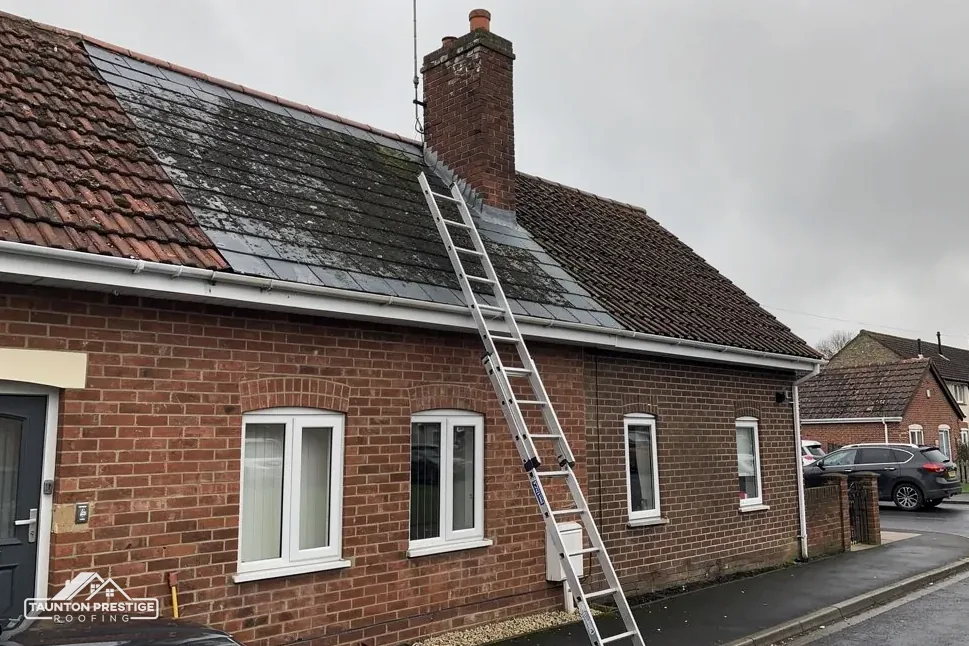
Choose a dry, calm hour and walk slowly round the house. Binoculars help, and so does the zoom on a phone. View each slope from two or three different spots instead of straight on, because a gap or a dip shows far better at an angle.
- Slates, tiles or ridge pieces on the lawn, in the borders or on the shed roof.
- Darker patches or gaps where the covering has gone, and courses that no longer run in straight lines.
- A ridge line with a kink in it, or ridge tiles sitting proud of their neighbours.
- Chimney pots or cowls leaning, and mortar missing around the stack.
- Lead flashing peeled back from a wall, chimney or window.
- Gutters sagging, stuffed with debris, or pulled off their brackets.
- Fascia and soffit boards, the timber trims under the eaves, lifted or split.
- Aerials or dishes that have shifted, or branches lying on the roof.
What can the fallen pieces tell you?
More than you might expect. A broken fragment shows what the covering is, how thick it is and whether it snapped clean or crumbled, which hints at its age. Photograph each piece where it landed before anyone moves it, then keep the pieces for the roofer so that matching replacements can be found.
Do not go hunting for pieces on a neighbour's roof or on a garage roof. Note what you can see from your own side, and mention it to the neighbour. A shed or outbuilding roof is worth a look as well, since felt and light sheeting often fail before the house does.
Loft checks with a torch
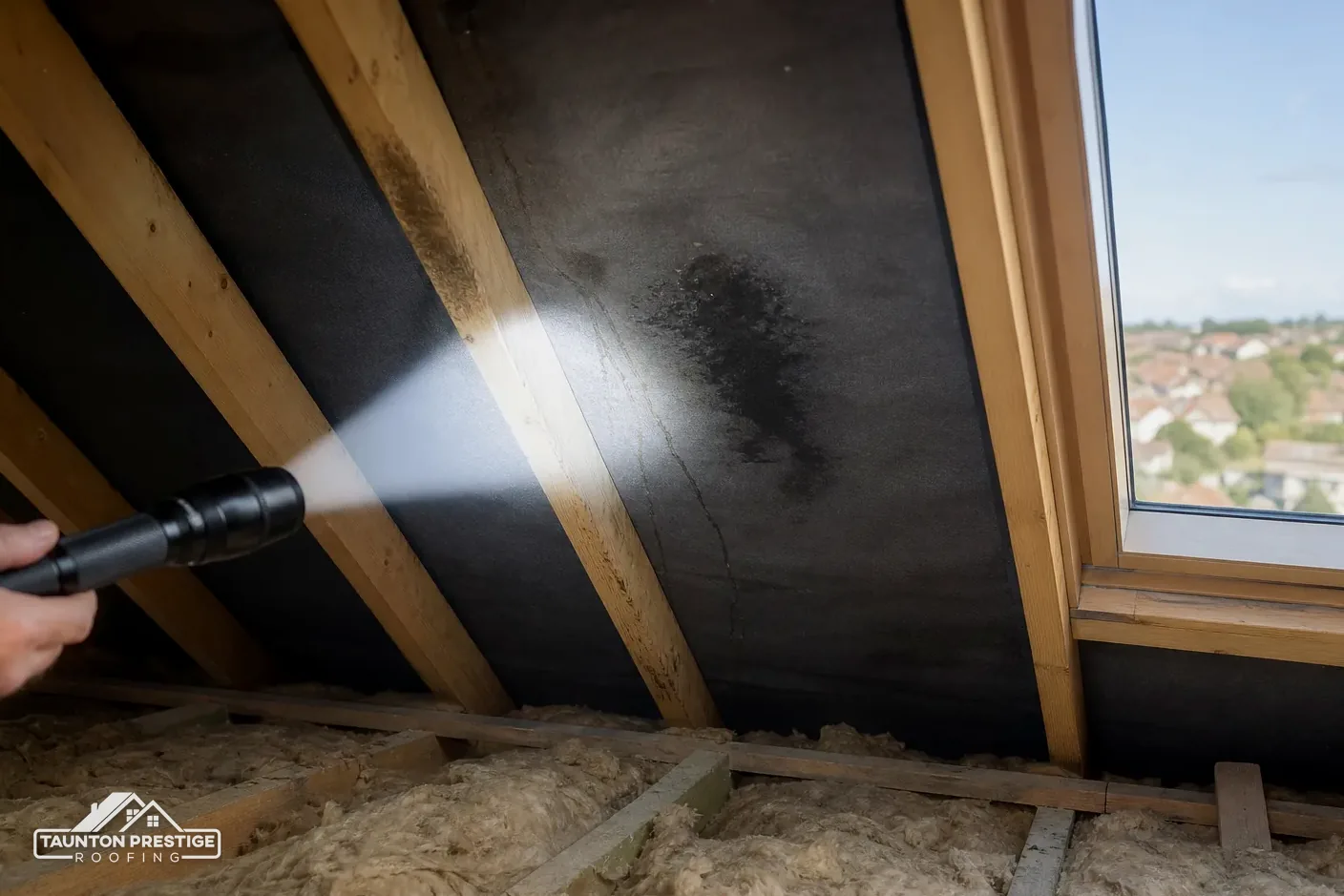
The loft shows what the ground cannot. Take a bright torch and step only where there is a joist or a board under your weight, never between. Work along each slope slowly, then look back along it from the opposite end, because a faint chink of light is easier to spot when your eyes have adjusted to the dark. Switch the torch off for a moment and let your eyes settle.
What are you looking for up there?
Daylight where none should be is the plainest sign of a missing covering. Beyond that, look for wet patches on the lining of the roof, drip marks, wet insulation and timber that looks darker than the boards beside it. A fresh stain that is clearly damp today points to a storm leak. A dry ring with a tide mark around the edge points to something older that the storm has made worse.
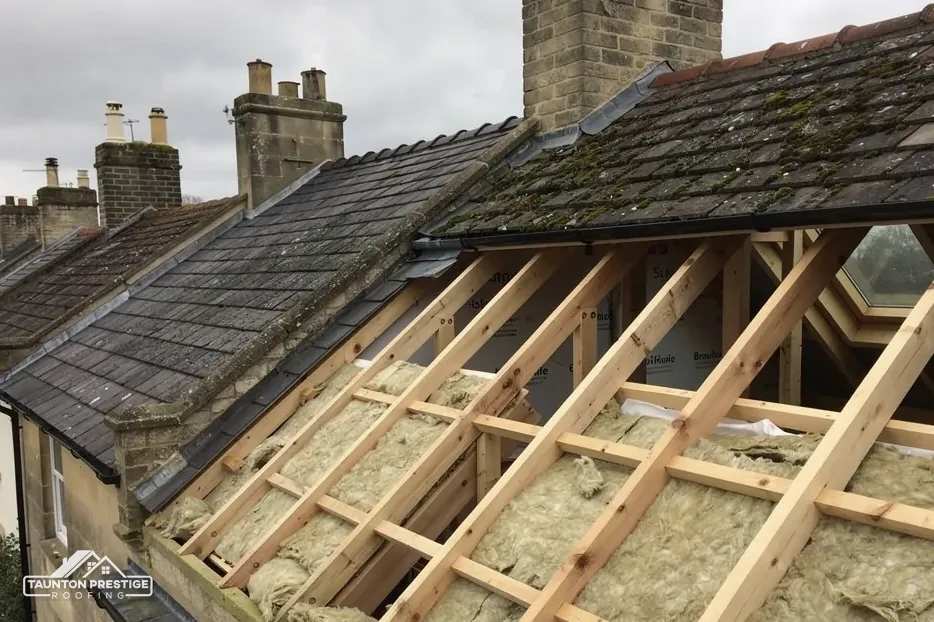
Check around the chimney and any roof window, and along the line where two slopes meet, because a valley carries a lot of water in heavy rain. The underlay is the sheet beneath the slates or tiles that catches wind-driven rain, and if it has torn you may see it flapping between the rafters.
Leave anything near ripped felt alone, and avoid shifting wet insulation more than you must. Take pictures of everything, with a note of where on the roof each fault sits. Our guide to checking your roof from the loft covers the same walk in more detail, including where to put your feet and what a sound loft looks like.
Which damage cannot wait?
Not every storm mark is an emergency, and sorting the urgent from the merely untidy keeps costs sensible. A roofer looking at your roof should be able to say which pile each fault belongs in, and show you the photo that proves it. Ask for that sorting in writing, so that the urgent items are separated from the ones that can wait for better weather.
Call these urgent: a gap in the covering over a living space, an active leak, a ridge or chimney that moves, and lead lifted far enough to let water get behind it. Book these as a normal survey in the following weeks: a cracked slate that is still seated, a short length of sagging gutter, and loose pointing that is not yet letting water through.
What does an emergency visit cost?
MyJobQuote lists emergency roofer call-outs at £150 to £300, with storm repairs at £1,200 or more, as typical UK ranges (MyJobQuote, Oct 2026). Those are national guide figures. On your own roof the price turns on access, how much covering has gone, the height, and whether scaffold is needed, and a single written price comes after the survey.
Does an urgent visit change your cancellation rights?
It can. A contract you sign in your own living room after the survey carries a 14-day cancellation right. Regulation 28(1)(e) of the 2013 consumer contracts regulations removes that right when you have asked a trader to visit specifically to carry out urgent repairs. Where the work is not urgent, take the survey first, read the written price and decide at your own pace. For advice on a dispute, ring the Citizens Advice consumer helpline on 0808 223 1133.
Evidence an insurer will want to see
Ring your insurer before you arrange anything beyond an emergency make-safe. Then have the temporary repair done, because a damaged roof left open makes a claim worse, and keep the paperwork for all of it.
IStructE, the structural engineers' institution, advises that photographs are vital in storm cases because they put the damage in front of the assessor. Date every file as you go. Take wide shots that place each fault on the house, then close-ups of the fault itself, and add the street-side view if a neighbour's roof is visible beside yours. Include fallen pieces on the ground, wet patches in the loft and on the ceiling below, and a before-and-after pair when a temporary repair has been done. Date the files, and keep the originals on the phone, not just copies sent by message.
Does a roofer's report help?
A written report from a roofer who has been on the roof can record what the covering is, what has been damaged and how it looks, which is useful background for the insurer. It supports a claim. It does not decide one, and no roofer can promise an outcome.
Which? reported that only 32% of storm-related claims made in 2024 ended in a payout, which is a good reason to be organised from the first day. Our separate guide to roof inspection for insurance sets out what a report can and cannot do, and the answer on roofer photos of the problem describes a good set of pictures.
If the claim is turned down
Insurers decide a claim on the wording of the policy, and a storm claim can turn on whether the damage came from a storm or from wear. The Financial Ombudsman Service gives its own working description, and in its terms a storm is severe wind, usually accompanied by rain, hail or snow, which is a handy test when an insurer says the damage was only wear.
Where does the Ombudsman come in?
The insurer's own complaints process comes first. If 8 weeks pass and the insurer has sent you nothing final, you may go to the Ombudsman anyway. When a final response does arrive and you disagree with it, the clock is 6 months from the date printed on that letter. The Ombudsman says its service is free and easy to use.
File every letter, note the dates, and keep your photos and the roofer's written findings together in one folder. A complaint is far easier to put when the evidence is in order.
Is the roof worth fixing while a claim runs?
If water is getting in, yes. A temporary repair protects the house, and its receipts are evidence in their own right. Leaving a roof open while a dispute plays out can turn a modest repair into a large one, and the insurer may argue that the extra damage could have been avoided. A survey can set out which repairs are urgent and which can wait for the outcome, with pictures to show it.
Where a claim fails, the roof still needs fixing. A repair that is planned and priced in writing lets you spread the work across a season if the budget needs it.
Storm inspection queries
Is it worth booking a roofer after a gale if nothing looks wrong?
Often, yes. Cracked slates, lifted ridge tiles and torn underlay do not always show from the ground, and a small gap can let water into the loft for weeks. A survey with photos either clears the roof or catches the fault while the repair is still small.
What should I photograph before a temporary repair?
Take wide shots that show where each fault sits on the house, close-ups of the damage, any fallen slates or tiles on the ground, and wet marks in the loft and on the ceiling below. Keep the dated originals, along with the receipts for the repair.
When can an insurance complaint go to the Ombudsman?
Once the insurer has gone 8 weeks without sending a final response, or when you hold a final response letter you disagree with. From the date on that letter you have 6 months. The Financial Ombudsman Service is free for consumers, so no fee stands in the way.
More on this subject: Roof inspections in Taunton