Two roofs can look alike from a bedroom window and still be built from very different materials. Natural slate is split from quarried rock, so no two pieces match. Fibre-cement slate comes off a production line, with cement and reinforcing fibres formed into sheets and cut to a standard size, so every piece is alike. Both go on in overlapping rows called courses, fixed to battens, the timber laths running across the rafters. Beyond that, they behave quite differently.
The choice usually arises when a slate roof reaches the point where a wider repair is on the table, or when an extension needs a covering that sits beside an old one. This guide sets the two side by side on weight, appearance, published lifespans and cost, and says where each one suits a roof. It also covers the checks worth making before one is swapped for the other, including the weight rule in Building Regulations and the extra care owners of listed and conservation-area homes need to take. Our slate roofing page sets out the wider service.
How natural and man-made slate differ
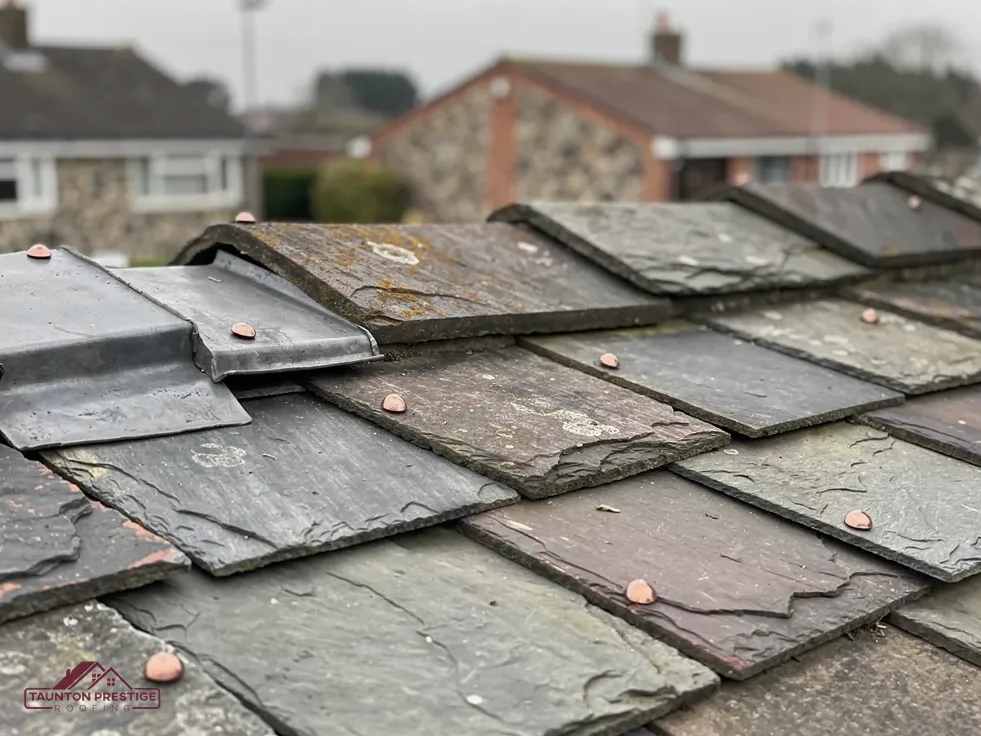
Natural slate is rock that splits into thin, flat sheets along its grain. A slater, or a machine, divides the block into slates and trims the edges. The surface keeps the texture of the stone, with fine ridges, flecks and shifts of colour. Slate is quarried in several countries, so the origin of any particular delivery is a question for the supplier, never something to guess from the look of it.
Fibre-cement slate is a manufactured product. Cement is combined with fibres for strength and formed into sheets in a works, and the colour and surface are set at that stage. The finish may be smooth or textured to echo stone. Man-made slate is a wider term than fibre-cement and takes in other factory products too, so always ask which material a quote actually names, and ask to see the maker's name on the data sheet.
Do both need the same roof pitch?
No. Slate maker Cupa says BS 5534 indicates a minimum pitch of 20 degrees for natural slate. Its advice is also to keep slate hooks off any roof pitched at less than 25 degrees, so on a shallow slope the slates are nailed instead. A man-made slate has its own minimum, set by its maker. Pitch simply means how steeply the roof rises, and a shallow slope sheds water more slowly, so the maker's sheet for the actual slate comes before any rule of thumb. Our answer on the minimum pitch for natural slate goes further.
It is also why a swap is never just a matter of choosing the nicer colour: the new slate has to suit the roof angle it is going on to.
Weight and what the roof frame carries
Weight is the first practical difference. Every covering has a weight per square metre, printed on the maker's data sheet, and the rafters, the sloped timbers carrying everything above, were chosen to suit whatever covering the roof first had. Putting a heavier covering on an old frame without checking it is how sagging starts, and a sagging slope lets water in at every joint.
The Planning Portal sets a clear line. Its rule is that Building Regulations approval applies once the new slates weigh 15 per cent or more over the old, and it recommends a structural look by an engineer or surveyor beforehand. A swap from natural slate to man-made, or the reverse, is exactly the sort of change where the figures on the two data sheets need comparing before anything is ordered.
Does a lighter slate mean the roof frame can be left alone?
Not by itself. A lighter covering may spare the frame extra load, but the rafters and battens still have to be sound, and a roofer who has lifted a few slates will see whether any timber needs attention. The weight rule is about the covering that goes on, not the one that comes off.
Where the covering stays natural slate and the new slates weigh about the same as the old, the 15 per cent line is not usually in play. Where the material changes, ask for both weights in writing before work is agreed.
On a house, changing a roof covering is normally permitted development under Class C. For building control, the Planning Portal's test is that less than 25 per cent of the building envelope and less than 50 per cent of the roof is affected.
Looks close up and from the road
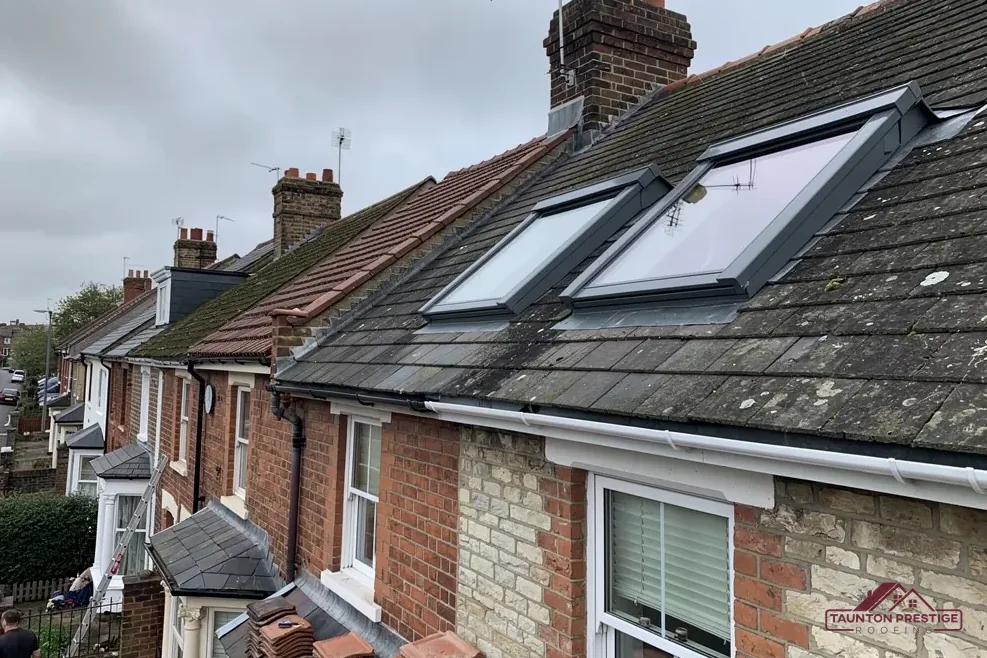
From the pavement, viewers read two things: colour and edges. Natural slate carries a natural variation, with a tone that shifts slightly from one slate to the next and a faintly uneven edge where the stone was trimmed. The courses catch light differently across the day, and after some years the roof settles into a softer, more mixed tone that is hard to copy.
Man-made slate is made to be consistent. The colour tends to be even across a batch and the edges are cut square. For a new extension or a modern house, that crisp regularity can look right. On an older terrace beside natural slate neighbours, the same evenness can look flat, and the line where old roof meets new shows from the road.
Will a man-made slate weather to match an old roof?
That depends on the product and on the age of the roof beside it, and nobody can promise it. The sensible route is to ask for a sample, and better still to go and look at a roof of similar age that already carries the same product. Our answer on matching replacement slates explains how roofers match size, thickness and colour when new slates are mixed into an old roof.
Where a roof faces a public road and the house is older, the look is more than taste. It is the reason many owners keep slate as slate, and the reason a planning officer may take an interest if the covering changes. The conservation-area guide in this set looks at that more closely, and the way we work is to put photographs of your own roof in front of you before any material is chosen, so the comparison is made against the real thing and not a brochure.
Published lifespans and what they really tell you
Lifespans are the figure people quote most and read least carefully. CORC, the Confederation of Roofing Contractors, lists 100+ years for slate that is looked after. That is a published expectation for the material, not a promise for any one roof, and it assumes the fixings keep holding. Where an old slate roof does fail, it is often the nails or the battens that give out before the stone does, which is why a very old roof can need re-fixing while its slates are still perfectly sound.
For fibre-cement slate, the lifespan comes from the maker. Each manufacturer publishes its own expected life and its own conditions, covering pitch, ventilation and fixings. Read those conditions as well as the headline number, because a figure only holds if the roof is built the way the data sheet says. Do not confuse the two: a warranty is a company's time-limited promise, whereas a lifespan is an expectation for the material itself.
What if the roof is older and man-made?
Check its age first. HSE tells owners to assume asbestos in any building from before 2000, whether built or refurbished then, and older cement-based roofing products are one place it turns up. Do not drill, break or scrub an old man-made slate roof you cannot identify. Ask a roofer to look first, and if asbestos is suspected, it is dealt with under HSE's rules and not treated as an ordinary repair.
Our guide to how long a slate roof lasts goes through the signs of age on natural slate, including the nail corrosion known as nail sickness.
What moves the price between the two
Published guides give a feel for scale, though they are national averages and never a quote for your house. MyJobQuote puts the average cost of a new slate roof at around £7,800 (MyJobQuote, Oct 2026). For a new roof in general, HomeBuilding (Sep 2025) gives £10,000 to £15,000 as the range for a new concrete-tiled roof on a three-bed semi, a figure that covers labour, scaffold and insulation, which shows how widely the guides differ. Treat both as a typical UK range, never as a price for your roof.
The slate itself is one part of the bill. What moves the final figure on your roof is:
- Roof size, and the number of slopes, valleys and chimneys it has to work around.
- The material chosen, because natural slate and fibre-cement slate come at different supplier prices and in different sizes.
- Access, including scaffold. HomeBuilding's guide puts scaffolding at approximately £1,000 with permits for a semi of that size, and MyJobQuote's £550 to £750 is for one week on a front elevation.
- What the survey finds under the slates, such as battens or rafters needing renewal.
- Whether sound existing slates can be reused.
Is man-made slate always the cheaper roof?
It can be on the day, but the cost of owning a roof runs longer than the day it is laid. A lower first cost that needs replacing sooner is not a saving, and a natural slate roof that is re-fixed once in its life may cost less over the years than two coverings. Our slate roof cost guide sets out the price drivers in more detail. You receive a single written price once the survey is done, with the covering named in it.
Listed homes, conservation areas and the swap
On an ordinary house, replacing a covering is normally permitted development under Class C. Section 55 of the Town and Country Planning Act 1990 treats works as outside planning control when they do not materially change how a building looks from outside. The question for a swap from natural to man-made slate is whether the look of the roof changes enough to matter, and that is for the planning team to judge, not for a roofer to assume.
Listed houses keep their Class C rights, though they need listed building consent as well, wherever the work touches what makes the building special. A change of slate type on a listed roof is exactly the kind of change that consent exists to examine. In a conservation area, an Article 4 direction may remove permitted development rights, so check with Somerset Council's planning team before agreeing a different covering.
Which choice suits which roof?
Natural slate suits an older roof, a roof on a listed or conservation-area home, and any house where the look of the street matters. Fibre-cement slate suits a new build, an extension where no old roof sits beside it, or a roof where low weight and a fixed colour are the priority. Both are fixed to the maker's instructions, with nails and battens chosen for the product.
Slate stays slate where it matters. Our conservation area guide covers the consent routes in detail. Whichever way the choice falls, the sensible order is survey, pictures of what is up there, then a decision on material, so you choose from evidence.
Natural and man-made slate queries
Can natural and fibre-cement slates be mixed on one roof?
They can sit on the same building, for example on an old roof and a new extension, but mixing them across a single slope is rarely a good idea. The sizes, thickness and fixings differ, and the join shows. Keep each material on its own slope or section, and fix each to its own data sheet.
Does fibre-cement slate need different nails?
It follows the maker's instructions, which name the fixing type and length for each product. Never assume the nails used for natural slate suit it. The data sheet sets the fixing, the pitch limits and the headlap, so a roofer works from the sheet for the exact slate going on your roof.
Should I choose man-made slate for a roof I plan to sell?
Choose for the roof, not the sale. A buyer's survey will look at the condition and the fixings, and at whether any consent was needed. A sound roof in the right material with the paperwork to show it is easier to sell than a cheap swap that raised questions.
More on this subject: Slate roofing in Taunton